

This beautiful, large plant arrived healthy!
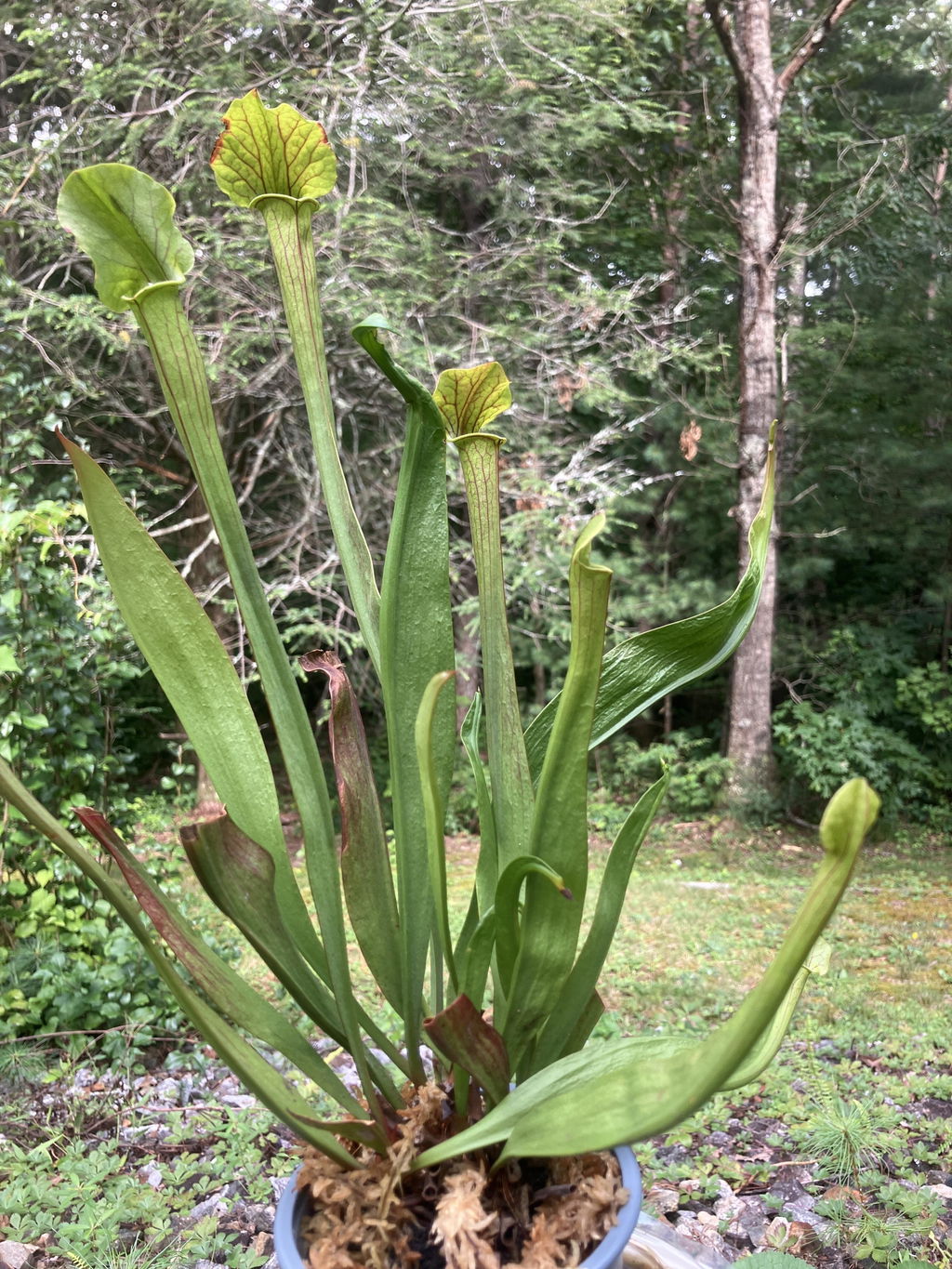
Plant arrived healthy with two large growth points. There is already a third growth point emerging!
Sign up for our newsletter!
Sort by:
379 products
379 products


This cyclosecta hybrid is perhaps our favorite hybrid that Damon’s ever made. We’ve decided to name this fantastic plant “Lilac Lollipop” in honor of its spectacular lilac flowers!
These little butterworts blush a soft purple when exposed to bright light, like a giant cyclosecta. It produces so many flowers that are a sweet lavender reminiscent of a violet. We’re head over heels in love with this plant! This is a must have butterwort!
The plants we are shipping are about the size of a quarter and will be 2-4” at full growth.
This plant will not come potted; you will need to pot it up upon arrival. Mexican/Tropical Pinguicula prefer our sandy PINGUICULA SOIL MIX.
IF YOU ORDER IN WINTER/EARLY SPRING YOUR PLANT MAY ARRIVE IN WINTER SUCCULENT MODE. DURING THIS TIME, IT WILL GROW SUBSTANTIALLY SMALLER, TIGHT, SUCCULENT LEAVES. DO NOT OVER WATER DURING THIS TIME. IT WILL GROW CARNIVOROUS LEAVES IN THE SPRING.
Care Instructions
Growth Habit: Pinguicula are generally small plants; depending on the species and growth phase, they can range from 1/2” to 8” across at maturity. Most are 2-4” across. They form rosettes of leaves covered in glistening dew, which have a high turnover rate, meaning that they die back frequently, and new leaves grow at the center from the plant. They have pretty leaves, some blush red or purple, and all are covered in sparkling dew. Their flowers are hummingbird and butterfly pollinated in the wild and because their pollinators are attracted to colorful flowers, they have beautiful flowers With long neck spurs! Many species will experience a winter succulent phase. A combination of shorter photo periods, cooler temperatures, and dryer conditions trigger this phase. While this phase is not necessary for the plant to thrive, it is often out of our control whether the plants do this or not. During their succulent phase, they grow small, rounded leaves that look very different from their large carnivorous leaves. Plants in this stage will be significantly smaller than they will be in carnivorous growth. The natural cycle of Pinguicula can lead them to be in succulent growth in spring, not starting their carnivorous growth until late spring sometimes even early summer. Watching them grow their carnivorous leaves is like watching a magic trick; tiny, tight leaves begin to transform into huge, sticky, carnivorous leaves! Pinguicula can easily propagate from leaf pullings, like a succulent. They will also form small clumps over time, dividing naturally. While they can have a long life, they won’t live forever, so it is a good idea to take pullings every year. They do not have significant root systems, and the roots they have are often minimal and very short. The roots can be white, transparent, or brown, and they use these roots mainly to anchor themselves to the soil's surface (they still offer benefits, though, so please do not cut them off).
Sun: Full to part sun. Sunny windowsills indoors, in a temperature-regulated greenhouse, or under grow lights. In tropical parts of the world or very mild climates, they can be grown outdoors in dappled sun, morning sun only, or under shade cloth. They must be protected from the full afternoon sun. It is best to grow under 30% shade cloth in the summer months when grown in a greenhouse. They can benefit from 30% shade cloth if grown outdoors as well. If your plant is much greener than it should be, developing larger, more elongated leaves than normal for the species or hybrid, and does not have much dew, it may need more light.
Water & Humidity: In the late spring, summer, and early autumn, Pinguicula can be kept in the tray system with overhead watering as long as they still have carnivorous foliage. This means setting the pots in a deep saucer or tray and routinely filling that with 1/4”-1/2” water. If grown in a non-draining pot, allow room to water and water overhead frequently to keep soil media moist, but do not water so deeply as to have standing water sitting on the surface of the soil; all the water should be absorbed. When the rosettes show their very first signs of growing their smaller, tighter succulent leaves immediately begin to dry out your plants. Keep the soil on the dry side, watering them only a little and let dry out in between watering. You can usually tell how dry a species enjoys its winter by the size of its succulent leaves. The tighter, smaller leafed rosettes such a Pinguicula gypsicola or the bulb-like heterophylla and macrophylla require bone-dry conditions. Species with larger winter leaves, like a few of the moranensis varieties or agnata, enjoy winters soils just slightly damp. Cuban species should be kept wet year-round, with only slight winter drying. When these plants are transitioning between carnivorous and succulent growth they are at the most risk of rotting, so it is better to air on the side of drier when the temperatures start to get colder and the photo periods shorten. In spring, as soon as the temperatures start to warm and the photo periods lengthen, start watering your plants more. When carnivorous leaves start to grow, begin the tray method again. (If your plant decides it does not want to make carnivorous leaves, don’t worry, sometimes they are stubborn! Water frequently and make sure your plant gets lots of light, preferably some natural light from the sun as well, to try to trigger carnivorous leaf growth. But don’t worry if your ping stays in succulent mode for a whole year, eventually it will grow carnivorous leaves again!) Pinguicula are extremely susceptible to dissolved minerals and salts in their water and poor water quality will directly contribute to decline of plants and death. Be sure to only use rainwater, reverse osmosis water, or distilled water. Pinguicula prefer drier conditions and do not require high humidity.
Temperature: 50 degrees - 90 degrees. While not ideal, Pinguicula can tolerate brief nighttime dips to 40 as long as daytime temperatures warm back up and can tolerate brief heat waves over 90 as long as they are protected from the sun and sitting in water AND nighttime temperatures decrease. Cold temperatures are likely to kill Pinguicula, so avoid exposing them to anything below 50 if possible.
Dormancy: No true dormancy but does have a winter succulent phase during which the plant will produce small succulent leaves instead of flat sticky leaves. Pinguicula do not need this period of succulent growth to grow well. If your plant does not grow succulent leaves, there is no need to try to induce the transition. See the section on watering for in depth care during this time.
Fertilizer: Apply Schultz Cactus Fertilizer once or twice a month to the leaves with a mister bottle, during the grow season. Do not apply in winter or during succulent winter mode. We use seven drops of fertilizer in 20 ounces of distilled water.
Soil & Repotting: Pinguicula grow in very dry and rocky soil mixes, do not use a mix that holds a lot of moisture. We use equal parts sand, peat moss, pumice, and perlite. You can order our custom Pinguicula soil mix! These plants ship bare-root so you will have to order potting media and pot them up upon arrival. Pinguicula do not have extensive roots and anchor to the surface of their soil making them ideal candidates for quirky, cute, small, non-draining planters like teacups or vintage pottery. You can plant them in all variety of pots as long as they are glazed ceramic, glazed terracotta, glass or plastic. Avoid un-glazed terracotta. They can be in small pots and do not need much room for roots. Pinguicula are one of the most sensitive plants to a build of minerals and salts in their soil or water. Repot every year to refresh soil.
More Information: For more information on repotting, pests, growing habits, and more, check out our FAQ page or our YouTube channel!


This cross takes the most famous classic red moorei, Sarracenia 'Royal Ruby,' and crosses it with our blackest and most shapely alata. Many of these offspring exhibit very dark coloration and have the potential to grow quite large!
These are divisions.
DORMANT SEASONALLY, STARTING AS EARLY AS OCTOBER AND LASTING AS LATE AS MARCH, DEPENDING ON THE CONDITIONS AND SPECIES/HYBRID. The pitchers turn brown and die back to the rhizome, or non-carnivorous leaves (phyllodia) grow during this time. Please see the final photo to see how Sarracenia look when dormant. They will begin to grow vigorously again in Spring when photoperiods lengthen and temperatures increase.
Care Instructions:
Growth Habit: Sarracenia primarily grow along the Southeastern coastal plain of the United States. They grow pitchers, which are modified leaves, seasonally that can vary in height, color, and size depending on the species or hybrid. The pitchers can die back during the growing season, but new pitchers will grow throughout the spring and summer. The pitchers start to grow in spring, and many grow as the year progresses; in summer, they will be at their best. In summer, you may see brown or black on your pitchers, which can be normal nectar burn or crisping from heat. As Fall comes on, the pitchers may start to die back, turning brown, and by winter, many or all of the pitchers are brown, but the rhizome remains healthy and intact throughout winter dormancy even if you cannot see anything growing. Sarracenia have brown, black, or white roots and do not generally have many of them. The rhizome can be brown and still be healthy.
Sun: Full sun. Sarracenia require lots of direct sun to grow and form pitchers properly. In many areas, they can be grown outdoors in full sun. If you live in a very hot AND very dry place like Arizona or Sacramento, for example, you will want to grow your plants in full morning sun with protection from the afternoon sun or under 30% shade cloth. It is common for several pitchers to "burn" and die back when you first place your plant into the sun; your plant is acclimating to your conditions, and in most cases, new leaves will soon grow and be fully acclimated. Sarracenia can be grown indoors on extremely sunny windowsills that receive all-day sun, but they will require a grow light in most circumstances due to the amount of light the plant needs. Grow lights should be 6-12” from the plant, depending on the light, and on a 10-12 hour day length. Sarracenia generally are not a good candidate for a terrarium as they need intense light and get quite tall. Shorter species like Sarracenia purpurea will do better in a terrarium. Grow outdoors if possible for best results.
Water: Always keep them in a saucer with a few inches of distilled, rainwater, or reverse osmosis water. Never let them dry out, especially in the hot summer months. Sarracenia are bog plants that prefer water-logged conditions unless you live somewhere both very hot AND extremely humid, like Alabama. In that case, let the water tray dry out for a day or two between refills. Always use distilled, reverse osmosis, or rainwater only. These plants are sensitive to their water quality, and giving them mineral and salt-free water is very important. In winter, when the plants are dormant, you can let them dry out a bit between rain storms, but do not let the soil get so dry that it pulls away from the edges of the pots. Be sure to supplement water as needed in between rains in winter.
Temperature and Dormancy: These are warm-temperate plants, meaning they need warm summers and chilly winters. They should be grown outdoors year-round in areas with mild winters. They thrive in temperatures ranging from 20 degrees - 100F degrees and can take a brief freeze or high-temperature spike up to 105F degrees for a short period. If nighttime temps drop below 20 but rise again during the day above 40, your plant will be fine outside.
If you live in an area with very cold winters, where nighttime temperatures drop below 20 degrees for sustained periods, you have three options for providing them with winter dormancy: the garage method, mulching in, or the fridge method. Dormancy is triggered by a combination of exposure to shorter photo-periods and cooler temperatures in the 40-60's F. While you can skip a dormancy period once or twice, in the long term, your plant will begin to do poorly and will eventually die if you skip this crucial period.
The garage method: Bring your plant indoors to a sunny windowsill in an unheated room or garage, where the nighttime temperatures will dip down to 50-60F. Keep it well watered during this period, do not let it dry out, and put it outside again when the outside nighttime temperatures increase consistently above 20F.
The mulch method: Mulch them in very, very well outdoors. Pack at least four inches of mulch on top of the plants and all around the sides to prevent winds from chilling them and freezing the roots. You can also dig the pots into the ground and then mulch heavily on top.
The fridge method: remove the plants from pots, gently clean the roots of soil, wrap the roots in a bit of damp long-fibered New Zealand sphagnum moss, place the plants in a resealable bag, and put the bag into the refrigerator. Leave them in the fridge from October to February, periodically checking on them to ensure they are still moist and not growing mold or fungus. Pot them back up in February. You can vary the timing to align with your outside nighttime temperatures so that your plants can come out of dormancy when it is safe to place them back outside. You can leave them in the fridge for an extended period if you have very long winters.
Soil and Repotting: We prefer a mix of four-part fertilizer-free peat moss to one-part perlite. You can add our pre-made mix to your order here. You do not need to repot your plant when you receive it from us for at least a year, and we recommend against it during the spring-summer months. Repot Sarracenia every 1-3 years in winter when they are dormant. Avoid placing in excessively large pots; size up only a few inches at a time. They do well in tall pots. Soil can also develop a swampy smell, especially right after shipping, when the plant is wrapped in plastic and sealed. This is normal; these plants grow naturally in bogs and swampy conditions, and peat moss can develop a bit of an anaerobic smell, but this does not indicate a problem with the soil.
Feeding and Fertilizer: Sarracenia will catch plenty of food when grown outdoors. When grown indoors, they will significantly benefit from fertilizing, both a foliar fertilizer and feeding the pitchers. Plants grown outdoors will appreciate a foliar feed as well. Apply MaxSea fertilizer once per month to the foliage only. Dilute 1/4 teaspoon of MaxSea into one gallon of water and then apply to the pitchers, and inside the pitchers, with a mister bottle or a watering can. Osmocote slow-release flower and vegetable pellets can be dropped into the pitchers with a bit of distilled water. Pellets can burn the sides of the pitchers where they come to rest; that is normal.
More Information: For further information on dormancy, repotting, dividing, and more, check out our website or our YouTube channel.


Sarracenia ( alata ‘Night’ x self ) x alata “Giant Red Tube” MKA48 Potted
From $ 39.99
Unit price perSarracenia ( alata ‘Night’ x self ) x alata “Giant Red Tube” MKA48 Potted
From $ 39.99
Unit price perA direct quote from Damon: “Sarracenia ( alata ‘Night’ x self ) x alata “Giant Red Tube” MKA48 is the best possible alata we could make!” The pod parent is the very darkest alata in our collection, which is a selfed ‘Night’ that is nearly completely black by late fall! The pollen parent is alata “Giant Red Tube!”
Since you’re about to buy a very expensive and beautiful alata, a quick primer on how they color up! Like all Sarracenia, even dark alata like these will have golden pitchers with lots of dark venation when they first open up. Over the course of the summer, those veins darken and spread, and it isn’t until the fall that these black alata will show you what they can do! And again, in all Sarracenia, strong light and optimal conditions are required for the best color depth.
These are seed-grown, so there is some variation in size and color.
DORMANT SEASONALLY, STARTING AS EARLY AS OCTOBER AND LASTING AS LATE AS MARCH, DEPENDING ON THE CONDITIONS AND SPECIES/HYBRID. The pitchers turn brown and die back to the rhizome, or non-carnivorous leaves (phyllodia) grow during this time. Please see the final photo to see how Sarracenia look when dormant. They will begin to grow vigorously again in Spring when photoperiods lengthen and temperatures increase.
Care Instructions:
Growth Habit: Sarracenia primarily grow along the Southeastern coastal plain of the United States. They grow pitchers, which are modified leaves, seasonally that can vary in height, color, and size depending on the species or hybrid. The pitchers can die back during the growing season, but new pitchers will grow throughout the spring and summer. The pitchers start to grow in spring, and many grow as the year progresses; in summer, they will be at their best. In summer, you may see brown or black on your pitchers, which can be normal nectar burn or crisping from heat. As Fall comes on, the pitchers may start to die back, turning brown, and by winter, many or all of the pitchers are brown, but the rhizome remains healthy and intact throughout winter dormancy even if you cannot see anything growing. Sarracenia have brown, black, or white roots and do not generally have many of them. The rhizome can be brown and still be healthy.
Sun: Full sun. Sarracenia require lots of direct sun to grow and form pitchers properly. In many areas, they can be grown outdoors in full sun. If you live in a very hot AND very dry place like Arizona or Sacramento, for example, you will want to grow your plants in full morning sun with protection from the afternoon sun or under 30% shade cloth. It is common for several pitchers to "burn" and die back when you first place your plant into the sun; your plant is acclimating to your conditions, and in most cases, new leaves will soon grow and be fully acclimated. Sarracenia can be grown indoors on extremely sunny windowsills that receive all-day sun, but they will require a grow light in most circumstances due to the amount of light the plant needs. Grow lights should be 6-12” from the plant, depending on the light, and on a 10-12 hour day length. Sarracenia generally are not a good candidate for a terrarium as they need intense light and get quite tall. Shorter species like Sarracenia purpurea will do better in a terrarium. Grow outdoors if possible for best results.
Water: Always keep them in a saucer with a few inches of distilled, rainwater, or reverse osmosis water. Never let them dry out, especially in the hot summer months. Sarracenia are bog plants that prefer water-logged conditions unless you live somewhere both very hot AND extremely humid, like Alabama. In that case, let the water tray dry out for a day or two between refills. Always use distilled, reverse osmosis, or rainwater only. These plants are sensitive to their water quality, and giving them mineral and salt-free water is very important. In winter, when the plants are dormant, you can let them dry out a bit between rain storms, but do not let the soil get so dry that it pulls away from the edges of the pots. Be sure to supplement water as needed in between rains in winter.
Temperature and Dormancy: These are warm-temperate plants, meaning they need warm summers and chilly winters. They should be grown outdoors year-round in areas with mild winters. They thrive in temperatures ranging from 20 degrees - 100F degrees and can take a brief freeze or high-temperature spike up to 105F degrees for a short period. If nighttime temps drop below 20 but rise again during the day above 40, your plant will be fine outside.
If you live in an area with very cold winters, where nighttime temperatures drop below 20 degrees for sustained periods, you have three options for providing them with winter dormancy: the garage method, mulching in, or the fridge method. Dormancy is triggered by a combination of exposure to shorter photo-periods and cooler temperatures in the 40-60's F. While you can skip a dormancy period once or twice, in the long term, your plant will begin to do poorly and will eventually die if you skip this crucial period.
The garage method: Bring your plant indoors to a sunny windowsill in an unheated room or garage, where the nighttime temperatures will dip down to 50-60F. Keep it well watered during this period, do not let it dry out, and put it outside again when the outside nighttime temperatures increase consistently above 20F.
The mulch method: Mulch them in very, very well outdoors. Pack at least four inches of mulch on top of the plants and all around the sides to prevent winds from chilling them and freezing the roots. You can also dig the pots into the ground and then mulch heavily on top.
The fridge method: remove the plants from pots, gently clean the roots of soil, wrap the roots in a bit of damp long-fibered New Zealand sphagnum moss, place the plants in a resealable bag, and put the bag into the refrigerator. Leave them in the fridge from October to February, periodically checking on them to ensure they are still moist and not growing mold or fungus. Pot them back up in February. You can vary the timing to align with your outside nighttime temperatures so that your plants can come out of dormancy when it is safe to place them back outside. You can leave them in the fridge for an extended period if you have very long winters.
Soil and Repotting: We prefer a mix of four-part fertilizer-free peat moss to one-part perlite. You can add our pre-made mix to your order here. You do not need to repot your plant when you receive it from us for at least a year, and we recommend against it during the spring-summer months. Repot Sarracenia every 1-3 years in winter when they are dormant. Avoid placing in excessively large pots; size up only a few inches at a time. They do well in tall pots. Soil can also develop a swampy smell, especially right after shipping, when the plant is wrapped in plastic and sealed. This is normal; these plants grow naturally in bogs and swampy conditions, and peat moss can develop a bit of an anaerobic smell, but this does not indicate a problem with the soil.
Feeding and Fertilizer: Sarracenia will catch plenty of food when grown outdoors. When grown indoors, they will significantly benefit from fertilizing, both a foliar fertilizer and feeding the pitchers. Plants grown outdoors will appreciate a foliar feed as well. Apply MaxSea fertilizer once per month to the foliage only. Dilute 1/4 teaspoon of MaxSea into one gallon of water and then apply to the pitchers, and inside the pitchers, with a mister bottle or a watering can. Osmocote slow-release flower and vegetable pellets can be dropped into the pitchers with a bit of distilled water. Pellets can burn the sides of the pitchers where they come to rest; that is normal.
More Information: For further information on dormancy, repotting, dividing, and more, check out our website or our YouTube channel.
Sarracenia ( readii selfed x leucophylla ‘Schnell’s Ghost’ ) x ( x ‘Saurus’ ) Potted
From $ 29.99
Unit price perSarracenia ( readii selfed x leucophylla ‘Schnell’s Ghost’ ) x ( x ‘Saurus’ ) Potted
From $ 29.99
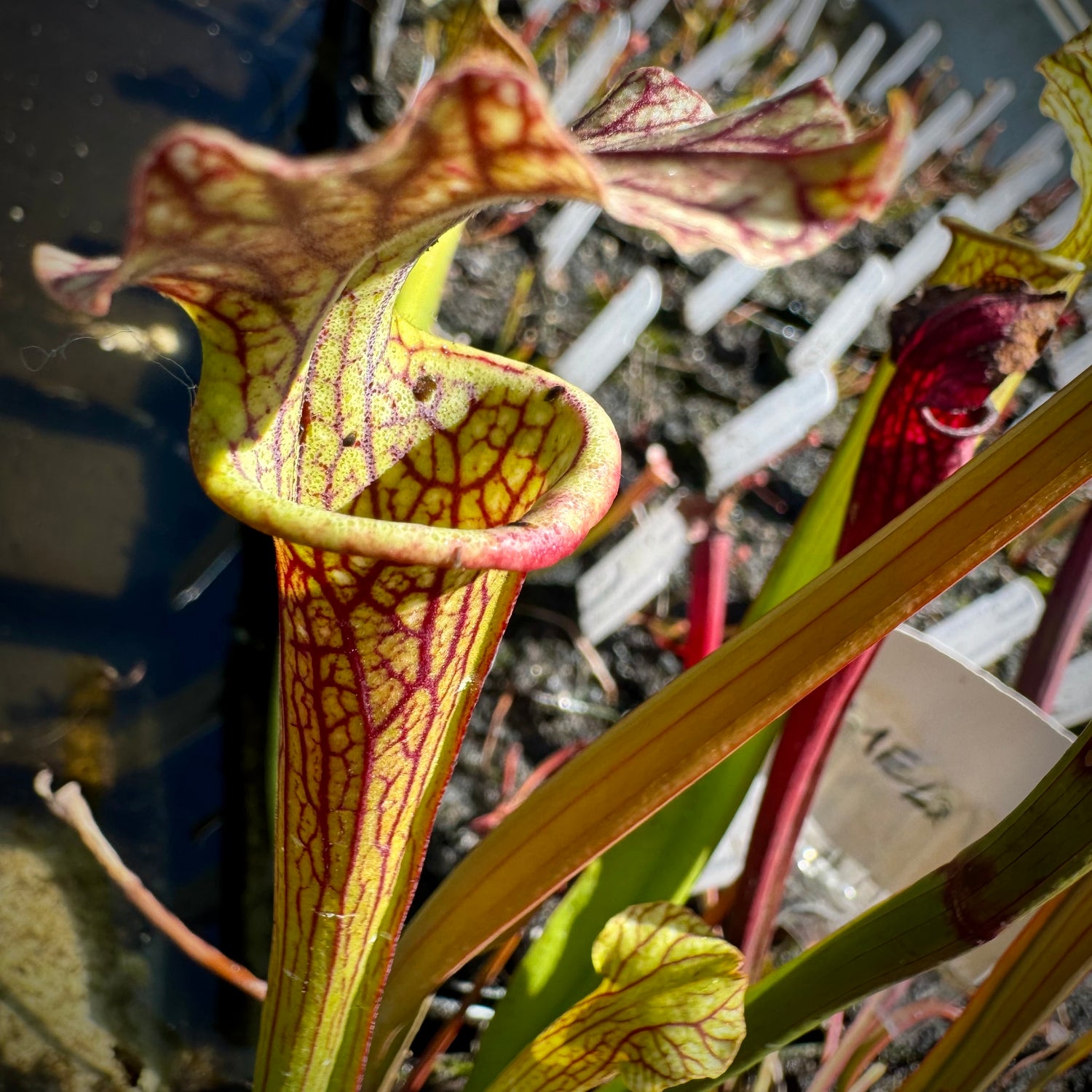
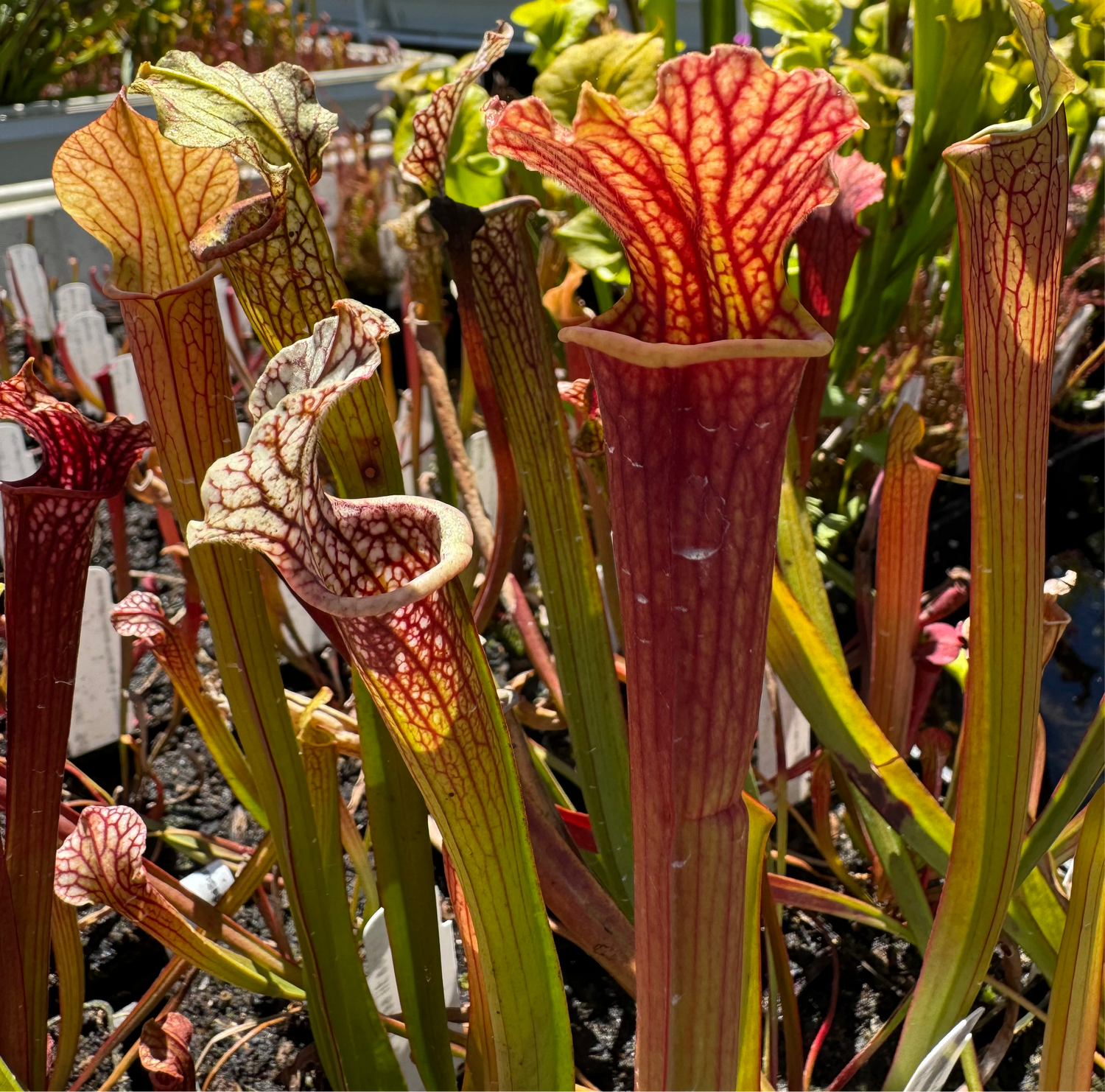
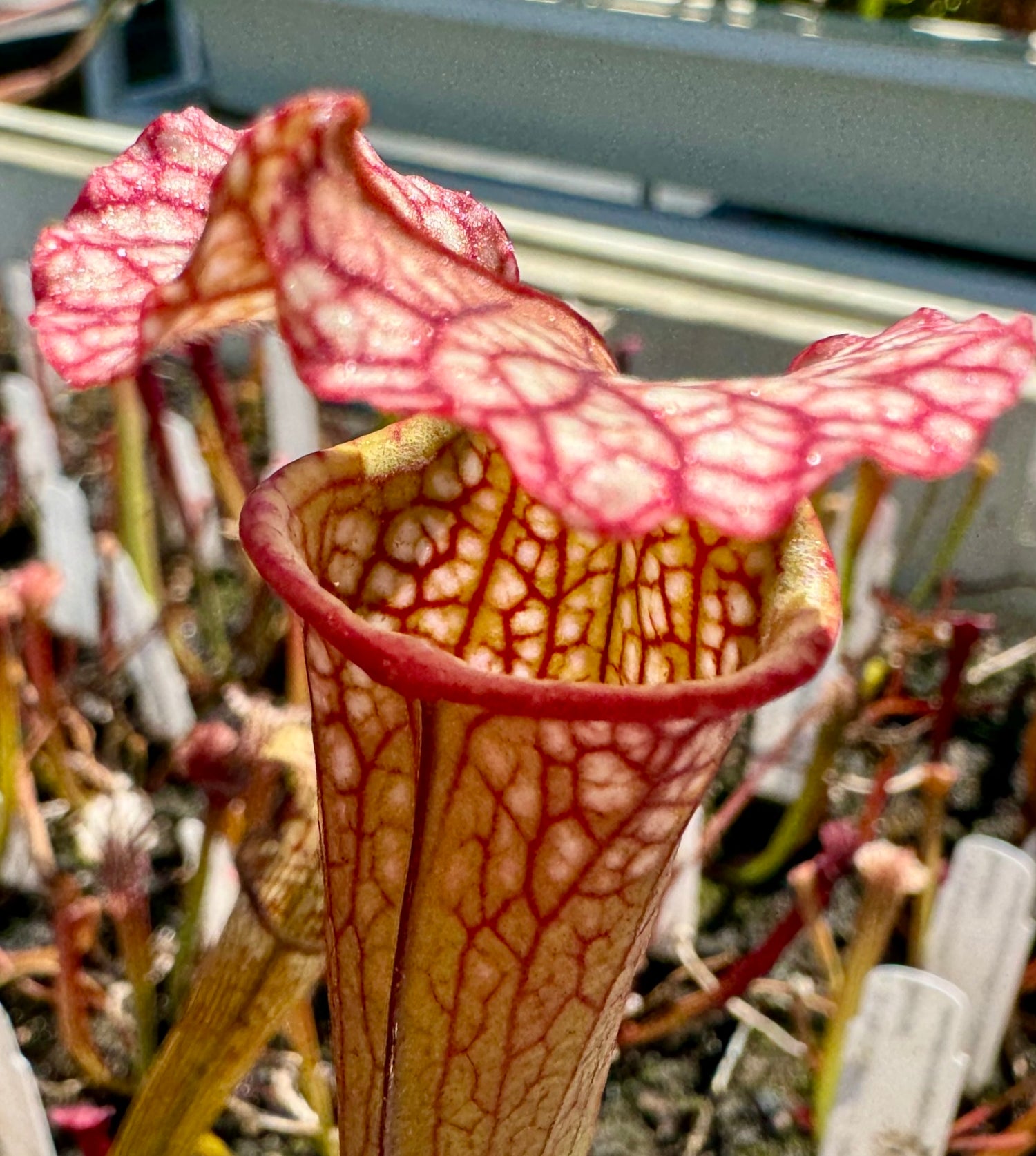
Unit price perWe are excited to release our first ‘Saurus’ crosses this year! ‘Saurus’ is the famous dark-red moorei created by Phil Faulisi; it is huge, beautiful, and hard to get! Damon has crossed it with one of his favorite leucophylla hybrids. This hybrid's pitchers start white and then get pinker and pinker as the pitcher ages! It’s beautiful to watch the white pitchers slowly blush!
With such a complicated cross, there is lots and lots of color variation, but one thing is for sure: they will be huge! The medium ones we offer are the most vigorous of the batch, so get one if you want a giant plant!
These are all seed-grown, and we have a limited number of them. There will be variations in color, size, and form.
DORMANT SEASONALLY, STARTING AS EARLY AS OCTOBER AND LASTING AS LATE AS MARCH, DEPENDING ON THE CONDITIONS AND SPECIES/HYBRID. The pitchers turn brown and die back to the rhizome, or non-carnivorous leaves (phyllodia) grow during this time. Please see the final photo to see how Sarracenia look when dormant. They will begin to grow vigorously again in Spring when photoperiods lengthen and temperatures increase.
Care Instructions:
Growth Habit: Sarracenia primarily grow along the Southeastern coastal plain of the United States. They grow pitchers, which are modified leaves, seasonally that can vary in height, color, and size depending on the species or hybrid. The pitchers can die back during the growing season, but new pitchers will grow throughout the spring and summer. The pitchers start to grow in spring, and many grow as the year progresses; in summer, they will be at their best. In summer, you may see brown or black on your pitchers, which can be normal nectar burn or crisping from heat. As Fall comes on, the pitchers may start to die back, turning brown, and by winter, many or all of the pitchers are brown, but the rhizome remains healthy and intact throughout winter dormancy even if you cannot see anything growing. Sarracenia have brown, black, or white roots and do not generally have many of them. The rhizome can be brown and still be healthy.
Sun: Full sun. Sarracenia require lots of direct sun to grow and form pitchers properly. In many areas, they can be grown outdoors in full sun. If you live in a very hot AND very dry place like Arizona or Sacramento, for example, you will want to grow your plants in full morning sun with protection from the afternoon sun or under 30% shade cloth. It is common for several pitchers to "burn" and die back when you first place your plant into the sun; your plant is acclimating to your conditions, and in most cases, new leaves will soon grow and be fully acclimated. Sarracenia can be grown indoors on extremely sunny windowsills that receive all-day sun, but they will require a grow light in most circumstances due to the amount of light the plant needs. Grow lights should be 6-12” from the plant, depending on the light, and on a 10-12 hour day length. Sarracenia generally are not a good candidate for a terrarium as they need intense light and get quite tall. Shorter species like Sarracenia purpurea will do better in a terrarium. Grow outdoors if possible for best results.
Water: Always keep them in a saucer with a few inches of distilled, rainwater, or reverse osmosis water. Never let them dry out, especially in the hot summer months. Sarracenia are bog plants that prefer water-logged conditions unless you live somewhere both very hot AND extremely humid, like Alabama. In that case, let the water tray dry out for a day or two between refills. Always use distilled, reverse osmosis, or rainwater only. These plants are sensitive to their water quality, and giving them mineral and salt-free water is very important. In winter, when the plants are dormant, you can let them dry out a bit between rain storms, but do not let the soil get so dry that it pulls away from the edges of the pots. Be sure to supplement water as needed in between rains in winter.
Temperature and Dormancy: These are warm-temperate plants, meaning they need warm summers and chilly winters. They should be grown outdoors year-round in areas with mild winters. They thrive in temperatures ranging from 20 degrees - 100F degrees and can take a brief freeze or high-temperature spike up to 105F degrees for a short period. If nighttime temps drop below 20 but rise again during the day above 40, your plant will be fine outside.
If you live in an area with very cold winters, where nighttime temperatures drop below 20 degrees for sustained periods, you have three options for providing them with winter dormancy: the garage method, mulching in, or the fridge method. Dormancy is triggered by a combination of exposure to shorter photo-periods and cooler temperatures in the 40-60's F. While you can skip a dormancy period once or twice, in the long term, your plant will begin to do poorly and will eventually die if you skip this crucial period.
The garage method: Bring your plant indoors to a sunny windowsill in an unheated room or garage, where the nighttime temperatures will dip down to 50-60F. Keep it well watered during this period, do not let it dry out, and put it outside again when the outside nighttime temperatures increase consistently above 20F.
The mulch method: Mulch them in very, very well outdoors. Pack at least four inches of mulch on top of the plants and all around the sides to prevent winds from chilling them and freezing the roots. You can also dig the pots into the ground and then mulch heavily on top.
The fridge method: remove the plants from pots, gently clean the roots of soil, wrap the roots in a bit of damp long-fibered New Zealand sphagnum moss, place the plants in a resealable bag, and put the bag into the refrigerator. Leave them in the fridge from October to February, periodically checking on them to ensure they are still moist and not growing mold or fungus. Pot them back up in February. You can vary the timing to align with your outside nighttime temperatures so that your plants can come out of dormancy when it is safe to place them back outside. You can leave them in the fridge for an extended period if you have very long winters.
Soil and Repotting: We prefer a mix of four-part fertilizer-free peat moss to one-part perlite. You can add our pre-made mix to your order here. You do not need to repot your plant when you receive it from us for at least a year, and we recommend against it during the spring-summer months. Repot Sarracenia every 1-3 years in winter when they are dormant. Avoid placing in excessively large pots; size up only a few inches at a time. They do well in tall pots. Soil can also develop a swampy smell, especially right after shipping, when the plant is wrapped in plastic and sealed. This is normal; these plants grow naturally in bogs and swampy conditions, and peat moss can develop a bit of an anaerobic smell, but this does not indicate a problem with the soil.
Feeding and Fertilizer: Sarracenia will catch plenty of food when grown outdoors. When grown indoors, they will significantly benefit from fertilizing, both a foliar fertilizer and feeding the pitchers. Plants grown outdoors will appreciate a foliar feed as well. Apply MaxSea fertilizer once per month to the foliage only. Dilute 1/4 teaspoon of MaxSea into one gallon of water and then apply to the pitchers, and inside the pitchers, with a mister bottle or a watering can. Osmocote slow-release flower and vegetable pellets can be dropped into the pitchers with a bit of distilled water. Pellets can burn the sides of the pitchers where they come to rest; that is normal.
More Information: For further information on dormancy, repotting, dividing, and more, check out our website or our YouTube channel.


Sarracenia ( rubra alabamensis x leucophylla ‘Schnell’s Ghost’ ) x ( x ‘Saurus’ ) Potted
From $ 24.99
Unit price perSarracenia ( rubra alabamensis x leucophylla ‘Schnell’s Ghost’ ) x ( x ‘Saurus’ ) Potted
From $ 24.99
Unit price perSarracenia ( rubra alabamensis x leucophylla ‘Schnell’s Ghost’ ) x ( x ‘Saurus’ )is a show-stopping new hybrid for 2026! Sarracenia rubra alabamensis x leucophylla ’Schnell’s Ghost’ is a select plant with amazing lemony color and an elongated lid! ‘Saurus’ is a Phil Faulisi creation that needs no introduction. It is widely considered the best and biggest dark red moorei out there! These plants have combined the best of both parents with profusions of pitchers with exaggerated lids and a crazy array of color! This is one of those fun crosses that has a ton of variability!
These seed-grown plants have insane variability in size, form, and color, no two look the same!
DORMANT SEASONALLY, STARTING AS EARLY AS OCTOBER AND LASTING AS LATE AS MARCH, DEPENDING ON THE CONDITIONS AND SPECIES/HYBRID. The pitchers turn brown and die back to the rhizome, or non-carnivorous leaves (phyllodia) grow during this time. Please see the final photo to see how Sarracenia look when dormant. They will begin to grow vigorously again in Spring when photoperiods lengthen and temperatures increase.
Care Instructions:
Growth Habit: Sarracenia primarily grow along the Southeastern coastal plain of the United States. They grow pitchers, which are modified leaves, seasonally that can vary in height, color, and size depending on the species or hybrid. The pitchers can die back during the growing season, but new pitchers will grow throughout the spring and summer. The pitchers start to grow in spring, and many grow as the year progresses; in summer, they will be at their best. In summer, you may see brown or black on your pitchers, which can be normal nectar burn or crisping from heat. As Fall comes on, the pitchers may start to die back, turning brown, and by winter, many or all of the pitchers are brown, but the rhizome remains healthy and intact throughout winter dormancy even if you cannot see anything growing. Sarracenia have brown, black, or white roots and do not generally have many of them. The rhizome can be brown and still be healthy.
Sun: Full sun. Sarracenia require lots of direct sun to grow and form pitchers properly. In many areas, they can be grown outdoors in full sun. If you live in a very hot AND very dry place like Arizona or Sacramento, for example, you will want to grow your plants in full morning sun with protection from the afternoon sun or under 30% shade cloth. It is common for several pitchers to "burn" and die back when you first place your plant into the sun; your plant is acclimating to your conditions, and in most cases, new leaves will soon grow and be fully acclimated. Sarracenia can be grown indoors on extremely sunny windowsills that receive all-day sun, but they will require a grow light in most circumstances due to the amount of light the plant needs. Grow lights should be 6-12” from the plant, depending on the light, and on a 10-12 hour day length. Sarracenia generally are not a good candidate for a terrarium as they need intense light and get quite tall. Shorter species like Sarracenia purpurea will do better in a terrarium. Grow outdoors if possible for best results.
Water: Always keep them in a saucer with a few inches of distilled, rainwater, or reverse osmosis water. Never let them dry out, especially in the hot summer months. Sarracenia are bog plants that prefer water-logged conditions unless you live somewhere both very hot AND extremely humid, like Alabama. In that case, let the water tray dry out for a day or two between refills. Always use distilled, reverse osmosis, or rainwater only. These plants are sensitive to their water quality, and giving them mineral and salt-free water is very important. In winter, when the plants are dormant, you can let them dry out a bit between rain storms, but do not let the soil get so dry that it pulls away from the edges of the pots. Be sure to supplement water as needed in between rains in winter.
Temperature and Dormancy: These are warm-temperate plants, meaning they need warm summers and chilly winters. They should be grown outdoors year-round in areas with mild winters. They thrive in temperatures ranging from 20 degrees - 100F degrees and can take a brief freeze or high-temperature spike up to 105F degrees for a short period. If nighttime temps drop below 20 but rise again during the day above 40, your plant will be fine outside.
If you live in an area with very cold winters, where nighttime temperatures drop below 20 degrees for sustained periods, you have three options for providing them with winter dormancy: the garage method, mulching in, or the fridge method. Dormancy is triggered by a combination of exposure to shorter photo-periods and cooler temperatures in the 40-60's F. While you can skip a dormancy period once or twice, in the long term, your plant will begin to do poorly and will eventually die if you skip this crucial period.
The garage method: Bring your plant indoors to a sunny windowsill in an unheated room or garage, where the nighttime temperatures will dip down to 50-60F. Keep it well watered during this period, do not let it dry out, and put it outside again when the outside nighttime temperatures increase consistently above 20F.
The mulch method: Mulch them in very, very well outdoors. Pack at least four inches of mulch on top of the plants and all around the sides to prevent winds from chilling them and freezing the roots. You can also dig the pots into the ground and then mulch heavily on top.
The fridge method: remove the plants from pots, gently clean the roots of soil, wrap the roots in a bit of damp long-fibered New Zealand sphagnum moss, place the plants in a resealable bag, and put the bag into the refrigerator. Leave them in the fridge from October to February, periodically checking on them to ensure they are still moist and not growing mold or fungus. Pot them back up in February. You can vary the timing to align with your outside nighttime temperatures so that your plants can come out of dormancy when it is safe to place them back outside. You can leave them in the fridge for an extended period if you have very long winters.
Soil and Repotting: We prefer a mix of four-part fertilizer-free peat moss to one-part perlite. You can add our pre-made mix to your order here. You do not need to repot your plant when you receive it from us for at least a year, and we recommend against it during the spring-summer months. Repot Sarracenia every 1-3 years in winter when they are dormant. Avoid placing in excessively large pots; size up only a few inches at a time. They do well in tall pots. Soil can also develop a swampy smell, especially right after shipping, when the plant is wrapped in plastic and sealed. This is normal; these plants grow naturally in bogs and swampy conditions, and peat moss can develop a bit of an anaerobic smell, but this does not indicate a problem with the soil.
Feeding and Fertilizer: Sarracenia will catch plenty of food when grown outdoors. When grown indoors, they will significantly benefit from fertilizing, both a foliar fertilizer and feeding the pitchers. Plants grown outdoors will appreciate a foliar feed as well. Apply MaxSea fertilizer once per month to the foliage only. Dilute 1/4 teaspoon of MaxSea into one gallon of water and then apply to the pitchers, and inside the pitchers, with a mister bottle or a watering can. Osmocote slow-release flower and vegetable pellets can be dropped into the pitchers with a bit of distilled water. Pellets can burn the sides of the pitchers where they come to rest; that is normal.
More Information: For further information on dormancy, repotting, dividing, and more, check out our website or our YouTube channel.


Sarracenia ( x 'Judith Hindle' ) x ( x ‘Caitrin Claire’ ) is one of our most exciting new releases of 2026! These lacy, hot-pink, ruffly beauties are exceptional! ‘Judith Hindle’ is a classic plant that is still a standout today, and Damon loves crossing with it because it adds lots of bright pinks and lacy ruffles. ‘Caitrin Claire’ is a relatively new and exceptionally beautiful cultivar that has some of the best electric-pink, psychedelic coloration of any Sarracenia! With a complicated cross like this, it’s hard to know what you’re going to get, but with this cross, every single plant is so good, we were tempted to keep them all!
These are seed-grown plants, so there are variations in size, color, and form.
DORMANT SEASONALLY, STARTING AS EARLY AS OCTOBER AND LASTING AS LATE AS MARCH, DEPENDING ON THE CONDITIONS AND SPECIES/HYBRID. The pitchers turn brown and die back to the rhizome, or non-carnivorous leaves (phyllodia) grow during this time. Please see the final photo to see how Sarracenia look when dormant. They will begin to grow vigorously again in Spring when photoperiods lengthen and temperatures increase.
Care Instructions:
Growth Habit: Sarracenia primarily grow along the Southeastern coastal plain of the United States. They grow pitchers, which are modified leaves, seasonally that can vary in height, color, and size depending on the species or hybrid. The pitchers can die back during the growing season, but new pitchers will grow throughout the spring and summer. The pitchers start to grow in spring, and many grow as the year progresses; in summer, they will be at their best. In summer, you may see brown or black on your pitchers, which can be normal nectar burn or crisping from heat. As Fall comes on, the pitchers may start to die back, turning brown, and by winter, many or all of the pitchers are brown, but the rhizome remains healthy and intact throughout winter dormancy even if you cannot see anything growing. Sarracenia have brown, black, or white roots and do not generally have many of them. The rhizome can be brown and still be healthy.
Sun: Full sun. Sarracenia require lots of direct sun to grow and form pitchers properly. In many areas, they can be grown outdoors in full sun. If you live in a very hot AND very dry place like Arizona or Sacramento, for example, you will want to grow your plants in full morning sun with protection from the afternoon sun or under 30% shade cloth. It is common for several pitchers to "burn" and die back when you first place your plant into the sun; your plant is acclimating to your conditions, and in most cases, new leaves will soon grow and be fully acclimated. Sarracenia can be grown indoors on extremely sunny windowsills that receive all-day sun, but they will require a grow light in most circumstances due to the amount of light the plant needs. Grow lights should be 6-12” from the plant, depending on the light, and on a 10-12 hour day length. Sarracenia generally are not a good candidate for a terrarium as they need intense light and get quite tall. Shorter species like Sarracenia purpurea will do better in a terrarium. Grow outdoors if possible for best results.
Water: Always keep them in a saucer with a few inches of distilled, rainwater, or reverse osmosis water. Never let them dry out, especially in the hot summer months. Sarracenia are bog plants that prefer water-logged conditions unless you live somewhere both very hot AND extremely humid, like Alabama. In that case, let the water tray dry out for a day or two between refills. Always use distilled, reverse osmosis, or rainwater only. These plants are sensitive to their water quality, and giving them mineral and salt-free water is very important. In winter, when the plants are dormant, you can let them dry out a bit between rain storms, but do not let the soil get so dry that it pulls away from the edges of the pots. Be sure to supplement water as needed in between rains in winter.
Temperature and Dormancy: These are warm-temperate plants, meaning they need warm summers and chilly winters. They should be grown outdoors year-round in areas with mild winters. They thrive in temperatures ranging from 20 degrees - 100F degrees and can take a brief freeze or high-temperature spike up to 105F degrees for a short period. If nighttime temps drop below 20 but rise again during the day above 40, your plant will be fine outside.
If you live in an area with very cold winters, where nighttime temperatures drop below 20 degrees for sustained periods, you have three options for providing them with winter dormancy: the garage method, mulching in, or the fridge method. Dormancy is triggered by a combination of exposure to shorter photo-periods and cooler temperatures in the 40-60's F. While you can skip a dormancy period once or twice, in the long term, your plant will begin to do poorly and will eventually die if you skip this crucial period.
The garage method: Bring your plant indoors to a sunny windowsill in an unheated room or garage, where the nighttime temperatures will dip down to 50-60F. Keep it well watered during this period, do not let it dry out, and put it outside again when the outside nighttime temperatures increase consistently above 20F.
The mulch method: Mulch them in very, very well outdoors. Pack at least four inches of mulch on top of the plants and all around the sides to prevent winds from chilling them and freezing the roots. You can also dig the pots into the ground and then mulch heavily on top.
The fridge method: remove the plants from pots, gently clean the roots of soil, wrap the roots in a bit of damp long-fibered New Zealand sphagnum moss, place the plants in a resealable bag, and put the bag into the refrigerator. Leave them in the fridge from October to February, periodically checking on them to ensure they are still moist and not growing mold or fungus. Pot them back up in February. You can vary the timing to align with your outside nighttime temperatures so that your plants can come out of dormancy when it is safe to place them back outside. You can leave them in the fridge for an extended period if you have very long winters.
Soil and Repotting: We prefer a mix of four-part fertilizer-free peat moss to one-part perlite. You can add our pre-made mix to your order here. You do not need to repot your plant when you receive it from us for at least a year, and we recommend against it during the spring-summer months. Repot Sarracenia every 1-3 years in winter when they are dormant. Avoid placing in excessively large pots; size up only a few inches at a time. They do well in tall pots. Soil can also develop a swampy smell, especially right after shipping, when the plant is wrapped in plastic and sealed. This is normal; these plants grow naturally in bogs and swampy conditions, and peat moss can develop a bit of an anaerobic smell, but this does not indicate a problem with the soil.
Feeding and Fertilizer: Sarracenia will catch plenty of food when grown outdoors. When grown indoors, they will significantly benefit from fertilizing, both a foliar fertilizer and feeding the pitchers. Plants grown outdoors will appreciate a foliar feed as well. Apply MaxSea fertilizer once per month to the foliage only. Dilute 1/4 teaspoon of MaxSea into one gallon of water and then apply to the pitchers, and inside the pitchers, with a mister bottle or a watering can. Osmocote slow-release flower and vegetable pellets can be dropped into the pitchers with a bit of distilled water. Pellets can burn the sides of the pitchers where they come to rest; that is normal.
More Information: For further information on dormancy, repotting, dividing, and more, check out our website or our YouTube channel.


Sarracenia ( x 'Judith Hindle' ) x leucophylla var alba “CK #14” Potted
From $ 24.99
Unit price perSarracenia ( x 'Judith Hindle' ) x leucophylla var alba “CK #14” Potted
From $ 24.99
Unit price perSarracenia ( x 'Judith Hindle' ) x leucophylla var alba “CK #14” are really beautiful, eye-catching ants! Genetically there’s plenty of leucophylla in ‘Judith Hindle.’ And so most of these look like fancy leucophylla with lots of ruffled lids and lots of lacy pink color.
These are seed-grown plants so there is variations in size, color and form.
DORMANT SEASONALLY, STARTING AS EARLY AS OCTOBER AND LASTING AS LATE AS MARCH, DEPENDING ON THE CONDITIONS AND SPECIES/HYBRID. The pitchers turn brown and die back to the rhizome, or non-carnivorous leaves (phyllodia) grow during this time. Please see the final photo to see how Sarracenia look when dormant. They will begin to grow vigorously again in Spring when photoperiods lengthen and temperatures increase.
Care Instructions:
Growth Habit: Sarracenia primarily grow along the Southeastern coastal plain of the United States. They grow pitchers, which are modified leaves, seasonally that can vary in height, color, and size depending on the species or hybrid. The pitchers can die back during the growing season, but new pitchers will grow throughout the spring and summer. The pitchers start to grow in spring, and many grow as the year progresses; in summer, they will be at their best. In summer, you may see brown or black on your pitchers, which can be normal nectar burn or crisping from heat. As Fall comes on, the pitchers may start to die back, turning brown, and by winter, many or all of the pitchers are brown, but the rhizome remains healthy and intact throughout winter dormancy even if you cannot see anything growing. Sarracenia have brown, black, or white roots and do not generally have many of them. The rhizome can be brown and still be healthy.
Sun: Full sun. Sarracenia require lots of direct sun to grow and form pitchers properly. In many areas, they can be grown outdoors in full sun. If you live in a very hot AND very dry place like Arizona or Sacramento, for example, you will want to grow your plants in full morning sun with protection from the afternoon sun or under 30% shade cloth. It is common for several pitchers to "burn" and die back when you first place your plant into the sun; your plant is acclimating to your conditions, and in most cases, new leaves will soon grow and be fully acclimated. Sarracenia can be grown indoors on extremely sunny windowsills that receive all-day sun, but they will require a grow light in most circumstances due to the amount of light the plant needs. Grow lights should be 6-12” from the plant, depending on the light, and on a 10-12 hour day length. Sarracenia generally are not a good candidate for a terrarium as they need intense light and get quite tall. Shorter species like Sarracenia purpurea will do better in a terrarium. Grow outdoors if possible for best results.
Water: Always keep them in a saucer with a few inches of distilled, rainwater, or reverse osmosis water. Never let them dry out, especially in the hot summer months. Sarracenia are bog plants that prefer water-logged conditions unless you live somewhere both very hot AND extremely humid, like Alabama. In that case, let the water tray dry out for a day or two between refills. Always use distilled, reverse osmosis, or rainwater only. These plants are sensitive to their water quality, and giving them mineral and salt-free water is very important. In winter, when the plants are dormant, you can let them dry out a bit between rain storms, but do not let the soil get so dry that it pulls away from the edges of the pots. Be sure to supplement water as needed in between rains in winter.
Temperature and Dormancy: These are warm-temperate plants, meaning they need warm summers and chilly winters. They should be grown outdoors year-round in areas with mild winters. They thrive in temperatures ranging from 20 degrees - 100F degrees and can take a brief freeze or high-temperature spike up to 105F degrees for a short period. If nighttime temps drop below 20 but rise again during the day above 40, your plant will be fine outside.
If you live in an area with very cold winters, where nighttime temperatures drop below 20 degrees for sustained periods, you have three options for providing them with winter dormancy: the garage method, mulching in, or the fridge method. Dormancy is triggered by a combination of exposure to shorter photo-periods and cooler temperatures in the 40-60's F. While you can skip a dormancy period once or twice, in the long term, your plant will begin to do poorly and will eventually die if you skip this crucial period.
The garage method: Bring your plant indoors to a sunny windowsill in an unheated room or garage, where the nighttime temperatures will dip down to 50-60F. Keep it well watered during this period, do not let it dry out, and put it outside again when the outside nighttime temperatures increase consistently above 20F.
The mulch method: Mulch them in very, very well outdoors. Pack at least four inches of mulch on top of the plants and all around the sides to prevent winds from chilling them and freezing the roots. You can also dig the pots into the ground and then mulch heavily on top.
The fridge method: remove the plants from pots, gently clean the roots of soil, wrap the roots in a bit of damp long-fibered New Zealand sphagnum moss, place the plants in a resealable bag, and put the bag into the refrigerator. Leave them in the fridge from October to February, periodically checking on them to ensure they are still moist and not growing mold or fungus. Pot them back up in February. You can vary the timing to align with your outside nighttime temperatures so that your plants can come out of dormancy when it is safe to place them back outside. You can leave them in the fridge for an extended period if you have very long winters.
Soil and Repotting: We prefer a mix of four-part fertilizer-free peat moss to one-part perlite. You can add our pre-made mix to your order here. You do not need to repot your plant when you receive it from us for at least a year, and we recommend against it during the spring-summer months. Repot Sarracenia every 1-3 years in winter when they are dormant. Avoid placing in excessively large pots; size up only a few inches at a time. They do well in tall pots. Soil can also develop a swampy smell, especially right after shipping, when the plant is wrapped in plastic and sealed. This is normal; these plants grow naturally in bogs and swampy conditions, and peat moss can develop a bit of an anaerobic smell, but this does not indicate a problem with the soil.
Feeding and Fertilizer: Sarracenia will catch plenty of food when grown outdoors. When grown indoors, they will significantly benefit from fertilizing, both a foliar fertilizer and feeding the pitchers. Plants grown outdoors will appreciate a foliar feed as well. Apply MaxSea fertilizer once per month to the foliage only. Dilute 1/4 teaspoon of MaxSea into one gallon of water and then apply to the pitchers, and inside the pitchers, with a mister bottle or a watering can. Osmocote slow-release flower and vegetable pellets can be dropped into the pitchers with a bit of distilled water. Pellets can burn the sides of the pitchers where they come to rest; that is normal.
More Information: For further information on dormancy, repotting, dividing, and more, check out our website or our YouTube channel.


Sarracenia ( x 'Lynda Butt' ) x ( x ‘Caitrin Claire’ ) is one of our most exciting new releases of 2026! If you want a plant with a fantastic, white lid and luscious pink coloration, this is the plant for you!
These are seed-grown plants, so there are variations in size, color, and form.
DORMANT SEASONALLY, STARTING AS EARLY AS OCTOBER AND LASTING AS LATE AS MARCH, DEPENDING ON THE CONDITIONS AND SPECIES/HYBRID. The pitchers turn brown and die back to the rhizome, or non-carnivorous leaves (phyllodia) grow during this time. Please see the final photo to see how Sarracenia look when dormant. They will begin to grow vigorously again in Spring when photoperiods lengthen and temperatures increase.
Care Instructions:
Growth Habit: Sarracenia primarily grow along the Southeastern coastal plain of the United States. They grow pitchers, which are modified leaves, seasonally that can vary in height, color, and size depending on the species or hybrid. The pitchers can die back during the growing season, but new pitchers will grow throughout the spring and summer. The pitchers start to grow in spring, and many grow as the year progresses; in summer, they will be at their best. In summer, you may see brown or black on your pitchers, which can be normal nectar burn or crisping from heat. As Fall comes on, the pitchers may start to die back, turning brown, and by winter, many or all of the pitchers are brown, but the rhizome remains healthy and intact throughout winter dormancy even if you cannot see anything growing. Sarracenia have brown, black, or white roots and do not generally have many of them. The rhizome can be brown and still be healthy.
Sun: Full sun. Sarracenia require lots of direct sun to grow and form pitchers properly. In many areas, they can be grown outdoors in full sun. If you live in a very hot AND very dry place like Arizona or Sacramento, for example, you will want to grow your plants in full morning sun with protection from the afternoon sun or under 30% shade cloth. It is common for several pitchers to "burn" and die back when you first place your plant into the sun; your plant is acclimating to your conditions, and in most cases, new leaves will soon grow and be fully acclimated. Sarracenia can be grown indoors on extremely sunny windowsills that receive all-day sun, but they will require a grow light in most circumstances due to the amount of light the plant needs. Grow lights should be 6-12” from the plant, depending on the light, and on a 10-12 hour day length. Sarracenia generally are not a good candidate for a terrarium as they need intense light and get quite tall. Shorter species like Sarracenia purpurea will do better in a terrarium. Grow outdoors if possible for best results.
Water: Always keep them in a saucer with a few inches of distilled, rainwater, or reverse osmosis water. Never let them dry out, especially in the hot summer months. Sarracenia are bog plants that prefer water-logged conditions unless you live somewhere both very hot AND extremely humid, like Alabama. In that case, let the water tray dry out for a day or two between refills. Always use distilled, reverse osmosis, or rainwater only. These plants are sensitive to their water quality, and giving them mineral and salt-free water is very important. In winter, when the plants are dormant, you can let them dry out a bit between rain storms, but do not let the soil get so dry that it pulls away from the edges of the pots. Be sure to supplement water as needed in between rains in winter.
Temperature and Dormancy: These are warm-temperate plants, meaning they need warm summers and chilly winters. They should be grown outdoors year-round in areas with mild winters. They thrive in temperatures ranging from 20 degrees - 100F degrees and can take a brief freeze or high-temperature spike up to 105F degrees for a short period. If nighttime temps drop below 20 but rise again during the day above 40, your plant will be fine outside.
If you live in an area with very cold winters, where nighttime temperatures drop below 20 degrees for sustained periods, you have three options for providing them with winter dormancy: the garage method, mulching in, or the fridge method. Dormancy is triggered by a combination of exposure to shorter photo-periods and cooler temperatures in the 40-60's F. While you can skip a dormancy period once or twice, in the long term, your plant will begin to do poorly and will eventually die if you skip this crucial period.
The garage method: Bring your plant indoors to a sunny windowsill in an unheated room or garage, where the nighttime temperatures will dip down to 50-60F. Keep it well watered during this period, do not let it dry out, and put it outside again when the outside nighttime temperatures increase consistently above 20F.
The mulch method: Mulch them in very, very well outdoors. Pack at least four inches of mulch on top of the plants and all around the sides to prevent winds from chilling them and freezing the roots. You can also dig the pots into the ground and then mulch heavily on top.
The fridge method: remove the plants from pots, gently clean the roots of soil, wrap the roots in a bit of damp long-fibered New Zealand sphagnum moss, place the plants in a resealable bag, and put the bag into the refrigerator. Leave them in the fridge from October to February, periodically checking on them to ensure they are still moist and not growing mold or fungus. Pot them back up in February. You can vary the timing to align with your outside nighttime temperatures so that your plants can come out of dormancy when it is safe to place them back outside. You can leave them in the fridge for an extended period if you have very long winters.
Soil and Repotting: We prefer a mix of four-part fertilizer-free peat moss to one-part perlite. You can add our pre-made mix to your order here. You do not need to repot your plant when you receive it from us for at least a year, and we recommend against it during the spring-summer months. Repot Sarracenia every 1-3 years in winter when they are dormant. Avoid placing in excessively large pots; size up only a few inches at a time. They do well in tall pots. Soil can also develop a swampy smell, especially right after shipping, when the plant is wrapped in plastic and sealed. This is normal; these plants grow naturally in bogs and swampy conditions, and peat moss can develop a bit of an anaerobic smell, but this does not indicate a problem with the soil.
Feeding and Fertilizer: Sarracenia will catch plenty of food when grown outdoors. When grown indoors, they will significantly benefit from fertilizing, both a foliar fertilizer and feeding the pitchers. Plants grown outdoors will appreciate a foliar feed as well. Apply MaxSea fertilizer once per month to the foliage only. Dilute 1/4 teaspoon of MaxSea into one gallon of water and then apply to the pitchers, and inside the pitchers, with a mister bottle or a watering can. Osmocote slow-release flower and vegetable pellets can be dropped into the pitchers with a bit of distilled water. Pellets can burn the sides of the pitchers where they come to rest; that is normal.
More Information: For further information on dormancy, repotting, dividing, and more, check out our website or our YouTube channel.


Sarracenia ( x mitchelliana “Dark Burgundy” ) x ( x ‘Simone’ ) Potted
From $ 24.99
Unit price perSarracenia ( x mitchelliana “Dark Burgundy” ) x ( x ‘Simone’ ) Potted
From $ 24.99
Unit price perDamon has crossed one of his favorite mitchelliana with one of our very favorite cultivars from Jerry Addington. ‘Simone’ is fantastic with dark red undersides of the lid and plentiful pitchers!
This cross will be around a foot tall at maturity with mostly upward-pointed lids. Because this is a smaller hybrid, the sizing will come in with shorter stature. The color is variable, but many of them have taken on the striking coloration of ‘Simone!’ If you’d like a more dainty plant with tons of pitchers, this is the perfect plant for you!
These are seed-grown, so there is a lot of variation in color, size and form.
DORMANT SEASONALLY, STARTING AS EARLY AS OCTOBER AND LASTING AS LATE AS MARCH, DEPENDING ON THE CONDITIONS AND SPECIES/HYBRID. The pitchers turn brown and die back to the rhizome, or non-carnivorous leaves (phyllodia) grow during this time. Please see the final photo to see how Sarracenia look when dormant. They will begin to grow vigorously again in Spring when photoperiods lengthen and temperatures increase.
Care Instructions:
Growth Habit: Sarracenia primarily grow along the Southeastern coastal plain of the United States. They grow pitchers, which are modified leaves, seasonally that can vary in height, color, and size depending on the species or hybrid. The pitchers can die back during the growing season, but new pitchers will grow throughout the spring and summer. The pitchers start to grow in spring, and many grow as the year progresses; in summer, they will be at their best. In summer, you may see brown or black on your pitchers, which can be normal nectar burn or crisping from heat. As Fall comes on, the pitchers may start to die back, turning brown, and by winter, many or all of the pitchers are brown, but the rhizome remains healthy and intact throughout winter dormancy even if you cannot see anything growing. Sarracenia have brown, black, or white roots and do not generally have many of them. The rhizome can be brown and still be healthy.
Sun: Full sun. Sarracenia require lots of direct sun to grow and form pitchers properly. In many areas, they can be grown outdoors in full sun. If you live in a very hot AND very dry place like Arizona or Sacramento, for example, you will want to grow your plants in full morning sun with protection from the afternoon sun or under 30% shade cloth. It is common for several pitchers to "burn" and die back when you first place your plant into the sun; your plant is acclimating to your conditions, and in most cases, new leaves will soon grow and be fully acclimated. Sarracenia can be grown indoors on extremely sunny windowsills that receive all-day sun, but they will require a grow light in most circumstances due to the amount of light the plant needs. Grow lights should be 6-12” from the plant, depending on the light, and on a 10-12 hour day length. Sarracenia generally are not a good candidate for a terrarium as they need intense light and get quite tall. Shorter species like Sarracenia purpurea will do better in a terrarium. Grow outdoors if possible for best results.
Water: Always keep them in a saucer with a few inches of distilled, rainwater, or reverse osmosis water. Never let them dry out, especially in the hot summer months. Sarracenia are bog plants that prefer water-logged conditions unless you live somewhere both very hot AND extremely humid, like Alabama. In that case, let the water tray dry out for a day or two between refills. Always use distilled, reverse osmosis, or rainwater only. These plants are sensitive to their water quality, and giving them mineral and salt-free water is very important. In winter, when the plants are dormant, you can let them dry out a bit between rain storms, but do not let the soil get so dry that it pulls away from the edges of the pots. Be sure to supplement water as needed in between rains in winter.
Temperature and Dormancy: These are warm-temperate plants, meaning they need warm summers and chilly winters. They should be grown outdoors year-round in areas with mild winters. They thrive in temperatures ranging from 20 degrees - 100F degrees and can take a brief freeze or high-temperature spike up to 105F degrees for a short period. If nighttime temps drop below 20 but rise again during the day above 40, your plant will be fine outside.
If you live in an area with very cold winters, where nighttime temperatures drop below 20 degrees for sustained periods, you have three options for providing them with winter dormancy: the garage method, mulching in, or the fridge method. Dormancy is triggered by a combination of exposure to shorter photo-periods and cooler temperatures in the 40-60's F. While you can skip a dormancy period once or twice, in the long term, your plant will begin to do poorly and will eventually die if you skip this crucial period.
The garage method: Bring your plant indoors to a sunny windowsill in an unheated room or garage, where the nighttime temperatures will dip down to 50-60F. Keep it well watered during this period, do not let it dry out, and put it outside again when the outside nighttime temperatures increase consistently above 20F.
The mulch method: Mulch them in very, very well outdoors. Pack at least four inches of mulch on top of the plants and all around the sides to prevent winds from chilling them and freezing the roots. You can also dig the pots into the ground and then mulch heavily on top.
The fridge method: remove the plants from pots, gently clean the roots of soil, wrap the roots in a bit of damp long-fibered New Zealand sphagnum moss, place the plants in a resealable bag, and put the bag into the refrigerator. Leave them in the fridge from October to February, periodically checking on them to ensure they are still moist and not growing mold or fungus. Pot them back up in February. You can vary the timing to align with your outside nighttime temperatures so that your plants can come out of dormancy when it is safe to place them back outside. You can leave them in the fridge for an extended period if you have very long winters.
Soil and Repotting: We prefer a mix of four-part fertilizer-free peat moss to one-part perlite. You can add our pre-made mix to your order here. You do not need to repot your plant when you receive it from us for at least a year, and we recommend against it during the spring-summer months. Repot Sarracenia every 1-3 years in winter when they are dormant. Avoid placing in excessively large pots; size up only a few inches at a time. They do well in tall pots. Soil can also develop a swampy smell, especially right after shipping, when the plant is wrapped in plastic and sealed. This is normal; these plants grow naturally in bogs and swampy conditions, and peat moss can develop a bit of an anaerobic smell, but this does not indicate a problem with the soil.
Feeding and Fertilizer: Sarracenia will catch plenty of food when grown outdoors. When grown indoors, they will significantly benefit from fertilizing, both a foliar fertilizer and feeding the pitchers. Plants grown outdoors will appreciate a foliar feed as well. Apply MaxSea fertilizer once per month to the foliage only. Dilute 1/4 teaspoon of MaxSea into one gallon of water and then apply to the pitchers, and inside the pitchers, with a mister bottle or a watering can. Osmocote slow-release flower and vegetable pellets can be dropped into the pitchers with a bit of distilled water. Pellets can burn the sides of the pitchers where they come to rest; that is normal.
More Information: For further information on dormancy, repotting, dividing, and more, check out our website or our YouTube channel.


Combining the famously tall and statuesque beauty of moorei with the incomparable white and pink dreamy coloration of ‘Adrian Slack’ has given this seed-grown batch of Sarracenia tall, elegant pitchers with contrasting coloration.
These are divisions.
DORMANT SEASONALLY, STARTING AS EARLY AS OCTOBER AND LASTING AS LATE AS MARCH, DEPENDING ON THE CONDITIONS AND SPECIES/HYBRID. The pitchers turn brown and die back to the rhizome, or non-carnivorous leaves (phyllodia) grow during this time. Please see the final photo to see how Sarracenia look when dormant. They will begin to grow vigorously again in Spring when photoperiods lengthen and temperatures increase.
Care Instructions:
Growth Habit: Sarracenia primarily grow along the Southeastern coastal plain of the United States. They grow pitchers, which are modified leaves, seasonally that can vary in height, color, and size depending on the species or hybrid. The pitchers can die back during the growing season, but new pitchers will grow throughout the spring and summer. The pitchers start to grow in spring, and many grow as the year progresses; in summer, they will be at their best. In summer, you may see brown or black on your pitchers, which can be normal nectar burn or crisping from heat. As Fall comes on, the pitchers may start to die back, turning brown, and by winter, many or all of the pitchers are brown, but the rhizome remains healthy and intact throughout winter dormancy even if you cannot see anything growing. Sarracenia have brown, black, or white roots and do not generally have many of them. The rhizome can be brown and still be healthy.
Sun: Full sun. Sarracenia require lots of direct sun to grow and form pitchers properly. In many areas, they can be grown outdoors in full sun. If you live in a very hot AND very dry place like Arizona or Sacramento, for example, you will want to grow your plants in full morning sun with protection from the afternoon sun or under 30% shade cloth. It is common for several pitchers to "burn" and die back when you first place your plant into the sun; your plant is acclimating to your conditions, and in most cases, new leaves will soon grow and be fully acclimated. Sarracenia can be grown indoors on extremely sunny windowsills that receive all-day sun, but they will require a grow light in most circumstances due to the amount of light the plant needs. Grow lights should be 6-12” from the plant, depending on the light, and on a 10-12 hour day length. Sarracenia generally are not a good candidate for a terrarium as they need intense light and get quite tall. Shorter species like Sarracenia purpurea will do better in a terrarium. Grow outdoors if possible for best results.
Water: Always keep them in a saucer with a few inches of distilled, rainwater, or reverse osmosis water. Never let them dry out, especially in the hot summer months. Sarracenia are bog plants that prefer water-logged conditions unless you live somewhere both very hot AND extremely humid, like Alabama. In that case, let the water tray dry out for a day or two between refills. Always use distilled, reverse osmosis, or rainwater only. These plants are sensitive to their water quality, and giving them mineral and salt-free water is very important. In winter, when the plants are dormant, you can let them dry out a bit between rain storms, but do not let the soil get so dry that it pulls away from the edges of the pots. Be sure to supplement water as needed in between rains in winter.
Temperature and Dormancy: These are warm-temperate plants, meaning they need warm summers and chilly winters. They should be grown outdoors year-round in areas with mild winters. They thrive in temperatures ranging from 20 degrees - 100F degrees and can take a brief freeze or high-temperature spike up to 105F degrees for a short period. If nighttime temps drop below 20 but rise again during the day above 40, your plant will be fine outside.
If you live in an area with very cold winters, where nighttime temperatures drop below 20 degrees for sustained periods, you have three options for providing them with winter dormancy: the garage method, mulching in, or the fridge method. Dormancy is triggered by a combination of exposure to shorter photo-periods and cooler temperatures in the 40-60's F. While you can skip a dormancy period once or twice, in the long term, your plant will begin to do poorly and will eventually die if you skip this crucial period.
The garage method: Bring your plant indoors to a sunny windowsill in an unheated room or garage, where the nighttime temperatures will dip down to 50-60F. Keep it well watered during this period, do not let it dry out, and put it outside again when the outside nighttime temperatures increase consistently above 20F.
The mulch method: Mulch them in very, very well outdoors. Pack at least four inches of mulch on top of the plants and all around the sides to prevent winds from chilling them and freezing the roots. You can also dig the pots into the ground and then mulch heavily on top.
The fridge method: remove the plants from pots, gently clean the roots of soil, wrap the roots in a bit of damp long-fibered New Zealand sphagnum moss, place the plants in a resealable bag, and put the bag into the refrigerator. Leave them in the fridge from October to February, periodically checking on them to ensure they are still moist and not growing mold or fungus. Pot them back up in February. You can vary the timing to align with your outside nighttime temperatures so that your plants can come out of dormancy when it is safe to place them back outside. You can leave them in the fridge for an extended period if you have very long winters.
Soil and Repotting: We prefer a mix of four-part fertilizer-free peat moss to one-part perlite. You can add our pre-made mix to your order here. You do not need to repot your plant when you receive it from us for at least a year, and we recommend against it during the spring-summer months. Repot Sarracenia every 1-3 years in winter when they are dormant. Avoid placing in excessively large pots; size up only a few inches at a time. They do well in tall pots. Soil can also develop a swampy smell, especially right after shipping, when the plant is wrapped in plastic and sealed. This is normal; these plants grow naturally in bogs and swampy conditions, and peat moss can develop a bit of an anaerobic smell, but this does not indicate a problem with the soil.
Feeding and Fertilizer: Sarracenia will catch plenty of food when grown outdoors. When grown indoors, they will significantly benefit from fertilizing, both a foliar fertilizer and feeding the pitchers. Plants grown outdoors will appreciate a foliar feed as well. Apply MaxSea fertilizer once per month to the foliage only. Dilute 1/4 teaspoon of MaxSea into one gallon of water and then apply to the pitchers, and inside the pitchers, with a mister bottle or a watering can. Osmocote slow-release flower and vegetable pellets can be dropped into the pitchers with a bit of distilled water. Pellets can burn the sides of the pitchers where they come to rest; that is normal.
More Information: For further information on dormancy, repotting, dividing, and more, check out our website or our YouTube channel.
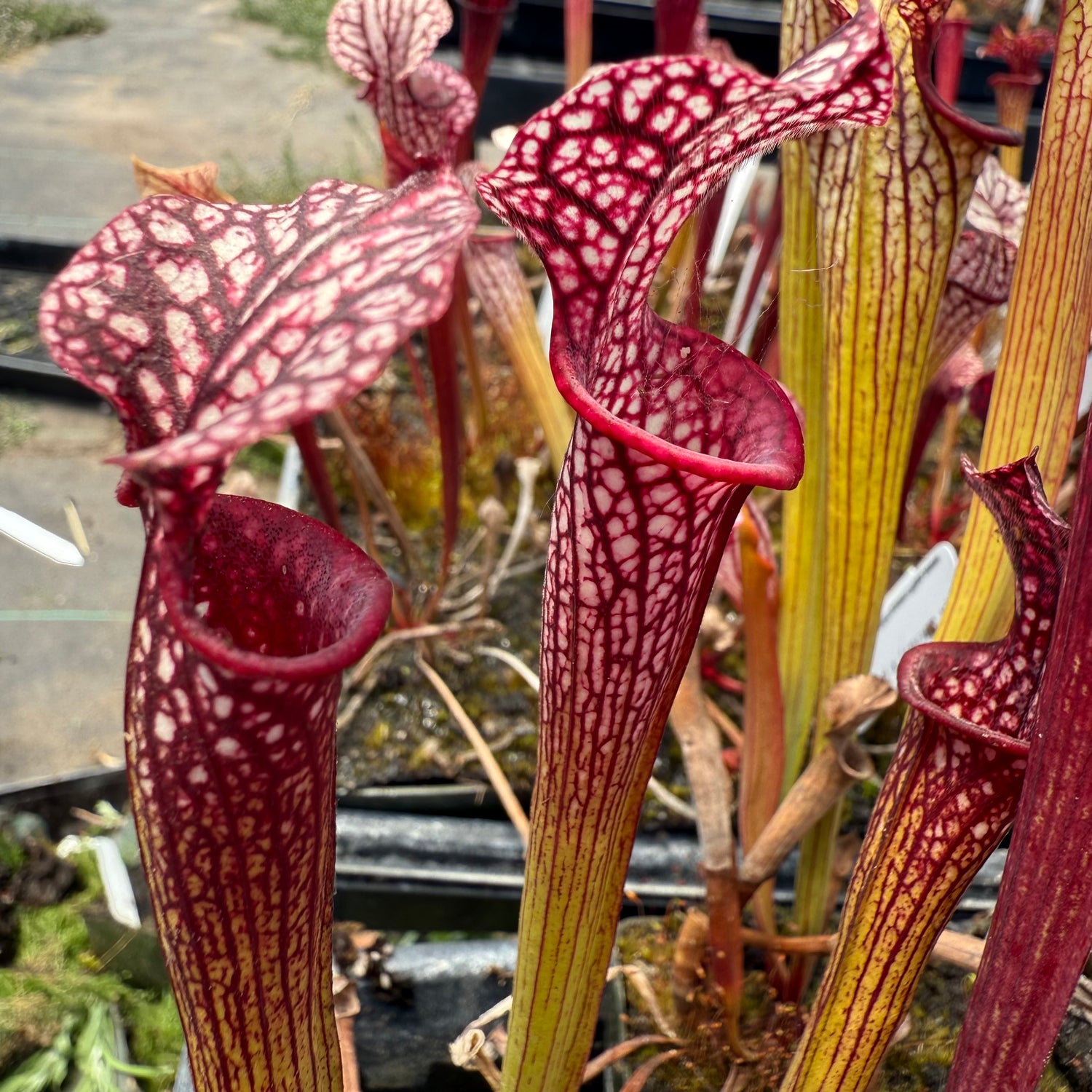
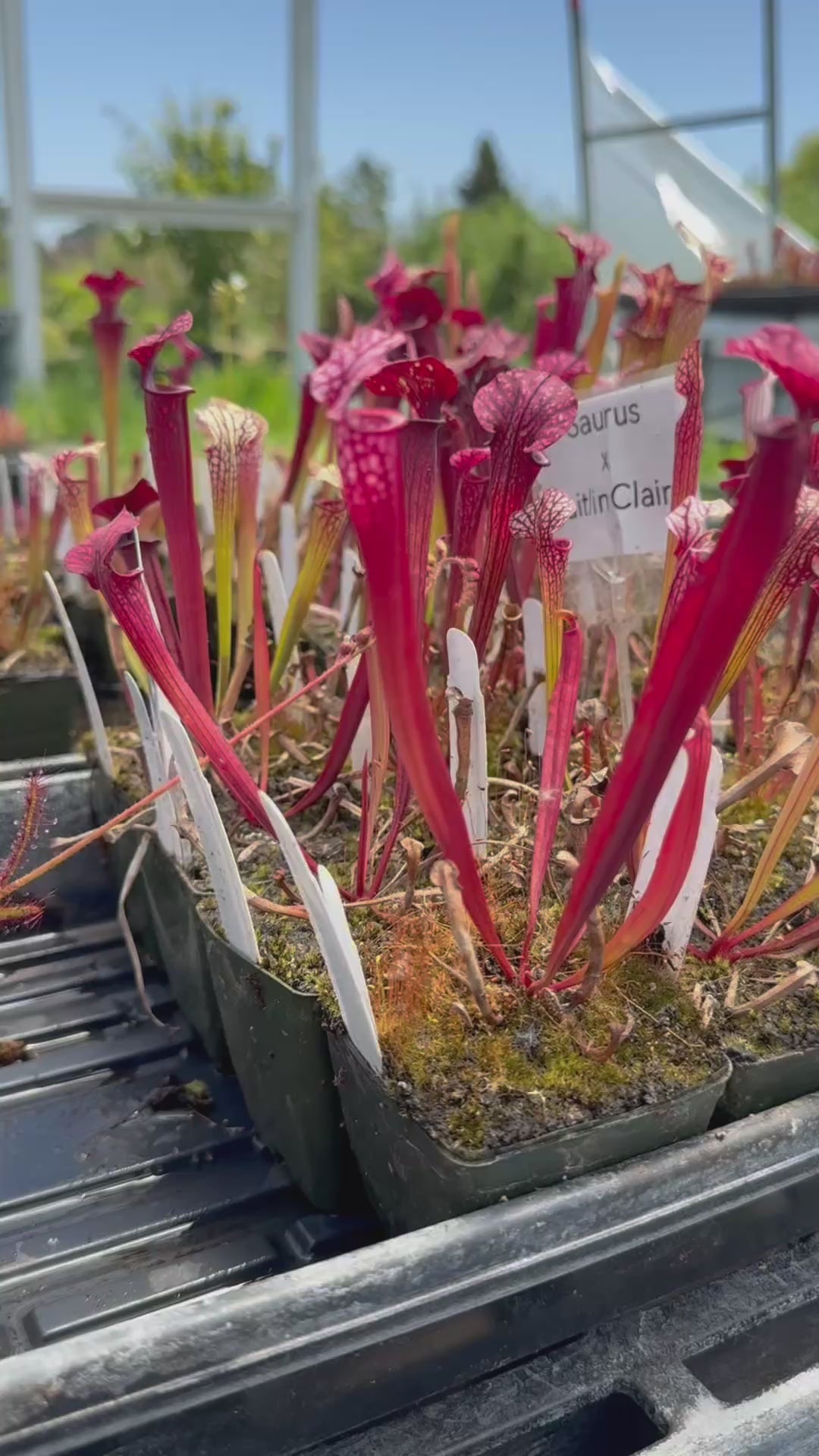
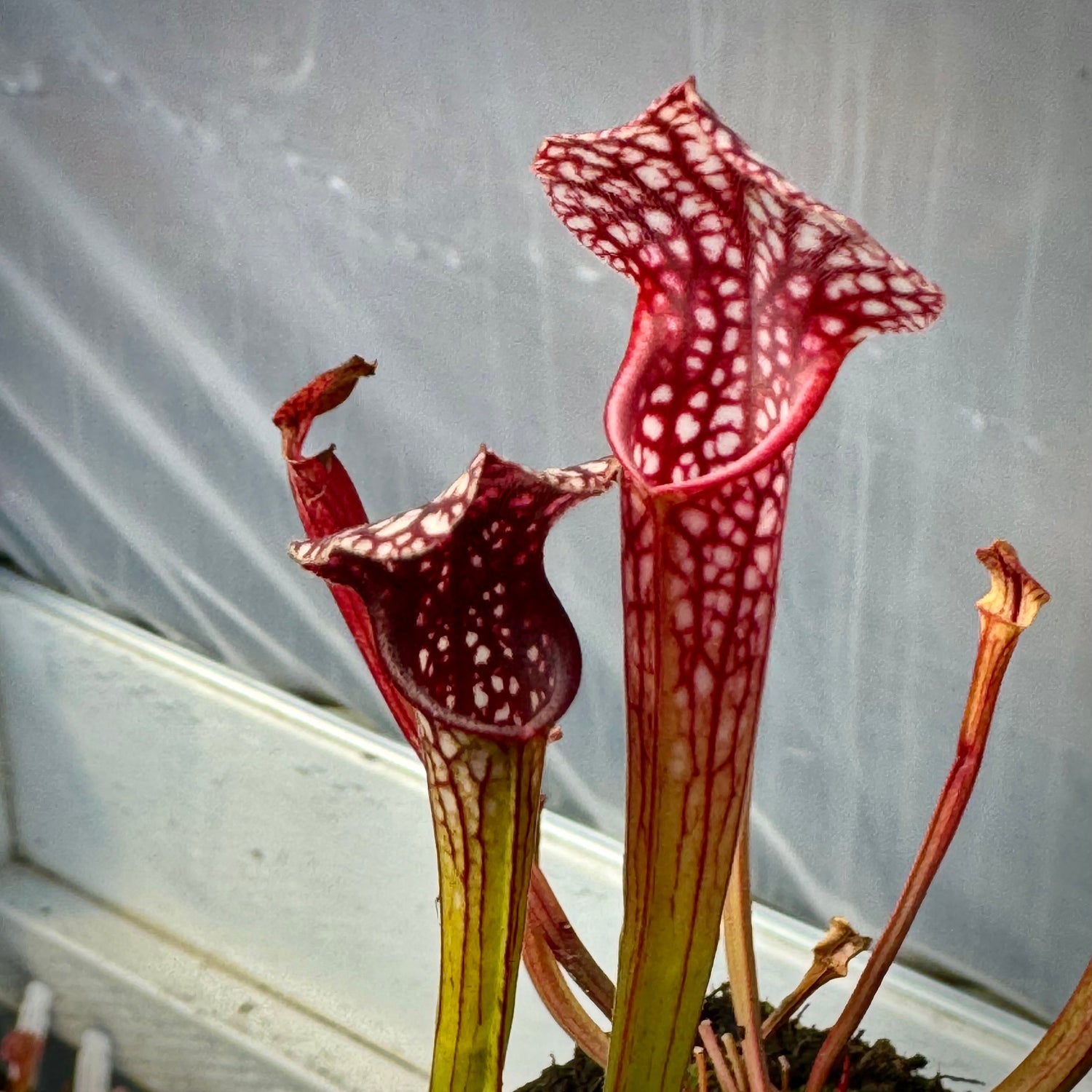
This is a dream cross that excites us even after hybridizing Sarracenia for over 30 years! ‘Caitrin Claire’ is one of the most stunning cultivars currently available. It has been aptly described as ‘Adrian Slack’ on acid! There is a crazy, vivid quality to its coloring. Damon has crossed that with the deep, dark maroon monster, ‘Saurus,’ one of the largest x moorei that exists today!
At maturity, all of these plants should be massive and mind-blowingly colorful! Don’t miss out on these if you want to add some hard-to-acquire, state-of-the-art genetics to your collection or breeding program! These are all seed-grown, so there is color, size, and shape variation!
DORMANT SEASONALLY, STARTING AS EARLY AS OCTOBER AND LASTING AS LATE AS MARCH, DEPENDING ON THE CONDITIONS AND SPECIES/HYBRID. The pitchers turn brown and die back to the rhizome, or non-carnivorous leaves (phyllodia) grow during this time. Please see the final photo to see how Sarracenia look when dormant. They will begin to grow vigorously again in Spring when photoperiods lengthen and temperatures increase.
Care Instructions:
Growth Habit: Sarracenia primarily grow along the Southeastern coastal plain of the United States. They grow pitchers, which are modified leaves, seasonally that can vary in height, color, and size depending on the species or hybrid. The pitchers can die back during the growing season, but new pitchers will grow throughout the spring and summer. The pitchers start to grow in spring, and many grow as the year progresses; in summer, they will be at their best. In summer, you may see brown or black on your pitchers, which can be normal nectar burn or crisping from heat. As Fall comes on, the pitchers may start to die back, turning brown, and by winter, many or all of the pitchers are brown, but the rhizome remains healthy and intact throughout winter dormancy even if you cannot see anything growing. Sarracenia have brown, black, or white roots and do not generally have many of them. The rhizome can be brown and still be healthy.
Sun: Full sun. Sarracenia require lots of direct sun to grow and form pitchers properly. In many areas, they can be grown outdoors in full sun. If you live in a very hot AND very dry place like Arizona or Sacramento, for example, you will want to grow your plants in full morning sun with protection from the afternoon sun or under 30% shade cloth. It is common for several pitchers to "burn" and die back when you first place your plant into the sun; your plant is acclimating to your conditions, and in most cases, new leaves will soon grow and be fully acclimated. Sarracenia can be grown indoors on extremely sunny windowsills that receive all-day sun, but they will require a grow light in most circumstances due to the amount of light the plant needs. Grow lights should be 6-12” from the plant, depending on the light, and on a 10-12 hour day length. Sarracenia generally are not a good candidate for a terrarium as they need intense light and get quite tall. Shorter species like Sarracenia purpurea will do better in a terrarium. Grow outdoors if possible for best results.
Water: Always keep them in a saucer with a few inches of distilled, rainwater, or reverse osmosis water. Never let them dry out, especially in the hot summer months. Sarracenia are bog plants that prefer water-logged conditions unless you live somewhere both very hot AND extremely humid, like Alabama. In that case, let the water tray dry out for a day or two between refills. Always use distilled, reverse osmosis, or rainwater only. These plants are sensitive to their water quality, and giving them mineral and salt-free water is very important. In winter, when the plants are dormant, you can let them dry out a bit between rain storms, but do not let the soil get so dry that it pulls away from the edges of the pots. Be sure to supplement water as needed in between rains in winter.
Temperature and Dormancy: These are warm-temperate plants, meaning they need warm summers and chilly winters. They should be grown outdoors year-round in areas with mild winters. They thrive in temperatures ranging from 20 degrees - 100F degrees and can take a brief freeze or high-temperature spike up to 105F degrees for a short period. If nighttime temps drop below 20 but rise again during the day above 40, your plant will be fine outside.
If you live in an area with very cold winters, where nighttime temperatures drop below 20 degrees for sustained periods, you have three options for providing them with winter dormancy: the garage method, mulching in, or the fridge method. Dormancy is triggered by a combination of exposure to shorter photo-periods and cooler temperatures in the 40-60's F. While you can skip a dormancy period once or twice, in the long term, your plant will begin to do poorly and will eventually die if you skip this crucial period.
The garage method: Bring your plant indoors to a sunny windowsill in an unheated room or garage, where the nighttime temperatures will dip down to 50-60F. Keep it well watered during this period, do not let it dry out, and put it outside again when the outside nighttime temperatures increase consistently above 20F.
The mulch method: Mulch them in very, very well outdoors. Pack at least four inches of mulch on top of the plants and all around the sides to prevent winds from chilling them and freezing the roots. You can also dig the pots into the ground and then mulch heavily on top.
The fridge method: remove the plants from pots, gently clean the roots of soil, wrap the roots in a bit of damp long-fibered New Zealand sphagnum moss, place the plants in a resealable bag, and put the bag into the refrigerator. Leave them in the fridge from October to February, periodically checking on them to ensure they are still moist and not growing mold or fungus. Pot them back up in February. You can vary the timing to align with your outside nighttime temperatures so that your plants can come out of dormancy when it is safe to place them back outside. You can leave them in the fridge for an extended period if you have very long winters.
Soil and Repotting: We prefer a mix of four-part fertilizer-free peat moss to one-part perlite. You can add our pre-made mix to your order here. You do not need to repot your plant when you receive it from us for at least a year, and we recommend against it during the spring-summer months. Repot Sarracenia every 1-3 years in winter when they are dormant. Avoid placing in excessively large pots; size up only a few inches at a time. They do well in tall pots. Soil can also develop a swampy smell, especially right after shipping, when the plant is wrapped in plastic and sealed. This is normal; these plants grow naturally in bogs and swampy conditions, and peat moss can develop a bit of an anaerobic smell, but this does not indicate a problem with the soil.
Feeding and Fertilizer: Sarracenia will catch plenty of food when grown outdoors. When grown indoors, they will significantly benefit from fertilizing, both a foliar fertilizer and feeding the pitchers. Plants grown outdoors will appreciate a foliar feed as well. Apply MaxSea fertilizer once per month to the foliage only. Dilute 1/4 teaspoon of MaxSea into one gallon of water and then apply to the pitchers, and inside the pitchers, with a mister bottle or a watering can. Osmocote slow-release flower and vegetable pellets can be dropped into the pitchers with a bit of distilled water. Pellets can burn the sides of the pitchers where they come to rest; that is normal.
More Information: For further information on dormancy, repotting, dividing, and more, check out our website or our YouTube channel.


Sarracenia ( x “Lemon Meringue” ) x ( leucophylla “Giant Red MKL18 x self” ) Potted
From $ 24.99
Unit price perSarracenia ( x “Lemon Meringue” ) x ( leucophylla “Giant Red MKL18 x self” ) Potted
From $ 24.99
Unit price perSarracenia ( x “Lemon Meringue” ) x ( leucophylla “Giant Red MKL18 x self” ) is a stunning new hybrid for 2026! Sarracenia x “Lemon Meringue” is one of Damon’s creations known for its lovely, lemony color and exaggerated lid! He’s combined that with a huge, vivid-red leucophylla and we expect these plants to have nice size, beautiful red and cream coloration and extra beautiful lids!
These seed-grown plants have variability in size, form, and color! X-Large sized plants do not indicate a taller plant, but a plant with multiple growth points.
DORMANT SEASONALLY, STARTING AS EARLY AS OCTOBER AND LASTING AS LATE AS MARCH, DEPENDING ON THE CONDITIONS AND SPECIES/HYBRID. The pitchers turn brown and die back to the rhizome, or non-carnivorous leaves (phyllodia) grow during this time. Please see the final photo to see how Sarracenia look when dormant. They will begin to grow vigorously again in Spring when photoperiods lengthen and temperatures increase.
Care Instructions:
Growth Habit: Sarracenia primarily grow along the Southeastern coastal plain of the United States. They grow pitchers, which are modified leaves, seasonally that can vary in height, color, and size depending on the species or hybrid. The pitchers can die back during the growing season, but new pitchers will grow throughout the spring and summer. The pitchers start to grow in spring, and many grow as the year progresses; in summer, they will be at their best. In summer, you may see brown or black on your pitchers, which can be normal nectar burn or crisping from heat. As Fall comes on, the pitchers may start to die back, turning brown, and by winter, many or all of the pitchers are brown, but the rhizome remains healthy and intact throughout winter dormancy even if you cannot see anything growing. Sarracenia have brown, black, or white roots and do not generally have many of them. The rhizome can be brown and still be healthy.
Sun: Full sun. Sarracenia require lots of direct sun to grow and form pitchers properly. In many areas, they can be grown outdoors in full sun. If you live in a very hot AND very dry place like Arizona or Sacramento, for example, you will want to grow your plants in full morning sun with protection from the afternoon sun or under 30% shade cloth. It is common for several pitchers to "burn" and die back when you first place your plant into the sun; your plant is acclimating to your conditions, and in most cases, new leaves will soon grow and be fully acclimated. Sarracenia can be grown indoors on extremely sunny windowsills that receive all-day sun, but they will require a grow light in most circumstances due to the amount of light the plant needs. Grow lights should be 6-12” from the plant, depending on the light, and on a 10-12 hour day length. Sarracenia generally are not a good candidate for a terrarium as they need intense light and get quite tall. Shorter species like Sarracenia purpurea will do better in a terrarium. Grow outdoors if possible for best results.
Water: Always keep them in a saucer with a few inches of distilled, rainwater, or reverse osmosis water. Never let them dry out, especially in the hot summer months. Sarracenia are bog plants that prefer water-logged conditions unless you live somewhere both very hot AND extremely humid, like Alabama. In that case, let the water tray dry out for a day or two between refills. Always use distilled, reverse osmosis, or rainwater only. These plants are sensitive to their water quality, and giving them mineral and salt-free water is very important. In winter, when the plants are dormant, you can let them dry out a bit between rain storms, but do not let the soil get so dry that it pulls away from the edges of the pots. Be sure to supplement water as needed in between rains in winter.
Temperature and Dormancy: These are warm-temperate plants, meaning they need warm summers and chilly winters. They should be grown outdoors year-round in areas with mild winters. They thrive in temperatures ranging from 20 degrees - 100F degrees and can take a brief freeze or high-temperature spike up to 105F degrees for a short period. If nighttime temps drop below 20 but rise again during the day above 40, your plant will be fine outside.
If you live in an area with very cold winters, where nighttime temperatures drop below 20 degrees for sustained periods, you have three options for providing them with winter dormancy: the garage method, mulching in, or the fridge method. Dormancy is triggered by a combination of exposure to shorter photo-periods and cooler temperatures in the 40-60's F. While you can skip a dormancy period once or twice, in the long term, your plant will begin to do poorly and will eventually die if you skip this crucial period.
The garage method: Bring your plant indoors to a sunny windowsill in an unheated room or garage, where the nighttime temperatures will dip down to 50-60F. Keep it well watered during this period, do not let it dry out, and put it outside again when the outside nighttime temperatures increase consistently above 20F.
The mulch method: Mulch them in very, very well outdoors. Pack at least four inches of mulch on top of the plants and all around the sides to prevent winds from chilling them and freezing the roots. You can also dig the pots into the ground and then mulch heavily on top.
The fridge method: remove the plants from pots, gently clean the roots of soil, wrap the roots in a bit of damp long-fibered New Zealand sphagnum moss, place the plants in a resealable bag, and put the bag into the refrigerator. Leave them in the fridge from October to February, periodically checking on them to ensure they are still moist and not growing mold or fungus. Pot them back up in February. You can vary the timing to align with your outside nighttime temperatures so that your plants can come out of dormancy when it is safe to place them back outside. You can leave them in the fridge for an extended period if you have very long winters.
Soil and Repotting: We prefer a mix of four-part fertilizer-free peat moss to one-part perlite. You can add our pre-made mix to your order here. You do not need to repot your plant when you receive it from us for at least a year, and we recommend against it during the spring-summer months. Repot Sarracenia every 1-3 years in winter when they are dormant. Avoid placing in excessively large pots; size up only a few inches at a time. They do well in tall pots. Soil can also develop a swampy smell, especially right after shipping, when the plant is wrapped in plastic and sealed. This is normal; these plants grow naturally in bogs and swampy conditions, and peat moss can develop a bit of an anaerobic smell, but this does not indicate a problem with the soil.
Feeding and Fertilizer: Sarracenia will catch plenty of food when grown outdoors. When grown indoors, they will significantly benefit from fertilizing, both a foliar fertilizer and feeding the pitchers. Plants grown outdoors will appreciate a foliar feed as well. Apply MaxSea fertilizer once per month to the foliage only. Dilute 1/4 teaspoon of MaxSea into one gallon of water and then apply to the pitchers, and inside the pitchers, with a mister bottle or a watering can. Osmocote slow-release flower and vegetable pellets can be dropped into the pitchers with a bit of distilled water. Pellets can burn the sides of the pitchers where they come to rest; that is normal.
More Information: For further information on dormancy, repotting, dividing, and more, check out our website or our YouTube channel.


Sarracenia x 'Adrian Slack' is a stunning hybrid that is a rainbow of colors. The pitchers turn from green to red in their upper tube, with a blood-red lip and an arresting white-topped lid streaked with red veins.
One of the most famous and sought-after of all Sarracenia cultivars, ‘Deep Throat’s’ gaping mouth graced the cover of the Savage Garden! It has a form unlike any other Sarracenia: a fiery, vaulted lid and a dark lip around its insanely wide mouth.
This is literally a dream hybridization, and every single seedling should be amazing! Damon already kept nine for our collection; he can’t keep them all…but wants to! These are seed-grown plants, and there will be considerable variation in color, form, and size.
DORMANT SEASONALLY, STARTING AS EARLY AS OCTOBER AND LASTING AS LATE AS MARCH, DEPENDING ON THE CONDITIONS AND SPECIES/HYBRID. The pitchers turn brown and die back to the rhizome, or non-carnivorous leaves (phyllodia) grow during this time. Please see the final photo to see how Sarracenia look when dormant. They will begin to grow vigorously again in Spring when photoperiods lengthen and temperatures increase.
Care Instructions:
Growth Habit: Sarracenia primarily grow along the Southeastern coastal plain of the United States. They grow pitchers, which are modified leaves, seasonally that can vary in height, color, and size depending on the species or hybrid. The pitchers can die back during the growing season, but new pitchers will grow throughout the spring and summer. The pitchers start to grow in spring, and many grow as the year progresses; in summer, they will be at their best. In summer, you may see brown or black on your pitchers, which can be normal nectar burn or crisping from heat. As Fall comes on, the pitchers may start to die back, turning brown, and by winter, many or all of the pitchers are brown, but the rhizome remains healthy and intact throughout winter dormancy even if you cannot see anything growing. Sarracenia have brown, black, or white roots and do not generally have many of them. The rhizome can be brown and still be healthy.
Sun: Full sun. Sarracenia require lots of direct sun to grow and form pitchers properly. In many areas, they can be grown outdoors in full sun. If you live in a very hot AND very dry place like Arizona or Sacramento, for example, you will want to grow your plants in full morning sun with protection from the afternoon sun or under 30% shade cloth. It is common for several pitchers to "burn" and die back when you first place your plant into the sun; your plant is acclimating to your conditions, and in most cases, new leaves will soon grow and be fully acclimated. Sarracenia can be grown indoors on extremely sunny windowsills that receive all-day sun, but they will require a grow light in most circumstances due to the amount of light the plant needs. Grow lights should be 6-12” from the plant, depending on the light, and on a 10-12 hour day length. Sarracenia generally are not a good candidate for a terrarium as they need intense light and get quite tall. Shorter species like Sarracenia purpurea will do better in a terrarium. Grow outdoors if possible for best results.
Water: Always keep them in a saucer with a few inches of distilled, rainwater, or reverse osmosis water. Never let them dry out, especially in the hot summer months. Sarracenia are bog plants that prefer water-logged conditions unless you live somewhere both very hot AND extremely humid, like Alabama. In that case, let the water tray dry out for a day or two between refills. Always use distilled, reverse osmosis, or rainwater only. These plants are sensitive to their water quality, and giving them mineral and salt-free water is very important. In winter, when the plants are dormant, you can let them dry out a bit between rain storms, but do not let the soil get so dry that it pulls away from the edges of the pots. Be sure to supplement water as needed in between rains in winter.
Temperature and Dormancy: These are warm-temperate plants, meaning they need warm summers and chilly winters. They should be grown outdoors year-round in areas with mild winters. They thrive in temperatures ranging from 20 degrees - 100F degrees and can take a brief freeze or high-temperature spike up to 105F degrees for a short period. If nighttime temps drop below 20 but rise again during the day above 40, your plant will be fine outside.
If you live in an area with very cold winters, where nighttime temperatures drop below 20 degrees for sustained periods, you have three options for providing them with winter dormancy: the garage method, mulching in, or the fridge method. Dormancy is triggered by a combination of exposure to shorter photo-periods and cooler temperatures in the 40-60's F. While you can skip a dormancy period once or twice, in the long term, your plant will begin to do poorly and will eventually die if you skip this crucial period.
The garage method: Bring your plant indoors to a sunny windowsill in an unheated room or garage, where the nighttime temperatures will dip down to 50-60F. Keep it well watered during this period, do not let it dry out, and put it outside again when the outside nighttime temperatures increase consistently above 20F.
The mulch method: Mulch them in very, very well outdoors. Pack at least four inches of mulch on top of the plants and all around the sides to prevent winds from chilling them and freezing the roots. You can also dig the pots into the ground and then mulch heavily on top.
The fridge method: remove the plants from pots, gently clean the roots of soil, wrap the roots in a bit of damp long-fibered New Zealand sphagnum moss, place the plants in a resealable bag, and put the bag into the refrigerator. Leave them in the fridge from October to February, periodically checking on them to ensure they are still moist and not growing mold or fungus. Pot them back up in February. You can vary the timing to align with your outside nighttime temperatures so that your plants can come out of dormancy when it is safe to place them back outside. You can leave them in the fridge for an extended period if you have very long winters.
Soil and Repotting: We prefer a mix of four-part fertilizer-free peat moss to one-part perlite. You can add our pre-made mix to your order here. You do not need to repot your plant when you receive it from us for at least a year, and we recommend against it during the spring-summer months. Repot Sarracenia every 1-3 years in winter when they are dormant. Avoid placing in excessively large pots; size up only a few inches at a time. They do well in tall pots. Soil can also develop a swampy smell, especially right after shipping, when the plant is wrapped in plastic and sealed. This is normal; these plants grow naturally in bogs and swampy conditions, and peat moss can develop a bit of an anaerobic smell, but this does not indicate a problem with the soil.
Feeding and Fertilizer: Sarracenia will catch plenty of food when grown outdoors. When grown indoors, they will significantly benefit from fertilizing, both a foliar fertilizer and feeding the pitchers. Plants grown outdoors will appreciate a foliar feed as well. Apply MaxSea fertilizer once per month to the foliage only. Dilute 1/4 teaspoon of MaxSea into one gallon of water and then apply to the pitchers, and inside the pitchers, with a mister bottle or a watering can. Osmocote slow-release flower and vegetable pellets can be dropped into the pitchers with a bit of distilled water. Pellets can burn the sides of the pitchers where they come to rest; that is normal.
More Information: For further information on dormancy, repotting, dividing, and more, check out our website or our YouTube channel.


Sarracenia ( x ‘Ember’ ) x ( x ‘Deep Throat’ ) is a lovely new hybrid—bright red with snake-shaped pitchers! When Damon combined these two plants, he was hoping for exaggerated mouths and profusions of pitchers!
These seed-grown plants have some variability in size, form, and color.
DORMANT SEASONALLY, STARTING AS EARLY AS OCTOBER AND LASTING AS LATE AS MARCH, DEPENDING ON THE CONDITIONS AND SPECIES/HYBRID. The pitchers turn brown and die back to the rhizome, or non-carnivorous leaves (phyllodia) grow during this time. Please see the final photo to see how Sarracenia look when dormant. They will begin to grow vigorously again in Spring when photoperiods lengthen and temperatures increase.
Care Instructions:
Growth Habit: Sarracenia primarily grow along the Southeastern coastal plain of the United States. They grow pitchers, which are modified leaves, seasonally that can vary in height, color, and size depending on the species or hybrid. The pitchers can die back during the growing season, but new pitchers will grow throughout the spring and summer. The pitchers start to grow in spring, and many grow as the year progresses; in summer, they will be at their best. In summer, you may see brown or black on your pitchers, which can be normal nectar burn or crisping from heat. As Fall comes on, the pitchers may start to die back, turning brown, and by winter, many or all of the pitchers are brown, but the rhizome remains healthy and intact throughout winter dormancy even if you cannot see anything growing. Sarracenia have brown, black, or white roots and do not generally have many of them. The rhizome can be brown and still be healthy.
Sun: Full sun. Sarracenia require lots of direct sun to grow and form pitchers properly. In many areas, they can be grown outdoors in full sun. If you live in a very hot AND very dry place like Arizona or Sacramento, for example, you will want to grow your plants in full morning sun with protection from the afternoon sun or under 30% shade cloth. It is common for several pitchers to "burn" and die back when you first place your plant into the sun; your plant is acclimating to your conditions, and in most cases, new leaves will soon grow and be fully acclimated. Sarracenia can be grown indoors on extremely sunny windowsills that receive all-day sun, but they will require a grow light in most circumstances due to the amount of light the plant needs. Grow lights should be 6-12” from the plant, depending on the light, and on a 10-12 hour day length. Sarracenia generally are not a good candidate for a terrarium as they need intense light and get quite tall. Shorter species like Sarracenia purpurea will do better in a terrarium. Grow outdoors if possible for best results.
Water: Always keep them in a saucer with a few inches of distilled, rainwater, or reverse osmosis water. Never let them dry out, especially in the hot summer months. Sarracenia are bog plants that prefer water-logged conditions unless you live somewhere both very hot AND extremely humid, like Alabama. In that case, let the water tray dry out for a day or two between refills. Always use distilled, reverse osmosis, or rainwater only. These plants are sensitive to their water quality, and giving them mineral and salt-free water is very important. In winter, when the plants are dormant, you can let them dry out a bit between rain storms, but do not let the soil get so dry that it pulls away from the edges of the pots. Be sure to supplement water as needed in between rains in winter.
Temperature and Dormancy: These are warm-temperate plants, meaning they need warm summers and chilly winters. They should be grown outdoors year-round in areas with mild winters. They thrive in temperatures ranging from 20 degrees - 100F degrees and can take a brief freeze or high-temperature spike up to 105F degrees for a short period. If nighttime temps drop below 20 but rise again during the day above 40, your plant will be fine outside.
If you live in an area with very cold winters, where nighttime temperatures drop below 20 degrees for sustained periods, you have three options for providing them with winter dormancy: the garage method, mulching in, or the fridge method. Dormancy is triggered by a combination of exposure to shorter photo-periods and cooler temperatures in the 40-60's F. While you can skip a dormancy period once or twice, in the long term, your plant will begin to do poorly and will eventually die if you skip this crucial period.
The garage method: Bring your plant indoors to a sunny windowsill in an unheated room or garage, where the nighttime temperatures will dip down to 50-60F. Keep it well watered during this period, do not let it dry out, and put it outside again when the outside nighttime temperatures increase consistently above 20F.
The mulch method: Mulch them in very, very well outdoors. Pack at least four inches of mulch on top of the plants and all around the sides to prevent winds from chilling them and freezing the roots. You can also dig the pots into the ground and then mulch heavily on top.
The fridge method: remove the plants from pots, gently clean the roots of soil, wrap the roots in a bit of damp long-fibered New Zealand sphagnum moss, place the plants in a resealable bag, and put the bag into the refrigerator. Leave them in the fridge from October to February, periodically checking on them to ensure they are still moist and not growing mold or fungus. Pot them back up in February. You can vary the timing to align with your outside nighttime temperatures so that your plants can come out of dormancy when it is safe to place them back outside. You can leave them in the fridge for an extended period if you have very long winters.
Soil and Repotting: We prefer a mix of four-part fertilizer-free peat moss to one-part perlite. You can add our pre-made mix to your order here. You do not need to repot your plant when you receive it from us for at least a year, and we recommend against it during the spring-summer months. Repot Sarracenia every 1-3 years in winter when they are dormant. Avoid placing in excessively large pots; size up only a few inches at a time. They do well in tall pots. Soil can also develop a swampy smell, especially right after shipping, when the plant is wrapped in plastic and sealed. This is normal; these plants grow naturally in bogs and swampy conditions, and peat moss can develop a bit of an anaerobic smell, but this does not indicate a problem with the soil.
Feeding and Fertilizer: Sarracenia will catch plenty of food when grown outdoors. When grown indoors, they will significantly benefit from fertilizing, both a foliar fertilizer and feeding the pitchers. Plants grown outdoors will appreciate a foliar feed as well. Apply MaxSea fertilizer once per month to the foliage only. Dilute 1/4 teaspoon of MaxSea into one gallon of water and then apply to the pitchers, and inside the pitchers, with a mister bottle or a watering can. Osmocote slow-release flower and vegetable pellets can be dropped into the pitchers with a bit of distilled water. Pellets can burn the sides of the pitchers where they come to rest; that is normal.
More Information: For further information on dormancy, repotting, dividing, and more, check out our website or our YouTube channel.


Sarracenia alata, the Pale Trumpet, has unique, superbly pale yellow, almost pure white flowers. Its very upright pitchers are quite variable in size and coloration. Sarracenia alata has neatly pointed lids, usually held closely to the mouth, and a slightly bulging throat.
These are divisions of a veinless clone.
*If you see black mold on your pitcher, don't panic! This harmless mold grows on the pitcher nectar and is not harmful to your plant. It exists on all Sarracenia but is more noticeable on the anthocyanin-free plants. Although some consider it unsightly, it is normal and occurs on both plants in the wild and cultivation. It can be difficult to wipe off, but the more persnickety of us can try!
DORMANT SEASONALLY, STARTING AS EARLY AS OCTOBER AND LASTING AS LATE AS MARCH, DEPENDING ON THE CONDITIONS AND SPECIES/HYBRID. The pitchers turn brown and die back to the rhizome, or non-carnivorous leaves (phyllodia) grow during this time. Please see the final photo to see how Sarracenia look when dormant. They will begin to grow vigorously again in Spring when photoperiods lengthen and temperatures increase.
Care Instructions:
Growth Habit: Sarracenia primarily grow along the Southeastern coastal plain of the United States. They grow pitchers, which are modified leaves, seasonally that can vary in height, color, and size depending on the species or hybrid. The pitchers can die back during the growing season, but new pitchers will grow throughout the spring and summer. The pitchers start to grow in spring, and many grow as the year progresses; in summer, they will be at their best. In summer, you may see brown or black on your pitchers, which can be normal nectar burn or crisping from heat. As Fall comes on, the pitchers may start to die back, turning brown, and by winter, many or all of the pitchers are brown, but the rhizome remains healthy and intact throughout winter dormancy even if you cannot see anything growing. Sarracenia have brown, black, or white roots and do not generally have many of them. The rhizome can be brown and still be healthy.
Sun: Full sun. Sarracenia require lots of direct sun to grow and form pitchers properly. In many areas, they can be grown outdoors in full sun. If you live in a very hot AND very dry place like Arizona or Sacramento, for example, you will want to grow your plants in full morning sun with protection from the afternoon sun or under 30% shade cloth. It is common for several pitchers to "burn" and die back when you first place your plant into the sun; your plant is acclimating to your conditions, and in most cases, new leaves will soon grow and be fully acclimated. Sarracenia can be grown indoors on extremely sunny windowsills that receive all-day sun, but they will require a grow light in most circumstances due to the amount of light the plant needs. Grow lights should be 6-12” from the plant, depending on the light, and on a 10-12 hour day length. Sarracenia generally are not a good candidate for a terrarium as they need intense light and get quite tall. Shorter species like Sarracenia purpurea will do better in a terrarium. Grow outdoors if possible for best results.
Water: Always keep them in a saucer with a few inches of distilled, rainwater, or reverse osmosis water. Never let them dry out, especially in the hot summer months. Sarracenia are bog plants that prefer water-logged conditions unless you live somewhere both very hot AND extremely humid, like Alabama. In that case, let the water tray dry out for a day or two between refills. Always use distilled, reverse osmosis, or rainwater only. These plants are sensitive to their water quality, and giving them mineral and salt-free water is very important. In winter, when the plants are dormant, you can let them dry out a bit between rain storms, but do not let the soil get so dry that it pulls away from the edges of the pots. Be sure to supplement water as needed in between rains in winter.
Temperature and Dormancy: These are warm-temperate plants, meaning they need warm summers and chilly winters. They should be grown outdoors year-round in areas with mild winters. They thrive in temperatures ranging from 20 degrees - 100F degrees and can take a brief freeze or high-temperature spike up to 105F degrees for a short period. If nighttime temps drop below 20 but rise again during the day above 40, your plant will be fine outside.
If you live in an area with very cold winters, where nighttime temperatures drop below 20 degrees for sustained periods, you have three options for providing them with winter dormancy: the garage method, mulching in, or the fridge method. Dormancy is triggered by a combination of exposure to shorter photo-periods and cooler temperatures in the 40-60's F. While you can skip a dormancy period once or twice, in the long term, your plant will begin to do poorly and will eventually die if you skip this crucial period.
The garage method: Bring your plant indoors to a sunny windowsill in an unheated room or garage, where the nighttime temperatures will dip down to 50-60F. Keep it well watered during this period, do not let it dry out, and put it outside again when the outside nighttime temperatures increase consistently above 20F.
The mulch method: Mulch them in very, very well outdoors. Pack at least four inches of mulch on top of the plants and all around the sides to prevent winds from chilling them and freezing the roots. You can also dig the pots into the ground and then mulch heavily on top.
The fridge method: remove the plants from pots, gently clean the roots of soil, wrap the roots in a bit of damp long-fibered New Zealand sphagnum moss, place the plants in a resealable bag, and put the bag into the refrigerator. Leave them in the fridge from October to February, periodically checking on them to ensure they are still moist and not growing mold or fungus. Pot them back up in February. You can vary the timing to align with your outside nighttime temperatures so that your plants can come out of dormancy when it is safe to place them back outside. You can leave them in the fridge for an extended period if you have very long winters.
Soil and Repotting: We prefer a mix of four-part fertilizer-free peat moss to one-part perlite. You can add our pre-made mix to your order here. You do not need to repot your plant when you receive it from us for at least a year, and we recommend against it during the spring-summer months. Repot Sarracenia every 1-3 years in winter when they are dormant. Avoid placing in excessively large pots; size up only a few inches at a time. They do well in tall pots. Soil can also develop a swampy smell, especially right after shipping, when the plant is wrapped in plastic and sealed. This is normal; these plants grow naturally in bogs and swampy conditions, and peat moss can develop a bit of an anaerobic smell, but this does not indicate a problem with the soil.
Feeding and Fertilizer: Sarracenia will catch plenty of food when grown outdoors. When grown indoors, they will significantly benefit from fertilizing, both a foliar fertilizer and feeding the pitchers. Plants grown outdoors will appreciate a foliar feed as well. Apply MaxSea fertilizer once per month to the foliage only. Dilute 1/4 teaspoon of MaxSea into one gallon of water and then apply to the pitchers, and inside the pitchers, with a mister bottle or a watering can. Osmocote slow-release flower and vegetable pellets can be dropped into the pitchers with a bit of distilled water. Pellets can burn the sides of the pitchers where they come to rest; that is normal.
More Information: For further information on dormancy, repotting, dividing, and more, check out our website or our YouTube channel.


Sarracenia alata, the Pale Trumpet, has unique, superbly pale yellow, almost pure white flowers. Its very upright pitchers are quite variable in size and coloration. Sarracenia alata has neatly pointed lids, usually held closely to the mouth, and a slightly bulging throat.
These are divisions of a veinless clone crossed with an anthocyanin-free recessive clone.
*If you see black mold on your pitcher, don't panic! This harmless mold grows on the pitcher nectar and is not harmful to your plant. It exists on all Sarracenia but is more noticeable on the anthocyanin-free plants. Although some consider it unsightly, it is normal and occurs on both plants in the wild and cultivation. It can be difficult to wipe off, but the more persnickety of us can try!
DORMANT SEASONALLY, STARTING AS EARLY AS OCTOBER AND LASTING AS LATE AS MARCH, DEPENDING ON THE CONDITIONS AND SPECIES/HYBRID. The pitchers turn brown and die back to the rhizome, or non-carnivorous leaves (phyllodia) grow during this time. Please see the final photo to see how Sarracenia look when dormant. They will begin to grow vigorously again in Spring when photoperiods lengthen and temperatures increase.
Care Instructions:
Growth Habit: Sarracenia primarily grow along the Southeastern coastal plain of the United States. They grow pitchers, which are modified leaves, seasonally that can vary in height, color, and size depending on the species or hybrid. The pitchers can die back during the growing season, but new pitchers will grow throughout the spring and summer. The pitchers start to grow in spring, and many grow as the year progresses; in summer, they will be at their best. In summer, you may see brown or black on your pitchers, which can be normal nectar burn or crisping from heat. As Fall comes on, the pitchers may start to die back, turning brown, and by winter, many or all of the pitchers are brown, but the rhizome remains healthy and intact throughout winter dormancy even if you cannot see anything growing. Sarracenia have brown, black, or white roots and do not generally have many of them. The rhizome can be brown and still be healthy.
Sun: Full sun. Sarracenia require lots of direct sun to grow and form pitchers properly. In many areas, they can be grown outdoors in full sun. If you live in a very hot AND very dry place like Arizona or Sacramento, for example, you will want to grow your plants in full morning sun with protection from the afternoon sun or under 30% shade cloth. It is common for several pitchers to "burn" and die back when you first place your plant into the sun; your plant is acclimating to your conditions, and in most cases, new leaves will soon grow and be fully acclimated. Sarracenia can be grown indoors on extremely sunny windowsills that receive all-day sun, but they will require a grow light in most circumstances due to the amount of light the plant needs. Grow lights should be 6-12” from the plant, depending on the light, and on a 10-12 hour day length. Sarracenia generally are not a good candidate for a terrarium as they need intense light and get quite tall. Shorter species like Sarracenia purpurea will do better in a terrarium. Grow outdoors if possible for best results.
Water: Always keep them in a saucer with a few inches of distilled, rainwater, or reverse osmosis water. Never let them dry out, especially in the hot summer months. Sarracenia are bog plants that prefer water-logged conditions unless you live somewhere both very hot AND extremely humid, like Alabama. In that case, let the water tray dry out for a day or two between refills. Always use distilled, reverse osmosis, or rainwater only. These plants are sensitive to their water quality, and giving them mineral and salt-free water is very important. In winter, when the plants are dormant, you can let them dry out a bit between rain storms, but do not let the soil get so dry that it pulls away from the edges of the pots. Be sure to supplement water as needed in between rains in winter.
Temperature and Dormancy: These are warm-temperate plants, meaning they need warm summers and chilly winters. They should be grown outdoors year-round in areas with mild winters. They thrive in temperatures ranging from 20 degrees - 100F degrees and can take a brief freeze or high-temperature spike up to 105F degrees for a short period. If nighttime temps drop below 20 but rise again during the day above 40, your plant will be fine outside.
If you live in an area with very cold winters, where nighttime temperatures drop below 20 degrees for sustained periods, you have three options for providing them with winter dormancy: the garage method, mulching in, or the fridge method. Dormancy is triggered by a combination of exposure to shorter photo-periods and cooler temperatures in the 40-60's F. While you can skip a dormancy period once or twice, in the long term, your plant will begin to do poorly and will eventually die if you skip this crucial period.
The garage method: Bring your plant indoors to a sunny windowsill in an unheated room or garage, where the nighttime temperatures will dip down to 50-60F. Keep it well watered during this period, do not let it dry out, and put it outside again when the outside nighttime temperatures increase consistently above 20F.
The mulch method: Mulch them in very, very well outdoors. Pack at least four inches of mulch on top of the plants and all around the sides to prevent winds from chilling them and freezing the roots. You can also dig the pots into the ground and then mulch heavily on top.
The fridge method: remove the plants from pots, gently clean the roots of soil, wrap the roots in a bit of damp long-fibered New Zealand sphagnum moss, place the plants in a resealable bag, and put the bag into the refrigerator. Leave them in the fridge from October to February, periodically checking on them to ensure they are still moist and not growing mold or fungus. Pot them back up in February. You can vary the timing to align with your outside nighttime temperatures so that your plants can come out of dormancy when it is safe to place them back outside. You can leave them in the fridge for an extended period if you have very long winters.
Soil and Repotting: We prefer a mix of four-part fertilizer-free peat moss to one-part perlite. You can add our pre-made mix to your order here. You do not need to repot your plant when you receive it from us for at least a year, and we recommend against it during the spring-summer months. Repot Sarracenia every 1-3 years in winter when they are dormant. Avoid placing in excessively large pots; size up only a few inches at a time. They do well in tall pots. Soil can also develop a swampy smell, especially right after shipping, when the plant is wrapped in plastic and sealed. This is normal; these plants grow naturally in bogs and swampy conditions, and peat moss can develop a bit of an anaerobic smell, but this does not indicate a problem with the soil.
Feeding and Fertilizer: Sarracenia will catch plenty of food when grown outdoors. When grown indoors, they will significantly benefit from fertilizing, both a foliar fertilizer and feeding the pitchers. Plants grown outdoors will appreciate a foliar feed as well. Apply MaxSea fertilizer once per month to the foliage only. Dilute 1/4 teaspoon of MaxSea into one gallon of water and then apply to the pitchers, and inside the pitchers, with a mister bottle or a watering can. Osmocote slow-release flower and vegetable pellets can be dropped into the pitchers with a bit of distilled water. Pellets can burn the sides of the pitchers where they come to rest; that is normal.
More Information: For further information on dormancy, repotting, dividing, and more, check out our website or our YouTube channel.


This is a selfing of the well known dark Sarracenia alata "Night". This plant displays dark red veining with bright yellow lips when first opening that mature into a dark black/red pitcher as the season progresses!
These are divisions.
DORMANT SEASONALLY, STARTING AS EARLY AS OCTOBER AND LASTING AS LATE AS MARCH, DEPENDING ON THE CONDITIONS AND SPECIES/HYBRID. The pitchers turn brown and die back to the rhizome, or non-carnivorous leaves (phyllodia) grow during this time. Please see the final photo to see how Sarracenia look when dormant. They will begin to grow vigorously again in Spring when photoperiods lengthen and temperatures increase.
Care Instructions:
Growth Habit: Sarracenia primarily grow along the Southeastern coastal plain of the United States. They grow pitchers, which are modified leaves, seasonally that can vary in height, color, and size depending on the species or hybrid. The pitchers can die back during the growing season, but new pitchers will grow throughout the spring and summer. The pitchers start to grow in spring, and many grow as the year progresses; in summer, they will be at their best. In summer, you may see brown or black on your pitchers, which can be normal nectar burn or crisping from heat. As Fall comes on, the pitchers may start to die back, turning brown, and by winter, many or all of the pitchers are brown, but the rhizome remains healthy and intact throughout winter dormancy even if you cannot see anything growing. Sarracenia have brown, black, or white roots and do not generally have many of them. The rhizome can be brown and still be healthy.
Sun: Full sun. Sarracenia require lots of direct sun to grow and form pitchers properly. In many areas, they can be grown outdoors in full sun. If you live in a very hot AND very dry place like Arizona or Sacramento, for example, you will want to grow your plants in full morning sun with protection from the afternoon sun or under 30% shade cloth. It is common for several pitchers to "burn" and die back when you first place your plant into the sun; your plant is acclimating to your conditions, and in most cases, new leaves will soon grow and be fully acclimated. Sarracenia can be grown indoors on extremely sunny windowsills that receive all-day sun, but they will require a grow light in most circumstances due to the amount of light the plant needs. Grow lights should be 6-12” from the plant, depending on the light, and on a 10-12 hour day length. Sarracenia generally are not a good candidate for a terrarium as they need intense light and get quite tall. Shorter species like Sarracenia purpurea will do better in a terrarium. Grow outdoors if possible for best results.
Water: Always keep them in a saucer with a few inches of distilled, rainwater, or reverse osmosis water. Never let them dry out, especially in the hot summer months. Sarracenia are bog plants that prefer water-logged conditions unless you live somewhere both very hot AND extremely humid, like Alabama. In that case, let the water tray dry out for a day or two between refills. Always use distilled, reverse osmosis, or rainwater only. These plants are sensitive to their water quality, and giving them mineral and salt-free water is very important. In winter, when the plants are dormant, you can let them dry out a bit between rain storms, but do not let the soil get so dry that it pulls away from the edges of the pots. Be sure to supplement water as needed in between rains in winter.
Temperature and Dormancy: These are warm-temperate plants, meaning they need warm summers and chilly winters. They should be grown outdoors year-round in areas with mild winters. They thrive in temperatures ranging from 20 degrees - 100F degrees and can take a brief freeze or high-temperature spike up to 105F degrees for a short period. If nighttime temps drop below 20 but rise again during the day above 40, your plant will be fine outside.
If you live in an area with very cold winters, where nighttime temperatures drop below 20 degrees for sustained periods, you have three options for providing them with winter dormancy: the garage method, mulching in, or the fridge method. Dormancy is triggered by a combination of exposure to shorter photo-periods and cooler temperatures in the 40-60's F. While you can skip a dormancy period once or twice, in the long term, your plant will begin to do poorly and will eventually die if you skip this crucial period.
The garage method: Bring your plant indoors to a sunny windowsill in an unheated room or garage, where the nighttime temperatures will dip down to 50-60F. Keep it well watered during this period, do not let it dry out, and put it outside again when the outside nighttime temperatures increase consistently above 20F.
The mulch method: Mulch them in very, very well outdoors. Pack at least four inches of mulch on top of the plants and all around the sides to prevent winds from chilling them and freezing the roots. You can also dig the pots into the ground and then mulch heavily on top.
The fridge method: remove the plants from pots, gently clean the roots of soil, wrap the roots in a bit of damp long-fibered New Zealand sphagnum moss, place the plants in a resealable bag, and put the bag into the refrigerator. Leave them in the fridge from October to February, periodically checking on them to ensure they are still moist and not growing mold or fungus. Pot them back up in February. You can vary the timing to align with your outside nighttime temperatures so that your plants can come out of dormancy when it is safe to place them back outside. You can leave them in the fridge for an extended period if you have very long winters.
Soil and Repotting: We prefer a mix of four-part fertilizer-free peat moss to one-part perlite. You can add our pre-made mix to your order here. You do not need to repot your plant when you receive it from us for at least a year, and we recommend against it during the spring-summer months. Repot Sarracenia every 1-3 years in winter when they are dormant. Avoid placing in excessively large pots; size up only a few inches at a time. They do well in tall pots. Soil can also develop a swampy smell, especially right after shipping, when the plant is wrapped in plastic and sealed. This is normal; these plants grow naturally in bogs and swampy conditions, and peat moss can develop a bit of an anaerobic smell, but this does not indicate a problem with the soil.
Feeding and Fertilizer: Sarracenia will catch plenty of food when grown outdoors. When grown indoors, they will significantly benefit from fertilizing, both a foliar fertilizer and feeding the pitchers. Plants grown outdoors will appreciate a foliar feed as well. Apply MaxSea fertilizer once per month to the foliage only. Dilute 1/4 teaspoon of MaxSea into one gallon of water and then apply to the pitchers, and inside the pitchers, with a mister bottle or a watering can. Osmocote slow-release flower and vegetable pellets can be dropped into the pitchers with a bit of distilled water. Pellets can burn the sides of the pitchers where they come to rest; that is normal.
More Information: For further information on dormancy, repotting, dividing, and more, check out our website or our YouTube channel.
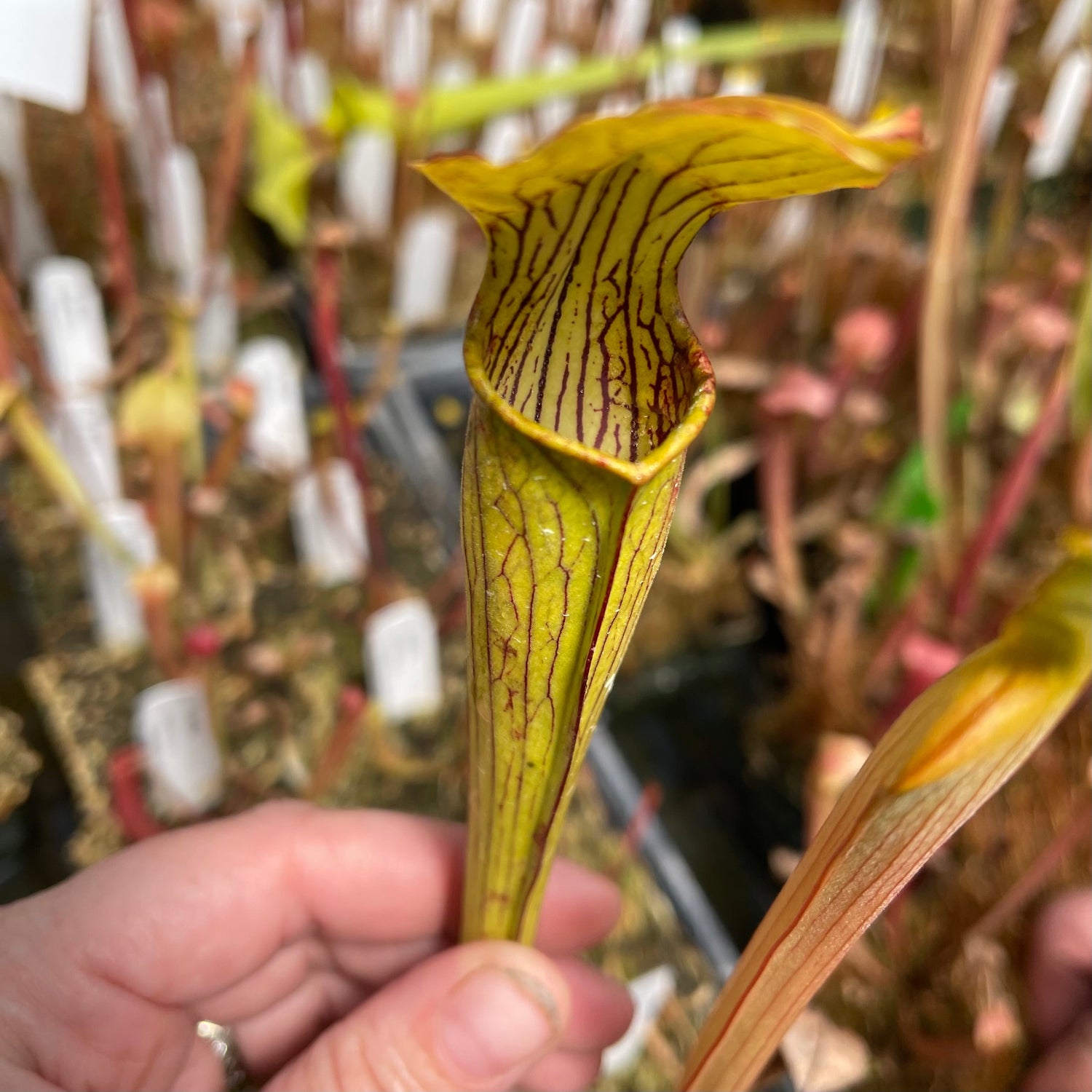
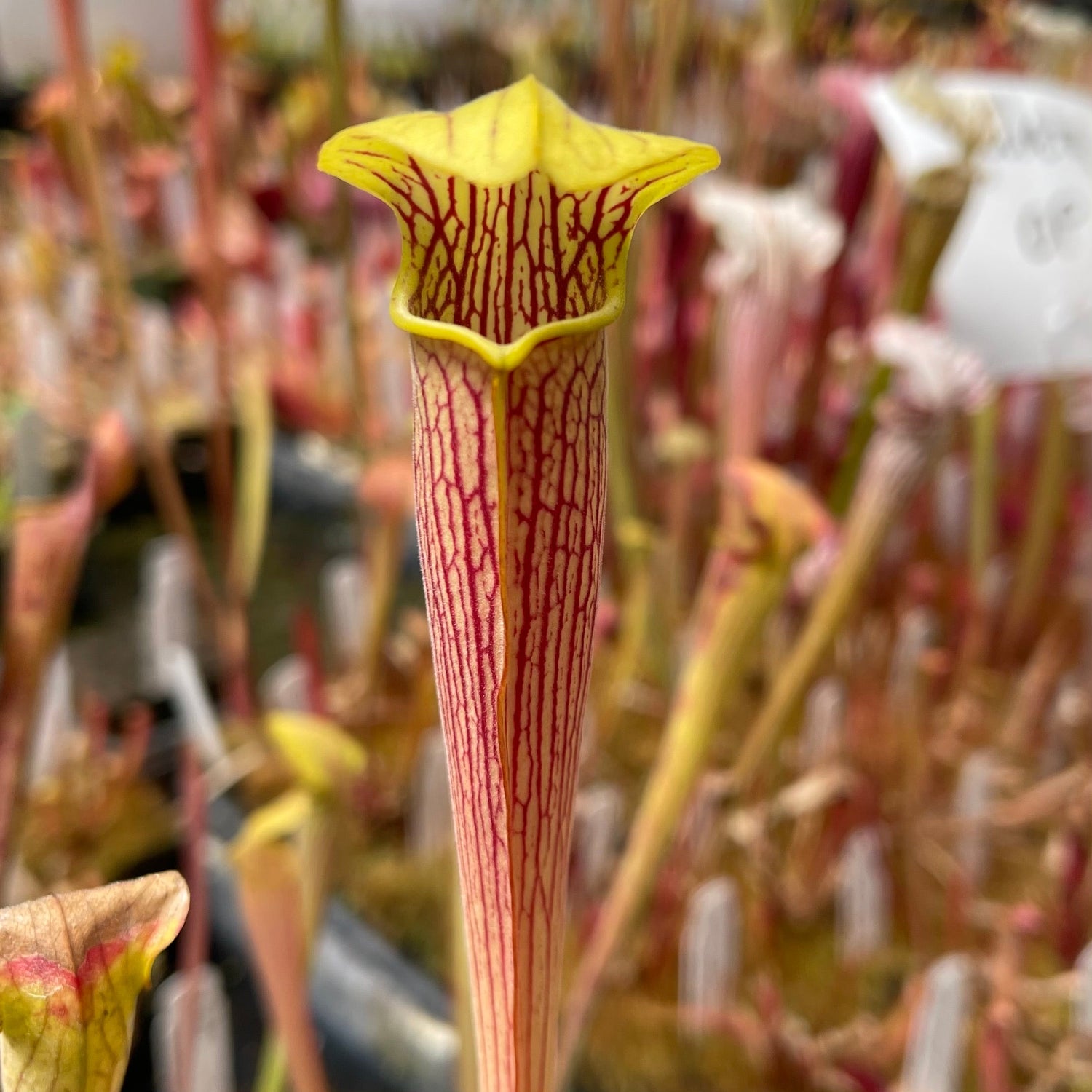
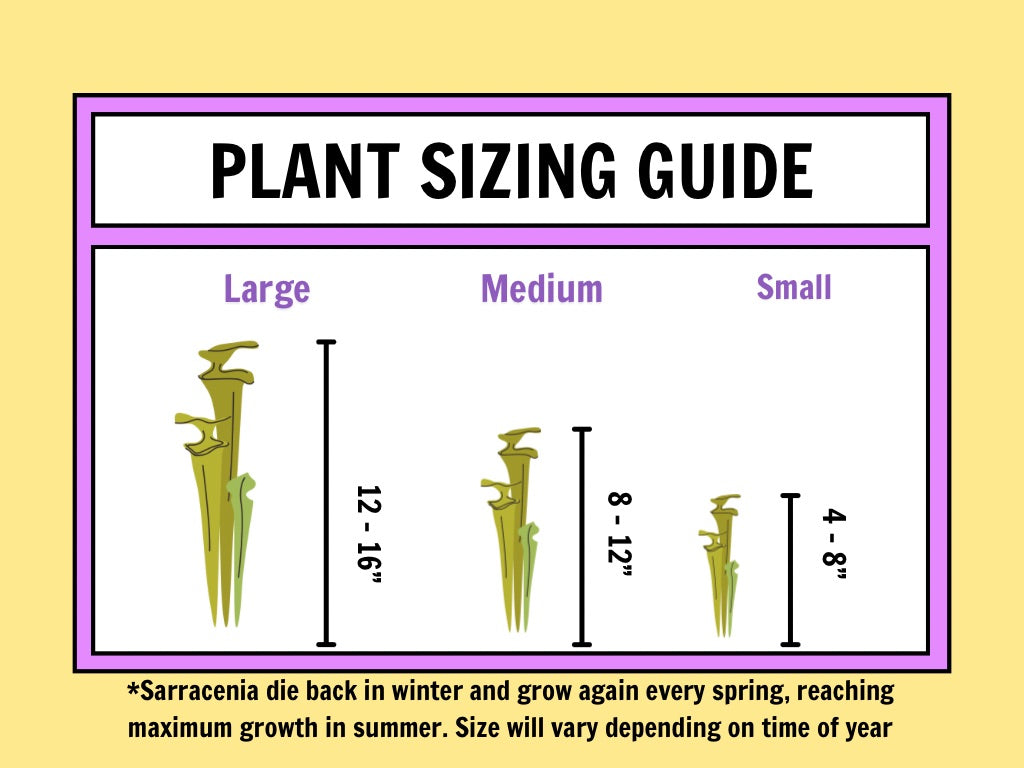
Sarracenia alata, the Pale Trumpet, has unique, superbly pale yellow, almost pure white flowers. It has very upright pitchers that are quite variable in both size and coloration. Sarracenia alata has neatly pointed lids, usually held closely to the mouth with a slightly bulging throat.
Small and Medium sized plants are divisions, Large and X-Large sized plants are tissue culture plants.
DORMANT SEASONALLY, STARTING AS EARLY AS OCTOBER AND LASTING AS LATE AS MARCH, DEPENDING ON THE CONDITIONS AND SPECIES/HYBRID. The pitchers turn brown and die back to the rhizome, or non-carnivorous leaves (phyllodia) grow during this time. Please see the final photo to see how Sarracenia look when dormant. They will begin to grow vigorously again in Spring when photoperiods lengthen and temperatures increase.
Care Instructions:
Growth Habit: Sarracenia primarily grow along the Southeastern coastal plain of the United States. They grow pitchers, which are modified leaves, seasonally that can vary in height, color, and size depending on the species or hybrid. The pitchers can die back during the growing season, but new pitchers will grow throughout the spring and summer. The pitchers start to grow in spring, and many grow as the year progresses; in summer, they will be at their best. In summer, you may see brown or black on your pitchers, which can be normal nectar burn or crisping from heat. As Fall comes on, the pitchers may start to die back, turning brown, and by winter, many or all of the pitchers are brown, but the rhizome remains healthy and intact throughout winter dormancy even if you cannot see anything growing. Sarracenia have brown, black, or white roots and do not generally have many of them. The rhizome can be brown and still be healthy.
Sun: Full sun. Sarracenia require lots of direct sun to grow and form pitchers properly. In many areas, they can be grown outdoors in full sun. If you live in a very hot AND very dry place like Arizona or Sacramento, for example, you will want to grow your plants in full morning sun with protection from the afternoon sun or under 30% shade cloth. It is common for several pitchers to "burn" and die back when you first place your plant into the sun; your plant is acclimating to your conditions, and in most cases, new leaves will soon grow and be fully acclimated. Sarracenia can be grown indoors on extremely sunny windowsills that receive all-day sun, but they will require a grow light in most circumstances due to the amount of light the plant needs. Grow lights should be 6-12” from the plant, depending on the light, and on a 10-12 hour day length. Sarracenia generally are not a good candidate for a terrarium as they need intense light and get quite tall. Shorter species like Sarracenia purpurea will do better in a terrarium. Grow outdoors if possible for best results.
Water: Always keep them in a saucer with a few inches of distilled, rainwater, or reverse osmosis water. Never let them dry out, especially in the hot summer months. Sarracenia are bog plants that prefer water-logged conditions unless you live somewhere both very hot AND extremely humid, like Alabama. In that case, let the water tray dry out for a day or two between refills. Always use distilled, reverse osmosis, or rainwater only. These plants are sensitive to their water quality, and giving them mineral and salt-free water is very important. In winter, when the plants are dormant, you can let them dry out a bit between rain storms, but do not let the soil get so dry that it pulls away from the edges of the pots. Be sure to supplement water as needed in between rains in winter.
Temperature and Dormancy: These are warm-temperate plants, meaning they need warm summers and chilly winters. They should be grown outdoors year-round in areas with mild winters. They thrive in temperatures ranging from 20 degrees - 100F degrees and can take a brief freeze or high-temperature spike up to 105F degrees for a short period. If nighttime temps drop below 20 but rise again during the day above 40, your plant will be fine outside.
If you live in an area with very cold winters, where nighttime temperatures drop below 20 degrees for sustained periods, you have three options for providing them with winter dormancy: the garage method, mulching in, or the fridge method. Dormancy is triggered by a combination of exposure to shorter photo-periods and cooler temperatures in the 40-60's F. While you can skip a dormancy period once or twice, in the long term, your plant will begin to do poorly and will eventually die if you skip this crucial period.
The garage method: Bring your plant indoors to a sunny windowsill in an unheated room or garage, where the nighttime temperatures will dip down to 50-60F. Keep it well watered during this period, do not let it dry out, and put it outside again when the outside nighttime temperatures increase consistently above 20F.
The mulch method: Mulch them in very, very well outdoors. Pack at least four inches of mulch on top of the plants and all around the sides to prevent winds from chilling them and freezing the roots. You can also dig the pots into the ground and then mulch heavily on top.
The fridge method: remove the plants from pots, gently clean the roots of soil, wrap the roots in a bit of damp long-fibered New Zealand sphagnum moss, place the plants in a resealable bag, and put the bag into the refrigerator. Leave them in the fridge from October to February, periodically checking on them to ensure they are still moist and not growing mold or fungus. Pot them back up in February. You can vary the timing to align with your outside nighttime temperatures so that your plants can come out of dormancy when it is safe to place them back outside. You can leave them in the fridge for an extended period if you have very long winters.
Soil and Repotting: We prefer a mix of four-part fertilizer-free peat moss to one-part perlite. You can add our pre-made mix to your order here. You do not need to repot your plant when you receive it from us for at least a year, and we recommend against it during the spring-summer months. Repot Sarracenia every 1-3 years in winter when they are dormant. Avoid placing in excessively large pots; size up only a few inches at a time. They do well in tall pots. Soil can also develop a swampy smell, especially right after shipping, when the plant is wrapped in plastic and sealed. This is normal; these plants grow naturally in bogs and swampy conditions, and peat moss can develop a bit of an anaerobic smell, but this does not indicate a problem with the soil.
Feeding and Fertilizer: Sarracenia will catch plenty of food when grown outdoors. When grown indoors, they will significantly benefit from fertilizing, both a foliar fertilizer and feeding the pitchers. Plants grown outdoors will appreciate a foliar feed as well. Apply MaxSea fertilizer once per month to the foliage only. Dilute 1/4 teaspoon of MaxSea into one gallon of water and then apply to the pitchers, and inside the pitchers, with a mister bottle or a watering can. Osmocote slow-release flower and vegetable pellets can be dropped into the pitchers with a bit of distilled water. Pellets can burn the sides of the pitchers where they come to rest; that is normal.
More Information: For further information on dormancy, repotting, dividing, and more, check out our website or our YouTube channel.


Sarracenia alata, the Pale Trumpet has unique, superbly pale yellow, almost pure white, flowers. It has very upright pitchers that are quite variable in both size and coloration. Sarracenia alata has neatly pointed lids, usually held closely to the mouth with a slightly bulging throat.
This particular clone exhibits an attractive red throat and dark coloration! These are divisions.
DORMANT SEASONALLY, STARTING AS EARLY AS OCTOBER AND LASTING AS LATE AS MARCH, DEPENDING ON THE CONDITIONS AND SPECIES/HYBRID. The pitchers turn brown and die back to the rhizome, or non-carnivorous leaves (phyllodia) grow during this time. Please see the final photo to see how Sarracenia look when dormant. They will begin to grow vigorously again in Spring when photoperiods lengthen and temperatures increase.
Care Instructions:
Growth Habit: Sarracenia primarily grow along the Southeastern coastal plain of the United States. They grow pitchers, which are modified leaves, seasonally that can vary in height, color, and size depending on the species or hybrid. The pitchers can die back during the growing season, but new pitchers will grow throughout the spring and summer. The pitchers start to grow in spring, and many grow as the year progresses; in summer, they will be at their best. In summer, you may see brown or black on your pitchers, which can be normal nectar burn or crisping from heat. As Fall comes on, the pitchers may start to die back, turning brown, and by winter, many or all of the pitchers are brown, but the rhizome remains healthy and intact throughout winter dormancy even if you cannot see anything growing. Sarracenia have brown, black, or white roots and do not generally have many of them. The rhizome can be brown and still be healthy.
Sun: Full sun. Sarracenia require lots of direct sun to grow and form pitchers properly. In many areas, they can be grown outdoors in full sun. If you live in a very hot AND very dry place like Arizona or Sacramento, for example, you will want to grow your plants in full morning sun with protection from the afternoon sun or under 30% shade cloth. It is common for several pitchers to "burn" and die back when you first place your plant into the sun; your plant is acclimating to your conditions, and in most cases, new leaves will soon grow and be fully acclimated. Sarracenia can be grown indoors on extremely sunny windowsills that receive all-day sun, but they will require a grow light in most circumstances due to the amount of light the plant needs. Grow lights should be 6-12” from the plant, depending on the light, and on a 10-12 hour day length. Sarracenia generally are not a good candidate for a terrarium as they need intense light and get quite tall. Shorter species like Sarracenia purpurea will do better in a terrarium. Grow outdoors if possible for best results.
Water: Always keep them in a saucer with a few inches of distilled, rainwater, or reverse osmosis water. Never let them dry out, especially in the hot summer months. Sarracenia are bog plants that prefer water-logged conditions unless you live somewhere both very hot AND extremely humid, like Alabama. In that case, let the water tray dry out for a day or two between refills. Always use distilled, reverse osmosis, or rainwater only. These plants are sensitive to their water quality, and giving them mineral and salt-free water is very important. In winter, when the plants are dormant, you can let them dry out a bit between rain storms, but do not let the soil get so dry that it pulls away from the edges of the pots. Be sure to supplement water as needed in between rains in winter.
Temperature and Dormancy: These are warm-temperate plants, meaning they need warm summers and chilly winters. They should be grown outdoors year-round in areas with mild winters. They thrive in temperatures ranging from 20 degrees - 100F degrees and can take a brief freeze or high-temperature spike up to 105F degrees for a short period. If nighttime temps drop below 20 but rise again during the day above 40, your plant will be fine outside.
If you live in an area with very cold winters, where nighttime temperatures drop below 20 degrees for sustained periods, you have three options for providing them with winter dormancy: the garage method, mulching in, or the fridge method. Dormancy is triggered by a combination of exposure to shorter photo-periods and cooler temperatures in the 40-60's F. While you can skip a dormancy period once or twice, in the long term, your plant will begin to do poorly and will eventually die if you skip this crucial period.
The garage method: Bring your plant indoors to a sunny windowsill in an unheated room or garage, where the nighttime temperatures will dip down to 50-60F. Keep it well watered during this period, do not let it dry out, and put it outside again when the outside nighttime temperatures increase consistently above 20F.
The mulch method: Mulch them in very, very well outdoors. Pack at least four inches of mulch on top of the plants and all around the sides to prevent winds from chilling them and freezing the roots. You can also dig the pots into the ground and then mulch heavily on top.
The fridge method: remove the plants from pots, gently clean the roots of soil, wrap the roots in a bit of damp long-fibered New Zealand sphagnum moss, place the plants in a resealable bag, and put the bag into the refrigerator. Leave them in the fridge from October to February, periodically checking on them to ensure they are still moist and not growing mold or fungus. Pot them back up in February. You can vary the timing to align with your outside nighttime temperatures so that your plants can come out of dormancy when it is safe to place them back outside. You can leave them in the fridge for an extended period if you have very long winters.
Soil and Repotting: We prefer a mix of four-part fertilizer-free peat moss to one-part perlite. You can add our pre-made mix to your order here. You do not need to repot your plant when you receive it from us for at least a year, and we recommend against it during the spring-summer months. Repot Sarracenia every 1-3 years in winter when they are dormant. Avoid placing in excessively large pots; size up only a few inches at a time. They do well in tall pots. Soil can also develop a swampy smell, especially right after shipping, when the plant is wrapped in plastic and sealed. This is normal; these plants grow naturally in bogs and swampy conditions, and peat moss can develop a bit of an anaerobic smell, but this does not indicate a problem with the soil.
Feeding and Fertilizer: Sarracenia will catch plenty of food when grown outdoors. When grown indoors, they will significantly benefit from fertilizing, both a foliar fertilizer and feeding the pitchers. Plants grown outdoors will appreciate a foliar feed as well. Apply MaxSea fertilizer once per month to the foliage only. Dilute 1/4 teaspoon of MaxSea into one gallon of water and then apply to the pitchers, and inside the pitchers, with a mister bottle or a watering can. Osmocote slow-release flower and vegetable pellets can be dropped into the pitchers with a bit of distilled water. Pellets can burn the sides of the pitchers where they come to rest; that is normal.
More Information: For further information on dormancy, repotting, dividing, and more, check out our website or our YouTube channel.


Sarracenia alata “DeSoto National Forest, MA, Stocky Black Tube” MKA28 DG Potted
$ 74.99
Unit price perSarracenia alata “DeSoto National Forest, MA, Stocky Black Tube” MKA28 DG Potted
$ 74.99
Unit price perSarracenia alata, the Pale Trumpet has unique, superbly pale yellow, almost pure white, flowers. It has very upright pitchers that are quite variable in both size and coloration. Sarracenia alata has neatly pointed lids, usually held closely to the mouth with a slightly bulging throat.
This particular clone is an exceptional plant, well known for its dark red, almost black coloration and their fantastic soft fuzz covering the pitchers. Early season pitchers can be taper and elegant but over time they get enormously thick and stocky! These are divisions.
DORMANT SEASONALLY, STARTING AS EARLY AS OCTOBER AND LASTING AS LATE AS MARCH, DEPENDING ON THE CONDITIONS AND SPECIES/HYBRID. The pitchers turn brown and die back to the rhizome, or non-carnivorous leaves (phyllodia) grow during this time. Please see the final photo to see how Sarracenia look when dormant. They will begin to grow vigorously again in Spring when photoperiods lengthen and temperatures increase.
Care Instructions:
Growth Habit: Sarracenia primarily grow along the Southeastern coastal plain of the United States. They grow pitchers, which are modified leaves, seasonally that can vary in height, color, and size depending on the species or hybrid. The pitchers can die back during the growing season, but new pitchers will grow throughout the spring and summer. The pitchers start to grow in spring, and many grow as the year progresses; in summer, they will be at their best. In summer, you may see brown or black on your pitchers, which can be normal nectar burn or crisping from heat. As Fall comes on, the pitchers may start to die back, turning brown, and by winter, many or all of the pitchers are brown, but the rhizome remains healthy and intact throughout winter dormancy even if you cannot see anything growing. Sarracenia have brown, black, or white roots and do not generally have many of them. The rhizome can be brown and still be healthy.
Sun: Full sun. Sarracenia require lots of direct sun to grow and form pitchers properly. In many areas, they can be grown outdoors in full sun. If you live in a very hot AND very dry place like Arizona or Sacramento, for example, you will want to grow your plants in full morning sun with protection from the afternoon sun or under 30% shade cloth. It is common for several pitchers to "burn" and die back when you first place your plant into the sun; your plant is acclimating to your conditions, and in most cases, new leaves will soon grow and be fully acclimated. Sarracenia can be grown indoors on extremely sunny windowsills that receive all-day sun, but they will require a grow light in most circumstances due to the amount of light the plant needs. Grow lights should be 6-12” from the plant, depending on the light, and on a 10-12 hour day length. Sarracenia generally are not a good candidate for a terrarium as they need intense light and get quite tall. Shorter species like Sarracenia purpurea will do better in a terrarium. Grow outdoors if possible for best results.
Water: Always keep them in a saucer with a few inches of distilled, rainwater, or reverse osmosis water. Never let them dry out, especially in the hot summer months. Sarracenia are bog plants that prefer water-logged conditions unless you live somewhere both very hot AND extremely humid, like Alabama. In that case, let the water tray dry out for a day or two between refills. Always use distilled, reverse osmosis, or rainwater only. These plants are sensitive to their water quality, and giving them mineral and salt-free water is very important. In winter, when the plants are dormant, you can let them dry out a bit between rain storms, but do not let the soil get so dry that it pulls away from the edges of the pots. Be sure to supplement water as needed in between rains in winter.
Temperature and Dormancy: These are warm-temperate plants, meaning they need warm summers and chilly winters. They should be grown outdoors year-round in areas with mild winters. They thrive in temperatures ranging from 20 degrees - 100F degrees and can take a brief freeze or high-temperature spike up to 105F degrees for a short period. If nighttime temps drop below 20 but rise again during the day above 40, your plant will be fine outside.
If you live in an area with very cold winters, where nighttime temperatures drop below 20 degrees for sustained periods, you have three options for providing them with winter dormancy: the garage method, mulching in, or the fridge method. Dormancy is triggered by a combination of exposure to shorter photo-periods and cooler temperatures in the 40-60's F. While you can skip a dormancy period once or twice, in the long term, your plant will begin to do poorly and will eventually die if you skip this crucial period.
The garage method: Bring your plant indoors to a sunny windowsill in an unheated room or garage, where the nighttime temperatures will dip down to 50-60F. Keep it well watered during this period, do not let it dry out, and put it outside again when the outside nighttime temperatures increase consistently above 20F.
The mulch method: Mulch them in very, very well outdoors. Pack at least four inches of mulch on top of the plants and all around the sides to prevent winds from chilling them and freezing the roots. You can also dig the pots into the ground and then mulch heavily on top.
The fridge method: remove the plants from pots, gently clean the roots of soil, wrap the roots in a bit of damp long-fibered New Zealand sphagnum moss, place the plants in a resealable bag, and put the bag into the refrigerator. Leave them in the fridge from October to February, periodically checking on them to ensure they are still moist and not growing mold or fungus. Pot them back up in February. You can vary the timing to align with your outside nighttime temperatures so that your plants can come out of dormancy when it is safe to place them back outside. You can leave them in the fridge for an extended period if you have very long winters.
Soil and Repotting: We prefer a mix of four-part fertilizer-free peat moss to one-part perlite. You can add our pre-made mix to your order here. You do not need to repot your plant when you receive it from us for at least a year, and we recommend against it during the spring-summer months. Repot Sarracenia every 1-3 years in winter when they are dormant. Avoid placing in excessively large pots; size up only a few inches at a time. They do well in tall pots. Soil can also develop a swampy smell, especially right after shipping, when the plant is wrapped in plastic and sealed. This is normal; these plants grow naturally in bogs and swampy conditions, and peat moss can develop a bit of an anaerobic smell, but this does not indicate a problem with the soil.
Feeding and Fertilizer: Sarracenia will catch plenty of food when grown outdoors. When grown indoors, they will significantly benefit from fertilizing, both a foliar fertilizer and feeding the pitchers. Plants grown outdoors will appreciate a foliar feed as well. Apply MaxSea fertilizer once per month to the foliage only. Dilute 1/4 teaspoon of MaxSea into one gallon of water and then apply to the pitchers, and inside the pitchers, with a mister bottle or a watering can. Osmocote slow-release flower and vegetable pellets can be dropped into the pitchers with a bit of distilled water. Pellets can burn the sides of the pitchers where they come to rest; that is normal.
More Information: For further information on dormancy, repotting, dividing, and more, check out our website or our YouTube channel.


Sarracenia alata “Giant, Wide Lid” MKA46” x leucophylla ‘Calen’s Super’ Potted
$ 24.99
Unit price perSarracenia alata “Giant, Wide Lid” MKA46” x leucophylla ‘Calen’s Super’ Potted
$ 24.99
Unit price perSarracenia alata “Giant, Wide Lid” MKA46” x leucophylla ‘Calen’s Super’ is a new release for 2026! Sarracenia areloata is the natural hybrid between leucophylla and alata. The two species hybridize readily whenever they grow together, and they are exceptionally vigorous and diverse in collation. This is the best areolata cross that Damon has done to date! We wouldn’t be surprised if all of these end up being over three feet tall at maturity because leucophylla ‘Calen’s Super’ is one of the largest and most exceptionally beautiful leucophylla in the collection! And here it’s been crossed with our very tallest alata!
These are seed-grown plants so there is variations in size, color and form.
DORMANT SEASONALLY, STARTING AS EARLY AS OCTOBER AND LASTING AS LATE AS MARCH, DEPENDING ON THE CONDITIONS AND SPECIES/HYBRID. The pitchers turn brown and die back to the rhizome, or non-carnivorous leaves (phyllodia) grow during this time. Please see the final photo to see how Sarracenia look when dormant. They will begin to grow vigorously again in Spring when photoperiods lengthen and temperatures increase.
Care Instructions:
Growth Habit: Sarracenia primarily grow along the Southeastern coastal plain of the United States. They grow pitchers, which are modified leaves, seasonally that can vary in height, color, and size depending on the species or hybrid. The pitchers can die back during the growing season, but new pitchers will grow throughout the spring and summer. The pitchers start to grow in spring, and many grow as the year progresses; in summer, they will be at their best. In summer, you may see brown or black on your pitchers, which can be normal nectar burn or crisping from heat. As Fall comes on, the pitchers may start to die back, turning brown, and by winter, many or all of the pitchers are brown, but the rhizome remains healthy and intact throughout winter dormancy even if you cannot see anything growing. Sarracenia have brown, black, or white roots and do not generally have many of them. The rhizome can be brown and still be healthy.
Sun: Full sun. Sarracenia require lots of direct sun to grow and form pitchers properly. In many areas, they can be grown outdoors in full sun. If you live in a very hot AND very dry place like Arizona or Sacramento, for example, you will want to grow your plants in full morning sun with protection from the afternoon sun or under 30% shade cloth. It is common for several pitchers to "burn" and die back when you first place your plant into the sun; your plant is acclimating to your conditions, and in most cases, new leaves will soon grow and be fully acclimated. Sarracenia can be grown indoors on extremely sunny windowsills that receive all-day sun, but they will require a grow light in most circumstances due to the amount of light the plant needs. Grow lights should be 6-12” from the plant, depending on the light, and on a 10-12 hour day length. Sarracenia generally are not a good candidate for a terrarium as they need intense light and get quite tall. Shorter species like Sarracenia purpurea will do better in a terrarium. Grow outdoors if possible for best results.
Water: Always keep them in a saucer with a few inches of distilled, rainwater, or reverse osmosis water. Never let them dry out, especially in the hot summer months. Sarracenia are bog plants that prefer water-logged conditions unless you live somewhere both very hot AND extremely humid, like Alabama. In that case, let the water tray dry out for a day or two between refills. Always use distilled, reverse osmosis, or rainwater only. These plants are sensitive to their water quality, and giving them mineral and salt-free water is very important. In winter, when the plants are dormant, you can let them dry out a bit between rain storms, but do not let the soil get so dry that it pulls away from the edges of the pots. Be sure to supplement water as needed in between rains in winter.
Temperature and Dormancy: These are warm-temperate plants, meaning they need warm summers and chilly winters. They should be grown outdoors year-round in areas with mild winters. They thrive in temperatures ranging from 20 degrees - 100F degrees and can take a brief freeze or high-temperature spike up to 105F degrees for a short period. If nighttime temps drop below 20 but rise again during the day above 40, your plant will be fine outside.
If you live in an area with very cold winters, where nighttime temperatures drop below 20 degrees for sustained periods, you have three options for providing them with winter dormancy: the garage method, mulching in, or the fridge method. Dormancy is triggered by a combination of exposure to shorter photo-periods and cooler temperatures in the 40-60's F. While you can skip a dormancy period once or twice, in the long term, your plant will begin to do poorly and will eventually die if you skip this crucial period.
The garage method: Bring your plant indoors to a sunny windowsill in an unheated room or garage, where the nighttime temperatures will dip down to 50-60F. Keep it well watered during this period, do not let it dry out, and put it outside again when the outside nighttime temperatures increase consistently above 20F.
The mulch method: Mulch them in very, very well outdoors. Pack at least four inches of mulch on top of the plants and all around the sides to prevent winds from chilling them and freezing the roots. You can also dig the pots into the ground and then mulch heavily on top.
The fridge method: remove the plants from pots, gently clean the roots of soil, wrap the roots in a bit of damp long-fibered New Zealand sphagnum moss, place the plants in a resealable bag, and put the bag into the refrigerator. Leave them in the fridge from October to February, periodically checking on them to ensure they are still moist and not growing mold or fungus. Pot them back up in February. You can vary the timing to align with your outside nighttime temperatures so that your plants can come out of dormancy when it is safe to place them back outside. You can leave them in the fridge for an extended period if you have very long winters.
Soil and Repotting: We prefer a mix of four-part fertilizer-free peat moss to one-part perlite. You can add our pre-made mix to your order here. You do not need to repot your plant when you receive it from us for at least a year, and we recommend against it during the spring-summer months. Repot Sarracenia every 1-3 years in winter when they are dormant. Avoid placing in excessively large pots; size up only a few inches at a time. They do well in tall pots. Soil can also develop a swampy smell, especially right after shipping, when the plant is wrapped in plastic and sealed. This is normal; these plants grow naturally in bogs and swampy conditions, and peat moss can develop a bit of an anaerobic smell, but this does not indicate a problem with the soil.
Feeding and Fertilizer: Sarracenia will catch plenty of food when grown outdoors. When grown indoors, they will significantly benefit from fertilizing, both a foliar fertilizer and feeding the pitchers. Plants grown outdoors will appreciate a foliar feed as well. Apply MaxSea fertilizer once per month to the foliage only. Dilute 1/4 teaspoon of MaxSea into one gallon of water and then apply to the pitchers, and inside the pitchers, with a mister bottle or a watering can. Osmocote slow-release flower and vegetable pellets can be dropped into the pitchers with a bit of distilled water. Pellets can burn the sides of the pitchers where they come to rest; that is normal.
More Information: For further information on dormancy, repotting, dividing, and more, check out our website or our YouTube channel.


Sarracenia flava, the Yellow trumpet, is the most striking and elegant American pitcher plant species. Old plants can produce pitchers almost three feet tall with wide mouths and beautiful big lids. It comes in seven official color varieties. The flowers are yellow with long petals and an unusual fragrance similar to bearded iris.
These are a mix of seed-grown and divisions in a few different flava forms, but mainly the iconic lime green color with a red-blotched throat.
DORMANT SEASONALLY, STARTING AS EARLY AS OCTOBER AND LASTING AS LATE AS MARCH, DEPENDING ON THE CONDITIONS AND SPECIES/HYBRID. The pitchers turn brown and die back to the rhizome, or non-carnivorous leaves (phyllodia) grow during this time. Please see the final photo to see how Sarracenia look when dormant. They will begin to grow vigorously again in Spring when photoperiods lengthen and temperatures increase.
Care Instructions:
Growth Habit: Sarracenia primarily grow along the Southeastern coastal plain of the United States. They grow pitchers, which are modified leaves, seasonally that can vary in height, color, and size depending on the species or hybrid. The pitchers can die back during the growing season, but new pitchers will grow throughout the spring and summer. The pitchers start to grow in spring, and many grow as the year progresses; in summer, they will be at their best. In summer, you may see brown or black on your pitchers, which can be normal nectar burn or crisping from heat. As Fall comes on, the pitchers may start to die back, turning brown, and by winter, many or all of the pitchers are brown, but the rhizome remains healthy and intact throughout winter dormancy even if you cannot see anything growing. Sarracenia have brown, black, or white roots and do not generally have many of them. The rhizome can be brown and still be healthy.
Sun: Full sun. Sarracenia require lots of direct sun to grow and form pitchers properly. In many areas, they can be grown outdoors in full sun. If you live in a very hot AND very dry place like Arizona or Sacramento, for example, you will want to grow your plants in full morning sun with protection from the afternoon sun or under 30% shade cloth. It is common for several pitchers to "burn" and die back when you first place your plant into the sun; your plant is acclimating to your conditions, and in most cases, new leaves will soon grow and be fully acclimated. Sarracenia can be grown indoors on extremely sunny windowsills that receive all-day sun, but they will require a grow light in most circumstances due to the amount of light the plant needs. Grow lights should be 6-12” from the plant, depending on the light, and on a 10-12 hour day length. Sarracenia generally are not a good candidate for a terrarium as they need intense light and get quite tall. Shorter species like Sarracenia purpurea will do better in a terrarium. Grow outdoors if possible for best results.
Water: Always keep them in a saucer with a few inches of distilled, rainwater, or reverse osmosis water. Never let them dry out, especially in the hot summer months. Sarracenia are bog plants that prefer water-logged conditions unless you live somewhere both very hot AND extremely humid, like Alabama. In that case, let the water tray dry out for a day or two between refills. Always use distilled, reverse osmosis, or rainwater only. These plants are sensitive to their water quality, and giving them mineral and salt-free water is very important. In winter, when the plants are dormant, you can let them dry out a bit between rain storms, but do not let the soil get so dry that it pulls away from the edges of the pots. Be sure to supplement water as needed in between rains in winter.
Temperature and Dormancy: These are warm-temperate plants, meaning they need warm summers and chilly winters. They should be grown outdoors year-round in areas with mild winters. They thrive in temperatures ranging from 20 degrees - 100F degrees and can take a brief freeze or high-temperature spike up to 105F degrees for a short period. If nighttime temps drop below 20 but rise again during the day above 40, your plant will be fine outside.
If you live in an area with very cold winters, where nighttime temperatures drop below 20 degrees for sustained periods, you have three options for providing them with winter dormancy: the garage method, mulching in, or the fridge method. Dormancy is triggered by a combination of exposure to shorter photo-periods and cooler temperatures in the 40-60's F. While you can skip a dormancy period once or twice, in the long term, your plant will begin to do poorly and will eventually die if you skip this crucial period.
The garage method: Bring your plant indoors to a sunny windowsill in an unheated room or garage, where the nighttime temperatures will dip down to 50-60F. Keep it well watered during this period, do not let it dry out, and put it outside again when the outside nighttime temperatures increase consistently above 20F.
The mulch method: Mulch them in very, very well outdoors. Pack at least four inches of mulch on top of the plants and all around the sides to prevent winds from chilling them and freezing the roots. You can also dig the pots into the ground and then mulch heavily on top.
The fridge method: remove the plants from pots, gently clean the roots of soil, wrap the roots in a bit of damp long-fibered New Zealand sphagnum moss, place the plants in a resealable bag, and put the bag into the refrigerator. Leave them in the fridge from October to February, periodically checking on them to ensure they are still moist and not growing mold or fungus. Pot them back up in February. You can vary the timing to align with your outside nighttime temperatures so that your plants can come out of dormancy when it is safe to place them back outside. You can leave them in the fridge for an extended period if you have very long winters.
Soil and Repotting: We prefer a mix of four-part fertilizer-free peat moss to one-part perlite. You can add our pre-made mix to your order here. You do not need to repot your plant when you receive it from us for at least a year, and we recommend against it during the spring-summer months. Repot Sarracenia every 1-3 years in winter when they are dormant. Avoid placing in excessively large pots; size up only a few inches at a time. They do well in tall pots. Soil can also develop a swampy smell, especially right after shipping, when the plant is wrapped in plastic and sealed. This is normal; these plants grow naturally in bogs and swampy conditions, and peat moss can develop a bit of an anaerobic smell, but this does not indicate a problem with the soil.
Feeding and Fertilizer: Sarracenia will catch plenty of food when grown outdoors. When grown indoors, they will significantly benefit from fertilizing, both a foliar fertilizer and feeding the pitchers. Plants grown outdoors will appreciate a foliar feed as well. Apply MaxSea fertilizer once per month to the foliage only. Dilute 1/4 teaspoon of MaxSea into one gallon of water and then apply to the pitchers, and inside the pitchers, with a mister bottle or a watering can. Osmocote slow-release flower and vegetable pellets can be dropped into the pitchers with a bit of distilled water. Pellets can burn the sides of the pitchers where they come to rest; that is normal.
More Information: For further information on dormancy, repotting, dividing, and more, check out our website or our YouTube channel.
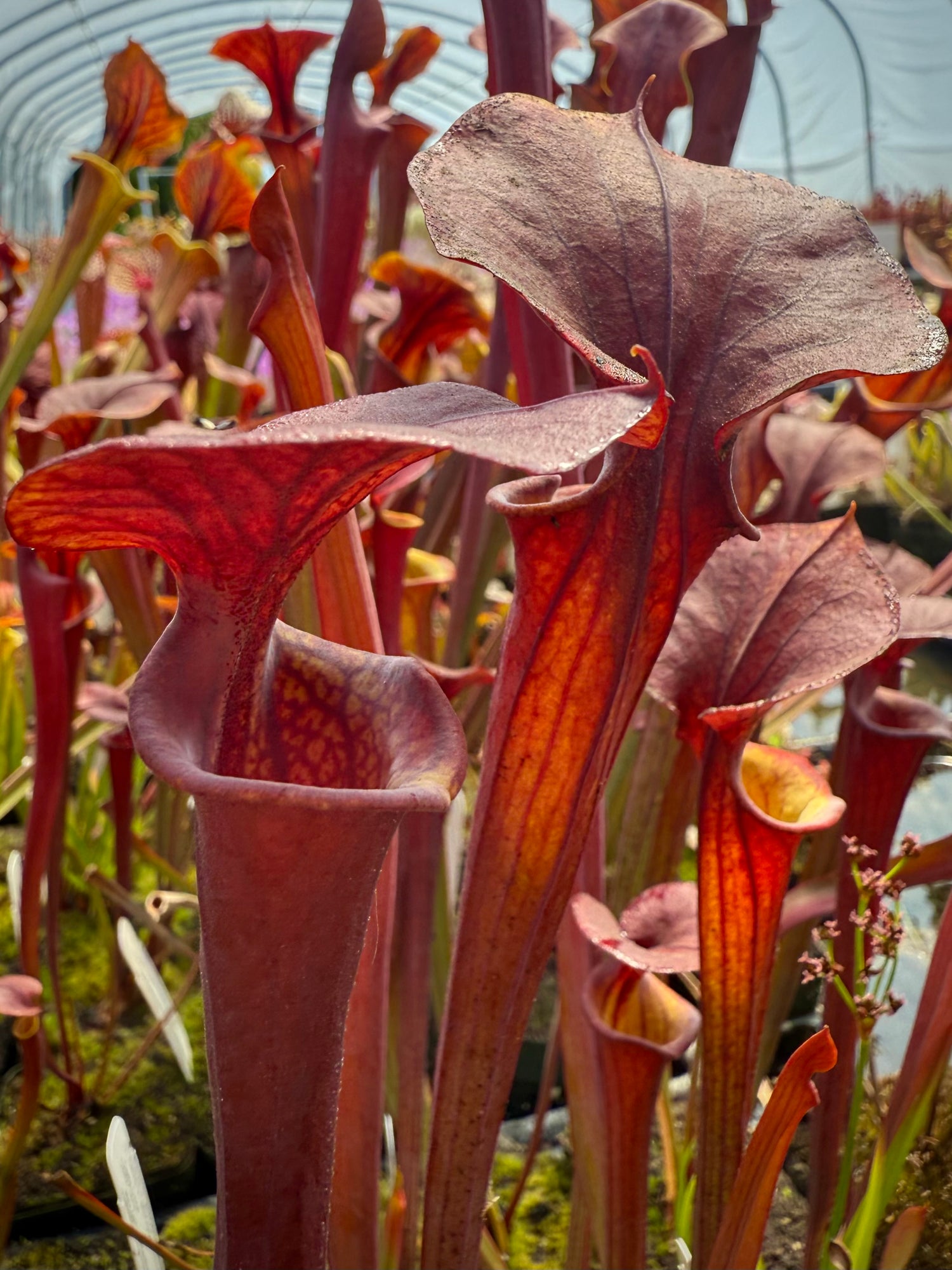
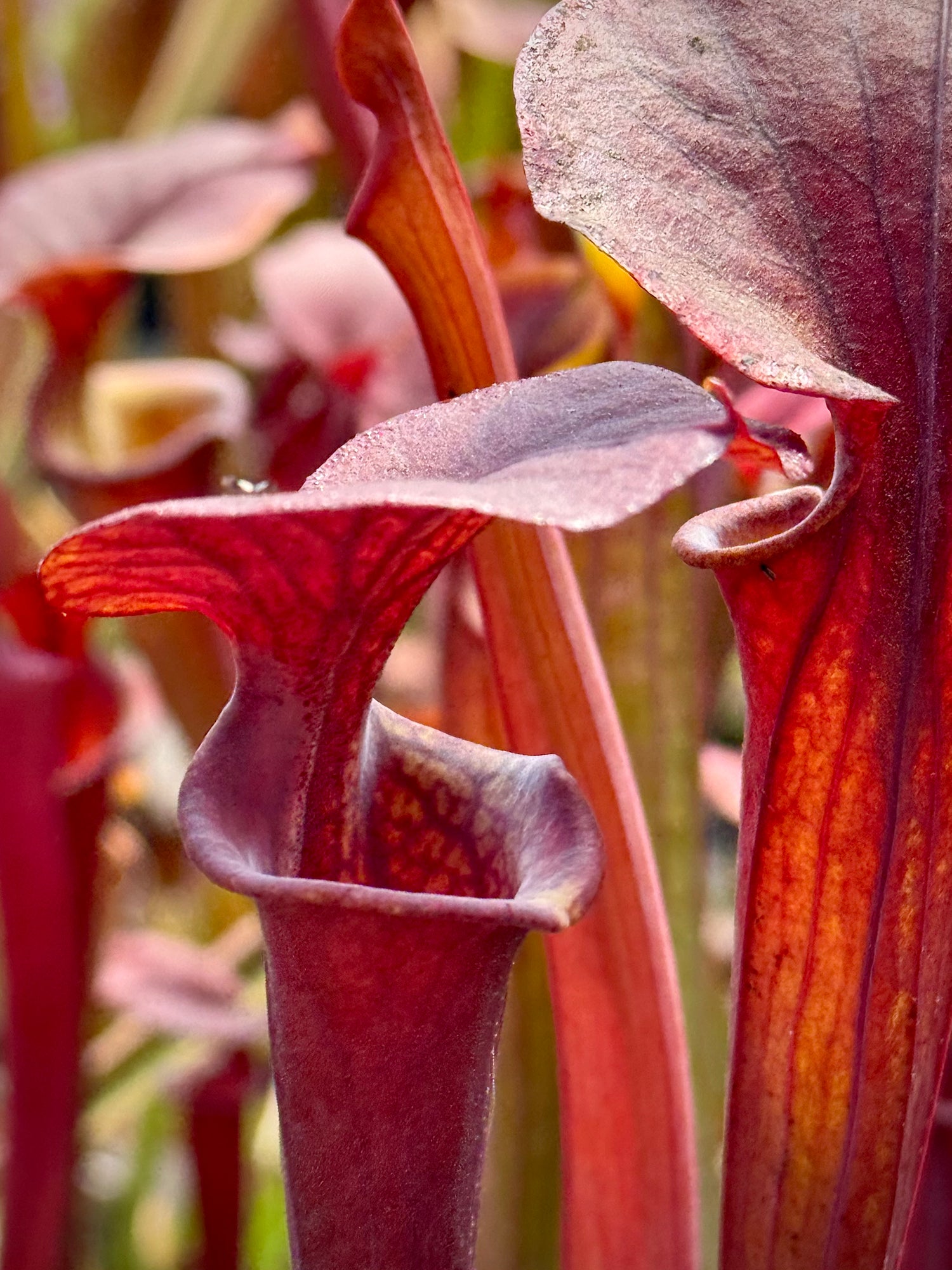
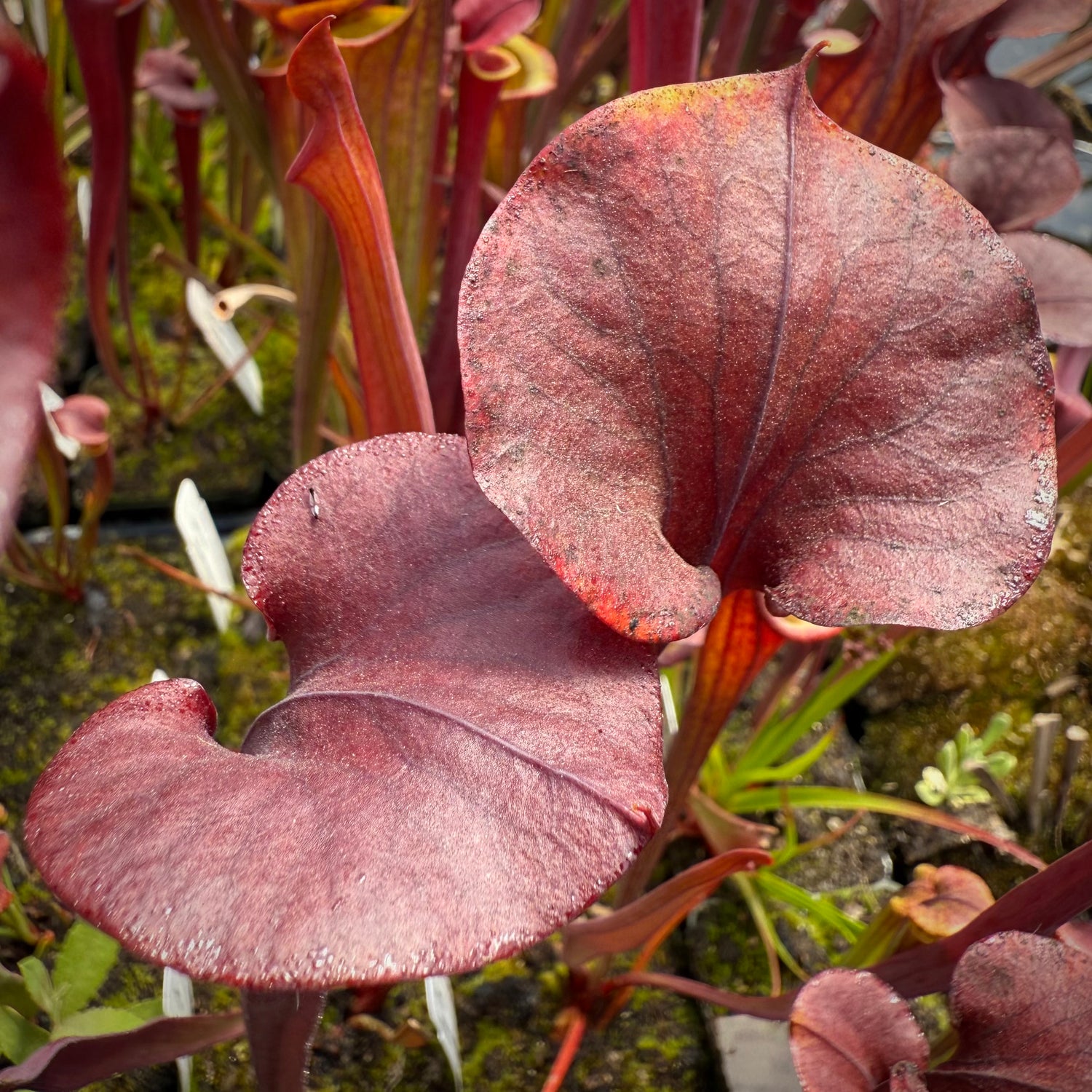
Sarracenia flava var atropurpurea is one of the most highly sought-after color forms of flava. The all-red color is truly striking! The pitchers deepen in color, rich blood-red, as they are exposed to more light throughout the season. When they first grow in, they can have contrasting golden-yellow lids, but these usually darken to a full red over time!
This is a beautiful clone from Andrew Daetz. These are divisions.
DORMANT SEASONALLY, STARTING AS EARLY AS OCTOBER AND LASTING AS LATE AS MARCH, DEPENDING ON THE CONDITIONS AND SPECIES/HYBRID. The pitchers turn brown and die back to the rhizome, or non-carnivorous leaves (phyllodia) grow during this time. Please see the final photo to see how Sarracenia look when dormant. They will begin to grow vigorously again in Spring when photoperiods lengthen and temperatures increase.
Care Instructions:
Growth Habit: Sarracenia primarily grow along the Southeastern coastal plain of the United States. They grow pitchers, which are modified leaves, seasonally that can vary in height, color, and size depending on the species or hybrid. The pitchers can die back during the growing season, but new pitchers will grow throughout the spring and summer. The pitchers start to grow in spring, and many grow as the year progresses; in summer, they will be at their best. In summer, you may see brown or black on your pitchers, which can be normal nectar burn or crisping from heat. As Fall comes on, the pitchers may start to die back, turning brown, and by winter, many or all of the pitchers are brown, but the rhizome remains healthy and intact throughout winter dormancy even if you cannot see anything growing. Sarracenia have brown, black, or white roots and do not generally have many of them. The rhizome can be brown and still be healthy.
Sun: Full sun. Sarracenia require lots of direct sun to grow and form pitchers properly. In many areas, they can be grown outdoors in full sun. If you live in a very hot AND very dry place like Arizona or Sacramento, for example, you will want to grow your plants in full morning sun with protection from the afternoon sun or under 30% shade cloth. It is common for several pitchers to "burn" and die back when you first place your plant into the sun; your plant is acclimating to your conditions, and in most cases, new leaves will soon grow and be fully acclimated. Sarracenia can be grown indoors on extremely sunny windowsills that receive all-day sun, but they will require a grow light in most circumstances due to the amount of light the plant needs. Grow lights should be 6-12” from the plant, depending on the light, and on a 10-12 hour day length. Sarracenia generally are not a good candidate for a terrarium as they need intense light and get quite tall. Shorter species like Sarracenia purpurea will do better in a terrarium. Grow outdoors if possible for best results.
Water: Always keep them in a saucer with a few inches of distilled, rainwater, or reverse osmosis water. Never let them dry out, especially in the hot summer months. Sarracenia are bog plants that prefer water-logged conditions unless you live somewhere both very hot AND extremely humid, like Alabama. In that case, let the water tray dry out for a day or two between refills. Always use distilled, reverse osmosis, or rainwater only. These plants are sensitive to their water quality, and giving them mineral and salt-free water is very important. In winter, when the plants are dormant, you can let them dry out a bit between rain storms, but do not let the soil get so dry that it pulls away from the edges of the pots. Be sure to supplement water as needed in between rains in winter.
Temperature and Dormancy: These are warm-temperate plants, meaning they need warm summers and chilly winters. They should be grown outdoors year-round in areas with mild winters. They thrive in temperatures ranging from 20 degrees - 100F degrees and can take a brief freeze or high-temperature spike up to 105F degrees for a short period. If nighttime temps drop below 20 but rise again during the day above 40, your plant will be fine outside.
If you live in an area with very cold winters, where nighttime temperatures drop below 20 degrees for sustained periods, you have three options for providing them with winter dormancy: the garage method, mulching in, or the fridge method. Dormancy is triggered by a combination of exposure to shorter photo-periods and cooler temperatures in the 40-60's F. While you can skip a dormancy period once or twice, in the long term, your plant will begin to do poorly and will eventually die if you skip this crucial period.
The garage method: Bring your plant indoors to a sunny windowsill in an unheated room or garage, where the nighttime temperatures will dip down to 50-60F. Keep it well watered during this period, do not let it dry out, and put it outside again when the outside nighttime temperatures increase consistently above 20F.
The mulch method: Mulch them in very, very well outdoors. Pack at least four inches of mulch on top of the plants and all around the sides to prevent winds from chilling them and freezing the roots. You can also dig the pots into the ground and then mulch heavily on top.
The fridge method: remove the plants from pots, gently clean the roots of soil, wrap the roots in a bit of damp long-fibered New Zealand sphagnum moss, place the plants in a resealable bag, and put the bag into the refrigerator. Leave them in the fridge from October to February, periodically checking on them to ensure they are still moist and not growing mold or fungus. Pot them back up in February. You can vary the timing to align with your outside nighttime temperatures so that your plants can come out of dormancy when it is safe to place them back outside. You can leave them in the fridge for an extended period if you have very long winters.
Soil and Repotting: We prefer a mix of four-part fertilizer-free peat moss to one-part perlite. You can add our pre-made mix to your order here. You do not need to repot your plant when you receive it from us for at least a year, and we recommend against it during the spring-summer months. Repot Sarracenia every 1-3 years in winter when they are dormant. Avoid placing in excessively large pots; size up only a few inches at a time. They do well in tall pots. Soil can also develop a swampy smell, especially right after shipping, when the plant is wrapped in plastic and sealed. This is normal; these plants grow naturally in bogs and swampy conditions, and peat moss can develop a bit of an anaerobic smell, but this does not indicate a problem with the soil.
Feeding and Fertilizer: Sarracenia will catch plenty of food when grown outdoors. When grown indoors, they will significantly benefit from fertilizing, both a foliar fertilizer and feeding the pitchers. Plants grown outdoors will appreciate a foliar feed as well. Apply MaxSea fertilizer once per month to the foliage only. Dilute 1/4 teaspoon of MaxSea into one gallon of water and then apply to the pitchers, and inside the pitchers, with a mister bottle or a watering can. Osmocote slow-release flower and vegetable pellets can be dropped into the pitchers with a bit of distilled water. Pellets can burn the sides of the pitchers where they come to rest; that is normal.
More Information: For further information on dormancy, repotting, dividing, and more, check out our website or our YouTube channel.
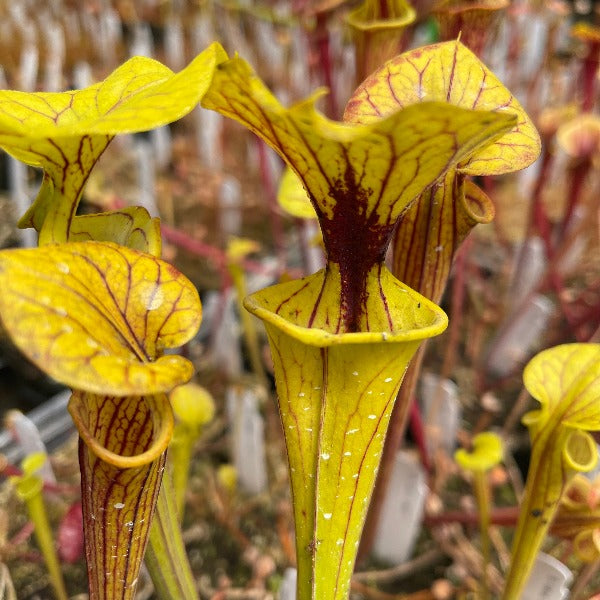
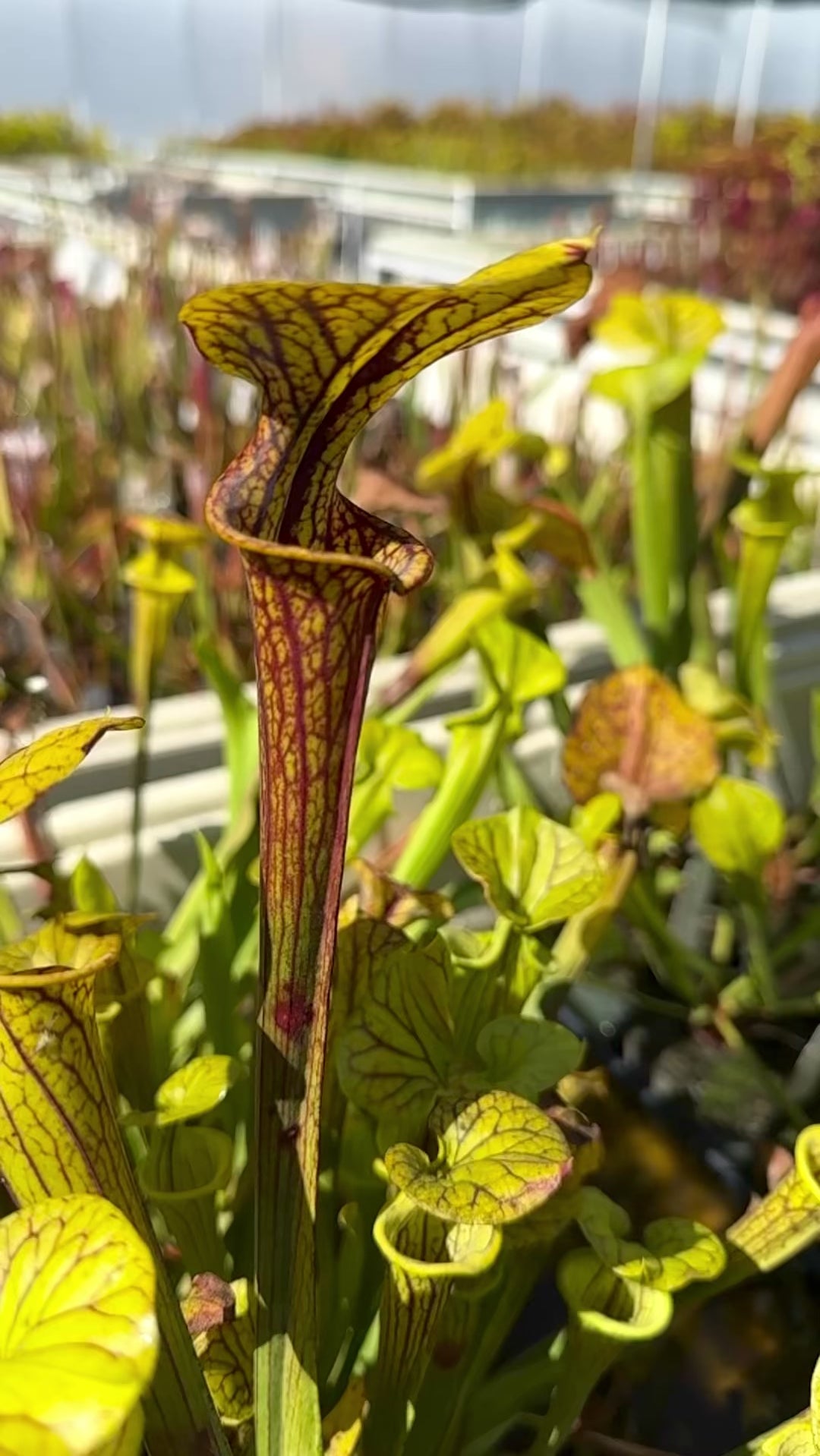
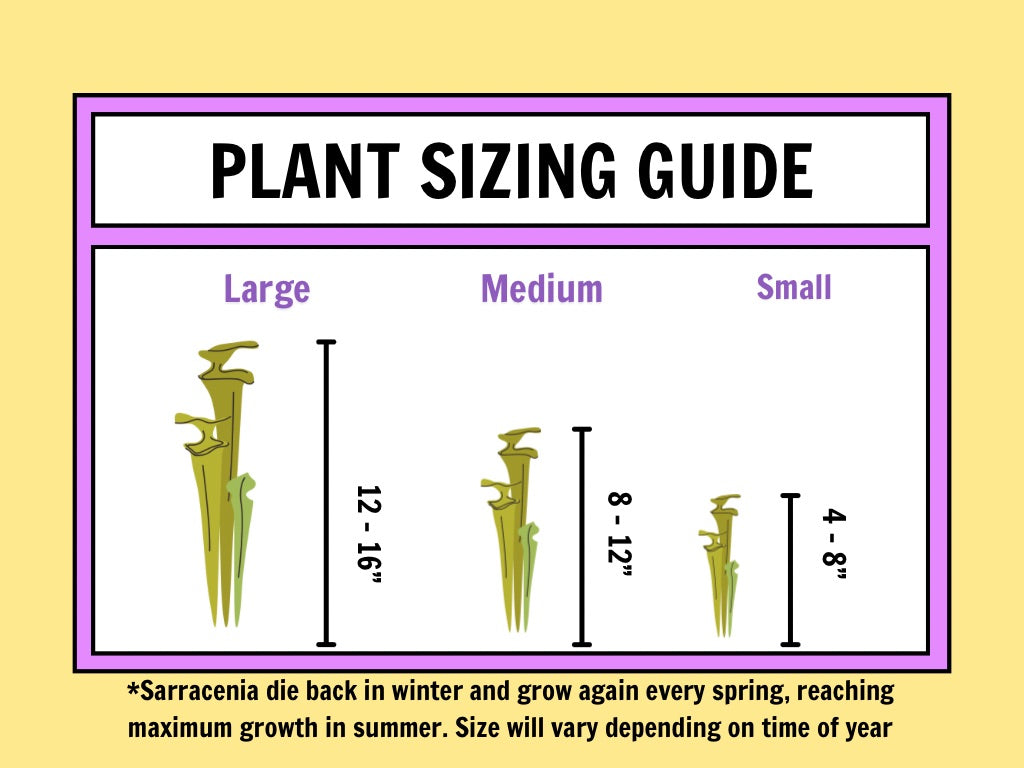
Some of the most beautiful flava in cultivation are the ornata variety. They have electric yellow pitchers with dark red pinstripes. They emerge in spring with brightly colored pitchers and red venation, and the color deepens over the summer with the venation turning blood-red, almost black, over time! The pitchers are tall with round, oversized lids.
These are divisions.
X-Large divisions aren’t necessarily taller but will have multiple growth points or very chonky rhizomes.
DORMANT SEASONALLY, STARTING AS EARLY AS OCTOBER AND LASTING AS LATE AS MARCH, DEPENDING ON THE CONDITIONS AND SPECIES/HYBRID. The pitchers turn brown and die back to the rhizome, or non-carnivorous leaves (phyllodia) grow during this time. Please see the final photo to see how Sarracenia look when dormant. They will begin to grow vigorously again in Spring when photoperiods lengthen and temperatures increase.
Care Instructions:
Growth Habit: Sarracenia primarily grow along the Southeastern coastal plain of the United States. They grow pitchers, which are modified leaves, seasonally that can vary in height, color, and size depending on the species or hybrid. The pitchers can die back during the growing season, but new pitchers will grow throughout the spring and summer. The pitchers start to grow in spring, and many grow as the year progresses; in summer, they will be at their best. In summer, you may see brown or black on your pitchers, which can be normal nectar burn or crisping from heat. As Fall comes on, the pitchers may start to die back, turning brown, and by winter, many or all of the pitchers are brown, but the rhizome remains healthy and intact throughout winter dormancy even if you cannot see anything growing. Sarracenia have brown, black, or white roots and do not generally have many of them. The rhizome can be brown and still be healthy.
Sun: Full sun. Sarracenia require lots of direct sun to grow and form pitchers properly. In many areas, they can be grown outdoors in full sun. If you live in a very hot AND very dry place like Arizona or Sacramento, for example, you will want to grow your plants in full morning sun with protection from the afternoon sun or under 30% shade cloth. It is common for several pitchers to "burn" and die back when you first place your plant into the sun; your plant is acclimating to your conditions, and in most cases, new leaves will soon grow and be fully acclimated. Sarracenia can be grown indoors on extremely sunny windowsills that receive all-day sun, but they will require a grow light in most circumstances due to the amount of light the plant needs. Grow lights should be 6-12” from the plant, depending on the light, and on a 10-12 hour day length. Sarracenia generally are not a good candidate for a terrarium as they need intense light and get quite tall. Shorter species like Sarracenia purpurea will do better in a terrarium. Grow outdoors if possible for best results.
Water: Always keep them in a saucer with a few inches of distilled, rainwater, or reverse osmosis water. Never let them dry out, especially in the hot summer months. Sarracenia are bog plants that prefer water-logged conditions unless you live somewhere both very hot AND extremely humid, like Alabama. In that case, let the water tray dry out for a day or two between refills. Always use distilled, reverse osmosis, or rainwater only. These plants are sensitive to their water quality, and giving them mineral and salt-free water is very important. In winter, when the plants are dormant, you can let them dry out a bit between rain storms, but do not let the soil get so dry that it pulls away from the edges of the pots. Be sure to supplement water as needed in between rains in winter.
Temperature and Dormancy: These are warm-temperate plants, meaning they need warm summers and chilly winters. They should be grown outdoors year-round in areas with mild winters. They thrive in temperatures ranging from 20 degrees - 100F degrees and can take a brief freeze or high-temperature spike up to 105F degrees for a short period. If nighttime temps drop below 20 but rise again during the day above 40, your plant will be fine outside.
If you live in an area with very cold winters, where nighttime temperatures drop below 20 degrees for sustained periods, you have three options for providing them with winter dormancy: the garage method, mulching in, or the fridge method. Dormancy is triggered by a combination of exposure to shorter photo-periods and cooler temperatures in the 40-60's F. While you can skip a dormancy period once or twice, in the long term, your plant will begin to do poorly and will eventually die if you skip this crucial period.
The garage method: Bring your plant indoors to a sunny windowsill in an unheated room or garage, where the nighttime temperatures will dip down to 50-60F. Keep it well watered during this period, do not let it dry out, and put it outside again when the outside nighttime temperatures increase consistently above 20F.
The mulch method: Mulch them in very, very well outdoors. Pack at least four inches of mulch on top of the plants and all around the sides to prevent winds from chilling them and freezing the roots. You can also dig the pots into the ground and then mulch heavily on top.
The fridge method: remove the plants from pots, gently clean the roots of soil, wrap the roots in a bit of damp long-fibered New Zealand sphagnum moss, place the plants in a resealable bag, and put the bag into the refrigerator. Leave them in the fridge from October to February, periodically checking on them to ensure they are still moist and not growing mold or fungus. Pot them back up in February. You can vary the timing to align with your outside nighttime temperatures so that your plants can come out of dormancy when it is safe to place them back outside. You can leave them in the fridge for an extended period if you have very long winters.
Soil and Repotting: We prefer a mix of four-part fertilizer-free peat moss to one-part perlite. You can add our pre-made mix to your order here. You do not need to repot your plant when you receive it from us for at least a year, and we recommend against it during the spring-summer months. Repot Sarracenia every 1-3 years in winter when they are dormant. Avoid placing in excessively large pots; size up only a few inches at a time. They do well in tall pots. Soil can also develop a swampy smell, especially right after shipping, when the plant is wrapped in plastic and sealed. This is normal; these plants grow naturally in bogs and swampy conditions, and peat moss can develop a bit of an anaerobic smell, but this does not indicate a problem with the soil.
Feeding and Fertilizer: Sarracenia will catch plenty of food when grown outdoors. When grown indoors, they will significantly benefit from fertilizing, both a foliar fertilizer and feeding the pitchers. Plants grown outdoors will appreciate a foliar feed as well. Apply MaxSea fertilizer once per month to the foliage only. Dilute 1/4 teaspoon of MaxSea into one gallon of water and then apply to the pitchers, and inside the pitchers, with a mister bottle or a watering can. Osmocote slow-release flower and vegetable pellets can be dropped into the pitchers with a bit of distilled water. Pellets can burn the sides of the pitchers where they come to rest; that is normal.
More Information: For further information on dormancy, repotting, dividing, and more, check out our website or our YouTube channel.
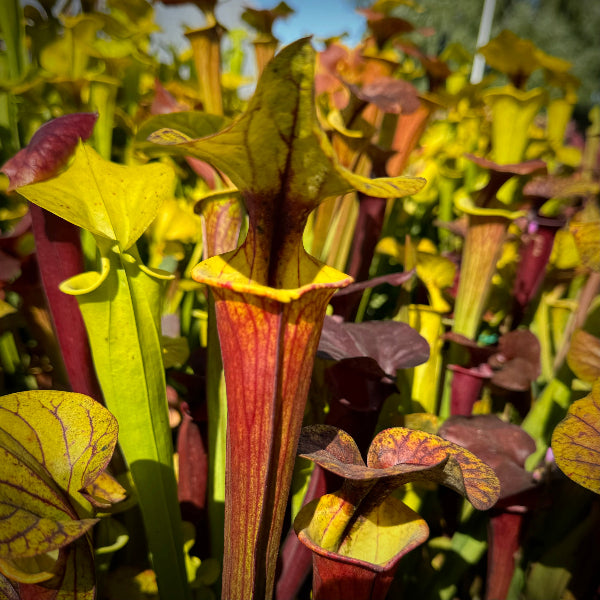
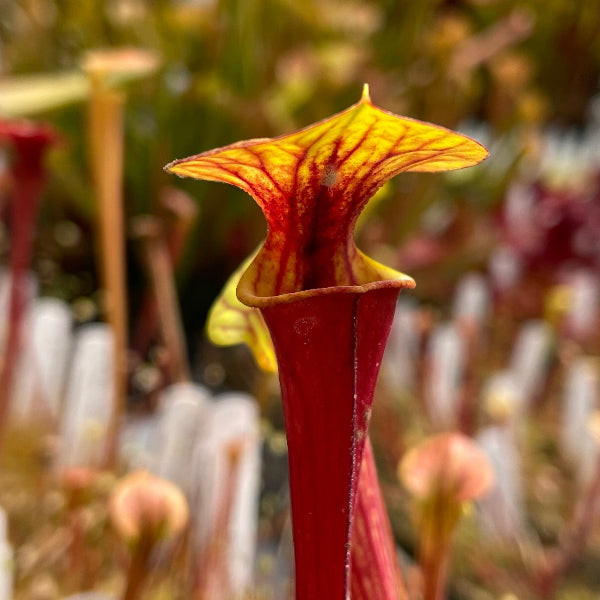
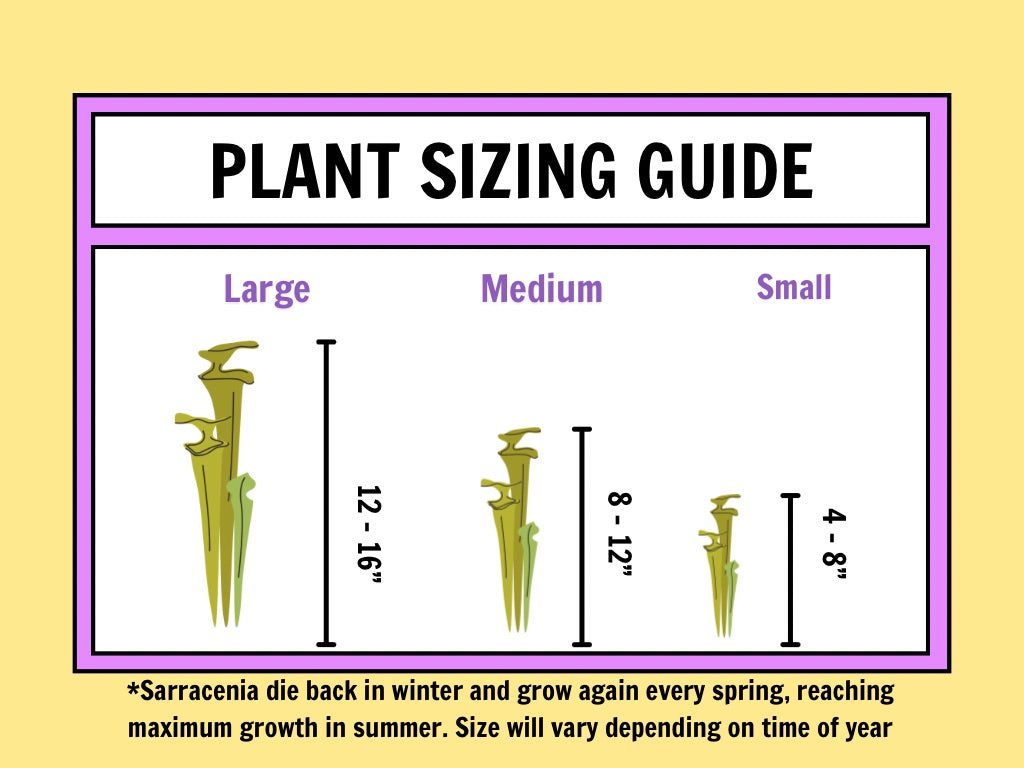
This is a fantastic color variety of Sarracenia flava! The entire pitcher's body is a stunning orangey-red, complemented by a deep red throat. The top of the lid and the lip stay vibrant green-yellow, creating a beautiful and eye-catching contrast. Spring pitchers can be more green, and as spring turns into summer, the pitcher's colors intensify and deepen, making it a truly mesmerizing sight!
These are seed-grown plants, so there is a bit of variation, but they will all have classic rubricorpora color and size!
DORMANT SEASONALLY, STARTING AS EARLY AS OCTOBER AND LASTING AS LATE AS MARCH, DEPENDING ON THE CONDITIONS AND SPECIES/HYBRID. The pitchers turn brown and die back to the rhizome, or non-carnivorous leaves (phyllodia) grow during this time. Please see the final photo to see how Sarracenia look when dormant. They will begin to grow vigorously again in Spring when photoperiods lengthen and temperatures increase.
Care Instructions:
Growth Habit: Sarracenia primarily grow along the Southeastern coastal plain of the United States. They grow pitchers, which are modified leaves, seasonally that can vary in height, color, and size depending on the species or hybrid. The pitchers can die back during the growing season, but new pitchers will grow throughout the spring and summer. The pitchers start to grow in spring, and many grow as the year progresses; in summer, they will be at their best. In summer, you may see brown or black on your pitchers, which can be normal nectar burn or crisping from heat. As Fall comes on, the pitchers may start to die back, turning brown, and by winter, many or all of the pitchers are brown, but the rhizome remains healthy and intact throughout winter dormancy even if you cannot see anything growing. Sarracenia have brown, black, or white roots and do not generally have many of them. The rhizome can be brown and still be healthy.
Sun: Full sun. Sarracenia require lots of direct sun to grow and form pitchers properly. In many areas, they can be grown outdoors in full sun. If you live in a very hot AND very dry place like Arizona or Sacramento, for example, you will want to grow your plants in full morning sun with protection from the afternoon sun or under 30% shade cloth. It is common for several pitchers to "burn" and die back when you first place your plant into the sun; your plant is acclimating to your conditions, and in most cases, new leaves will soon grow and be fully acclimated. Sarracenia can be grown indoors on extremely sunny windowsills that receive all-day sun, but they will require a grow light in most circumstances due to the amount of light the plant needs. Grow lights should be 6-12” from the plant, depending on the light, and on a 10-12 hour day length. Sarracenia generally are not a good candidate for a terrarium as they need intense light and get quite tall. Shorter species like Sarracenia purpurea will do better in a terrarium. Grow outdoors if possible for best results.
Water: Always keep them in a saucer with a few inches of distilled, rainwater, or reverse osmosis water. Never let them dry out, especially in the hot summer months. Sarracenia are bog plants that prefer water-logged conditions unless you live somewhere both very hot AND extremely humid, like Alabama. In that case, let the water tray dry out for a day or two between refills. Always use distilled, reverse osmosis, or rainwater only. These plants are sensitive to their water quality, and giving them mineral and salt-free water is very important. In winter, when the plants are dormant, you can let them dry out a bit between rain storms, but do not let the soil get so dry that it pulls away from the edges of the pots. Be sure to supplement water as needed in between rains in winter.
Temperature and Dormancy: These are warm-temperate plants, meaning they need warm summers and chilly winters. They should be grown outdoors year-round in areas with mild winters. They thrive in temperatures ranging from 20 degrees - 100F degrees and can take a brief freeze or high-temperature spike up to 105F degrees for a short period. If nighttime temps drop below 20 but rise again during the day above 40, your plant will be fine outside.
If you live in an area with very cold winters, where nighttime temperatures drop below 20 degrees for sustained periods, you have three options for providing them with winter dormancy: the garage method, mulching in, or the fridge method. Dormancy is triggered by a combination of exposure to shorter photo-periods and cooler temperatures in the 40-60's F. While you can skip a dormancy period once or twice, in the long term, your plant will begin to do poorly and will eventually die if you skip this crucial period.
The garage method: Bring your plant indoors to a sunny windowsill in an unheated room or garage, where the nighttime temperatures will dip down to 50-60F. Keep it well watered during this period, do not let it dry out, and put it outside again when the outside nighttime temperatures increase consistently above 20F.
The mulch method: Mulch them in very, very well outdoors. Pack at least four inches of mulch on top of the plants and all around the sides to prevent winds from chilling them and freezing the roots. You can also dig the pots into the ground and then mulch heavily on top.
The fridge method: remove the plants from pots, gently clean the roots of soil, wrap the roots in a bit of damp long-fibered New Zealand sphagnum moss, place the plants in a resealable bag, and put the bag into the refrigerator. Leave them in the fridge from October to February, periodically checking on them to ensure they are still moist and not growing mold or fungus. Pot them back up in February. You can vary the timing to align with your outside nighttime temperatures so that your plants can come out of dormancy when it is safe to place them back outside. You can leave them in the fridge for an extended period if you have very long winters.
Soil and Repotting: We prefer a mix of four-part fertilizer-free peat moss to one-part perlite. You can add our pre-made mix to your order here. You do not need to repot your plant when you receive it from us for at least a year, and we recommend against it during the spring-summer months. Repot Sarracenia every 1-3 years in winter when they are dormant. Avoid placing in excessively large pots; size up only a few inches at a time. They do well in tall pots. Soil can also develop a swampy smell, especially right after shipping, when the plant is wrapped in plastic and sealed. This is normal; these plants grow naturally in bogs and swampy conditions, and peat moss can develop a bit of an anaerobic smell, but this does not indicate a problem with the soil.
Feeding and Fertilizer: Sarracenia will catch plenty of food when grown outdoors. When grown indoors, they will significantly benefit from fertilizing, both a foliar fertilizer and feeding the pitchers. Plants grown outdoors will appreciate a foliar feed as well. Apply MaxSea fertilizer once per month to the foliage only. Dilute 1/4 teaspoon of MaxSea into one gallon of water and then apply to the pitchers, and inside the pitchers, with a mister bottle or a watering can. Osmocote slow-release flower and vegetable pellets can be dropped into the pitchers with a bit of distilled water. Pellets can burn the sides of the pitchers where they come to rest; that is normal.
More Information: For further information on dormancy, repotting, dividing, and more, check out our website or our YouTube channel.
Showing 275/379