

This beautiful, large plant arrived healthy!
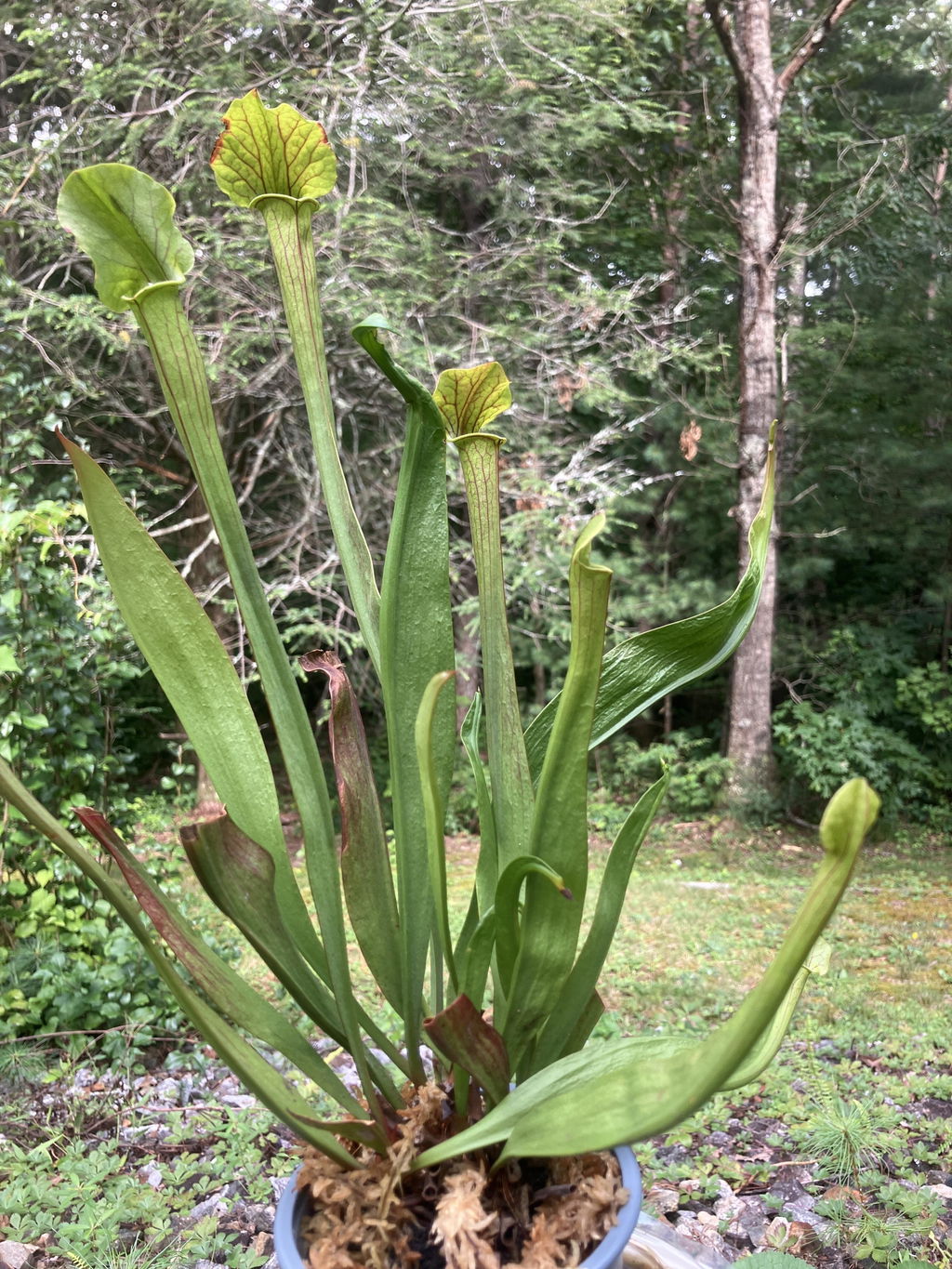
Plant arrived healthy with two large growth points. There is already a third growth point emerging!
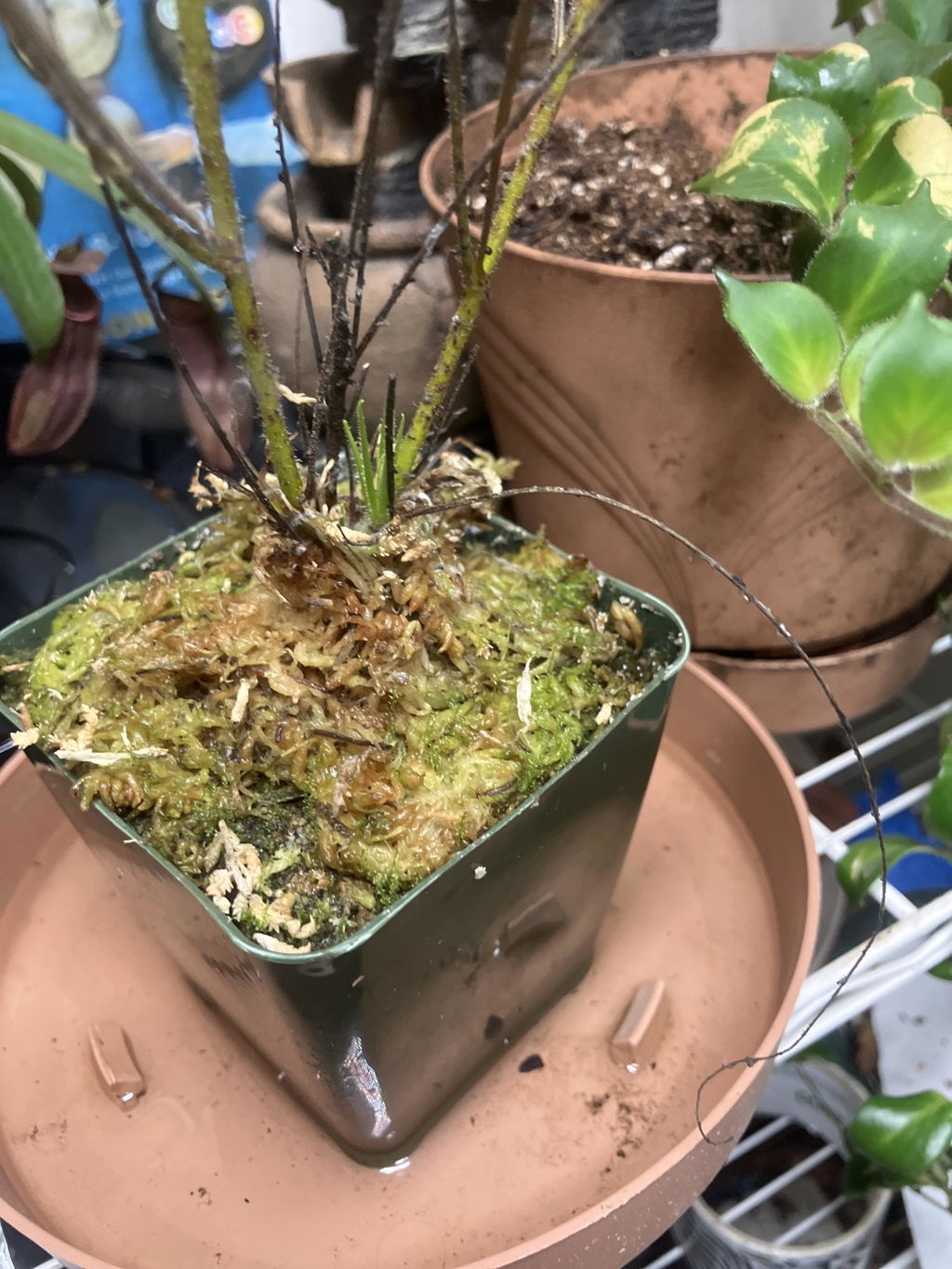
This Sarracenia arrived healthy and happy!
Sign up for our newsletter!
Sort by:
379 products
379 products


Some of our favorite moments in our carnivorous garden are seeing the dragonflies fly from pitcher to pitcher, lightly perching. Now you can carry a dragonfly around with you in the new design, created by our very own Mail Order Maven, Nikayla.
Please Read Before Ordering
Each clothing item is made to order just for you and shipped directly from our production partner. As a small business, we’re unable to offer returns or exchanges on apparel at this time.
Please be sure to review the size chart carefully before placing your order. If you’re between sizes or unsure, we recommend sizing up for a more comfortable fit.
Please note: Plants and growing supplies ship separately from our merch and may arrive in a different package at a different time.
Thank you so much for supporting our small business — every order truly means the world to us! 💛
• 100% combed and ringspun cotton
• Tri-blends are 50% polyester/25% combed/25% ringspun cotton/rayon
• Fabric weight: 4.2 oz/yd² (142.40 g/m²), triblends: 3.8 oz/yd² (90.07 g/m²)
• 30 singles thread weight
• Side-seamed
• Blank product sourced from Nicaragua, Honduras, or the US
This product is made especially for you as soon as you place an order, which is why it takes us a bit longer to deliver it to you. Making products on demand instead of in bulk helps reduce overproduction, so thank you for making thoughtful purchasing decisions!
Size guide
| BODY LENGTH (inches) | BODY WIDTH (inches) | |
| XS | 26 | 16 ¼ |
| S | 27 | 18 ¼ |
| M | 28 | 20 ¼ |
| L | 29 | 22 ¼ |
| XL | 30 | 24 ¼ |
| 2XL | 31 | 26 ¼ |


Some of our favorite moments in our carnivorous garden are seeing the dragonflies fly from pitcher to pitcher, lightly perching. Now you can carry a dragonfly around with you in the new design, created by our very own Mail Order Maven, Nikayla.
Please Read Before Ordering
Each clothing item is made to order just for you and shipped directly from our production partner. As a small business, we’re unable to offer returns or exchanges on apparel at this time.
Please be sure to review the size chart carefully before placing your order. If you’re between sizes or unsure, we recommend sizing up for a more comfortable fit.
Please note: Plants and growing supplies ship separately from our merch and may arrive in a different package at a different time.
Thank you so much for supporting our small business — every order truly means the world to us! 💛
• 100% ring-spun cotton
• Ring Spun Sport Grey color is 90% ring-spun cotton, 10% polyester
• Fabric weight: 4.5 oz./yd.² (153 g/m²)
• Semi-fitted
• Side-seamed construction
• Narrow-width rib collar
• Taped neck and shoulders
• Blank product sourced from Honduras
Disclaimer: Due to the fabric properties, the White color variant may appear off-white rather than bright white.
This product is made especially for you as soon as you place an order, which is why it takes us a bit longer to deliver it to you. Making products on demand instead of in bulk helps reduce overproduction, so thank you for making thoughtful purchasing decisions!
Size guide
| LENGTH (inches) | CHEST (inches) | |
| S | 25 ½ | 31-34 |
| M | 26 | 35-38 |
| L | 27 | 39-41 |
| XL | 28 | 42-45 |
| 2XL | 28 ½ | 46-48 |


Some of our favorite moments in our carnivorous garden are seeing the dragonflies fly from pitcher to pitcher, lightly perching. Now you can carry a dragonfly around with you in the new design, created by our very own Mail Order Maven, Nikayla.
Please Read Before Ordering
Each clothing item is made to order just for you and shipped directly from our production partner. As a small business, we’re unable to offer returns or exchanges on apparel at this time.
Please be sure to review the size chart carefully before placing your order. If you’re between sizes or unsure, we recommend sizing up for a more comfortable fit.
Please note: Plants and growing supplies ship separately from our merch and may arrive in a different package at a different time.
Thank you so much for supporting our small business — every order truly means the world to us! 💛
• 60% combed ringspun cotton, 40% polyester
• Fabric weight: 4 oz./yd.² (113.4 g/m²)
• Lightweight jersey
• Breathable and comfy for all-day wear
• Fitted silhouette
• Scoop neck and racerback
• Self-binding seams in matching colors for a seamless look
• Blank product sourced from Honduras
This product is made especially for you as soon as you place an order, which is why it takes us a bit longer to deliver it to you. Making products on demand instead of in bulk helps reduce overproduction, so thank you for making thoughtful purchasing decisions!
Size guide
| CHEST (inches) | LENGTH (inches) | |
| XS | 14 | 26 ¾ |
| S | 15 | 27 ⅜ |
| M | 16 | 28 |
| L | 17 | 28 ⅝ |
| XL | 18 | 29 ¼ |
| 2XL | 19 | 29 ⅞ |


Some of our favorite moments in our carnivorous garden are seeing the dragonflies fly from pitcher to pitcher, lightly perching. Now you can carry a dragonfly around with you in the new design, created by our very own Mail Order Maven, Nikayla.
Please Read Before Ordering
Each clothing item is made to order just for you and shipped directly from our production partner. As a small business, we’re unable to offer returns or exchanges on apparel at this time.
Please be sure to review the size chart carefully before placing your order. If you’re between sizes or unsure, we recommend sizing up for a more comfortable fit.
Please note: Plants and growing supplies ship separately from our merch and may arrive in a different package at a different time.
Thank you so much for supporting our small business — every order truly means the world to us! 💛
• 100% combed and ring-spun cotton
• Heather colors are 52% combed and ring-spun cotton, 48% polyester
• Athletic Heather is 90% combed and ring-spun cotton, 10% polyester
• Fabric weight: 4.2 oz/yd² (142 g/m2)
• Pre-shrunk fabric
• 32 singles
• Relaxed unisex fit
• Side-seamed construction
• Blank product sourced from Nicaragua, the US, Guatemala, or Honduras
Disclaimer: The fabric is slightly sheer and may appear see-through, especially in lighter colors or under certain lighting conditions.
This product is made especially for you as soon as you place an order, which is why it takes us a bit longer to deliver it to you. Making products on demand instead of in bulk helps reduce overproduction, so thank you for making thoughtful purchasing decisions!
Size guide
| WIDTH (inches) | LENGTH (inches) | |
| S | 15 ¼ | 20 ⅞ |
| M | 16 ¼ | 22 ⅛ |
| L | 17 ¼ | 23 ⅜ |
| XL | 18 ¼ | 24 ⅜ |
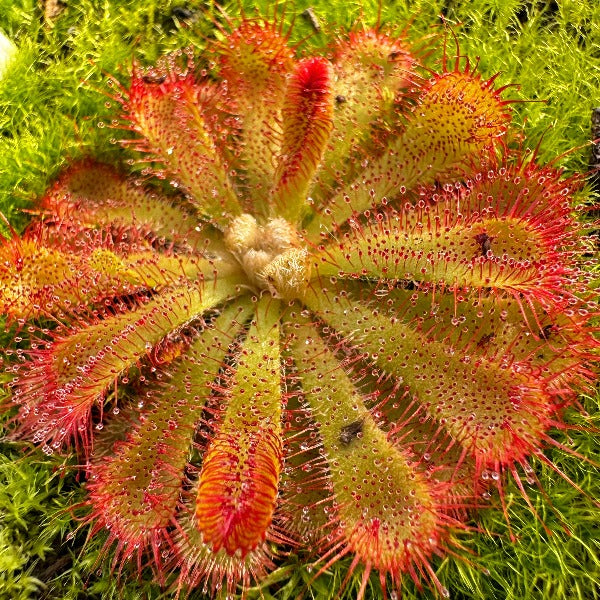
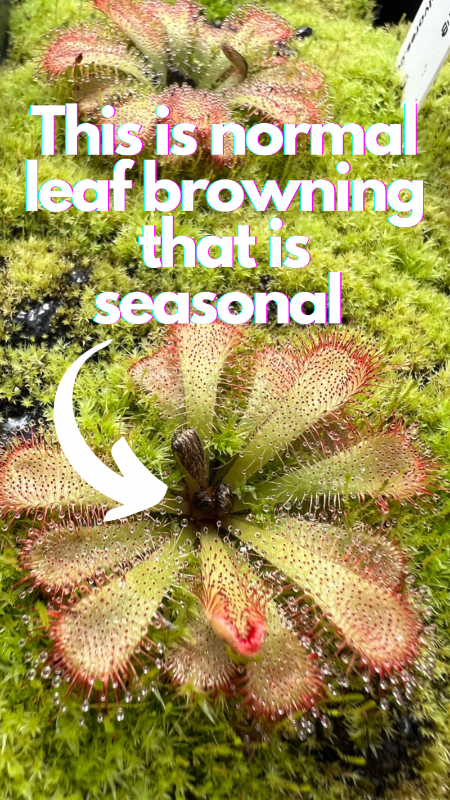
The Alice sundew (Drosera aliciae) is quite possibly the most popular rosetted sundew, and it is easy to see why! It is excellent for terrariums and windowsills, is tolerant of light frost, and is a reliable seed producer. Its handsome wedge-shaped green leaves have bright red tentacles and form rosettes one to three inches across. It often produces offshoots from its roots and slowly produces attractive clumps.
The plants we are shipping have rosettes 1-2” across.
Please note: shipping can be hard on the sticky dew covering the leaves so your plant may arrive without dew. It can take a few weeks for the plant to produce more dew, if after four weeks it has not produced dew, you may need to increase light.
Care Instructions
Growth Habit: This plant grows in a rosette of leaves, slowly growing taller along its stem. As the older leaves die back, they turn brown and form a skirt of older leaves under the new leaves. The stem can be brown as well. Mature rosettes can be 3” across. New leaves grow from the crown of the plant. The roots can be brown to black and thick. The flowers are self-fertile and produce lots of seeds. These plants can regrow from the roots if they die back.
Sun: Full sun indoors, in a terrarium, or outdoors if you live in a nearly frost-free climate. If grown under grow lights, the lights should be on a 10-12 hour day length 6-10” above the plants, depending on the strength of your lights. If your plant does not have dew, it may need more light.
Water & Humidity: Always keep the pot sitting in at least two inches of distilled, rain, or reverse osmosis water. These plants will do best with a humidity of 60% or more.
Temperature & Dormancy: 50 degrees—90 degrees, with high humidity. This species has no winter dormancy but may grow more slowly in winter if exposed to cooler temperatures and shorter photoperiods. This is a tropical plant and can not tolerate cold temperatures. Never expose it to anything below 40 degrees.
Soil & Repotting: We prefer a mix of four-part fertilizer-free peat moss to one-part perlite. You can add our pre-made mix to your order here. You do not need to repot your plant when you receive it from us for at least a year, and we recommend against it during the spring-summer months. Repot Drosera every 1-3 years. Avoid placing in excessively large pots; size up only a few inches at a time, but they appreciate tall pots. Soil can also develop a swampy smell, especially right after shipping, when the plant is wrapped in plastic and sealed. This is normal; these plants grow naturally in bogs and swampy conditions, and peat moss can develop a bit of an anaerobic smell, but this does not indicate a problem with the soil.
Feeding and Fertilizer: Drosera will catch plenty of food when grown outdoors. When grown indoors, they will significantly benefit from a foliar fertilizer. Plants grown outdoors will appreciate a foliar feed as well. Apply MaxSea fertilizer once per month to the foliage only. Dilute 1/4 teaspoon of MaxSea into one gallon of water and then apply to the leaves with a mister bottle or a watering can.
More Information: For further information on dormancy, repotting, dividing, and more, check out our website or our YouTube channel.


Drosera binata 'Octopus' is phenomenal forked leaf sundew! The leaves, at maturity, are huge and fork over and over! Created be Christian Klein, this is a hybrid between binata var binata and binata var dichotoma. This beast of a plant can fork 28 times at maturity and has gigantic leaves!
If you live in an area with very cold winters, where nighttime temperatures drop below 20 degrees for sustained periods, you have three options for providing them with winter dormancy: the garage method, mulching in, or the fridge method. Dormancy is triggered by a combination of exposure to shorter photo-periods and cooler temperatures in the 40-60's F. While you can skip a dormancy period once or twice, in the long term, your plant will begin to do poorly and will eventually die if you skip this crucial period.
The garage method: Bring your plant indoors to a sunny windowsill in an unheated room or garage, where the nighttime temperatures will dip down to 50-60F. Keep it well watered during this period, do not let it dry out, and put it outside again when the outside nighttime temperatures increase consistently above 20F.
The mulch method: Mulch them in very, very well outdoors. Pack at least four inches of mulch on top of the plants and all around the sides to prevent winds from chilling them and freezing the roots. You can also dig the pots into the ground and then mulch heavily on top.
The fridge method: leave your plant potted and place the pot in a resealable bag, and put the bag into the refrigerator. You can also treat the pot with super as a preventative before placing in the fridge. Leave them in the fridge from October to February, periodically checking on them to ensure they are still moist and not growing mold or fungus. Bring them out in February. You can vary the timing to align with your outside nighttime temperatures so that your plants can come out of dormancy when it is safe to place them back outside. You can leave them in the fridge for an extended period if you have very long winters.
Soil and Repotting: We prefer a mix of four-part fertilizer-free peat moss to one-part perlite. You can add our pre-made mix to your order here. You do not need to repot your plant when you receive it from us for at least a year, and we recommend against it during the spring-summer months. Repot Drosera every 3 years in winter when they are dormant. Avoid placing in excessively large pots; size up only a few inches at a time. They do well in tall pots. Soil can also develop a swampy smell, especially right after shipping, when the plant is wrapped in plastic and sealed. This is normal; these plants grow naturally in bogs and swampy conditions, and peat moss can develop a bit of an anaerobic smell, but this does not indicate a problem with the soil.
Feeding and Fertilizer: Drosera will catch plenty of food when grown outdoors. When grown indoors, they will significantly benefit from a foliar fertilizer. Plants grown outdoors will appreciate a foliar feed as well. Apply MaxSea fertilizer once per month to the foliage only. Dilute 1/4 teaspoon of MaxSea into one gallon of water and then apply with a mister bottle or a watering can.
More Information: For further information on dormancy, repotting, dividing, and more, check out our website or our YouTube channel.
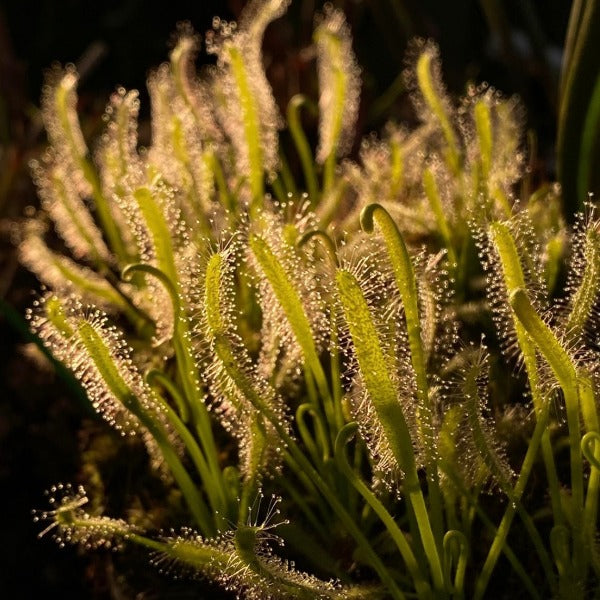
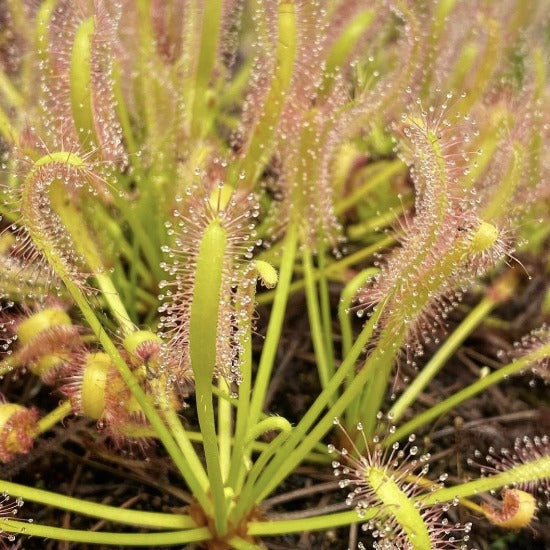
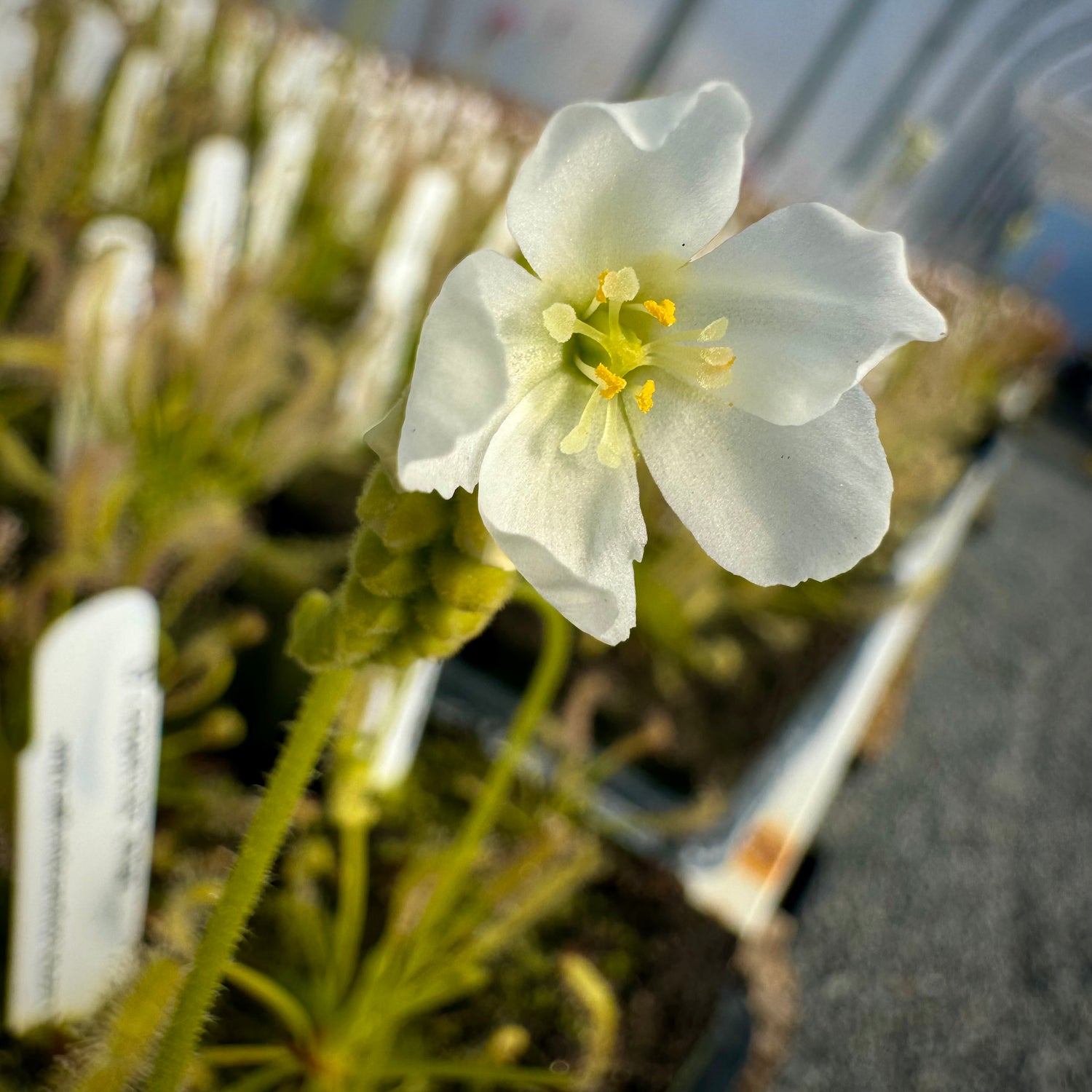
These beautiful sundews (Drosera capensis) are the albino form of the Cape Sundew. 'Alba' lacks red pigment (anthocyanin), so its tentacles aren't red, and the flowers are white. Grow it next to the red Cape Sundew or a red Sarracenia for a stunning contrast! Cape Sundews catch gnats, fruit flies, and occasional house flies.
If you have been thinking about growing carnivorous plants but don't know where to start, look no further than Drosera capensis. These plants are easy to grow and rewarding and will grow in various conditions. They will thrive indoors in full sun, on a windowsill, or under lights. They will also do well outside in lots of sun and are cold hardy down to 40 degrees reliably. They will briefly freeze with the leaves dying back, but the plants regrow readily from the roots in spring.
The plants we are shipping are about 2-4” tall.
Please note: shipping can be hard on the sticky dew covering the leaves so your plant may arrive without dew. It can take a few weeks for the plant to produce more dew, if after four weeks it has not produced dew, you may need to increase light.
Care Instructions
Growth Habit: Drosera capensis are small, bushy plants that grow about 6” tall at maturity, although some forms can be slightly larger. Capensis spread readily by dropping seeds from their abundant flowers in their pots, which do not need to be pollinated. As they grow, their leaves die back, starting from the base of the plant and moving up. The leaves die back and can be cut off. The stem will thicken and be black or brown. Sometimes larger, older plants will flop over and grow sideways as they age, growing taller and taller with new leaves emerging from the top of the plant. Capensis can regrow from the roots quite readily, so if your crown dies, keep nurturing it, and you should see new growth. These plants have a high leaf turnover, meaning their leaves die back frequently, but new leaves grow just as fast.
Sun: Full sun. Grow indoors on a sunny windowsill, in a terrarium under lights, or outdoors. If grown indoors, Drosera will require full sun to produce their sticky dew, so be sure to place them in a window where they will receive direct sunlight for most of the day. If grown under lights, keep your grow lights on a 10 to 12-hour day length and hang your grow lights 6 to 10 inches above the plants on the quality of your lights. Grown outdoors, these plants will enjoy a great deal of sun. If you live somewhere extremely hot, for example, Arizona, you will want to protect them from the Full intensity of the afternoon sunlight. You can either grow them in morning sun only, or use shade cloth to help protect them in these very hot areas. These plants may be more colorful and smaller when grown outdoors because the light is more intense. You can expect a few leaves to burn back when you first place your plant outdoors in the sun, and if you receive your plant in the summer, it is a good idea to slowly acclimate it to the sunlight over a day or two. Even in less sunny seasons, areas, or with acclimation, you can still expect to see some burned leaves when first placed outside. This is normal, and new leaves will grow that are more adjusted to the sun. In winter, when grown in sunlight, indoors or outdoors, it is very normal for color to fade from red varieties due to less sun. IF YOUR SUNDEW IS NOT PRODUCING DEW, IT MOST LIKELY NEEDS MORE SUNLIGHT. It can also take a few weeks after shipping for dew to generate.
Water: Always sitting in a few inches of distilled, rain, or reverse osmosis water. These plants always prefer to have their roots wet and can have their pots sitting in a deep saucer of water all the time.
Temperature and Dormancy: Drosera capensis tolerate a wide range of temperatures but will be happiest in 40 - 80 degrees. They can take temperatures from freezing to 100 degrees but only for short periods and can grow back from the roots after a freeze if the daytime temperatures increase above 40. Drosera capensis do not need a dormancy but will die back or slow growth in winter depending on the conditions they are exposed to. If exposed to freezes, they will die back. And many will slow their growth or grow smaller in winter. Drosera capensis does need a nighttime drop in temperatures of 10-20 degrees; if you’d like to grow this in a tropical zone, we recommend the ‘Alba’ cultivar as it can tolerate no nighttime drop in temperature.
Soil and Repotting: We prefer a mix of four-part fertilizer-free peat moss to one-part perlite. You can add our pre-made mix to your order here. You do not need to repot your plant when you receive it from us for at least a year, and we recommend against it during the spring-summer months. Repot Drosera every 1-3 years. Avoid placing in excessively large pots; size up only a few inches at a time. Soil can also develop a swampy smell, especially right after shipping, when the plant is wrapped in plastic and sealed. This is normal; these plants grow naturally in bogs and swampy conditions, and peat moss can develop a bit of an anaerobic smell, but this does not indicate a problem with the soil.
Feeding and Fertilizer: Drosera catch small insects like fungus gnats and fruit flies in their sticky dew. They can catch bigger prey like houseflies or crane flies and can slowly curl their leaves around these larger bugs to make better contact. Over time, their leaves will produce enzymes to digest the nutrients from the bug, absorbing them through their leaves, leaving only the exoskeleton on their sticky leaves. There’s no need to remove these as they often serve as a lure to other insects looking for an easy meal. When grown outdoors, they will catch plenty of food. When grown indoors, they will significantly benefit from a foliar fertilizer. Plants grown outdoors will appreciate a foliar feed as well. Apply MaxSea fertilizer once per month to the foliage only. Dilute 1/4 teaspoon of MaxSea into one gallon of water with a mister bottle or a watering can. Watch as the Drosera slowly curl their leaves after a foliar fertilizer application!
More Information: For further information on dormancy, repotting, growing from seed, and more, check out our website or our YouTube channel.
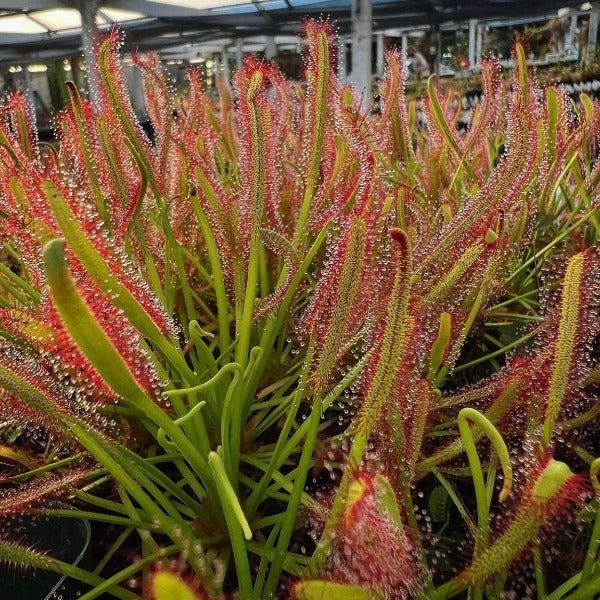
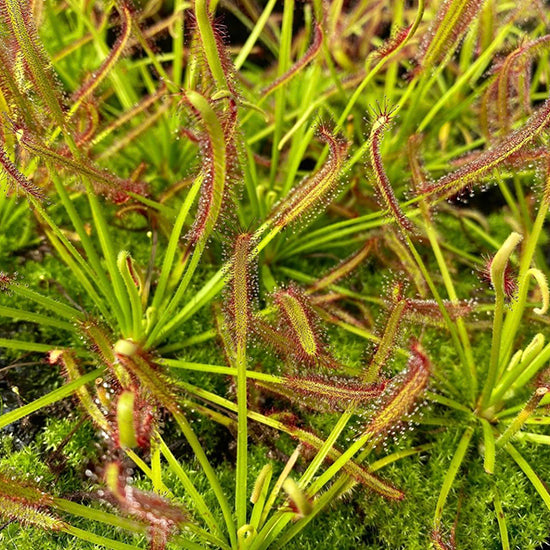
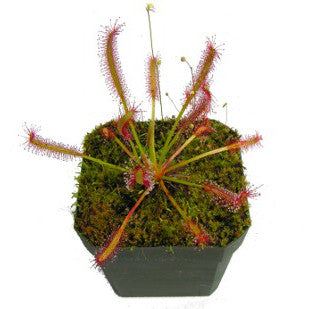
If you have been thinking about growing carnivorous plants but don't know where to start, look no further than Drosera capensis. These plants are easy to grow, rewarding and will grow in a variety of conditions. They will thrive indoors in full sun, on a windowsill or under lights. They will also do well outside in lots of sun and are cold hardy down to 40 degrees reliably. They will even take a brief freeze with the leaves dying back but the plants regrowing readily from the roots in spring.
This is the most typical form of Drosera capensis; the leaves are thin and delicate looking with red tentacles tipped in mucilage. The pink flowers unfurl off of long, arching scapes. Cape Sundews catch many gnats, fruit flies and occasionally house flies.
The plants we are shipping are about 2-4” tall.
Please note: shipping can be hard on the sticky dew covering the leaves so your plant may arrive without dew. It can take a few weeks for the plant to produce more dew, if after four weeks it has not produced dew, you may need to increase light.
Care Instructions
Growth Habit: Drosera capensis are small, bushy plants that grow about 6” tall at maturity, although some forms can be slightly larger. Capensis spread readily by dropping seeds from their abundant flowers in their pots, which do not need to be pollinated. As they grow, their leaves die back, starting from the base of the plant and moving up. The leaves die back and can be cut off. The stem will thicken and be black or brown. Sometimes larger, older plants will flop over and grow sideways as they age, growing taller and taller with new leaves emerging from the top of the plant. Capensis can regrow from the roots quite readily, so if your crown dies, keep nurturing it, and you should see new growth. These plants have a high leaf turnover, meaning their leaves die back frequently, but new leaves grow just as fast.
Sun: Full sun. Grow indoors on a sunny windowsill, in a terrarium under lights, or outdoors. If grown indoors, Drosera will require full sun to produce their sticky dew, so be sure to place them in a window where they will receive direct sunlight for most of the day. If grown under lights, keep your grow lights on a 10 to 12-hour day length and hang your grow lights 6 to 10 inches above the plants on the quality of your lights. Grown outdoors, these plants will enjoy a great deal of sun. If you live somewhere extremely hot, for example, Arizona, you will want to protect them from the Full intensity of the afternoon sunlight. You can either grow them in morning sun only, or use shade cloth to help protect them in these very hot areas. These plants may be more colorful and smaller when grown outdoors because the light is more intense. You can expect a few leaves to burn back when you first place your plant outdoors in the sun, and if you receive your plant in the summer, it is a good idea to slowly acclimate it to the sunlight over a day or two. Even in less sunny seasons, areas, or with acclimation, you can still expect to see some burned leaves when first placed outside. This is normal, and new leaves will grow that are more adjusted to the sun. In winter, when grown in sunlight, indoors or outdoors, it is very normal for color to fade from red varieties due to less sun. IF YOUR SUNDEW IS NOT PRODUCING DEW, IT MOST LIKELY NEEDS MORE SUNLIGHT. It can also take a few weeks after shipping for dew to generate.
Water: Always sitting in a few inches of distilled, rain, or reverse osmosis water. These plants always prefer to have their roots wet and can have their pots sitting in a deep saucer of water all the time.
Temperature and Dormancy: Drosera capensis tolerate a wide range of temperatures but will be happiest in 40 - 80 degrees. They can take temperatures from freezing to 100 degrees but only for short periods and can grow back from the roots after a freeze if the daytime temperatures increase above 40. Drosera capensis do not need a dormancy but will die back or slow growth in winter depending on the conditions they are exposed to. If exposed to freezes, they will die back. And many will slow their growth or grow smaller in winter. Drosera capensis does need a nighttime drop in temperatures of 10-20 degrees; if you’d like to grow this in a tropical zone, we recommend the ‘Alba’ cultivar as it can tolerate no nighttime drop in temperature.
Soil and Repotting: We prefer a mix of four-part fertilizer-free peat moss to one-part perlite. You can add our pre-made mix to your order here. You do not need to repot your plant when you receive it from us for at least a year, and we recommend against it during the spring-summer months. Repot Drosera every 1-3 years. Avoid placing in excessively large pots; size up only a few inches at a time. Soil can also develop a swampy smell, especially right after shipping, when the plant is wrapped in plastic and sealed. This is normal; these plants grow naturally in bogs and swampy conditions, and peat moss can develop a bit of an anaerobic smell, but this does not indicate a problem with the soil.
Feeding and Fertilizer: Drosera catch small insects like fungus gnats and fruit flies in their sticky dew. They can catch bigger prey like houseflies or crane flies and can slowly curl their leaves around these larger bugs to make better contact. Over time, their leaves will produce enzymes to digest the nutrients from the bug, absorbing them through their leaves, leaving only the exoskeleton on their sticky leaves. There’s no need to remove these as they often serve as a lure to other insects looking for an easy meal. When grown outdoors, they will catch plenty of food. When grown indoors, they will significantly benefit from a foliar fertilizer. Plants grown outdoors will appreciate a foliar feed as well. Apply MaxSea fertilizer once per month to the foliage only. Dilute 1/4 teaspoon of MaxSea into one gallon of water with a mister bottle or a watering can. Watch as the Drosera slowly curl their leaves after a foliar fertilizer application!
More Information: For further information on dormancy, repotting, growing from seed, and more, check out our website or our YouTube channel.


If you have been thinking about growing carnivorous plants but don't know where to start, look no further than Drosera capensis. These plants are easy to grow, rewarding and will grow in a variety of conditions. They will thrive indoors in full sun, on a windowsill or under lights. They will also do well outside in lots of sun and are cold hardy down to 40 degrees reliably. They will even take a brief freeze with the leaves dying back but the plants regrowing readily from the roots in spring.
These are seed grown plants from Betty’s Bay, South Africa and are a nice, typical form.
The plants we are shipping are 1-3” tall.
Please note: shipping can be hard on the sticky dew covering the leaves so your plant may arrive without dew. It can take a few weeks for the plant to produce more dew, if after four weeks it has not produced dew, you may need to increase light.
Care Instructions
Growth Habit: Drosera capensis are small, bushy plants that grow about 6” tall at maturity, although some forms can be slightly larger. Capensis spread readily by dropping seeds from their abundant flowers in their pots, which do not need to be pollinated. As they grow, their leaves die back, starting from the base of the plant and moving up. The leaves die back and can be cut off. The stem will thicken and be black or brown. Sometimes larger, older plants will flop over and grow sideways as they age, growing taller and taller with new leaves emerging from the top of the plant. Capensis can regrow from the roots quite readily, so if your crown dies, keep nurturing it, and you should see new growth. These plants have a high leaf turnover, meaning their leaves die back frequently, but new leaves grow just as fast.
Sun: Full sun. Grow indoors on a sunny windowsill, in a terrarium under lights, or outdoors. If grown indoors, Drosera will require full sun to produce their sticky dew, so be sure to place them in a window where they will receive direct sunlight for most of the day. If grown under lights, keep your grow lights on a 10 to 12-hour day length and hang your grow lights 6 to 10 inches above the plants on the quality of your lights. Grown outdoors, these plants will enjoy a great deal of sun. If you live somewhere extremely hot, for example, Arizona, you will want to protect them from the Full intensity of the afternoon sunlight. You can either grow them in morning sun only, or use shade cloth to help protect them in these very hot areas. These plants may be more colorful and smaller when grown outdoors because the light is more intense. You can expect a few leaves to burn back when you first place your plant outdoors in the sun, and if you receive your plant in the summer, it is a good idea to slowly acclimate it to the sunlight over a day or two. Even in less sunny seasons, areas, or with acclimation, you can still expect to see some burned leaves when first placed outside. This is normal, and new leaves will grow that are more adjusted to the sun. In winter, when grown in sunlight, indoors or outdoors, it is very normal for color to fade from red varieties due to less sun. IF YOUR SUNDEW IS NOT PRODUCING DEW, IT MOST LIKELY NEEDS MORE SUNLIGHT. It can also take a few weeks after shipping for dew to generate.
Water: Always sitting in a few inches of distilled, rain, or reverse osmosis water. These plants always prefer to have their roots wet and can have their pots sitting in a deep saucer of water all the time.
Temperature and Dormancy: Drosera capensis tolerate a wide range of temperatures but will be happiest in 40 - 80 degrees. They can take temperatures from freezing to 100 degrees but only for short periods and can grow back from the roots after a freeze if the daytime temperatures increase above 40. Drosera capensis do not need a dormancy but will die back or slow growth in winter depending on the conditions they are exposed to. If exposed to freezes, they will die back. And many will slow their growth or grow smaller in winter. Drosera capensis does need a nighttime drop in temperatures of 10-20 degrees; if you’d like to grow this in a tropical zone, we recommend the ‘Alba’ cultivar as it can tolerate no nighttime drop in temperature.
Soil and Repotting: We prefer a mix of four-part fertilizer-free peat moss to one-part perlite. You can add our pre-made mix to your order here. You do not need to repot your plant when you receive it from us for at least a year, and we recommend against it during the spring-summer months. Repot Drosera every 1-3 years. Avoid placing in excessively large pots; size up only a few inches at a time. Soil can also develop a swampy smell, especially right after shipping, when the plant is wrapped in plastic and sealed. This is normal; these plants grow naturally in bogs and swampy conditions, and peat moss can develop a bit of an anaerobic smell, but this does not indicate a problem with the soil.
Feeding and Fertilizer: Drosera catch small insects like fungus gnats and fruit flies in their sticky dew. They can catch bigger prey like houseflies or crane flies and can slowly curl their leaves around these larger bugs to make better contact. Over time, their leaves will produce enzymes to digest the nutrients from the bug, absorbing them through their leaves, leaving only the exoskeleton on their sticky leaves. There’s no need to remove these as they often serve as a lure to other insects looking for an easy meal. When grown outdoors, they will catch plenty of food. When grown indoors, they will significantly benefit from a foliar fertilizer. Plants grown outdoors will appreciate a foliar feed as well. Apply MaxSea fertilizer once per month to the foliage only. Dilute 1/4 teaspoon of MaxSea into one gallon of water with a mister bottle or a watering can. Watch as the Drosera slowly curl their leaves after a foliar fertilizer application!
More Information: For further information on dormancy, repotting, growing from seed, and more, check out our website or our YouTube channel.


This form of capensis from Ceres, South Africa is exceptional! Each leaf is covered in extra red tentacles making them bushier, fuller, redder and more sparkly than the average sundew! This is a must have Drosera capensis for the new grower and the collector!
If you have been thinking about growing carnivorous plants but don't know where to start, look no further than Drosera capensis. These plants are easy to grow, rewarding and will grow in a variety of conditions. They will thrive indoors in full sun, on a windowsill or under lights.They will also do well outside in lots of sun and are cold hardy down to 40 degrees reliably. They will even take a brief freeze with the leaves dying back but the plants regrowing readily from the roots in spring.
The plants we are shipping are about 2-4” tall.
Please note: shipping can be hard on the sticky dew covering the leaves so your plant may arrive without dew. It can take a few weeks for the plant to produce more dew, if after four weeks it has not produced dew, you may need to increase light.
Care Instructions
Growth Habit: Drosera capensis are small, bushy plants that grow about 6” tall at maturity, although some forms can be slightly larger. Capensis spread readily by dropping seeds from their abundant flowers in their pots, which do not need to be pollinated. As they grow, their leaves die back, starting from the base of the plant and moving up. The leaves die back and can be cut off. The stem will thicken and be black or brown. Sometimes larger, older plants will flop over and grow sideways as they age, growing taller and taller with new leaves emerging from the top of the plant. Capensis can regrow from the roots quite readily, so if your crown dies, keep nurturing it, and you should see new growth. These plants have a high leaf turnover, meaning their leaves die back frequently, but new leaves grow just as fast.
Sun: Full sun. Grow indoors on a sunny windowsill, in a terrarium under lights, or outdoors. If grown indoors, Drosera will require full sun to produce their sticky dew, so be sure to place them in a window where they will receive direct sunlight for most of the day. If grown under lights, keep your grow lights on a 10 to 12-hour day length and hang your grow lights 6 to 10 inches above the plants on the quality of your lights. Grown outdoors, these plants will enjoy a great deal of sun. If you live somewhere extremely hot, for example, Arizona, you will want to protect them from the Full intensity of the afternoon sunlight. You can either grow them in morning sun only, or use shade cloth to help protect them in these very hot areas. These plants may be more colorful and smaller when grown outdoors because the light is more intense. You can expect a few leaves to burn back when you first place your plant outdoors in the sun, and if you receive your plant in the summer, it is a good idea to slowly acclimate it to the sunlight over a day or two. Even in less sunny seasons, areas, or with acclimation, you can still expect to see some burned leaves when first placed outside. This is normal, and new leaves will grow that are more adjusted to the sun. In winter, when grown in sunlight, indoors or outdoors, it is very normal for color to fade from red varieties due to less sun. IF YOUR SUNDEW IS NOT PRODUCING DEW, IT MOST LIKELY NEEDS MORE SUNLIGHT. It can also take a few weeks after shipping for dew to generate.
Water: Always sitting in a few inches of distilled, rain, or reverse osmosis water. These plants always prefer to have their roots wet and can have their pots sitting in a deep saucer of water all the time.
Temperature and Dormancy: Drosera capensis tolerate a wide range of temperatures but will be happiest in 40 - 80 degrees. They can take temperatures from freezing to 100 degrees but only for short periods and can grow back from the roots after a freeze if the daytime temperatures increase above 40. Drosera capensis do not need a dormancy but will die back or slow growth in winter depending on the conditions they are exposed to. If exposed to freezes, they will die back. And many will slow their growth or grow smaller in winter. Drosera capensis does need a nighttime drop in temperatures of 10-20 degrees; if you’d like to grow this in a tropical zone, we recommend the ‘Alba’ cultivar as it can tolerate no nighttime drop in temperature.
Soil and Repotting: We prefer a mix of four-part fertilizer-free peat moss to one-part perlite. You can add our pre-made mix to your order here. You do not need to repot your plant when you receive it from us for at least a year, and we recommend against it during the spring-summer months. Repot Drosera every 1-3 years. Avoid placing in excessively large pots; size up only a few inches at a time. Soil can also develop a swampy smell, especially right after shipping, when the plant is wrapped in plastic and sealed. This is normal; these plants grow naturally in bogs and swampy conditions, and peat moss can develop a bit of an anaerobic smell, but this does not indicate a problem with the soil.
Feeding and Fertilizer: Drosera catch small insects like fungus gnats and fruit flies in their sticky dew. They can catch bigger prey like houseflies or crane flies and can slowly curl their leaves around these larger bugs to make better contact. Over time, their leaves will produce enzymes to digest the nutrients from the bug, absorbing them through their leaves, leaving only the exoskeleton on their sticky leaves. There’s no need to remove these as they often serve as a lure to other insects looking for an easy meal. When grown outdoors, they will catch plenty of food. When grown indoors, they will significantly benefit from a foliar fertilizer. Plants grown outdoors will appreciate a foliar feed as well. Apply MaxSea fertilizer once per month to the foliage only. Dilute 1/4 teaspoon of MaxSea into one gallon of water with a mister bottle or a watering can. Watch as the Drosera slowly curl their leaves after a foliar fertilizer application!
More Information: For further information on dormancy, repotting, growing from seed, and more, check out our website or our YouTube channel.


If you have been thinking about growing carnivorous plants but don't know where to start, look no further than Drosera capensis. These plants are easy to grow, rewarding and will grow in a variety of conditions. They will thrive indoors in full sun, on a windowsill or under lights. They will also do well outside in lots of sun and are cold hardy down to 40 degrees reliably. They will even take a brief freeze with the leaves dying back but the plants regrowing readily from the roots in spring.
These are plants from Vogelgraat, South Africa and are a nice, wider leaf, giant form.
The plants we are shipping are 2-4” tall.
Please note: shipping can be hard on the sticky dew covering the leaves so your plant may arrive without dew. It can take a few weeks for the plant to produce more dew, if after four weeks it has not produced dew, you may need to increase light.
Care Instructions
Growth Habit: Drosera capensis are small, bushy plants that grow about 6” tall at maturity, although some forms can be slightly larger. Capensis spread readily by dropping seeds from their abundant flowers in their pots, which do not need to be pollinated. As they grow, their leaves die back, starting from the base of the plant and moving up. The leaves die back and can be cut off. The stem will thicken and be black or brown. Sometimes larger, older plants will flop over and grow sideways as they age, growing taller and taller with new leaves emerging from the top of the plant. Capensis can regrow from the roots quite readily, so if your crown dies, keep nurturing it, and you should see new growth. These plants have a high leaf turnover, meaning their leaves die back frequently, but new leaves grow just as fast.
Sun: Full sun. Grow indoors on a sunny windowsill, in a terrarium under lights, or outdoors. If grown indoors, Drosera will require full sun to produce their sticky dew, so be sure to place them in a window where they will receive direct sunlight for most of the day. If grown under lights, keep your grow lights on a 10 to 12-hour day length and hang your grow lights 6 to 10 inches above the plants on the quality of your lights. Grown outdoors, these plants will enjoy a great deal of sun. If you live somewhere extremely hot, for example, Arizona, you will want to protect them from the Full intensity of the afternoon sunlight. You can either grow them in morning sun only, or use shade cloth to help protect them in these very hot areas. These plants may be more colorful and smaller when grown outdoors because the light is more intense. You can expect a few leaves to burn back when you first place your plant outdoors in the sun, and if you receive your plant in the summer, it is a good idea to slowly acclimate it to the sunlight over a day or two. Even in less sunny seasons, areas, or with acclimation, you can still expect to see some burned leaves when first placed outside. This is normal, and new leaves will grow that are more adjusted to the sun. In winter, when grown in sunlight, indoors or outdoors, it is very normal for color to fade from red varieties due to less sun. IF YOUR SUNDEW IS NOT PRODUCING DEW, IT MOST LIKELY NEEDS MORE SUNLIGHT. It can also take a few weeks after shipping for dew to generate.
Water: Always sitting in a few inches of distilled, rain, or reverse osmosis water. These plants always prefer to have their roots wet and can have their pots sitting in a deep saucer of water all the time.
Temperature and Dormancy: Drosera capensis tolerate a wide range of temperatures but will be happiest in 40 - 80 degrees. They can take temperatures from freezing to 100 degrees but only for short periods and can grow back from the roots after a freeze if the daytime temperatures increase above 40. Drosera capensis do not need a dormancy but will die back or slow growth in winter depending on the conditions they are exposed to. If exposed to freezes, they will die back. And many will slow their growth or grow smaller in winter. Drosera capensis does need a nighttime drop in temperatures of 10-20 degrees; if you’d like to grow this in a tropical zone, we recommend the ‘Alba’ cultivar as it can tolerate no nighttime drop in temperature.
Soil and Repotting: We prefer a mix of four-part fertilizer-free peat moss to one-part perlite. You can add our pre-made mix to your order here. You do not need to repot your plant when you receive it from us for at least a year, and we recommend against it during the spring-summer months. Repot Drosera every 1-3 years. Avoid placing in excessively large pots; size up only a few inches at a time. Soil can also develop a swampy smell, especially right after shipping, when the plant is wrapped in plastic and sealed. This is normal; these plants grow naturally in bogs and swampy conditions, and peat moss can develop a bit of an anaerobic smell, but this does not indicate a problem with the soil.
Feeding and Fertilizer: Drosera catch small insects like fungus gnats and fruit flies in their sticky dew. They can catch bigger prey like houseflies or crane flies and can slowly curl their leaves around these larger bugs to make better contact. Over time, their leaves will produce enzymes to digest the nutrients from the bug, absorbing them through their leaves, leaving only the exoskeleton on their sticky leaves. There’s no need to remove these as they often serve as a lure to other insects looking for an easy meal. When grown outdoors, they will catch plenty of food. When grown indoors, they will significantly benefit from a foliar fertilizer. Plants grown outdoors will appreciate a foliar feed as well. Apply MaxSea fertilizer once per month to the foliage only. Dilute 1/4 teaspoon of MaxSea into one gallon of water with a mister bottle or a watering can. Watch as the Drosera slowly curl their leaves after a foliar fertilizer application!
More Information: For further information on dormancy, repotting, growing from seed, and more, check out our website or our YouTube channel.
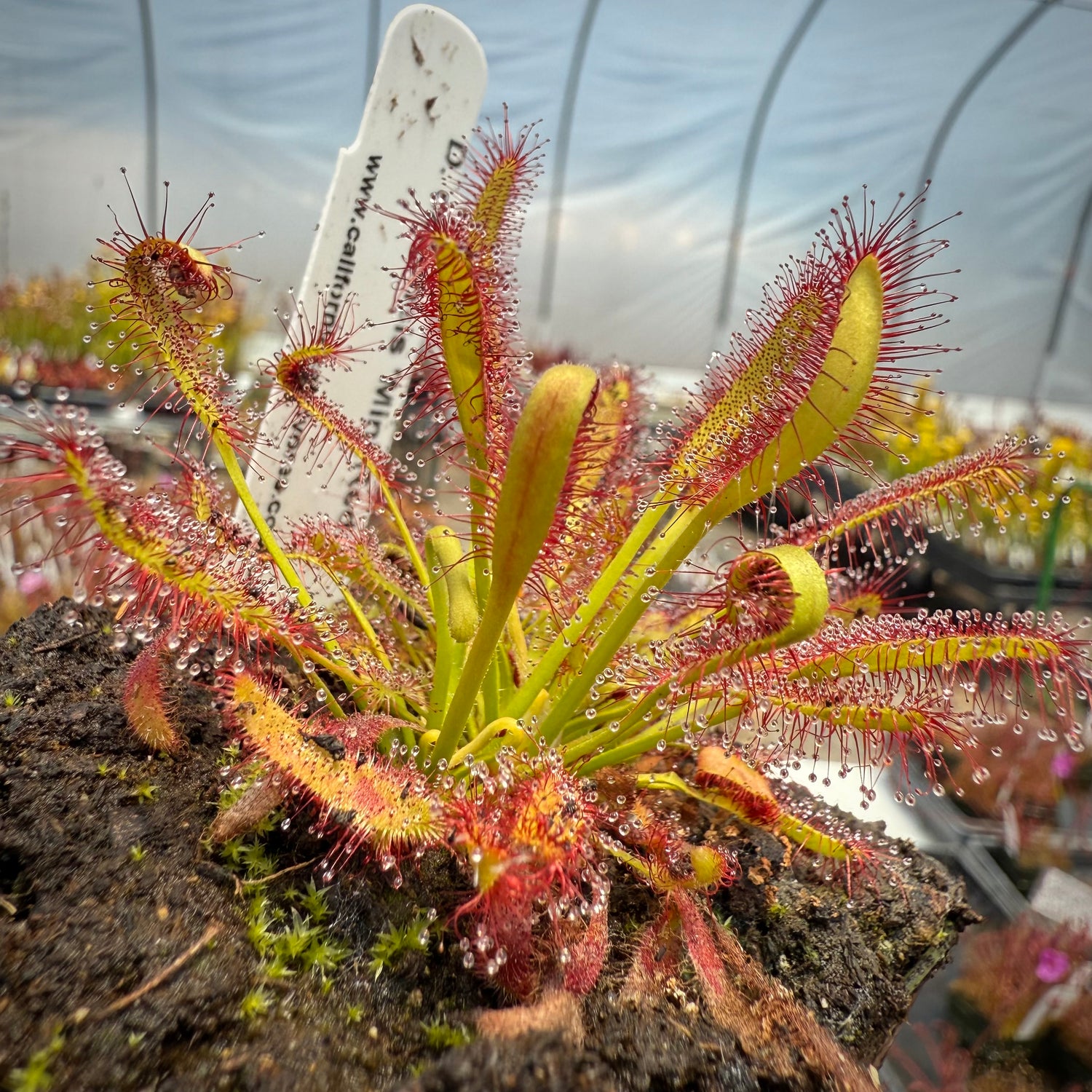
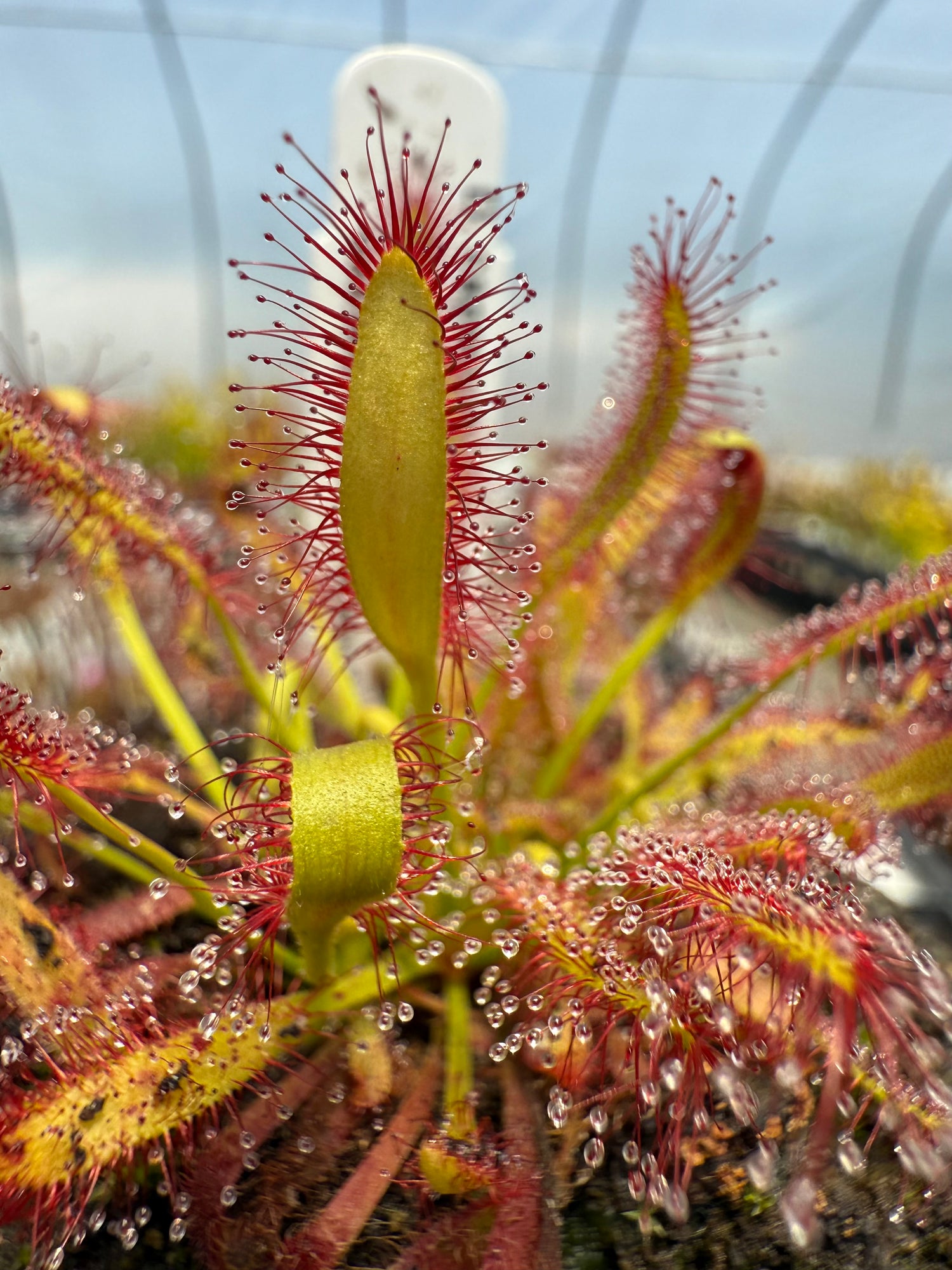
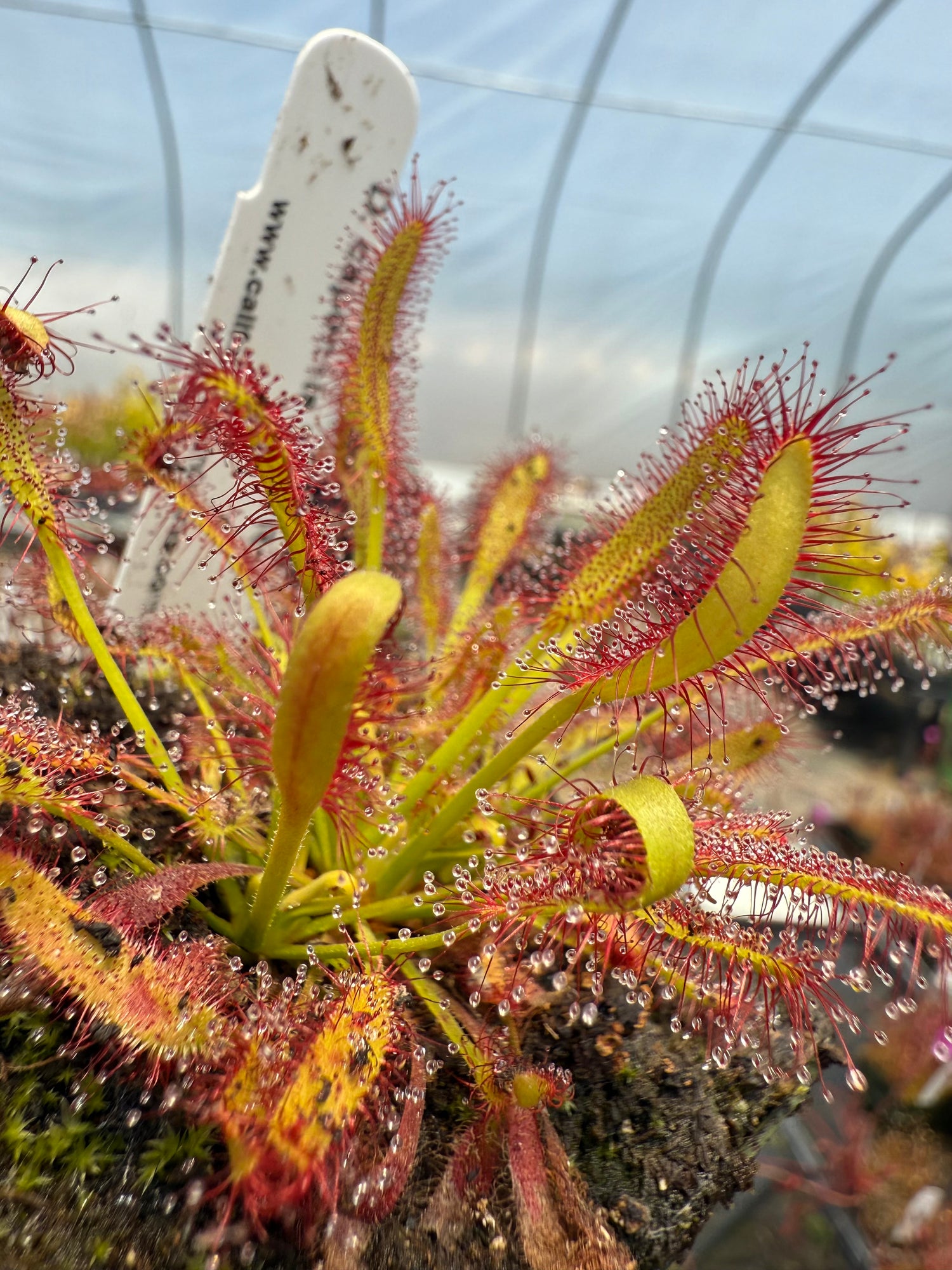
Cape sundews are some of the easiest and most forgiving carnivorous plants to grow! There’s something magical about these dew-covered plants! Each leaf is covered in tons of dewy tentacles, waiting to lure in, trap, and eat insects like fungus gnats and fruit flies.
This is a new cultivar to us, called “Mini Red.” It has a slightly smaller stature than other capensis—a charmingly petite plant! It is covered in red tentacles with green petioles.
The plants we are shipping are about 2-3” tall.
Please note: Shipping can be hard on the sticky dew covering the leaves, so your plant may arrive without dew. It can take a few weeks for the plant to produce more dew. If after four weeks it has not produced dew, you may need to increase light.
Care Instructions
Growth Habit: Drosera capensis are small, bushy plants that grow about 6” tall at maturity, although some forms can be slightly larger and this form is likely much smaller. Capensis spread readily by dropping seeds from their abundant flowers in their pots, which do not need to be pollinated. As they grow, their leaves die back, starting from the base of the plant and moving up. The leaves die back and can be cut off. The stem will thicken and be black or brown. Sometimes larger, older plants will flop over and grow sideways as they age, growing taller and taller with new leaves emerging from the top of the plant. Capensis can regrow from the roots quite readily, so if your crown dies, keep nurturing it, and you should see new growth. These plants have a high leaf turnover, meaning their leaves die back frequently, but new leaves grow just as fast.
Sun: Full sun. Grow indoors on a sunny windowsill, in a terrarium under lights, or outdoors. If grown indoors, Drosera will require full sun to produce their sticky dew, so be sure to place them in a window where they will receive direct sunlight for most of the day. If grown under lights, keep your grow lights on a 10 to 12-hour day length and hang your grow lights 6 to 10 inches above the plants on the quality of your lights. Grown outdoors, these plants will enjoy a great deal of sun. If you live somewhere extremely hot, for example, Arizona, you will want to protect them from the Full intensity of the afternoon sunlight. You can either grow them in morning sun only, or use shade cloth to help protect them in these very hot areas. These plants may be more colorful and smaller when grown outdoors because the light is more intense. You can expect a few leaves to burn back when you first place your plant outdoors in the sun, and if you receive your plant in the summer, it is a good idea to slowly acclimate it to the sunlight over a day or two. Even in less sunny seasons, areas, or with acclimation, you can still expect to see some burned leaves when first placed outside. This is normal, and new leaves will grow that are more adjusted to the sun. In winter, when grown in sunlight, indoors or outdoors, it is very normal for color to fade from red varieties due to less sun. IF YOUR SUNDEW IS NOT PRODUCING DEW, IT MOST LIKELY NEEDS MORE SUNLIGHT. It can also take a few weeks after shipping for dew to generate.
Water: Always sitting in a few inches of distilled, rain, or reverse osmosis water. These plants always prefer to have their roots wet and can have their pots sitting in a deep saucer of water all the time.
Temperature and Dormancy: Drosera capensis tolerate a wide range of temperatures but will be happiest in 40 - 80 degrees. They can take temperatures from freezing to 100 degrees but only for short periods and can grow back from the roots after a freeze if the daytime temperatures increase above 40. Drosera capensis do not need a dormancy but will die back or slow growth in winter depending on the conditions they are exposed to. If exposed to freezes, they will die back. And many will slow their growth or grow smaller in winter. Drosera capensis does need a nighttime drop in temperatures of 10-20 degrees; if you’d like to grow this in a tropical zone, we recommend the ‘Alba’ cultivar as it can tolerate no nighttime drop in temperature.
Soil and Repotting: We prefer a mix of four-part fertilizer-free peat moss to one-part perlite. You can add our pre-made mix to your order here. You do not need to repot your plant when you receive it from us for at least a year, and we recommend against it during the spring-summer months. Repot Drosera every 1-3 years. Avoid placing in excessively large pots; size up only a few inches at a time. Soil can also develop a swampy smell, especially right after shipping, when the plant is wrapped in plastic and sealed. This is normal; these plants grow naturally in bogs and swampy conditions, and peat moss can develop a bit of an anaerobic smell, but this does not indicate a problem with the soil.
Feeding and Fertilizer: Drosera catch small insects like fungus gnats and fruit flies in their sticky dew. They can catch bigger prey like houseflies or crane flies and can slowly curl their leaves around these larger bugs to make better contact. Over time, their leaves will produce enzymes to digest the nutrients from the bug, absorbing them through their leaves, leaving only the exoskeleton on their sticky leaves. There’s no need to remove these as they often serve as a lure to other insects looking for an easy meal. When grown outdoors, they will catch plenty of food. When grown indoors, they will significantly benefit from a foliar fertilizer. Plants grown outdoors will appreciate a foliar feed as well. Apply MaxSea fertilizer once per month to the foliage only. Dilute 1/4 teaspoon of MaxSea into one gallon of water with a mister bottle or a watering can. Watch as the Drosera slowly curl their leaves after a foliar fertilizer application!
More Information: For further information on dormancy, repotting, growing from seed, and more, check out our website or our YouTube channel.


If you live in an area with very cold winters, where nighttime temperatures drop below 15 degrees for sustained periods, you have three options for providing them with winter dormancy: the garage method, mulching in, or the fridge method. Dormancy is triggered by a combination of exposure to shorter photo-periods and cooler temperatures in the 40-60's F. While you can skip a dormancy period once or twice, in the long term, your plant will begin to do poorly and will eventually die if you skip this crucial period. Please note, these plants die back to a dormant winter bud; large, blackish and hairy. Often a fine white hair-like fluff will form on this bud as well.
The garage method: Bring your plant indoors to a sunny windowsill in an unheated room or garage, where the nighttime temperatures will dip down to 50-60F. Keep it well watered during this period, do not let it dry out, and put it outside again when the outside nighttime temperatures increase consistently above 20F.
The mulch method: Mulch them in very, very well outdoors. Pack at least four inches of mulch on top of the plants and all around the sides to prevent winds from chilling them and freezing the roots. You can also dig the pots into the ground and then mulch heavily on top.
The fridge method: leave your plant potted and place the pot in a resealable bag, and put the bag into the refrigerator. You can also treat the pot with super as a preventative before placing in the fridge. Leave them in the fridge from October to February, periodically checking on them to ensure they are still moist and not growing mold or fungus. Bring them out in February. You can vary the timing to align with your outside nighttime temperatures so that your plants can come out of dormancy when it is safe to place them back outside. You can leave them in the fridge for an extended period if you have very long winters.
Soil and Repotting: We prefer a mix of four-part fertilizer-free peat moss to one-part perlite. You can add our pre-made mix to your order here. You do not need to repot your plant when you receive it from us for at least a year, and we recommend against it during the spring-summer months. Repot Drosera every 3 years in winter when they are dormant. Avoid placing in excessively large pots; size up only a few inches at a time. They do well in tall pots. Soil can also develop a swampy smell, especially right after shipping, when the plant is wrapped in plastic and sealed. This is normal; these plants grow naturally in bogs and swampy conditions, and peat moss can develop a bit of an anaerobic smell, but this does not indicate a problem with the soil.
Feeding and Fertilizer: Drosera will catch plenty of food when grown outdoors. When grown indoors, they will significantly benefit from a foliar fertilizer. Plants grown outdoors will appreciate a foliar feed as well. Apply MaxSea fertilizer once per month to the foliage only. Dilute 1/4 teaspoon of MaxSea into one gallon of water and then apply with a mister bottle or a watering can.
More Information: For further information on dormancy, repotting, dividing, and more, check out our website or our YouTube channel.


These thread leaf sundews come from New Jersey. Thread leaf sundews have an amazing magic all their own; in spring and summer they send up many leaves of long, slowly unfurling dew covered leaves that catch lots of insects but also glisten like a curtain of crystals in the sun.
The plants we are shipping will be 2-4” in size.
Please note: Shipping can be hard on the sticky dew covering the leaves, so your plant may arrive without dew. It can take a few weeks for the plant to produce more dew. If after four weeks it has not produced dew, you may need to increase light.
If you live in an area with very cold winters, where nighttime temperatures drop below 15 degrees for sustained periods, you have three options for providing them with winter dormancy: the garage method, mulching in, or the fridge method. Dormancy is triggered by a combination of exposure to shorter photo-periods and cooler temperatures in the 40-60's F. While you can skip a dormancy period once or twice, in the long term, your plant will begin to do poorly and will eventually die if you skip this crucial period. Please note, these plants die back to a dormant winter bud; large, blackish and hairy. Often a fine white hair-like fluff will form on this bud as well.
The garage method: Bring your plant indoors to a sunny windowsill in an unheated room or garage, where the nighttime temperatures will dip down to 50-60F. Keep it well watered during this period, do not let it dry out, and put it outside again when the outside nighttime temperatures increase consistently above 20F.
The mulch method: Mulch them in very, very well outdoors. Pack at least four inches of mulch on top of the plants and all around the sides to prevent winds from chilling them and freezing the roots. You can also dig the pots into the ground and then mulch heavily on top.
The fridge method: leave your plant potted and place the pot in a resealable bag, and put the bag into the refrigerator. You can also treat the pot with super as a preventative before placing in the fridge. Leave them in the fridge from October to February, periodically checking on them to ensure they are still moist and not growing mold or fungus. Bring them out in February. You can vary the timing to align with your outside nighttime temperatures so that your plants can come out of dormancy when it is safe to place them back outside. You can leave them in the fridge for an extended period if you have very long winters.
Soil and Repotting: We prefer a mix of four-part fertilizer-free peat moss to one-part perlite. You can add our pre-made mix to your order here. You do not need to repot your plant when you receive it from us for at least a year, and we recommend against it during the spring-summer months. Repot Drosera every 3 years in winter when they are dormant. Avoid placing in excessively large pots; size up only a few inches at a time. They do well in tall pots. Soil can also develop a swampy smell, especially right after shipping, when the plant is wrapped in plastic and sealed. This is normal; these plants grow naturally in bogs and swampy conditions, and peat moss can develop a bit of an anaerobic smell, but this does not indicate a problem with the soil.
Feeding and Fertilizer: Drosera will catch plenty of food when grown outdoors. When grown indoors, they will significantly benefit from a foliar fertilizer. Plants grown outdoors will appreciate a foliar feed as well. Apply MaxSea fertilizer once per month to the foliage only. Dilute 1/4 teaspoon of MaxSea into one gallon of water and then apply with a mister bottle or a watering can.
More Information: For further information on dormancy, repotting, dividing, and more, check out our website or our YouTube channel.


These are a beautiful, true filiformis, grown from seeds collected at the Old Dock Site in North Carolina. We are super excited to be selling this new, more vigorous filiformis.
The plants we are shipping will be 2-4” in size.
Please note: Shipping can be hard on the sticky dew covering the leaves, so your plant may arrive without dew. It can take a few weeks for the plant to produce more dew. If after four weeks it has not produced dew, you may need to increase light.
If you live in an area with very cold winters, where nighttime temperatures drop below 15 degrees for sustained periods, you have three options for providing them with winter dormancy: the garage method, mulching in, or the fridge method. Dormancy is triggered by a combination of exposure to shorter photo-periods and cooler temperatures in the 40-60's F. While you can skip a dormancy period once or twice, in the long term, your plant will begin to do poorly and will eventually die if you skip this crucial period. Please note, these plants die back to a dormant winter bud; large, blackish and hairy. Often a fine white hair-like fluff will form on this bud as well.
The garage method: Bring your plant indoors to a sunny windowsill in an unheated room or garage, where the nighttime temperatures will dip down to 50-60F. Keep it well watered during this period, do not let it dry out, and put it outside again when the outside nighttime temperatures increase consistently above 20F.
The mulch method: Mulch them in very, very well outdoors. Pack at least four inches of mulch on top of the plants and all around the sides to prevent winds from chilling them and freezing the roots. You can also dig the pots into the ground and then mulch heavily on top.
The fridge method: leave your plant potted and place the pot in a resealable bag, and put the bag into the refrigerator. You can also treat the pot with super as a preventative before placing in the fridge. Leave them in the fridge from October to February, periodically checking on them to ensure they are still moist and not growing mold or fungus. Bring them out in February. You can vary the timing to align with your outside nighttime temperatures so that your plants can come out of dormancy when it is safe to place them back outside. You can leave them in the fridge for an extended period if you have very long winters.
Soil and Repotting: We prefer a mix of four-part fertilizer-free peat moss to one-part perlite. You can add our pre-made mix to your order here. You do not need to repot your plant when you receive it from us for at least a year, and we recommend against it during the spring-summer months. Repot Drosera every 3 years in winter when they are dormant. Avoid placing in excessively large pots; size up only a few inches at a time. They do well in tall pots. Soil can also develop a swampy smell, especially right after shipping, when the plant is wrapped in plastic and sealed. This is normal; these plants grow naturally in bogs and swampy conditions, and peat moss can develop a bit of an anaerobic smell, but this does not indicate a problem with the soil.
Feeding and Fertilizer: Drosera will catch plenty of food when grown outdoors. When grown indoors, they will significantly benefit from a foliar fertilizer. Plants grown outdoors will appreciate a foliar feed as well. Apply MaxSea fertilizer once per month to the foliage only. Dilute 1/4 teaspoon of MaxSea into one gallon of water and then apply with a mister bottle or a watering can.
More Information: For further information on dormancy, repotting, dividing, and more, check out our website or our YouTube channel.


Drosera filiformis ‘Carolina Giant” is a lovely, delicate threadleaf sundew with red tinted dew! The second photo is of our display pot, full of mature plants, the third photo is an example of the plant you will receive.
The plants we are shipping will be 2-4” in size.
Please note: Shipping can be hard on the sticky dew covering the leaves, so your plant may arrive without dew. It can take a few weeks for the plant to produce more dew. If after four weeks it has not produced dew, you may need to increase light.
If you live in an area with very cold winters, where nighttime temperatures drop below 15 degrees for sustained periods, you have three options for providing them with winter dormancy: the garage method, mulching in, or the fridge method. Dormancy is triggered by a combination of exposure to shorter photo-periods and cooler temperatures in the 40-60's F. While you can skip a dormancy period once or twice, in the long term, your plant will begin to do poorly and will eventually die if you skip this crucial period. Please note, these plants die back to a dormant winter bud; large, blackish and hairy. Often a fine white hair-like fluff will form on this bud as well.
The garage method: Bring your plant indoors to a sunny windowsill in an unheated room or garage, where the nighttime temperatures will dip down to 50-60F. Keep it well watered during this period, do not let it dry out, and put it outside again when the outside nighttime temperatures increase consistently above 20F.
The mulch method: Mulch them in very, very well outdoors. Pack at least four inches of mulch on top of the plants and all around the sides to prevent winds from chilling them and freezing the roots. You can also dig the pots into the ground and then mulch heavily on top.
The fridge method: leave your plant potted and place the pot in a resealable bag, and put the bag into the refrigerator. You can also treat the pot with super as a preventative before placing in the fridge. Leave them in the fridge from October to February, periodically checking on them to ensure they are still moist and not growing mold or fungus. Bring them out in February. You can vary the timing to align with your outside nighttime temperatures so that your plants can come out of dormancy when it is safe to place them back outside. You can leave them in the fridge for an extended period if you have very long winters.
Soil and Repotting: We prefer a mix of four-part fertilizer-free peat moss to one-part perlite. You can add our pre-made mix to your order here. You do not need to repot your plant when you receive it from us for at least a year, and we recommend against it during the spring-summer months. Repot Drosera every 3 years in winter when they are dormant. Avoid placing in excessively large pots; size up only a few inches at a time. They do well in tall pots. Soil can also develop a swampy smell, especially right after shipping, when the plant is wrapped in plastic and sealed. This is normal; these plants grow naturally in bogs and swampy conditions, and peat moss can develop a bit of an anaerobic smell, but this does not indicate a problem with the soil.
Feeding and Fertilizer: Drosera will catch plenty of food when grown outdoors. When grown indoors, they will significantly benefit from a foliar fertilizer. Plants grown outdoors will appreciate a foliar feed as well. Apply MaxSea fertilizer once per month to the foliage only. Dilute 1/4 teaspoon of MaxSea into one gallon of water and then apply with a mister bottle or a watering can.
More Information: For further information on dormancy, repotting, dividing, and more, check out our website or our YouTube channel.


If you live in an area with very cold winters, where nighttime temperatures drop below 15 degrees for sustained periods, you have three options for providing them with winter dormancy: the garage method, mulching in, or the fridge method. Dormancy is triggered by a combination of exposure to shorter photo-periods and cooler temperatures in the 40-60's F. While you can skip a dormancy period once or twice, in the long term, your plant will begin to do poorly and will eventually die if you skip this crucial period. Please note, these plants die back to a dormant winter bud; large, blackish and hairy. Often a fine white hair-like fluff will form on this bud as well.
The garage method: Bring your plant indoors to a sunny windowsill in an unheated room or garage, where the nighttime temperatures will dip down to 50-60F. Keep it well watered during this period, do not let it dry out, and put it outside again when the outside nighttime temperatures increase consistently above 20F.
The mulch method: Mulch them in very, very well outdoors. Pack at least four inches of mulch on top of the plants and all around the sides to prevent winds from chilling them and freezing the roots. You can also dig the pots into the ground and then mulch heavily on top.
The fridge method: leave your plant potted and place the pot in a resealable bag, and put the bag into the refrigerator. You can also treat the pot with super as a preventative before placing in the fridge. Leave them in the fridge from October to February, periodically checking on them to ensure they are still moist and not growing mold or fungus. Bring them out in February. You can vary the timing to align with your outside nighttime temperatures so that your plants can come out of dormancy when it is safe to place them back outside. You can leave them in the fridge for an extended period if you have very long winters.
Soil and Repotting: We prefer a mix of four-part fertilizer-free peat moss to one-part perlite. You can add our pre-made mix to your order here. You do not need to repot your plant when you receive it from us for at least a year, and we recommend against it during the spring-summer months. Repot Drosera every 3 years in winter when they are dormant. Avoid placing in excessively large pots; size up only a few inches at a time. They do well in tall pots. Soil can also develop a swampy smell, especially right after shipping, when the plant is wrapped in plastic and sealed. This is normal; these plants grow naturally in bogs and swampy conditions, and peat moss can develop a bit of an anaerobic smell, but this does not indicate a problem with the soil.
Feeding and Fertilizer: Drosera will catch plenty of food when grown outdoors. When grown indoors, they will significantly benefit from a foliar fertilizer. Plants grown outdoors will appreciate a foliar feed as well. Apply MaxSea fertilizer once per month to the foliage only. Dilute 1/4 teaspoon of MaxSea into one gallon of water and then apply with a mister bottle or a watering can.
More Information: For further information on dormancy, repotting, dividing, and more, check out our website or our YouTube channel.

If you live in an area with very cold winters, where nighttime temperatures drop below 15 degrees for sustained periods, you have three options for providing them with winter dormancy: the garage method, mulching in, or the fridge method. Dormancy is triggered by a combination of exposure to shorter photo-periods and cooler temperatures in the 40-60's F. While you can skip a dormancy period once or twice, in the long term, your plant will begin to do poorly and will eventually die if you skip this crucial period. Please note, these plants die back to a dormant winter bud; large, blackish and hairy. Often a fine white hair-like fluff will form on this bud as well.
The garage method: Bring your plant indoors to a sunny windowsill in an unheated room or garage, where the nighttime temperatures will dip down to 50-60F. Keep it well watered during this period, do not let it dry out, and put it outside again when the outside nighttime temperatures increase consistently above 20F.
The mulch method: Mulch them in very, very well outdoors. Pack at least four inches of mulch on top of the plants and all around the sides to prevent winds from chilling them and freezing the roots. You can also dig the pots into the ground and then mulch heavily on top.
The fridge method: leave your plant potted and place the pot in a resealable bag, and put the bag into the refrigerator. You can also treat the pot with super as a preventative before placing in the fridge. Leave them in the fridge from October to February, periodically checking on them to ensure they are still moist and not growing mold or fungus. Bring them out in February. You can vary the timing to align with your outside nighttime temperatures so that your plants can come out of dormancy when it is safe to place them back outside. You can leave them in the fridge for an extended period if you have very long winters.
Soil and Repotting: We prefer a mix of four-part fertilizer-free peat moss to one-part perlite. You can add our pre-made mix to your order here. You do not need to repot your plant when you receive it from us for at least a year, and we recommend against it during the spring-summer months. Repot Drosera every 3 years in winter when they are dormant. Avoid placing in excessively large pots; size up only a few inches at a time. They do well in tall pots. Soil can also develop a swampy smell, especially right after shipping, when the plant is wrapped in plastic and sealed. This is normal; these plants grow naturally in bogs and swampy conditions, and peat moss can develop a bit of an anaerobic smell, but this does not indicate a problem with the soil.
Feeding and Fertilizer: Drosera will catch plenty of food when grown outdoors. When grown indoors, they will significantly benefit from a foliar fertilizer. Plants grown outdoors will appreciate a foliar feed as well. Apply MaxSea fertilizer once per month to the foliage only. Dilute 1/4 teaspoon of MaxSea into one gallon of water and then apply with a mister bottle or a watering can.
More Information: For further information on dormancy, repotting, dividing, and more, check out our website or our YouTube channel.


If you live in an area with very cold winters, where nighttime temperatures drop below 15 degrees for sustained periods, you have three options for providing them with winter dormancy: the garage method, mulching in, or the fridge method. Dormancy is triggered by a combination of exposure to shorter photo-periods and cooler temperatures in the 40-60's F. While you can skip a dormancy period once or twice, in the long term, your plant will begin to do poorly and will eventually die if you skip this crucial period. Please note, these plants die back to a dormant winter bud; large, blackish and hairy. Often a fine white hair-like fluff will form on this bud as well.
The garage method: Bring your plant indoors to a sunny windowsill in an unheated room or garage, where the nighttime temperatures will dip down to 50-60F. Keep it well watered during this period, do not let it dry out, and put it outside again when the outside nighttime temperatures increase consistently above 20F.
The mulch method: Mulch them in very, very well outdoors. Pack at least four inches of mulch on top of the plants and all around the sides to prevent winds from chilling them and freezing the roots. You can also dig the pots into the ground and then mulch heavily on top.
The fridge method: leave your plant potted and place the pot in a resealable bag, and put the bag into the refrigerator. You can also treat the pot with super as a preventative before placing in the fridge. Leave them in the fridge from October to February, periodically checking on them to ensure they are still moist and not growing mold or fungus. Bring them out in February. You can vary the timing to align with your outside nighttime temperatures so that your plants can come out of dormancy when it is safe to place them back outside. You can leave them in the fridge for an extended period if you have very long winters.
Soil and Repotting: We prefer a mix of four-part fertilizer-free peat moss to one-part perlite. You can add our pre-made mix to your order here. You do not need to repot your plant when you receive it from us for at least a year, and we recommend against it during the spring-summer months. Repot Drosera every 3 years in winter when they are dormant. Avoid placing in excessively large pots; size up only a few inches at a time. They do well in tall pots. Soil can also develop a swampy smell, especially right after shipping, when the plant is wrapped in plastic and sealed. This is normal; these plants grow naturally in bogs and swampy conditions, and peat moss can develop a bit of an anaerobic smell, but this does not indicate a problem with the soil.
Feeding and Fertilizer: Drosera will catch plenty of food when grown outdoors. When grown indoors, they will significantly benefit from a foliar fertilizer. Plants grown outdoors will appreciate a foliar feed as well. Apply MaxSea fertilizer once per month to the foliage only. Dilute 1/4 teaspoon of MaxSea into one gallon of water and then apply with a mister bottle or a watering can.
More Information: For further information on dormancy, repotting, dividing, and more, check out our website or our YouTube channel.


This is a beautiful temperate form of Drosera intermedia, native to Eastern Canada, the US, and Europe. In nature it often grows semi-aquatically around lakes in pure peat moss. In cultivation, it does best in un-drained bowls of waterlogged peat. It forms a tight bud to overwinter cold conditions. Great for the outdoor bog garden and it will reseed.
These have been grown under 30% shade cloth and are lightly colored, best to transition to more full sun to reduce burning.
The plants we are shipping will be 1-3” in size.
Please note: Shipping can be hard on the sticky dew covering the leaves, so your plant may arrive without dew. It can take a few weeks for the plant to produce more dew. If after four weeks it has not produced dew, you may need to increase light.
The garage method: Bring your plant indoors to a sunny windowsill in an unheated room or garage, where the nighttime temperatures will dip down to 50-60F. Keep it well watered during this period, do not let it dry out, and put it outside again when the outside nighttime temperatures increase consistently above 20F.
The mulch method: Mulch them in very, very well outdoors. Pack at least four inches of mulch on top of the plants and all around the sides to prevent winds from chilling them and freezing the roots. You can also dig the pots into the ground and then mulch heavily on top.
The fridge method: leave your plant potted and place the pot in a resealable bag, and put the bag into the refrigerator. You can also treat the pot with super as a preventative before placing in the fridge. Leave them in the fridge from October to February, periodically checking on them to ensure they are still moist and not growing mold or fungus. Bring them out in February. You can vary the timing to align with your outside nighttime temperatures so that your plants can come out of dormancy when it is safe to place them back outside. You can leave them in the fridge for an extended period if you have very long winters.
Soil and Repotting: We prefer a mix of four-part fertilizer-free peat moss to one-part perlite. You can add our pre-made mix to your order here. You do not need to repot your plant when you receive it from us for at least a year, and we recommend against it during the spring-summer months. Repot Drosera every 3 years in winter when they are dormant. Avoid placing in excessively large pots; size up only a few inches at a time. They do well in tall pots. Soil can also develop a swampy smell, especially right after shipping, when the plant is wrapped in plastic and sealed. This is normal; these plants grow naturally in bogs and swampy conditions, and peat moss can develop a bit of an anaerobic smell, but this does not indicate a problem with the soil.
Feeding and Fertilizer: Drosera will catch plenty of food when grown outdoors. When grown indoors, they will significantly benefit from a foliar fertilizer. Plants grown outdoors will appreciate a foliar feed as well. Apply MaxSea fertilizer once per month to the foliage only. Dilute 1/4 teaspoon of MaxSea into one gallon of water and then apply with a mister bottle or a watering can.
More Information: For further information on dormancy, repotting, dividing, and more, check out our website or our YouTube channel.


We love the stunning Drosera intermedia x capillaris! This little sundew boasts temperate parents, making it a perfect year-round outdoor plant in areas with mild winters. These delicate plants will be 2” tall and wide at maturity. Each paddle-shaped leaf is candy-apple-red and covered in glistening drops of sticky dew. They are unbelievably beautiful, especially when grown en masse.
The plants we are shipping will be 1-2” in size.
Please note: Shipping can be hard on the sticky dew covering the leaves, so your plant may arrive without dew. It can take a few weeks for the plant to produce more dew. If after four weeks it has not produced dew, you may need to increase light.
The garage method: Bring your plant indoors to a sunny windowsill in an unheated room or garage, where the nighttime temperatures will dip down to 50-60F. Keep it well watered during this period, do not let it dry out, and put it outside again when the outside nighttime temperatures increase consistently above 20F.
The mulch method: Mulch them in very, very well outdoors. Pack at least four inches of mulch on top of the plants and all around the sides to prevent winds from chilling them and freezing the roots. You can also dig the pots into the ground and then mulch heavily on top.
The fridge method: leave your plant potted and place the pot in a resealable bag, and put the bag into the refrigerator. You can also treat the pot with super as a preventative before placing in the fridge. Leave them in the fridge from October to February, periodically checking on them to ensure they are still moist and not growing mold or fungus. Bring them out in February. You can vary the timing to align with your outside nighttime temperatures so that your plants can come out of dormancy when it is safe to place them back outside. You can leave them in the fridge for an extended period if you have very long winters.
Soil and Repotting: We prefer a mix of four-part fertilizer-free peat moss to one-part perlite. You can add our pre-made mix to your order here. You do not need to repot your plant when you receive it from us for at least a year, and we recommend against it during the spring-summer months. Repot Drosera every 3 years in winter when they are dormant. Avoid placing in excessively large pots; size up only a few inches at a time. They do well in tall pots. Soil can also develop a swampy smell, especially right after shipping, when the plant is wrapped in plastic and sealed. This is normal; these plants grow naturally in bogs and swampy conditions, and peat moss can develop a bit of an anaerobic smell, but this does not indicate a problem with the soil.
Feeding and Fertilizer: Drosera will catch plenty of food when grown outdoors. When grown indoors, they will significantly benefit from a foliar fertilizer. Plants grown outdoors will appreciate a foliar feed as well. Apply MaxSea fertilizer once per month to the foliage only. Dilute 1/4 teaspoon of MaxSea into one gallon of water and then apply with a mister bottle or a watering can.
More Information: For further information on dormancy, repotting, dividing, and more, check out our website or our YouTube channel.


Fertilizer: Apply diluted Maxsea fertilizer once or twice a month to the leaves.
Soil & Repotting: King sundews should be grown in a mix of long-fibered New Zealand sphagnum moss, orchid bark, pumice, and perlite. Our custom Nepenthes soil blend is available to add to your order (this is the appropriate mix for Drosera regia), but you do not need to repot your plant after receiving it from us. Regia do not appreciate repotting but should be moved to a bigger pot after 1-2 years. They prefer a tall pot.
More Information: For more information check out our FAQ page or our YouTube channel!


Water & Humidity: Always keep them in a saucer with a few inches of distilled, rainwater, or reverse osmosis water. Never let them dry out, especially in the hot summer months. Drosera are bog plants that prefer water-logged conditions unless you live somewhere both very hot AND extremely humid, like Alabama. In that case, let the water tray dry out for a day or two between refills. Always use distilled, reverse osmosis, or rainwater only. These plants are sensitive to their water quality, and giving them mineral and salt-free water is very important. In winter you can let them dry out a bit between rain storms, but do not let the soil get so dry that it pulls away from the edges of the pots. Be sure to supplement water as needed in between rains in winter. These plants appreciate humidity of at least 40%.
Temperature and Dormancy: These are subtropical plants, meaning they grow throughout the year without dormancy requirements and prefer warmer temperatures but can tolerate a brief frost. They thrive in temperatures ranging from 45 degrees - 90F. These plants do appreciate a 10-20 degree drop in temperature at night. They do not need or require a dormancy, making them an ideal houseplant.
Soil and Repotting: We prefer a mix of four-part fertilizer-free peat moss to one-part perlite. You can add our pre-made mix to your order here. You do not need to repot your plant when you receive it from us for at least a year, and we recommend against it during the spring-summer months. Repot Drosera every 1-3 years. Avoid placing in excessively large pots; size up only a few inches at a time. Soil can also develop a swampy smell, especially right after shipping, when the plant is wrapped in plastic and sealed. This is normal; these plants grow naturally in bogs and swampy conditions, and peat moss can develop a bit of an anaerobic smell, but this does not indicate a problem with the soil.
Feeding and Fertilizer: Drosera will catch plenty of food when grown outdoors. When grown indoors, they will significantly benefit from a foliar fertilizer. Plants grown outdoors will appreciate a foliar feed as well. Apply MaxSea fertilizer once per month to the foliage only. Dilute 1/4 teaspoon of MaxSea into one gallon of water and then apply to the leaves with a mister bottle or a watering can.
More Information: For further information on dormancy, repotting, dividing, and more, check out our website or our YouTube channel.


The plants we are shipping will be 2-4” in size.
Please note: Shipping can be hard on the sticky dew covering the leaves, so your plant may arrive without dew. It can take a few weeks for the plant to produce more dew. If after four weeks it has not produced dew, you may need to increase light.
If you live in an area with very cold winters, where nighttime temperatures drop below 15 degrees for sustained periods, you have three options for providing them with winter dormancy: the garage method, mulching in, or the fridge method. Dormancy is triggered by a combination of exposure to shorter photo-periods and cooler temperatures in the 40-60's F. While you can skip a dormancy period once or twice, in the long term, your plant will begin to do poorly and will eventually die if you skip this crucial period. Please note, these plants die back to a dormant winter bud; large, blackish and hairy. Often a fine white hair-like fluff will form on this bud as well.
The garage method: Bring your plant indoors to a sunny windowsill in an unheated room or garage, where the nighttime temperatures will dip down to 50-60F. Keep it well watered during this period, do not let it dry out, and put it outside again when the outside nighttime temperatures increase consistently above 20F.
The mulch method: Mulch them in very, very well outdoors. Pack at least four inches of mulch on top of the plants and all around the sides to prevent winds from chilling them and freezing the roots. You can also dig the pots into the ground and then mulch heavily on top.
The fridge method: leave your plant potted and place the pot in a resealable bag, and put the bag into the refrigerator. You can also treat the pot with super as a preventative before placing in the fridge. Leave them in the fridge from October to February, periodically checking on them to ensure they are still moist and not growing mold or fungus. Bring them out in February. You can vary the timing to align with your outside nighttime temperatures so that your plants can come out of dormancy when it is safe to place them back outside. You can leave them in the fridge for an extended period if you have very long winters.
Soil and Repotting: We prefer a mix of four-part fertilizer-free peat moss to one-part perlite. You can add our pre-made mix to your order here. You do not need to repot your plant when you receive it from us for at least a year, and we recommend against it during the spring-summer months. Repot Drosera every 3 years in winter when they are dormant. Avoid placing in excessively large pots; size up only a few inches at a time. They do well in tall pots. Soil can also develop a swampy smell, especially right after shipping, when the plant is wrapped in plastic and sealed. This is normal; these plants grow naturally in bogs and swampy conditions, and peat moss can develop a bit of an anaerobic smell, but this does not indicate a problem with the soil.
Feeding and Fertilizer: Drosera will catch plenty of food when grown outdoors. When grown indoors, they will significantly benefit from a foliar fertilizer. Plants grown outdoors will appreciate a foliar feed as well. Apply MaxSea fertilizer once per month to the foliage only. Dilute 1/4 teaspoon of MaxSea into one gallon of water and then apply with a mister bottle or a watering can.
More Information: For further information on dormancy, repotting, dividing, and more, check out our website or our YouTube channel.


The plants we are shipping will be 2-4” in size.
Please note: Shipping can be hard on the sticky dew covering the leaves, so your plant may arrive without dew. It can take a few weeks for the plant to produce more dew. If after four weeks it has not produced dew, you may need to increase light.
If you live in an area with very cold winters, where nighttime temperatures drop below 15 degrees for sustained periods, you have three options for providing them with winter dormancy: the garage method, mulching in, or the fridge method. Dormancy is triggered by a combination of exposure to shorter photo-periods and cooler temperatures in the 40-60's F. While you can skip a dormancy period once or twice, in the long term, your plant will begin to do poorly and will eventually die if you skip this crucial period. Please note, these plants die back to a dormant winter bud; large, blackish and hairy. Often a fine white hair-like fluff will form on this bud as well.
The garage method: Bring your plant indoors to a sunny windowsill in an unheated room or garage, where the nighttime temperatures will dip down to 50-60F. Keep it well watered during this period, do not let it dry out, and put it outside again when the outside nighttime temperatures increase consistently above 20F.
The mulch method: Mulch them in very, very well outdoors. Pack at least four inches of mulch on top of the plants and all around the sides to prevent winds from chilling them and freezing the roots. You can also dig the pots into the ground and then mulch heavily on top.
The fridge method: leave your plant potted and place the pot in a resealable bag, and put the bag into the refrigerator. You can also treat the pot with super as a preventative before placing in the fridge. Leave them in the fridge from October to February, periodically checking on them to ensure they are still moist and not growing mold or fungus. Bring them out in February. You can vary the timing to align with your outside nighttime temperatures so that your plants can come out of dormancy when it is safe to place them back outside. You can leave them in the fridge for an extended period if you have very long winters.
Soil and Repotting: We prefer a mix of four-part fertilizer-free peat moss to one-part perlite. You can add our pre-made mix to your order here. You do not need to repot your plant when you receive it from us for at least a year, and we recommend against it during the spring-summer months. Repot Drosera every 3 years in winter when they are dormant. Avoid placing in excessively large pots; size up only a few inches at a time. They do well in tall pots. Soil can also develop a swampy smell, especially right after shipping, when the plant is wrapped in plastic and sealed. This is normal; these plants grow naturally in bogs and swampy conditions, and peat moss can develop a bit of an anaerobic smell, but this does not indicate a problem with the soil.
Feeding and Fertilizer: Drosera will catch plenty of food when grown outdoors. When grown indoors, they will significantly benefit from a foliar fertilizer. Plants grown outdoors will appreciate a foliar feed as well. Apply MaxSea fertilizer once per month to the foliage only. Dilute 1/4 teaspoon of MaxSea into one gallon of water and then apply with a mister bottle or a watering can.
More Information: For further information on dormancy, repotting, dividing, and more, check out our website or our YouTube channel.
Showing 150/379