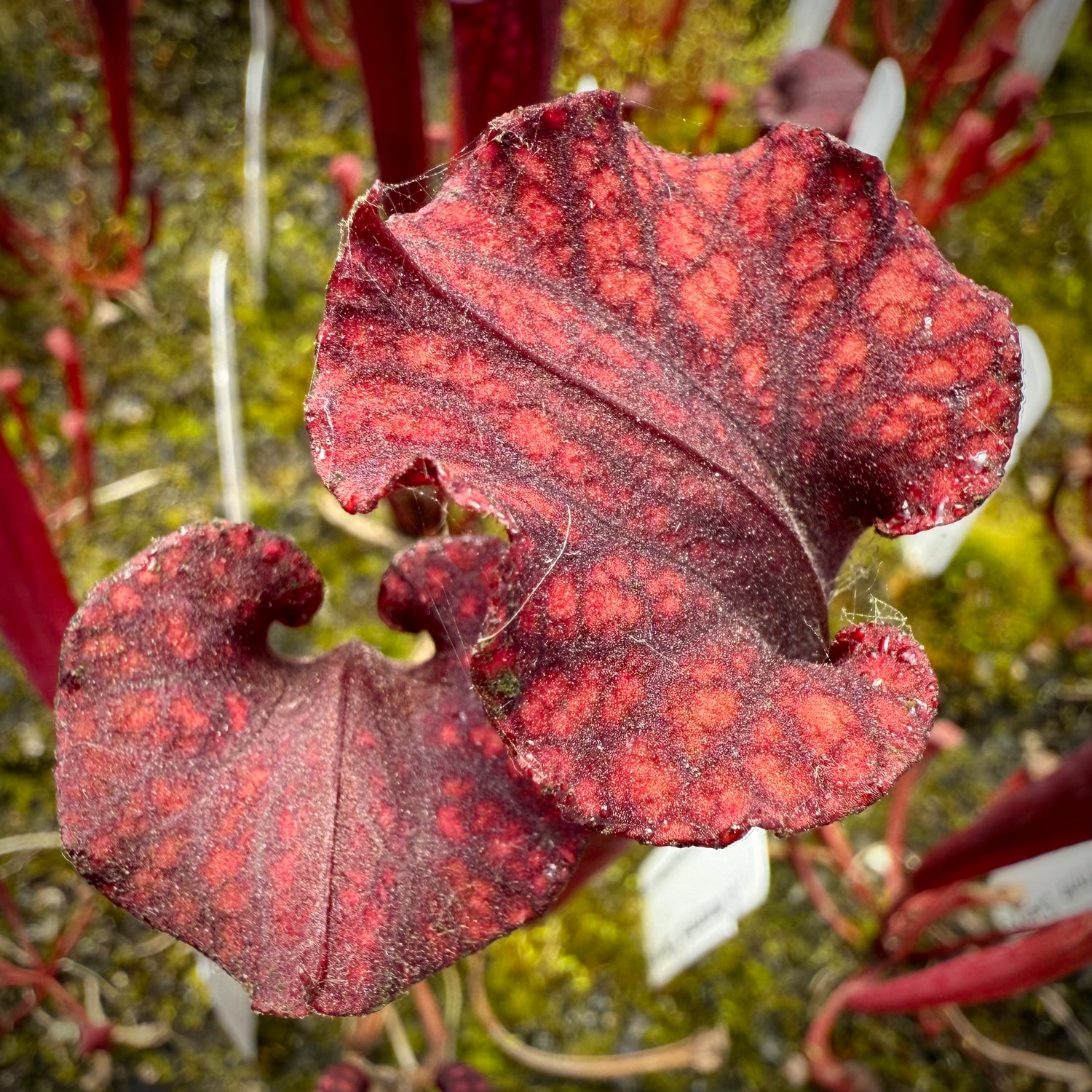
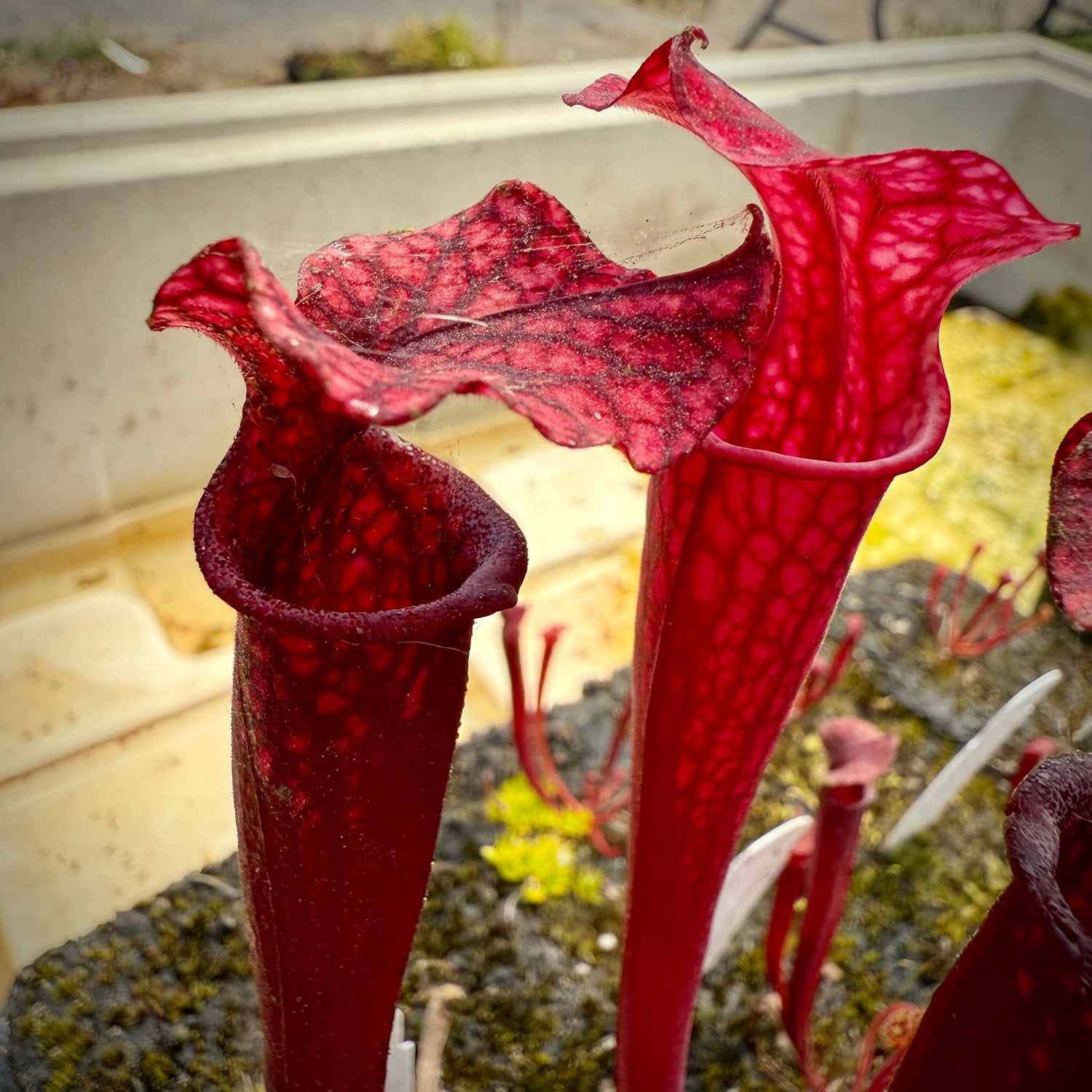
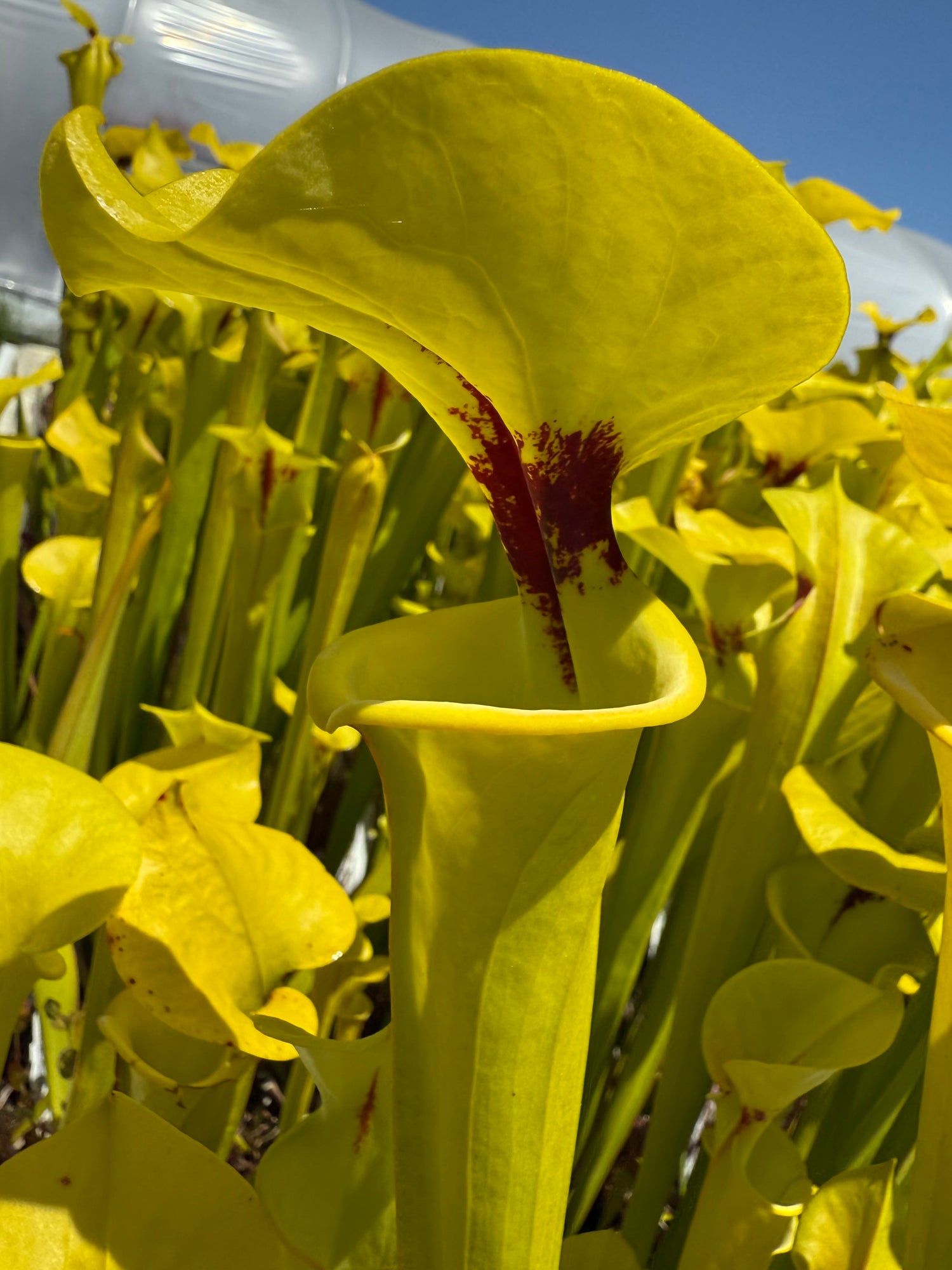
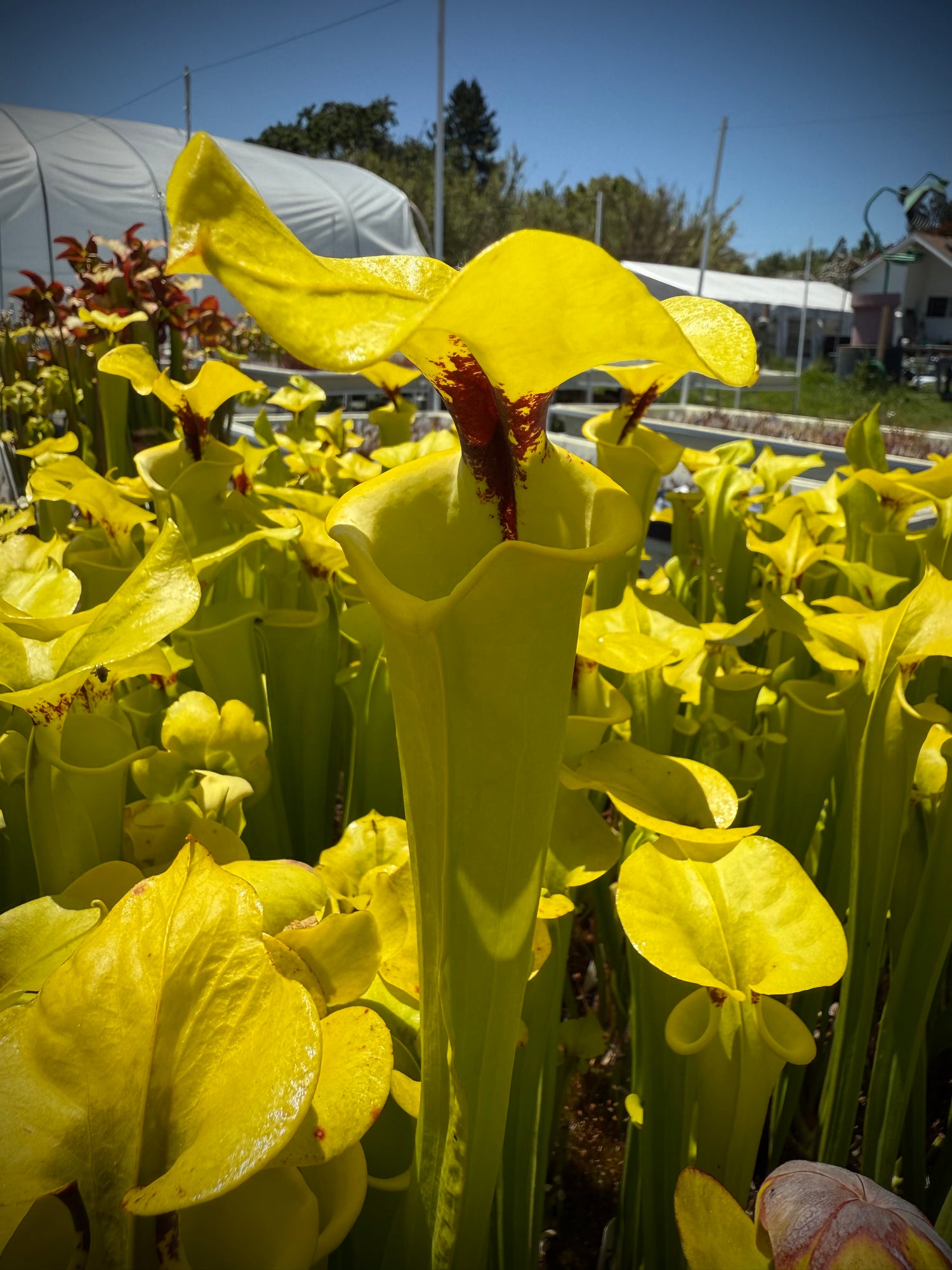
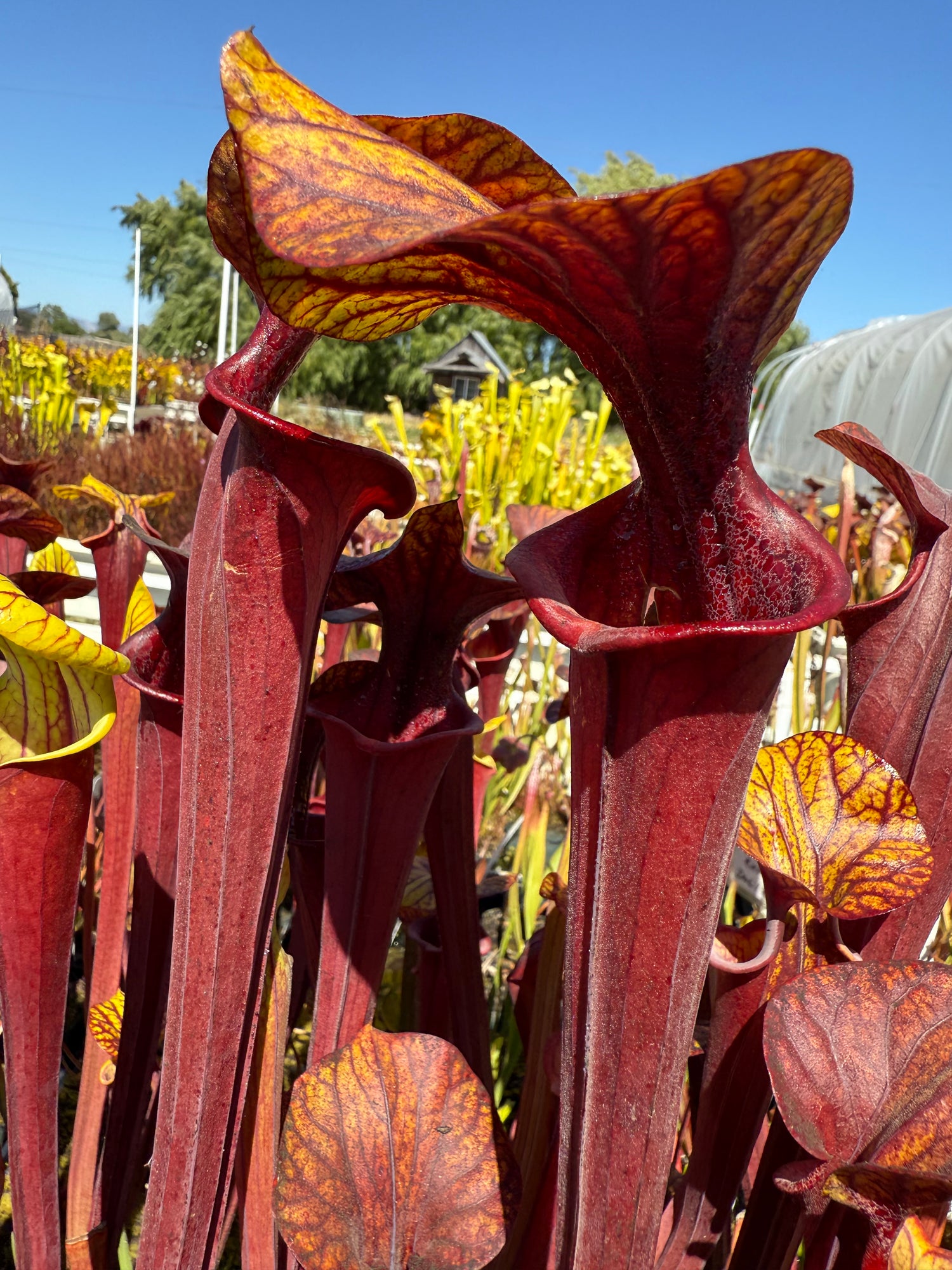
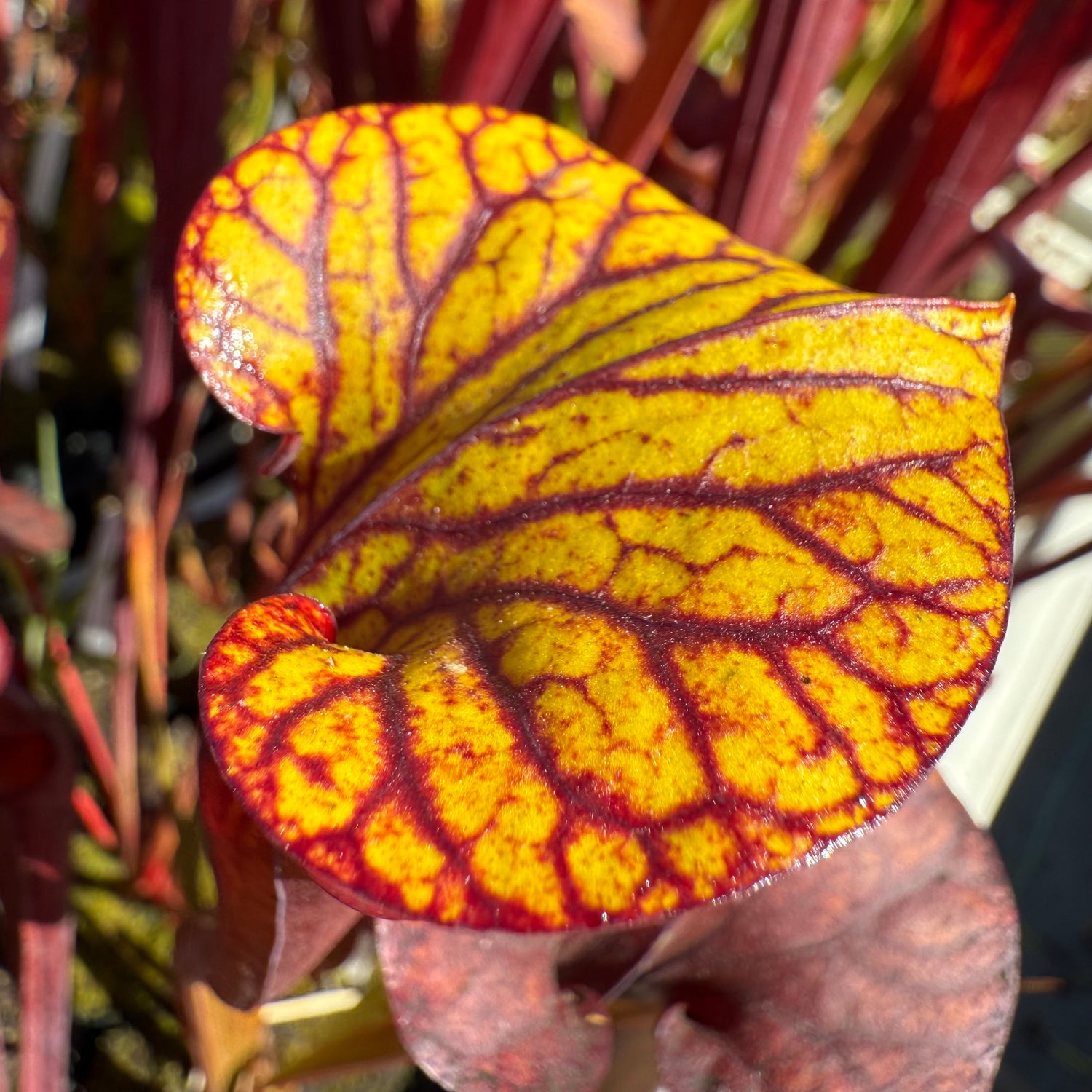
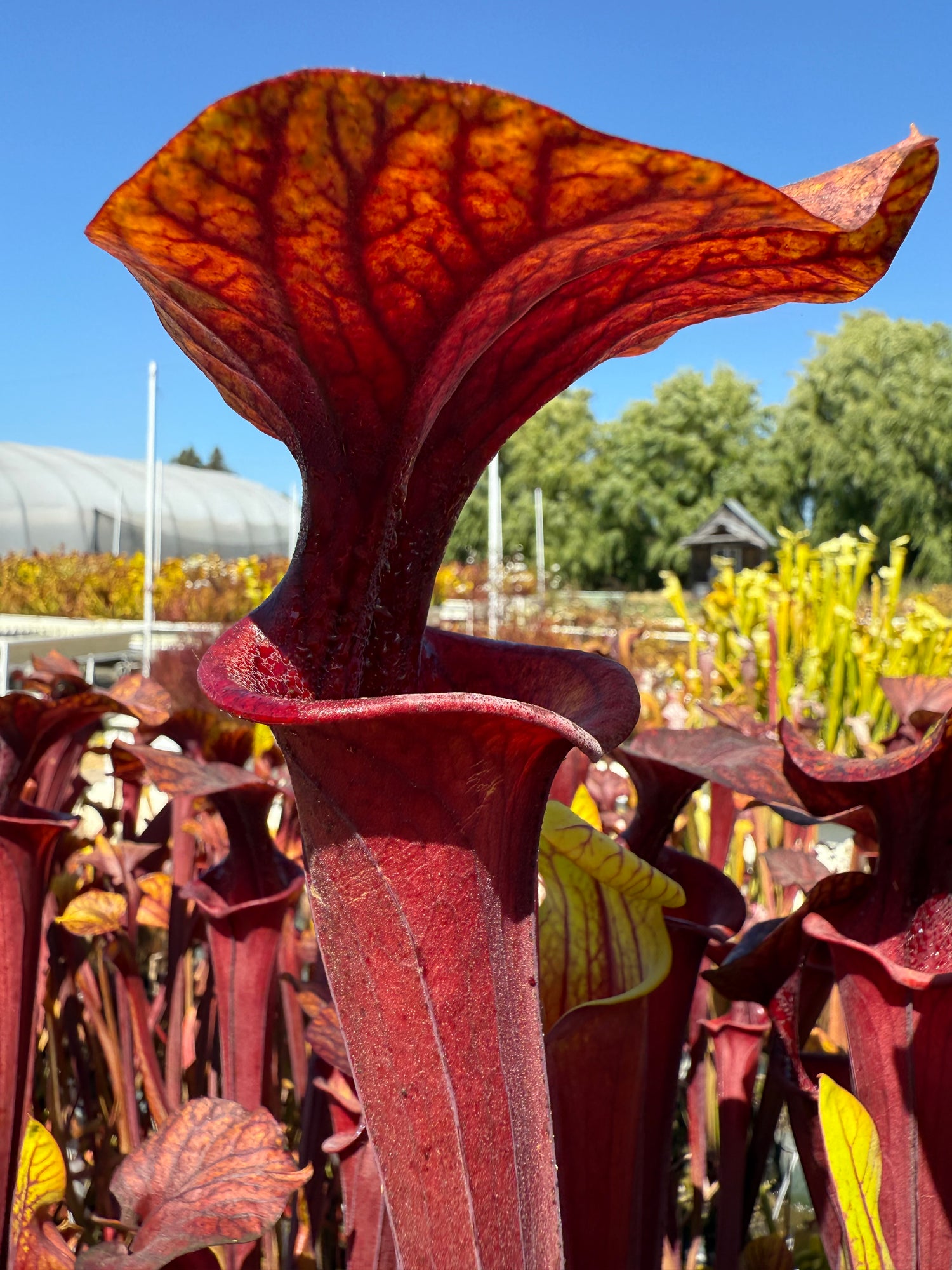
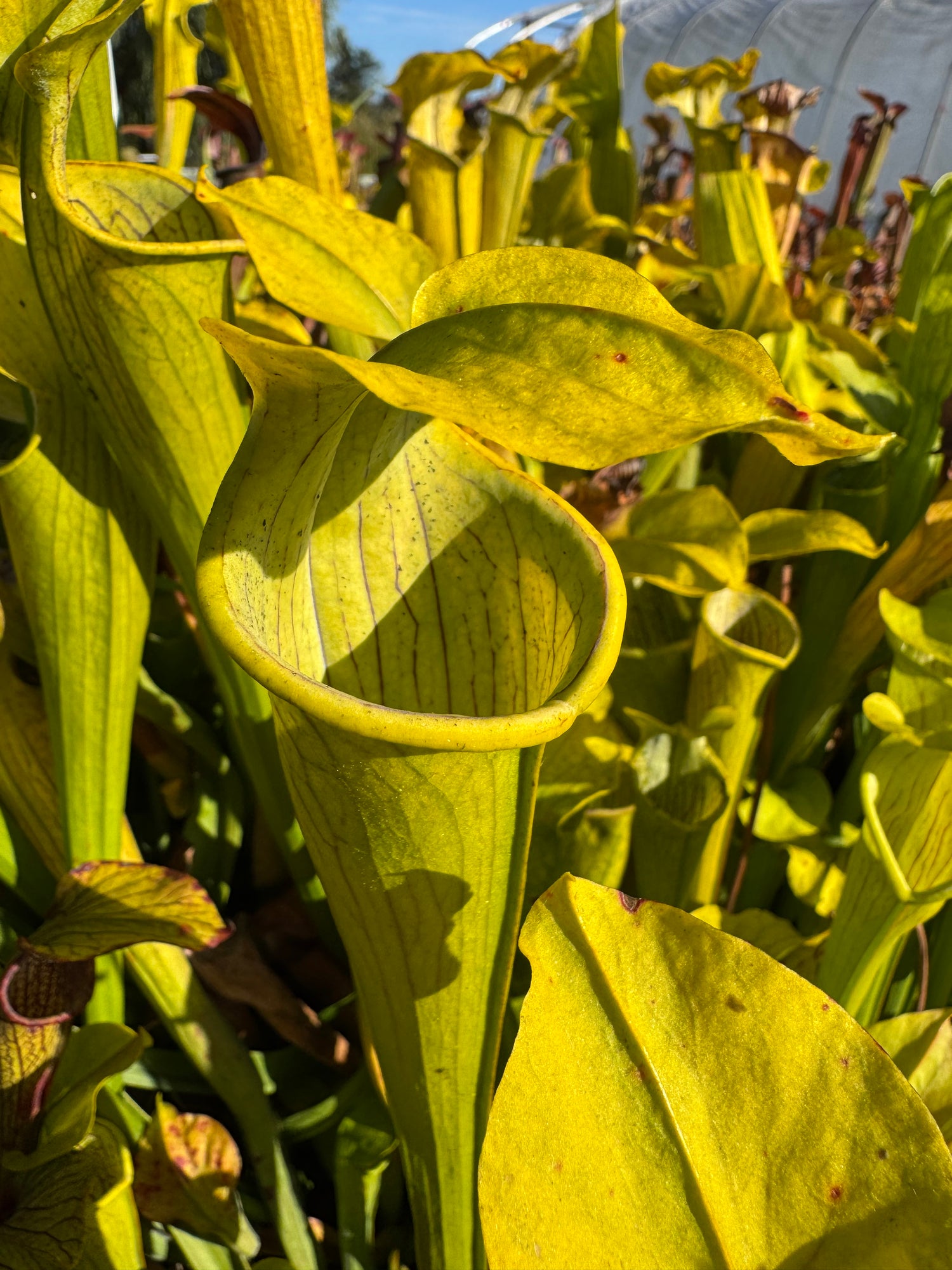
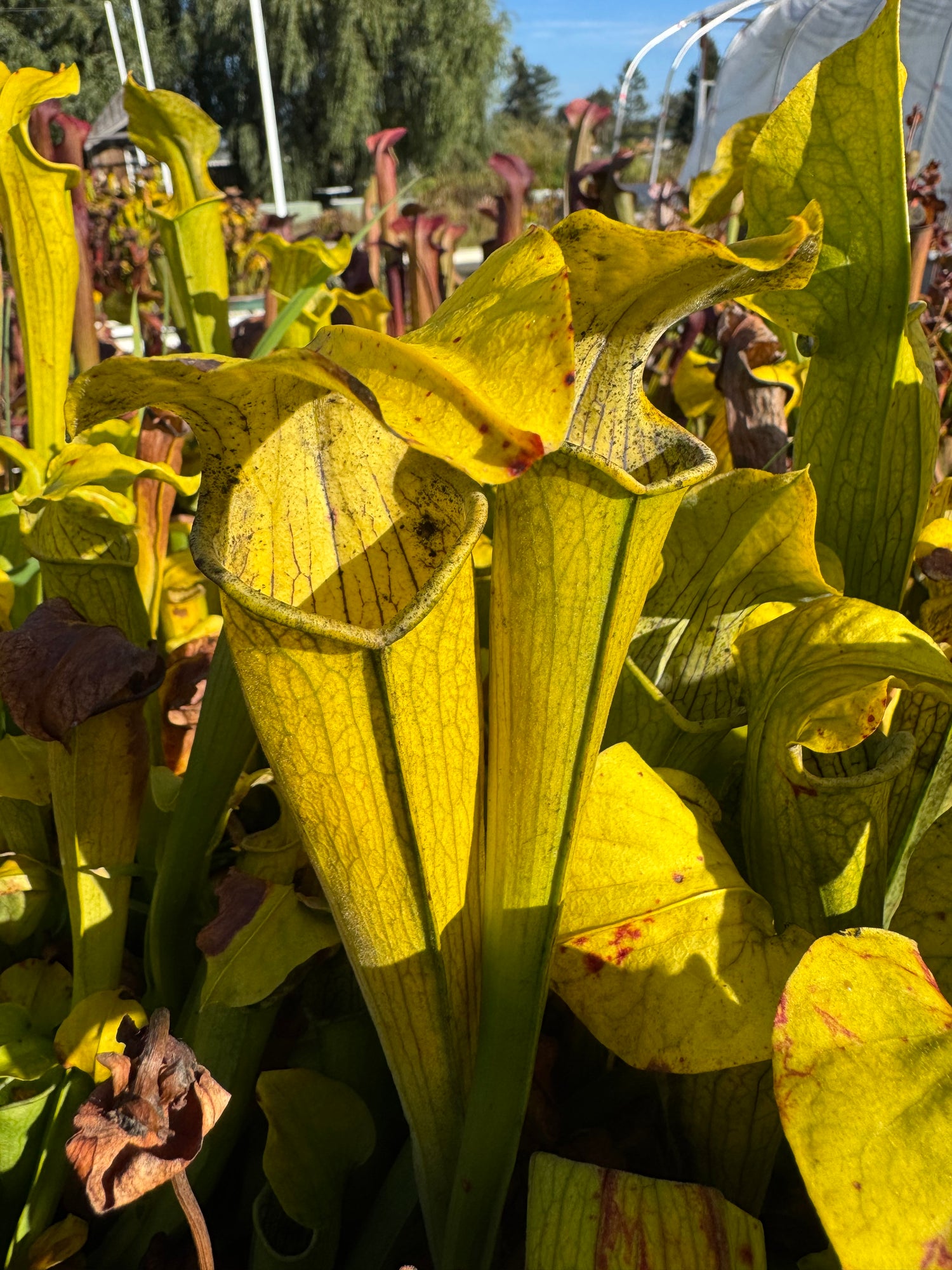
Came through shipping just fine and is growing happily out in the garden.
Great service fast shipping and prices and always great vedios to watch.
My VFT arrived healthy and beautiful. The downside is that takes so long to get it.
Sign up for our newsletter!
Sort by:
52 products
52 products
Did you know that the greatest diversity of carnivorous plants occurs in the United States? Did you know they are in danger of going extinct forever?
Venus flytraps, American pitcher plants, Cobra Plants, Sundews, Butterworts, and Bladderworts once filled the vast wetlands of North America. Today, after about 250 years of the deliberate destruction of our wetlands, we estimate that only about 5 percent of our carnivorous plants remain. We have been almost too late to realize the botanical treasures that our wetlands held and even the miraculous Venus flytrap has been relegated to only a handful of sites teetering on the edge of extinction.
The North American Sarracenia Conservancy is fighting to keep that from happening.
Venus flytraps and American pitcher plants used to grow at the site photographed above. Without notice, this site was plowed under and mulched to make it easier for timber trucks to navigate the sandy road. Nearly all of the plants were destroyed, but a precious few remained. The North American Sarracenia Conservancy removed the remaining plants and relocated them to a protected area. This small group of dedicated individuals are fighting to keep our carnivores from going extinct in a very real way. When bogs are to be destroyed for development, with permission from the owners, they will remove the plants and relocate them to a protected site. Their growers also keep plants with location data so that the genetic diversity of the plants can be horticulturally preserved as well.
If you love the plants as much as we do, please donate to help keep our carnivores from disappearing forever from the wild.
Every dollar will go directly to the real, on the ground, conservation of our plants that are in such desperate trouble.
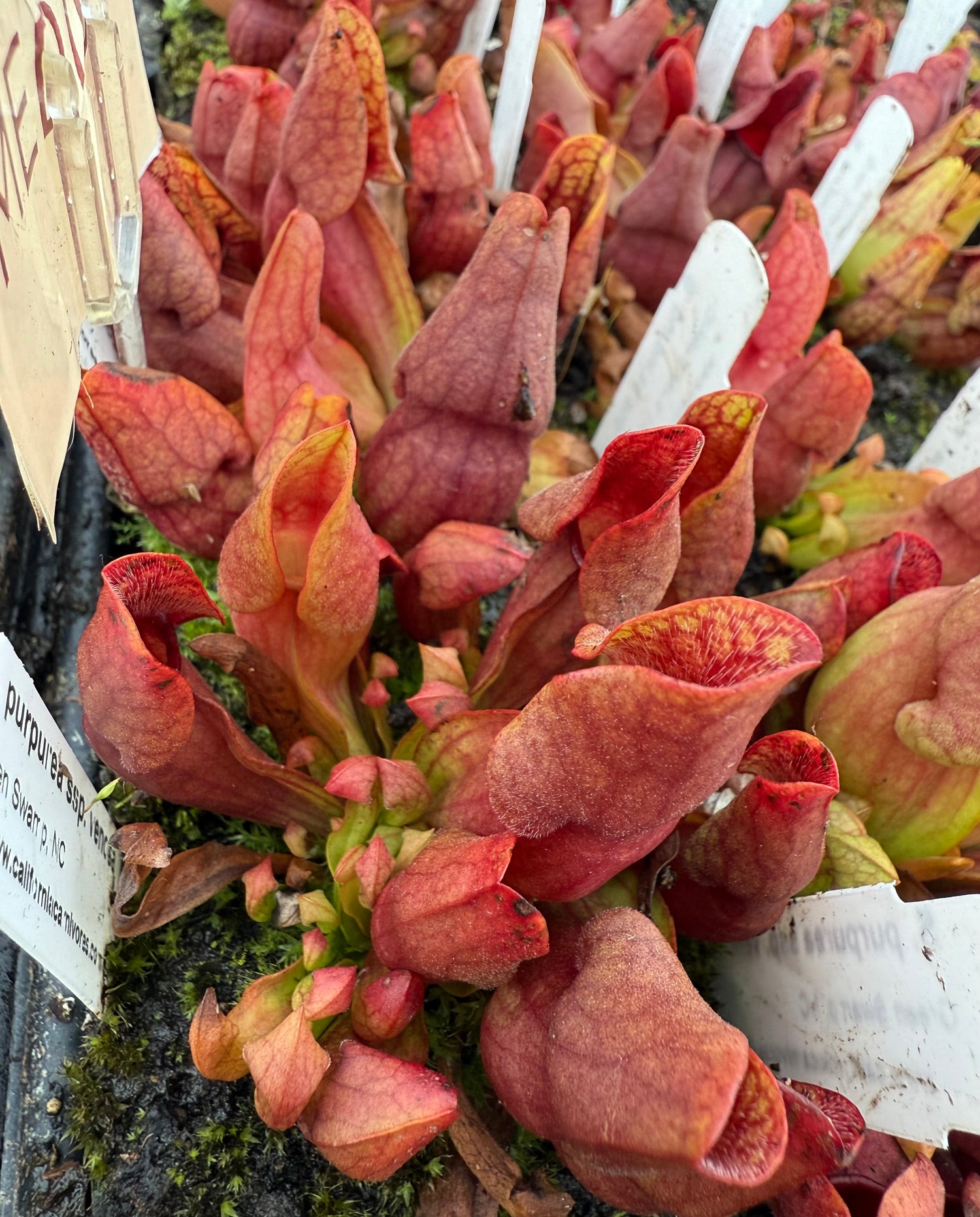
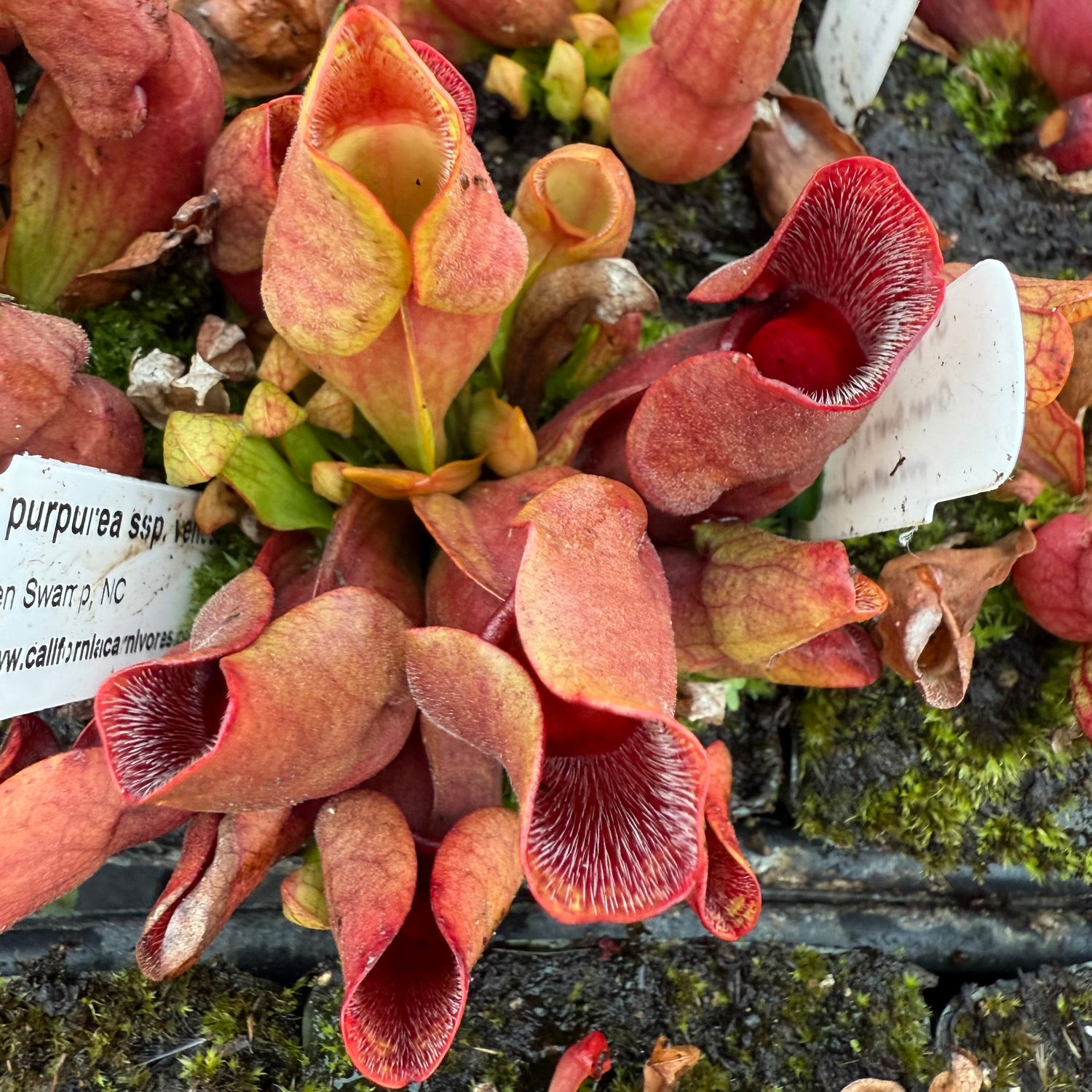
Sarracenia purpurea ssp. venosa are always show-stopping plants, intensely colorful with large, gently undulating pitchers and forming large rosettes in their pots. There's something so charismatic about purpurea; a pot that slowly fills in with their ruffled, low pitchers is always spectacular!
These plants don't grow very tall, so they are perfect if you'd like a shorter Sarracenia. They often keep pitchers through their winter dormancy. Watering these from overhead is best to help fill their pitchers periodically. These are tissue-culture plants.
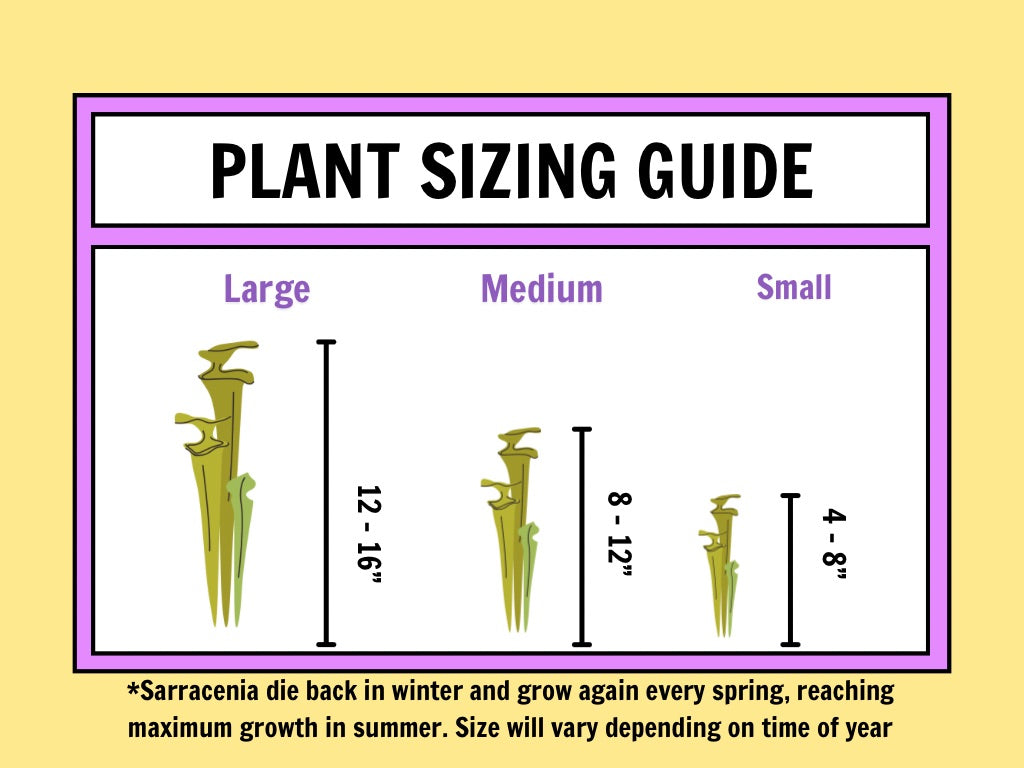
DORMANT SEASONALLY, STARTING AS EARLY AS OCTOBER AND LASTING AS LATE AS MARCH, DEPENDING ON THE CONDITIONS AND SPECIES/HYBRID. The pitchers turn brown and die back to the rhizome, or non-carnivorous leaves (phyllodia) grow during this time. Please see the final photo to see how Sarracenia look when dormant. They will begin to grow vigorously again in Spring when photoperiods lengthen and temperatures increase.
Care Instructions:
Growth Habit: Sarracenia primarily grow along the Southeastern coastal plain of the United States. They grow pitchers, which are modified leaves, seasonally that can vary in height, color, and size depending on the species or hybrid. The pitchers can die back during the growing season, but new pitchers will grow throughout the spring and summer. The pitchers start to grow in spring, and many grow as the year progresses; in summer, they will be at their best. In summer, you may see brown or black on your pitchers, which can be normal nectar burn or crisping from heat. As Fall comes on, the pitchers may start to die back, turning brown, and by winter, many or all of the pitchers are brown, but the rhizome remains healthy and intact throughout winter dormancy even if you cannot see anything growing. Sarracenia have brown, black, or white roots and do not generally have many of them. The rhizome can be brown and still be healthy.
Sun: Full sun. Sarracenia require lots of direct sun to grow and form pitchers properly. In many areas, they can be grown outdoors in full sun. If you live in a very hot AND very dry place like Arizona or Sacramento, for example, you will want to grow your plants in full morning sun with protection from the afternoon sun or under 30% shade cloth. It is common for several pitchers to "burn" and die back when you first place your plant into the sun; your plant is acclimating to your conditions, and in most cases, new leaves will soon grow and be fully acclimated. Sarracenia can be grown indoors on extremely sunny windowsills that receive all-day sun, but they will require a grow light in most circumstances due to the amount of light the plant needs. Grow lights should be 6-12” from the plant, depending on the light, and on a 10-12 hour day length. Sarracenia generally are not a good candidate for a terrarium as they need intense light and get quite tall. Shorter species like Sarracenia purpurea will do better in a terrarium. Grow outdoors if possible for best results.
Water: Always keep them in a saucer with a few inches of distilled, rainwater, or reverse osmosis water. Never let them dry out, especially in the hot summer months. Sarracenia are bog plants that prefer water-logged conditions unless you live somewhere both very hot AND extremely humid, like Alabama. In that case, let the water tray dry out for a day or two between refills. Always use distilled, reverse osmosis, or rainwater only. These plants are sensitive to their water quality, and giving them mineral and salt-free water is very important. In winter, when the plants are dormant, you can let them dry out a bit between rain storms, but do not let the soil get so dry that it pulls away from the edges of the pots. Be sure to supplement water as needed in between rains in winter.
Temperature and Dormancy: These are warm-temperate plants, meaning they need warm summers and chilly winters. They should be grown outdoors year-round in areas with mild winters. They thrive in temperatures ranging from 20 degrees - 100F degrees and can take a brief freeze or high-temperature spike up to 105F degrees for a short period. If nighttime temps drop below 20 but rise again during the day above 40, your plant will be fine outside.
If you live in an area with very cold winters, where nighttime temperatures drop below 20 degrees for sustained periods, you have three options for providing them with winter dormancy: the garage method, mulching in, or the fridge method. Dormancy is triggered by a combination of exposure to shorter photo-periods and cooler temperatures in the 40-60's F. While you can skip a dormancy period once or twice, in the long term, your plant will begin to do poorly and will eventually die if you skip this crucial period.
The garage method: Bring your plant indoors to a sunny windowsill in an unheated room or garage, where the nighttime temperatures will dip down to 50-60F. Keep it well watered during this period, do not let it dry out, and put it outside again when the outside nighttime temperatures increase consistently above 20F.
The mulch method: Mulch them in very, very well outdoors. Pack at least four inches of mulch on top of the plants and all around the sides to prevent winds from chilling them and freezing the roots. You can also dig the pots into the ground and then mulch heavily on top.
The fridge method: remove the plants from pots, gently clean the roots of soil, wrap the roots in a bit of damp long-fibered New Zealand sphagnum moss, place the plants in a resealable bag, and put the bag into the refrigerator. Leave them in the fridge from October to February, periodically checking on them to ensure they are still moist and not growing mold or fungus. Pot them back up in February. You can vary the timing to align with your outside nighttime temperatures so that your plants can come out of dormancy when it is safe to place them back outside. You can leave them in the fridge for an extended period if you have very long winters.
Soil and Repotting: We prefer a mix of four-part fertilizer-free peat moss to one-part perlite. You can add our pre-made mix to your order here. You do not need to repot your plant when you receive it from us for at least a year, and we recommend against it during the spring-summer months. Repot Sarracenia every 1-3 years in winter when they are dormant. Avoid placing in excessively large pots; size up only a few inches at a time. They do well in tall pots. Soil can also develop a swampy smell, especially right after shipping, when the plant is wrapped in plastic and sealed. This is normal; these plants grow naturally in bogs and swampy conditions, and peat moss can develop a bit of an anaerobic smell, but this does not indicate a problem with the soil.
Feeding and Fertilizer: Sarracenia will catch plenty of food when grown outdoors. When grown indoors, they will significantly benefit from fertilizing, both a foliar fertilizer and feeding the pitchers. Plants grown outdoors will appreciate a foliar feed as well. Apply MaxSea fertilizer once per month to the foliage only. Dilute 1/4 teaspoon of MaxSea into one gallon of water and then apply to the pitchers, and inside the pitchers, with a mister bottle or a watering can. Osmocote slow-release flower and vegetable pellets can be dropped into the pitchers with a bit of distilled water. Pellets can burn the sides of the pitchers where they come to rest; that is normal.
More Information: For further information on dormancy, repotting, dividing, and more, check out our website or our YouTube channel.

Sarracenia x 'Judith Hindle' is one of the most beautiful cultivars yet to be produced. Alan Hindle bred and grew this plant in England many years ago. He sent a division to California Carnivores, and Peter registered it, naming it after Alan's wife.
The compact pitchers have a wildly undulating lid and start green, dappled in whites and yellows. As they age, they transform into deep, dark red. This is probably the most popular of the hundreds of Sarracenia in our collection!
Judith Hindle's parents were two different clones of S. (purpurea x flava) x leucophylla. It is one of the few Sarracenia in tissue culture, so now everyone can have one! If you only grow one American pitcher plant, this should be the one. These are tissue culture plants.
DORMANT SEASONALLY, STARTING AS EARLY AS OCTOBER AND LASTING AS LATE AS MARCH, DEPENDING ON THE CONDITIONS AND SPECIES/HYBRID. The pitchers turn brown and die back to the rhizome, or non-carnivorous leaves (phyllodia) grow during this time. Please see the final photo to see how Sarracenia look when dormant. They will begin to grow vigorously again in Spring when photoperiods lengthen and temperatures increase.
Care Instructions:
Growth Habit: Sarracenia primarily grow along the Southeastern coastal plain of the United States. They grow pitchers, which are modified leaves, seasonally that can vary in height, color, and size depending on the species or hybrid. The pitchers can die back during the growing season, but new pitchers will grow throughout the spring and summer. The pitchers start to grow in spring, and many grow as the year progresses; in summer, they will be at their best. In summer, you may see brown or black on your pitchers, which can be normal nectar burn or crisping from heat. As Fall comes on, the pitchers may start to die back, turning brown, and by winter, many or all of the pitchers are brown, but the rhizome remains healthy and intact throughout winter dormancy even if you cannot see anything growing. Sarracenia have brown, black, or white roots and do not generally have many of them. The rhizome can be brown and still be healthy.
Sun: Full sun. Sarracenia require lots of direct sun to grow and form pitchers properly. In many areas, they can be grown outdoors in full sun. If you live in a very hot AND very dry place like Arizona or Sacramento, for example, you will want to grow your plants in full morning sun with protection from the afternoon sun or under 30% shade cloth. It is common for several pitchers to "burn" and die back when you first place your plant into the sun; your plant is acclimating to your conditions, and in most cases, new leaves will soon grow and be fully acclimated. Sarracenia can be grown indoors on extremely sunny windowsills that receive all-day sun, but they will require a grow light in most circumstances due to the amount of light the plant needs. Grow lights should be 6-12” from the plant, depending on the light, and on a 10-12 hour day length. Sarracenia generally are not a good candidate for a terrarium as they need intense light and get quite tall. Shorter species like Sarracenia purpurea will do better in a terrarium. Grow outdoors if possible for best results.
Water: Always keep them in a saucer with a few inches of distilled, rainwater, or reverse osmosis water. Never let them dry out, especially in the hot summer months. Sarracenia are bog plants that prefer water-logged conditions unless you live somewhere both very hot AND extremely humid, like Alabama. In that case, let the water tray dry out for a day or two between refills. Always use distilled, reverse osmosis, or rainwater only. These plants are sensitive to their water quality, and giving them mineral and salt-free water is very important. In winter, when the plants are dormant, you can let them dry out a bit between rain storms, but do not let the soil get so dry that it pulls away from the edges of the pots. Be sure to supplement water as needed in between rains in winter.
Temperature and Dormancy: These are warm-temperate plants, meaning they need warm summers and chilly winters. They should be grown outdoors year-round in areas with mild winters. They thrive in temperatures ranging from 20 degrees - 100F degrees and can take a brief freeze or high-temperature spike up to 105F degrees for a short period. If nighttime temps drop below 20 but rise again during the day above 40, your plant will be fine outside.
If you live in an area with very cold winters, where nighttime temperatures drop below 20 degrees for sustained periods, you have three options for providing them with winter dormancy: the garage method, mulching in, or the fridge method. Dormancy is triggered by a combination of exposure to shorter photo-periods and cooler temperatures in the 40-60's F. While you can skip a dormancy period once or twice, in the long term, your plant will begin to do poorly and will eventually die if you skip this crucial period.
The garage method: Bring your plant indoors to a sunny windowsill in an unheated room or garage, where the nighttime temperatures will dip down to 50-60F. Keep it well watered during this period, do not let it dry out, and put it outside again when the outside nighttime temperatures increase consistently above 20F.
The mulch method: Mulch them in very, very well outdoors. Pack at least four inches of mulch on top of the plants and all around the sides to prevent winds from chilling them and freezing the roots. You can also dig the pots into the ground and then mulch heavily on top.
The fridge method: remove the plants from pots, gently clean the roots of soil, wrap the roots in a bit of damp long-fibered New Zealand sphagnum moss, place the plants in a resealable bag, and put the bag into the refrigerator. Leave them in the fridge from October to February, periodically checking on them to ensure they are still moist and not growing mold or fungus. Pot them back up in February. You can vary the timing to align with your outside nighttime temperatures so that your plants can come out of dormancy when it is safe to place them back outside. You can leave them in the fridge for an extended period if you have very long winters.
Soil and Repotting: We prefer a mix of four-part fertilizer-free peat moss to one-part perlite. You can add our pre-made mix to your order here. You do not need to repot your plant when you receive it from us for at least a year, and we recommend against it during the spring-summer months. Repot Sarracenia every 1-3 years in winter when they are dormant. Avoid placing in excessively large pots; size up only a few inches at a time. They do well in tall pots. Soil can also develop a swampy smell, especially right after shipping, when the plant is wrapped in plastic and sealed. This is normal; these plants grow naturally in bogs and swampy conditions, and peat moss can develop a bit of an anaerobic smell, but this does not indicate a problem with the soil.
Feeding and Fertilizer: Sarracenia will catch plenty of food when grown outdoors. When grown indoors, they will significantly benefit from fertilizing, both a foliar fertilizer and feeding the pitchers. Plants grown outdoors will appreciate a foliar feed as well. Apply MaxSea fertilizer once per month to the foliage only. Dilute 1/4 teaspoon of MaxSea into one gallon of water and then apply to the pitchers, and inside the pitchers, with a mister bottle or a watering can. Osmocote slow-release flower and vegetable pellets can be dropped into the pitchers with a bit of distilled water. Pellets can burn the sides of the pitchers where they come to rest; that is normal.
More Information: For further information on dormancy, repotting, dividing, and more, check out our website or our YouTube channel.

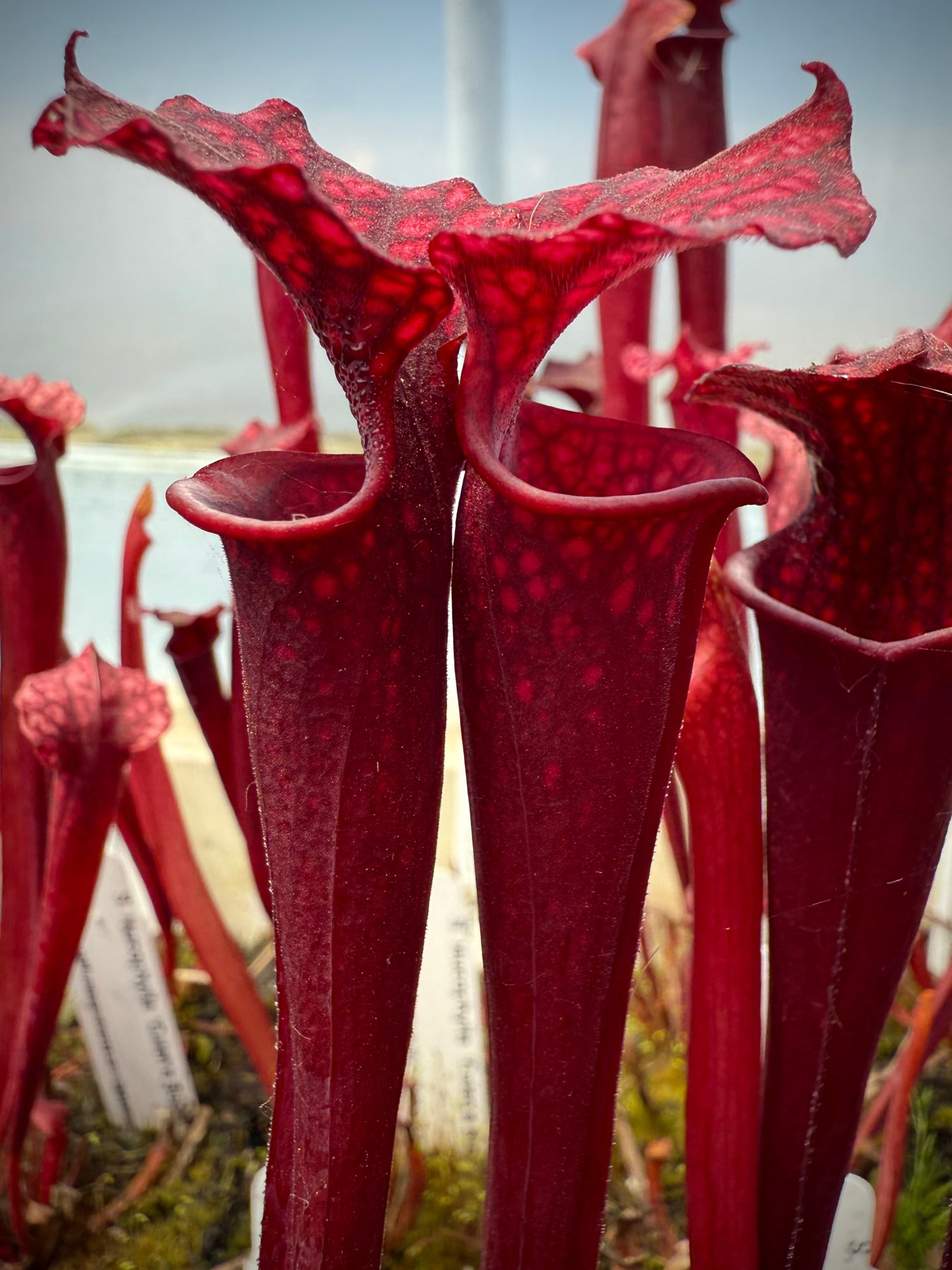
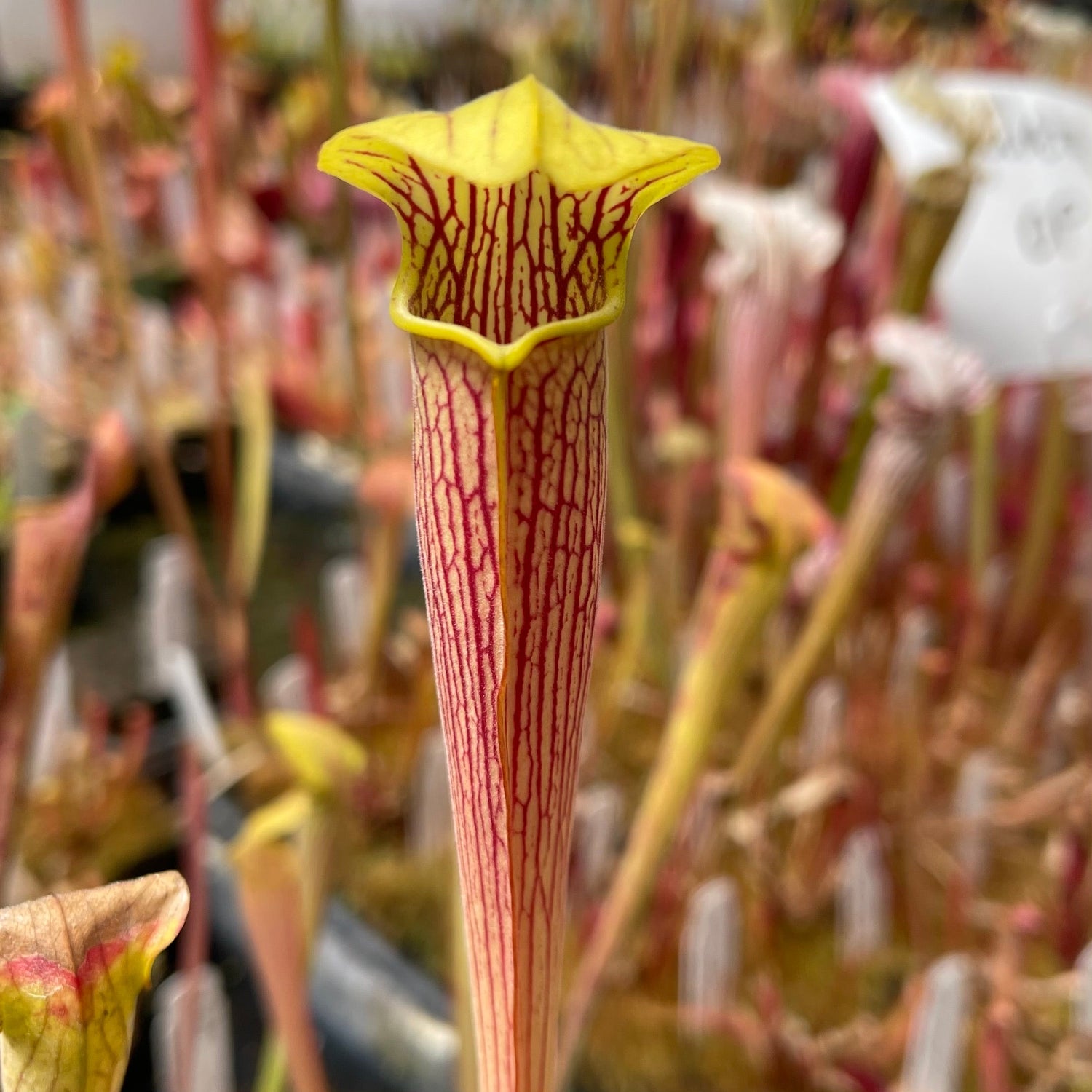
Sarracenia leucophylla, the white trumpet, is considered by many to be the most beautiful species of American pitcher plant. It produces large, red petaled flowers that can be as tall as 3 feet! The first pitchers of the season are usually thinner and more delicate than the second crop of pitchers produced in late summer to early autumn. These later pitchers put on a spectacular show; they can be as tall as the flowers were in spring! The pitchers are variable with the lower part of the tubes green, tan or purplish red. The upper portion of the tube, mouth, column and lid are nearly pure white laced with a network of veins in green to pink to red to purple.
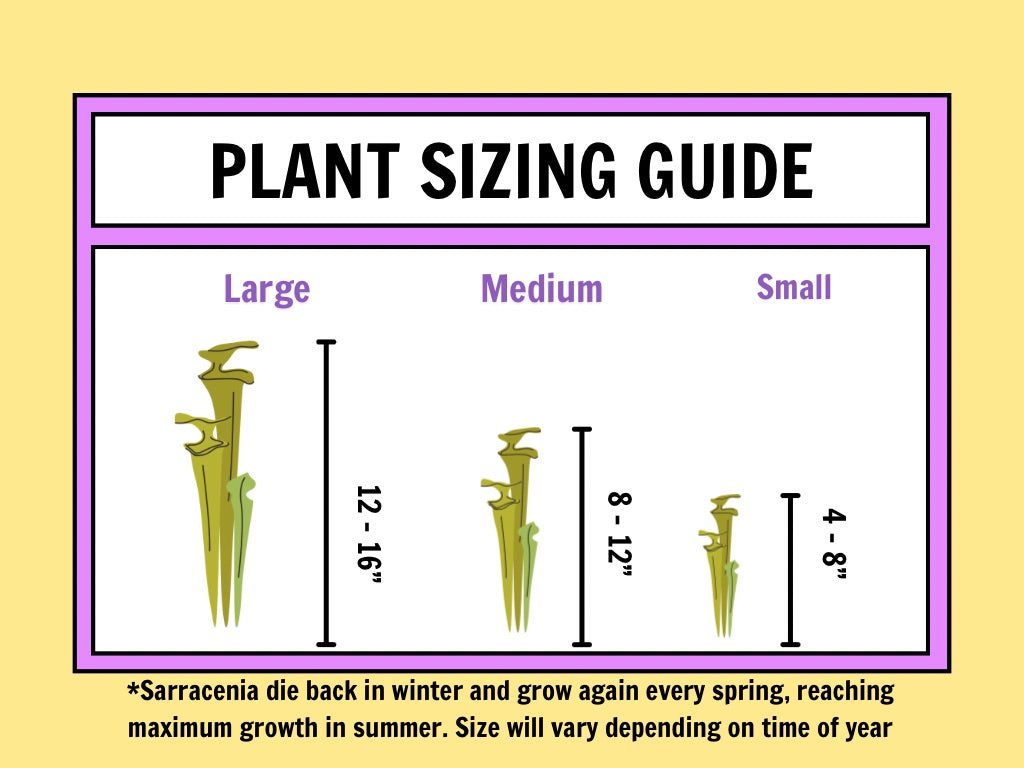
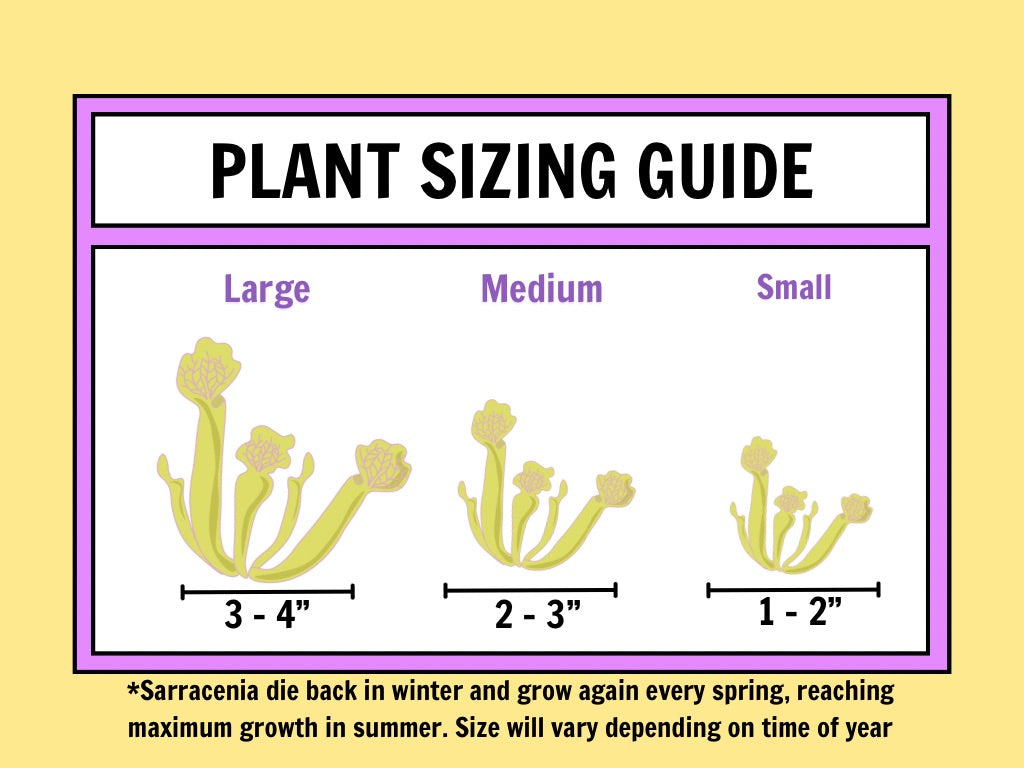
These are divisions from our botanical collection and there is some variation in color form. The small sized plants are tissue culture plants.
DORMANT SEASONALLY, STARTING AS EARLY AS OCTOBER AND LASTING AS LATE AS MARCH, DEPENDING ON THE CONDITIONS AND SPECIES/HYBRID. The pitchers turn brown and die back to the rhizome, or non-carnivorous leaves (phyllodia) grow during this time. Please see the final photo to see how Sarracenia look when dormant. They will begin to grow vigorously again in Spring when photoperiods lengthen and temperatures increase.
Care Instructions:
Growth Habit: Sarracenia primarily grow along the Southeastern coastal plain of the United States. They grow pitchers, which are modified leaves, seasonally that can vary in height, color, and size depending on the species or hybrid. The pitchers can die back during the growing season, but new pitchers will grow throughout the spring and summer. The pitchers start to grow in spring, and many grow as the year progresses; in summer, they will be at their best. In summer, you may see brown or black on your pitchers, which can be normal nectar burn or crisping from heat. As Fall comes on, the pitchers may start to die back, turning brown, and by winter, many or all of the pitchers are brown, but the rhizome remains healthy and intact throughout winter dormancy even if you cannot see anything growing. Sarracenia have brown, black, or white roots and do not generally have many of them. The rhizome can be brown and still be healthy.
Sun: Full sun. Sarracenia require lots of direct sun to grow and form pitchers properly. In many areas, they can be grown outdoors in full sun. If you live in a very hot AND very dry place like Arizona or Sacramento, for example, you will want to grow your plants in full morning sun with protection from the afternoon sun or under 30% shade cloth. It is common for several pitchers to "burn" and die back when you first place your plant into the sun; your plant is acclimating to your conditions, and in most cases, new leaves will soon grow and be fully acclimated. Sarracenia can be grown indoors on extremely sunny windowsills that receive all-day sun, but they will require a grow light in most circumstances due to the amount of light the plant needs. Grow lights should be 6-12” from the plant, depending on the light, and on a 10-12 hour day length. Sarracenia generally are not a good candidate for a terrarium as they need intense light and get quite tall. Shorter species like Sarracenia purpurea will do better in a terrarium. Grow outdoors if possible for best results.
Water: Always keep them in a saucer with a few inches of distilled, rainwater, or reverse osmosis water. Never let them dry out, especially in the hot summer months. Sarracenia are bog plants that prefer water-logged conditions unless you live somewhere both very hot AND extremely humid, like Alabama. In that case, let the water tray dry out for a day or two between refills. Always use distilled, reverse osmosis, or rainwater only. These plants are sensitive to their water quality, and giving them mineral and salt-free water is very important. In winter, when the plants are dormant, you can let them dry out a bit between rain storms, but do not let the soil get so dry that it pulls away from the edges of the pots. Be sure to supplement water as needed in between rains in winter.
Temperature and Dormancy: These are warm-temperate plants, meaning they need warm summers and chilly winters. They should be grown outdoors year-round in areas with mild winters. They thrive in temperatures ranging from 20 degrees - 100F degrees and can take a brief freeze or high-temperature spike up to 105F degrees for a short period. If nighttime temps drop below 20 but rise again during the day above 40, your plant will be fine outside.
If you live in an area with very cold winters, where nighttime temperatures drop below 20 degrees for sustained periods, you have three options for providing them with winter dormancy: the garage method, mulching in, or the fridge method. Dormancy is triggered by a combination of exposure to shorter photo-periods and cooler temperatures in the 40-60's F. While you can skip a dormancy period once or twice, in the long term, your plant will begin to do poorly and will eventually die if you skip this crucial period.
The garage method: Bring your plant indoors to a sunny windowsill in an unheated room or garage, where the nighttime temperatures will dip down to 50-60F. Keep it well watered during this period, do not let it dry out, and put it outside again when the outside nighttime temperatures increase consistently above 20F.
The mulch method: Mulch them in very, very well outdoors. Pack at least four inches of mulch on top of the plants and all around the sides to prevent winds from chilling them and freezing the roots. You can also dig the pots into the ground and then mulch heavily on top.
The fridge method: remove the plants from pots, gently clean the roots of soil, wrap the roots in a bit of damp long-fibered New Zealand sphagnum moss, place the plants in a resealable bag, and put the bag into the refrigerator. Leave them in the fridge from October to February, periodically checking on them to ensure they are still moist and not growing mold or fungus. Pot them back up in February. You can vary the timing to align with your outside nighttime temperatures so that your plants can come out of dormancy when it is safe to place them back outside. You can leave them in the fridge for an extended period if you have very long winters.
Soil and Repotting: We prefer a mix of four-part fertilizer-free peat moss to one-part perlite. You can add our pre-made mix to your order here. You do not need to repot your plant when you receive it from us for at least a year, and we recommend against it during the spring-summer months. Repot Sarracenia every 1-3 years in winter when they are dormant. Avoid placing in excessively large pots; size up only a few inches at a time. They do well in tall pots. Soil can also develop a swampy smell, especially right after shipping, when the plant is wrapped in plastic and sealed. This is normal; these plants grow naturally in bogs and swampy conditions, and peat moss can develop a bit of an anaerobic smell, but this does not indicate a problem with the soil.
Feeding and Fertilizer: Sarracenia will catch plenty of food when grown outdoors. When grown indoors, they will significantly benefit from fertilizing, both a foliar fertilizer and feeding the pitchers. Plants grown outdoors will appreciate a foliar feed as well. Apply MaxSea fertilizer once per month to the foliage only. Dilute 1/4 teaspoon of MaxSea into one gallon of water and then apply to the pitchers, and inside the pitchers, with a mister bottle or a watering can. Osmocote slow-release flower and vegetable pellets can be dropped into the pitchers with a bit of distilled water. Pellets can burn the sides of the pitchers where they come to rest; that is normal.
More Information: For further information on dormancy, repotting, dividing, and more, check out our website or our YouTube channel.
Sarracenia x 'Dana's Delight' comes from New Zealand and has become a mainstay in the carnivorous plant community. And it’s easy to see why; it combines the size and form of Leucophylla with a vivid hot pink color when grown in full sun.
These are great for catching yellow jackets, wasps, and flies!
DORMANT SEASONALLY, STARTING AS EARLY AS OCTOBER AND LASTING AS LATE AS MARCH, DEPENDING ON THE CONDITIONS AND SPECIES/HYBRID. The pitchers turn brown and die back to the rhizome, or non-carnivorous leaves (phyllodia) grow during this time. Please see the final photo to see how Sarracenia look when dormant. They will begin to grow vigorously again in Spring when photoperiods lengthen and temperatures increase.
Care Instructions:
Growth Habit: Sarracenia primarily grow along the Southeastern coastal plain of the United States. They grow pitchers, which are modified leaves, seasonally that can vary in height, color, and size depending on the species or hybrid. The pitchers can die back during the growing season, but new pitchers will grow throughout the spring and summer. The pitchers start to grow in spring, and many grow as the year progresses; in summer, they will be at their best. In summer, you may see brown or black on your pitchers, which can be normal nectar burn or crisping from heat. As Fall comes on, the pitchers may start to die back, turning brown, and by winter, many or all of the pitchers are brown, but the rhizome remains healthy and intact throughout winter dormancy even if you cannot see anything growing. Sarracenia have brown, black, or white roots and do not generally have many of them. The rhizome can be brown and still be healthy.
Sun: Full sun. Sarracenia require lots of direct sun to grow and form pitchers properly. In many areas, they can be grown outdoors in full sun. If you live in a very hot AND very dry place like Arizona or Sacramento, for example, you will want to grow your plants in full morning sun with protection from the afternoon sun or under 30% shade cloth. It is common for several pitchers to "burn" and die back when you first place your plant into the sun; your plant is acclimating to your conditions, and in most cases, new leaves will soon grow and be fully acclimated. Sarracenia can be grown indoors on extremely sunny windowsills that receive all-day sun, but they will require a grow light in most circumstances due to the amount of light the plant needs. Grow lights should be 6-12” from the plant, depending on the light, and on a 10-12 hour day length. Sarracenia generally are not a good candidate for a terrarium as they need intense light and get quite tall. Shorter species like Sarracenia purpurea will do better in a terrarium. Grow outdoors if possible for best results.
Water: Always keep them in a saucer with a few inches of distilled, rainwater, or reverse osmosis water. Never let them dry out, especially in the hot summer months. Sarracenia are bog plants that prefer water-logged conditions unless you live somewhere both very hot AND extremely humid, like Alabama. In that case, let the water tray dry out for a day or two between refills. Always use distilled, reverse osmosis, or rainwater only. These plants are sensitive to their water quality, and giving them mineral and salt-free water is very important. In winter, when the plants are dormant, you can let them dry out a bit between rain storms, but do not let the soil get so dry that it pulls away from the edges of the pots. Be sure to supplement water as needed in between rains in winter.
Temperature and Dormancy: These are warm-temperate plants, meaning they need warm summers and chilly winters. They should be grown outdoors year-round in areas with mild winters. They thrive in temperatures ranging from 20 degrees - 100F degrees and can take a brief freeze or high-temperature spike up to 105F degrees for a short period. If nighttime temps drop below 20 but rise again during the day above 40, your plant will be fine outside.
If you live in an area with very cold winters, where nighttime temperatures drop below 20 degrees for sustained periods, you have three options for providing them with winter dormancy: the garage method, mulching in, or the fridge method. Dormancy is triggered by a combination of exposure to shorter photo-periods and cooler temperatures in the 40-60's F. While you can skip a dormancy period once or twice, in the long term, your plant will begin to do poorly and will eventually die if you skip this crucial period.
The garage method: Bring your plant indoors to a sunny windowsill in an unheated room or garage, where the nighttime temperatures will dip down to 50-60F. Keep it well watered during this period, do not let it dry out, and put it outside again when the outside nighttime temperatures increase consistently above 20F.
The mulch method: Mulch them in very, very well outdoors. Pack at least four inches of mulch on top of the plants and all around the sides to prevent winds from chilling them and freezing the roots. You can also dig the pots into the ground and then mulch heavily on top.
The fridge method: remove the plants from pots, gently clean the roots of soil, wrap the roots in a bit of damp long-fibered New Zealand sphagnum moss, place the plants in a resealable bag, and put the bag into the refrigerator. Leave them in the fridge from October to February, periodically checking on them to ensure they are still moist and not growing mold or fungus. Pot them back up in February. You can vary the timing to align with your outside nighttime temperatures so that your plants can come out of dormancy when it is safe to place them back outside. You can leave them in the fridge for an extended period if you have very long winters.
Soil and Repotting: We prefer a mix of four-part fertilizer-free peat moss to one-part perlite. You can add our pre-made mix to your order here. You do not need to repot your plant when you receive it from us for at least a year, and we recommend against it during the spring-summer months. Repot Sarracenia every 1-3 years in winter when they are dormant. Avoid placing in excessively large pots; size up only a few inches at a time. They do well in tall pots. Soil can also develop a swampy smell, especially right after shipping, when the plant is wrapped in plastic and sealed. This is normal; these plants grow naturally in bogs and swampy conditions, and peat moss can develop a bit of an anaerobic smell, but this does not indicate a problem with the soil.
Feeding and Fertilizer: Sarracenia will catch plenty of food when grown outdoors. When grown indoors, they will significantly benefit from fertilizing, both a foliar fertilizer and feeding the pitchers. Plants grown outdoors will appreciate a foliar feed as well. Apply MaxSea fertilizer once per month to the foliage only. Dilute 1/4 teaspoon of MaxSea into one gallon of water and then apply to the pitchers, and inside the pitchers, with a mister bottle or a watering can. Osmocote slow-release flower and vegetable pellets can be dropped into the pitchers with a bit of distilled water. Pellets can burn the sides of the pitchers where they come to rest; that is normal.
More Information: For further information on dormancy, repotting, dividing, and more, check out our website or our YouTube channel.
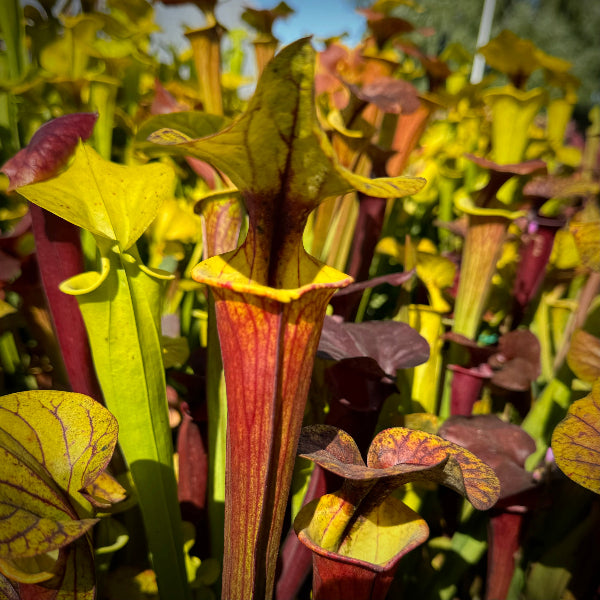
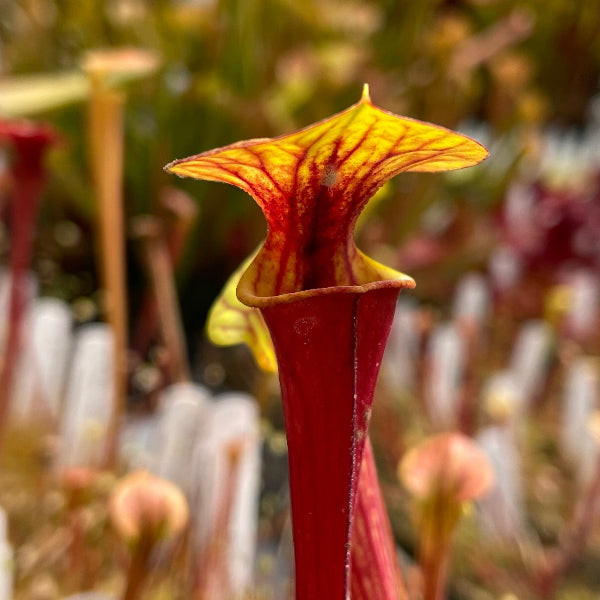
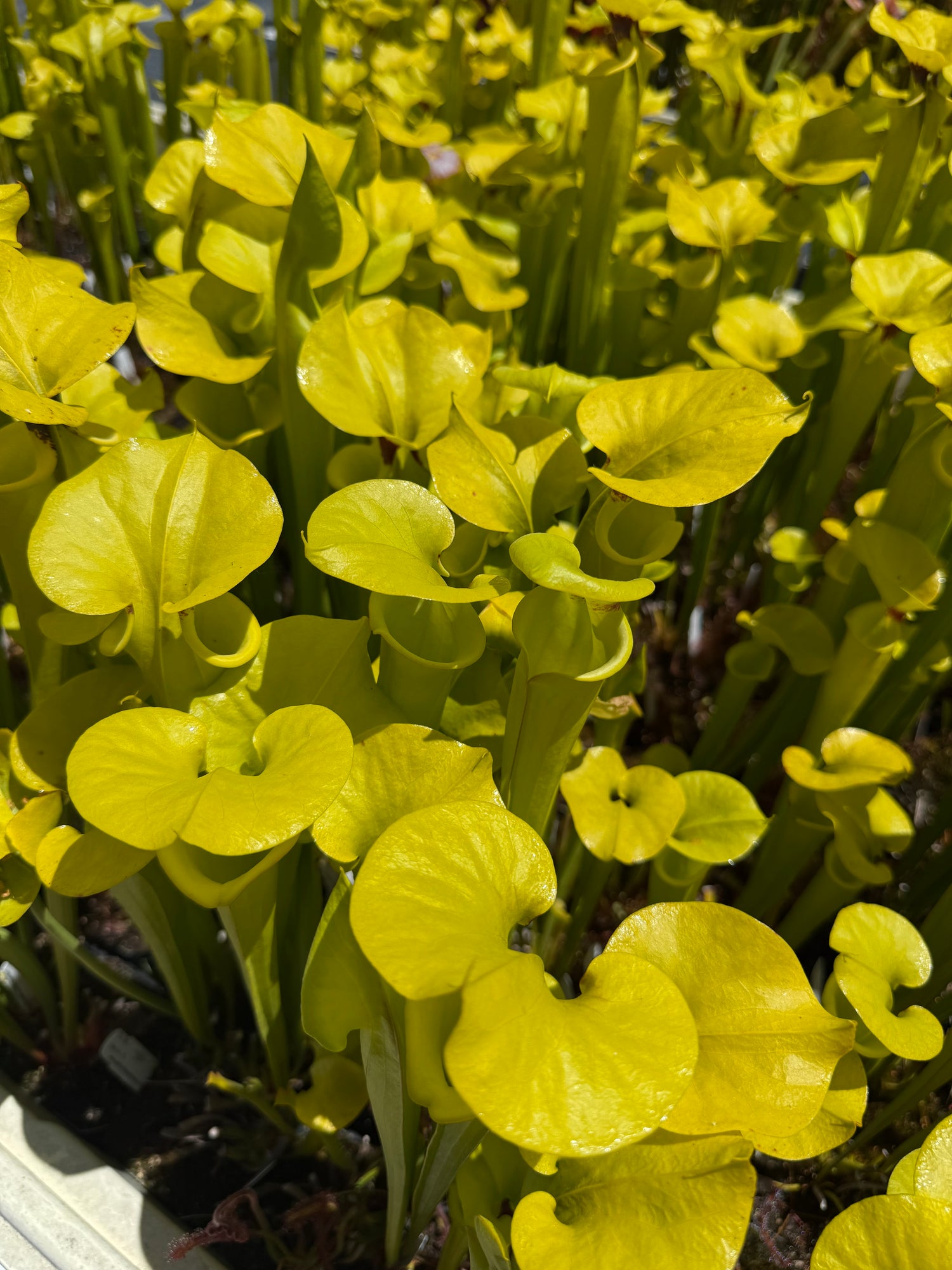
Sarracenia flava, the Yellow trumpet, is the most striking and elegant American pitcher plant species. Old plants can produce pitchers almost three feet tall with wide mouths and beautiful big lids. It comes in seven official color varieties. The flowers are yellow with long petals and an unusual fragrance similar to bearded iris.
These are a mix of seed-grown and divisions in a few different flava forms, but mainly the iconic lime green color with a red-blotched throat.
DORMANT SEASONALLY, STARTING AS EARLY AS OCTOBER AND LASTING AS LATE AS MARCH, DEPENDING ON THE CONDITIONS AND SPECIES/HYBRID. The pitchers turn brown and die back to the rhizome, or non-carnivorous leaves (phyllodia) grow during this time. Please see the final photo to see how Sarracenia look when dormant. They will begin to grow vigorously again in Spring when photoperiods lengthen and temperatures increase.
Care Instructions:
Growth Habit: Sarracenia primarily grow along the Southeastern coastal plain of the United States. They grow pitchers, which are modified leaves, seasonally that can vary in height, color, and size depending on the species or hybrid. The pitchers can die back during the growing season, but new pitchers will grow throughout the spring and summer. The pitchers start to grow in spring, and many grow as the year progresses; in summer, they will be at their best. In summer, you may see brown or black on your pitchers, which can be normal nectar burn or crisping from heat. As Fall comes on, the pitchers may start to die back, turning brown, and by winter, many or all of the pitchers are brown, but the rhizome remains healthy and intact throughout winter dormancy even if you cannot see anything growing. Sarracenia have brown, black, or white roots and do not generally have many of them. The rhizome can be brown and still be healthy.
Sun: Full sun. Sarracenia require lots of direct sun to grow and form pitchers properly. In many areas, they can be grown outdoors in full sun. If you live in a very hot AND very dry place like Arizona or Sacramento, for example, you will want to grow your plants in full morning sun with protection from the afternoon sun or under 30% shade cloth. It is common for several pitchers to "burn" and die back when you first place your plant into the sun; your plant is acclimating to your conditions, and in most cases, new leaves will soon grow and be fully acclimated. Sarracenia can be grown indoors on extremely sunny windowsills that receive all-day sun, but they will require a grow light in most circumstances due to the amount of light the plant needs. Grow lights should be 6-12” from the plant, depending on the light, and on a 10-12 hour day length. Sarracenia generally are not a good candidate for a terrarium as they need intense light and get quite tall. Shorter species like Sarracenia purpurea will do better in a terrarium. Grow outdoors if possible for best results.
Water: Always keep them in a saucer with a few inches of distilled, rainwater, or reverse osmosis water. Never let them dry out, especially in the hot summer months. Sarracenia are bog plants that prefer water-logged conditions unless you live somewhere both very hot AND extremely humid, like Alabama. In that case, let the water tray dry out for a day or two between refills. Always use distilled, reverse osmosis, or rainwater only. These plants are sensitive to their water quality, and giving them mineral and salt-free water is very important. In winter, when the plants are dormant, you can let them dry out a bit between rain storms, but do not let the soil get so dry that it pulls away from the edges of the pots. Be sure to supplement water as needed in between rains in winter.
Temperature and Dormancy: These are warm-temperate plants, meaning they need warm summers and chilly winters. They should be grown outdoors year-round in areas with mild winters. They thrive in temperatures ranging from 20 degrees - 100F degrees and can take a brief freeze or high-temperature spike up to 105F degrees for a short period. If nighttime temps drop below 20 but rise again during the day above 40, your plant will be fine outside.
If you live in an area with very cold winters, where nighttime temperatures drop below 20 degrees for sustained periods, you have three options for providing them with winter dormancy: the garage method, mulching in, or the fridge method. Dormancy is triggered by a combination of exposure to shorter photo-periods and cooler temperatures in the 40-60's F. While you can skip a dormancy period once or twice, in the long term, your plant will begin to do poorly and will eventually die if you skip this crucial period.
The garage method: Bring your plant indoors to a sunny windowsill in an unheated room or garage, where the nighttime temperatures will dip down to 50-60F. Keep it well watered during this period, do not let it dry out, and put it outside again when the outside nighttime temperatures increase consistently above 20F.
The mulch method: Mulch them in very, very well outdoors. Pack at least four inches of mulch on top of the plants and all around the sides to prevent winds from chilling them and freezing the roots. You can also dig the pots into the ground and then mulch heavily on top.
The fridge method: remove the plants from pots, gently clean the roots of soil, wrap the roots in a bit of damp long-fibered New Zealand sphagnum moss, place the plants in a resealable bag, and put the bag into the refrigerator. Leave them in the fridge from October to February, periodically checking on them to ensure they are still moist and not growing mold or fungus. Pot them back up in February. You can vary the timing to align with your outside nighttime temperatures so that your plants can come out of dormancy when it is safe to place them back outside. You can leave them in the fridge for an extended period if you have very long winters.
Soil and Repotting: We prefer a mix of four-part fertilizer-free peat moss to one-part perlite. You can add our pre-made mix to your order here. You do not need to repot your plant when you receive it from us for at least a year, and we recommend against it during the spring-summer months. Repot Sarracenia every 1-3 years in winter when they are dormant. Avoid placing in excessively large pots; size up only a few inches at a time. They do well in tall pots. Soil can also develop a swampy smell, especially right after shipping, when the plant is wrapped in plastic and sealed. This is normal; these plants grow naturally in bogs and swampy conditions, and peat moss can develop a bit of an anaerobic smell, but this does not indicate a problem with the soil.
Feeding and Fertilizer: Sarracenia will catch plenty of food when grown outdoors. When grown indoors, they will significantly benefit from fertilizing, both a foliar fertilizer and feeding the pitchers. Plants grown outdoors will appreciate a foliar feed as well. Apply MaxSea fertilizer once per month to the foliage only. Dilute 1/4 teaspoon of MaxSea into one gallon of water and then apply to the pitchers, and inside the pitchers, with a mister bottle or a watering can. Osmocote slow-release flower and vegetable pellets can be dropped into the pitchers with a bit of distilled water. Pellets can burn the sides of the pitchers where they come to rest; that is normal.
More Information: For further information on dormancy, repotting, dividing, and more, check out our website or our YouTube channel.
Sarracenia purpurea ssp. purpurea is the hardiest of all the Sarracenia taxa. It ranges all the way from New Jersey and deep into Canada. It differs from its Southern subspecies, venosa, with its shiny, waxy-looking pitchers and the collar is generally less ruffled and slightly more pinched towards the mouth. The first photo is of a mature plant from our collection.
Sarracenia purpurea benefits from overhead watering so as to fill its pitchers with water. It also doesn’t lose its pitchers to winter dormancy as much as other Sarracenia species.
These are seed-grown plants. Plant in photo is an extra large size plant from our botanical collection!
DORMANT SEASONALLY, STARTING AS EARLY AS OCTOBER AND LASTING AS LATE AS MARCH, DEPENDING ON THE CONDITIONS AND SPECIES/HYBRID. The pitchers turn brown and die back to the rhizome, or non-carnivorous leaves (phyllodia) grow during this time. Please see the final photo to see how Sarracenia look when dormant. They will begin to grow vigorously again in Spring when photoperiods lengthen and temperatures increase.
Care Instructions:
Growth Habit: Sarracenia primarily grow along the Southeastern coastal plain of the United States. They grow pitchers, which are modified leaves, seasonally that can vary in height, color, and size depending on the species or hybrid. The pitchers can die back during the growing season, but new pitchers will grow throughout the spring and summer. The pitchers start to grow in spring, and many grow as the year progresses; in summer, they will be at their best. In summer, you may see brown or black on your pitchers, which can be normal nectar burn or crisping from heat. As Fall comes on, the pitchers may start to die back, turning brown, and by winter, many or all of the pitchers are brown, but the rhizome remains healthy and intact throughout winter dormancy even if you cannot see anything growing. Sarracenia have brown, black, or white roots and do not generally have many of them. The rhizome can be brown and still be healthy.
Sun: Full sun. Sarracenia require lots of direct sun to grow and form pitchers properly. In many areas, they can be grown outdoors in full sun. If you live in a very hot AND very dry place like Arizona or Sacramento, for example, you will want to grow your plants in full morning sun with protection from the afternoon sun or under 30% shade cloth. It is common for several pitchers to "burn" and die back when you first place your plant into the sun; your plant is acclimating to your conditions, and in most cases, new leaves will soon grow and be fully acclimated. Sarracenia can be grown indoors on extremely sunny windowsills that receive all-day sun, but they will require a grow light in most circumstances due to the amount of light the plant needs. Grow lights should be 6-12” from the plant, depending on the light, and on a 10-12 hour day length. Sarracenia generally are not a good candidate for a terrarium as they need intense light and get quite tall. Shorter species like Sarracenia purpurea will do better in a terrarium. Grow outdoors if possible for best results.
Water: Always keep them in a saucer with a few inches of distilled, rainwater, or reverse osmosis water. Never let them dry out, especially in the hot summer months. Sarracenia are bog plants that prefer water-logged conditions unless you live somewhere both very hot AND extremely humid, like Alabama. In that case, let the water tray dry out for a day or two between refills. Always use distilled, reverse osmosis, or rainwater only. These plants are sensitive to their water quality, and giving them mineral and salt-free water is very important. In winter, when the plants are dormant, you can let them dry out a bit between rain storms, but do not let the soil get so dry that it pulls away from the edges of the pots. Be sure to supplement water as needed in between rains in winter.
Temperature and Dormancy: These are warm-temperate plants, meaning they need warm summers and chilly winters. They should be grown outdoors year-round in areas with mild winters. They thrive in temperatures ranging from 15 degrees - 80F degrees and can take a brief freeze or high-temperature spike up to 90F degrees for a short period. If nighttime temps drop below 15 but rise again during the day above 40, your plant will be fine outside.
If you live in an area with very cold winters, where nighttime temperatures drop below 15 degrees for sustained periods, you have three options for providing them with winter dormancy: the garage method, mulching in, or the fridge method. Dormancy is triggered by a combination of exposure to shorter photo-periods and cooler temperatures in the 40-60's F. While you can skip a dormancy period once or twice, in the long term, your plant will begin to do poorly and will eventually die if you skip this crucial period.
The garage method: Bring your plant indoors to a sunny windowsill in an unheated room or garage, where the nighttime temperatures will dip down to 50-60F. Keep it well watered during this period, do not let it dry out, and put it outside again when the outside nighttime temperatures increase consistently above 15F.
The mulch method: Mulch them in very, very well outdoors. Pack at least four inches of mulch on top of the plants and all around the sides to prevent winds from chilling them and freezing the roots. You can also dig the pots into the ground and then mulch heavily on top.
The fridge method: remove the plants from pots, gently clean the roots of soil, wrap the roots in a bit of damp long-fibered New Zealand sphagnum moss, place the plants in a resealable bag, and put the bag into the refrigerator. Leave them in the fridge from October to February, periodically checking on them to ensure they are still moist and not growing mold or fungus. Pot them back up in February. You can vary the timing to align with your outside nighttime temperatures so that your plants can come out of dormancy when it is safe to place them back outside. You can leave them in the fridge for an extended period if you have very long winters.
Soil and Repotting: We prefer a mix of four-part fertilizer-free peat moss to one-part perlite. You can add our pre-made mix to your order here. You do not need to repot your plant when you receive it from us for at least a year, and we recommend against it during the spring-summer months. Repot Sarracenia every 1-3 years in winter when they are dormant. Avoid placing in excessively large pots; size up only a few inches at a time. They do well in tall pots. Soil can also develop a swampy smell, especially right after shipping, when the plant is wrapped in plastic and sealed. This is normal; these plants grow naturally in bogs and swampy conditions, and peat moss can develop a bit of an anaerobic smell, but this does not indicate a problem with the soil.
Feeding and Fertilizer: Sarracenia will catch plenty of food when grown outdoors. When grown indoors, they will significantly benefit from fertilizing, both a foliar fertilizer and feeding the pitchers. Plants grown outdoors will appreciate a foliar feed as well. Apply MaxSea fertilizer once per month to the foliage only. Dilute 1/4 teaspoon of MaxSea into one gallon of water and then apply to the pitchers, and inside the pitchers, with a mister bottle or a watering can. Osmocote slow-release flower and vegetable pellets can be dropped into the pitchers with a bit of distilled water. Pellets can burn the sides of the pitchers where they come to rest; that is normal.
More Information: For further information on dormancy, repotting, dividing, and more, check out our website or our YouTube channel.
This is a stunning pink plant in autumn! ‘Pink Thing’ looks its best in autumn and due to the rubra in its genetics, it makes a profusion of pitchers. It develops larger and whitest pitchers from September.
DORMANT SEASONALLY, STARTING AS EARLY AS OCTOBER AND LASTING AS LATE AS MARCH, DEPENDING ON THE CONDITIONS AND SPECIES/HYBRID. The pitchers turn brown and die back to the rhizome, or non-carnivorous leaves (phyllodia) grow during this time. Please see the final photo to see how Sarracenia look when dormant. They will begin to grow vigorously again in Spring when photoperiods lengthen and temperatures increase.
Care Instructions:
Growth Habit: Sarracenia primarily grow along the Southeastern coastal plain of the United States. They grow pitchers, which are modified leaves, seasonally that can vary in height, color, and size depending on the species or hybrid. The pitchers can die back during the growing season, but new pitchers will grow throughout the spring and summer. The pitchers start to grow in spring, and many grow as the year progresses; in summer, they will be at their best. In summer, you may see brown or black on your pitchers, which can be normal nectar burn or crisping from heat. As Fall comes on, the pitchers may start to die back, turning brown, and by winter, many or all of the pitchers are brown, but the rhizome remains healthy and intact throughout winter dormancy even if you cannot see anything growing. Sarracenia have brown, black, or white roots and do not generally have many of them. The rhizome can be brown and still be healthy.
Sun: Full sun. Sarracenia require lots of direct sun to grow and form pitchers properly. In many areas, they can be grown outdoors in full sun. If you live in a very hot AND very dry place like Arizona or Sacramento, for example, you will want to grow your plants in full morning sun with protection from the afternoon sun or under 30% shade cloth. It is common for several pitchers to "burn" and die back when you first place your plant into the sun; your plant is acclimating to your conditions, and in most cases, new leaves will soon grow and be fully acclimated. Sarracenia can be grown indoors on extremely sunny windowsills that receive all-day sun, but they will require a grow light in most circumstances due to the amount of light the plant needs. Grow lights should be 6-12” from the plant, depending on the light, and on a 10-12 hour day length. Sarracenia generally are not a good candidate for a terrarium as they need intense light and get quite tall. Shorter species like Sarracenia purpurea will do better in a terrarium. Grow outdoors if possible for best results.
Water: Always keep them in a saucer with a few inches of distilled, rainwater, or reverse osmosis water. Never let them dry out, especially in the hot summer months. Sarracenia are bog plants that prefer water-logged conditions unless you live somewhere both very hot AND extremely humid, like Alabama. In that case, let the water tray dry out for a day or two between refills. Always use distilled, reverse osmosis, or rainwater only. These plants are sensitive to their water quality, and giving them mineral and salt-free water is very important. In winter, when the plants are dormant, you can let them dry out a bit between rain storms, but do not let the soil get so dry that it pulls away from the edges of the pots. Be sure to supplement water as needed in between rains in winter.
Temperature and Dormancy: These are warm-temperate plants, meaning they need warm summers and chilly winters. They should be grown outdoors year-round in areas with mild winters. They thrive in temperatures ranging from 20 degrees - 100F degrees and can take a brief freeze or high-temperature spike up to 105F degrees for a short period. If nighttime temps drop below 20 but rise again during the day above 40, your plant will be fine outside.
If you live in an area with very cold winters, where nighttime temperatures drop below 20 degrees for sustained periods, you have three options for providing them with winter dormancy: the garage method, mulching in, or the fridge method. Dormancy is triggered by a combination of exposure to shorter photo-periods and cooler temperatures in the 40-60's F. While you can skip a dormancy period once or twice, in the long term, your plant will begin to do poorly and will eventually die if you skip this crucial period.
The garage method: Bring your plant indoors to a sunny windowsill in an unheated room or garage, where the nighttime temperatures will dip down to 50-60F. Keep it well watered during this period, do not let it dry out, and put it outside again when the outside nighttime temperatures increase consistently above 20F.
The mulch method: Mulch them in very, very well outdoors. Pack at least four inches of mulch on top of the plants and all around the sides to prevent winds from chilling them and freezing the roots. You can also dig the pots into the ground and then mulch heavily on top.
The fridge method: remove the plants from pots, gently clean the roots of soil, wrap the roots in a bit of damp long-fibered New Zealand sphagnum moss, place the plants in a resealable bag, and put the bag into the refrigerator. Leave them in the fridge from October to February, periodically checking on them to ensure they are still moist and not growing mold or fungus. Pot them back up in February. You can vary the timing to align with your outside nighttime temperatures so that your plants can come out of dormancy when it is safe to place them back outside. You can leave them in the fridge for an extended period if you have very long winters.
Soil and Repotting: We prefer a mix of four-part fertilizer-free peat moss to one-part perlite. You can add our pre-made mix to your order here. You do not need to repot your plant when you receive it from us for at least a year, and we recommend against it during the spring-summer months. Repot Sarracenia every 1-3 years in winter when they are dormant. Avoid placing in excessively large pots; size up only a few inches at a time. They do well in tall pots. Soil can also develop a swampy smell, especially right after shipping, when the plant is wrapped in plastic and sealed. This is normal; these plants grow naturally in bogs and swampy conditions, and peat moss can develop a bit of an anaerobic smell, but this does not indicate a problem with the soil.
Feeding and Fertilizer: Sarracenia will catch plenty of food when grown outdoors. When grown indoors, they will significantly benefit from fertilizing, both a foliar fertilizer and feeding the pitchers. Plants grown outdoors will appreciate a foliar feed as well. Apply MaxSea fertilizer once per month to the foliage only. Dilute 1/4 teaspoon of MaxSea into one gallon of water and then apply to the pitchers, and inside the pitchers, with a mister bottle or a watering can. Osmocote slow-release flower and vegetable pellets can be dropped into the pitchers with a bit of distilled water. Pellets can burn the sides of the pitchers where they come to rest; that is normal.
More Information: For further information on dormancy, repotting, dividing, and more, check out our website or our YouTube channel.
Psittacina is Latin for 'Parrot'. This low, rosetted Sarracenia species was given that name because of its beaked and domed lid. They are very beautiful and often dark red with white fenestration or windows. In the wild, they grow partially submerged or sometimes even floating in the water. They can even catch wayward minnows and pollywogs who swim into submerged traps! This is a late species and doesn't start to grow new pitchers and flowers in California until around late May so you can expect the pitchers to grow most robustly in late summer and fall. If you order earlier in the year your plant will arrive with smaller and fewer pitchers.
The are from tissue culture.
DORMANT SEASONALLY, STARTING AS EARLY AS OCTOBER AND LASTING AS LATE AS MARCH, DEPENDING ON THE CONDITIONS AND SPECIES/HYBRID. The pitchers turn brown and die back to the rhizome, or non-carnivorous leaves (phyllodia) grow during this time. Please see the final photo to see how Sarracenia look when dormant. They will begin to grow vigorously again in Spring when photoperiods lengthen and temperatures increase.
Care Instructions:
Growth Habit: Sarracenia primarily grow along the Southeastern coastal plain of the United States. They grow pitchers, which are modified leaves, seasonally that can vary in height, color, and size depending on the species or hybrid. The pitchers can die back during the growing season, but new pitchers will grow throughout the spring and summer. The pitchers start to grow in spring, and many grow as the year progresses; in summer, they will be at their best. In summer, you may see brown or black on your pitchers, which can be normal nectar burn or crisping from heat. As Fall comes on, the pitchers may start to die back, turning brown, and by winter, many or all of the pitchers are brown, but the rhizome remains healthy and intact throughout winter dormancy even if you cannot see anything growing. Sarracenia have brown, black, or white roots and do not generally have many of them. The rhizome can be brown and still be healthy.
Sun: Full sun. Sarracenia require lots of direct sun to grow and form pitchers properly. In many areas, they can be grown outdoors in full sun. If you live in a very hot AND very dry place like Arizona or Sacramento, for example, you will want to grow your plants in full morning sun with protection from the afternoon sun or under 30% shade cloth. It is common for several pitchers to "burn" and die back when you first place your plant into the sun; your plant is acclimating to your conditions, and in most cases, new leaves will soon grow and be fully acclimated. Sarracenia can be grown indoors on extremely sunny windowsills that receive all-day sun, but they will require a grow light in most circumstances due to the amount of light the plant needs. Grow lights should be 6-12” from the plant, depending on the light, and on a 10-12 hour day length. Sarracenia generally are not a good candidate for a terrarium as they need intense light and get quite tall. Shorter species like Sarracenia purpurea will do better in a terrarium. Grow outdoors if possible for best results.
Water: Always keep them in a saucer with a few inches of distilled, rainwater, or reverse osmosis water. Never let them dry out, especially in the hot summer months. Sarracenia are bog plants that prefer water-logged conditions unless you live somewhere both very hot AND extremely humid, like Alabama. In that case, let the water tray dry out for a day or two between refills. Always use distilled, reverse osmosis, or rainwater only. These plants are sensitive to their water quality, and giving them mineral and salt-free water is very important. In winter, when the plants are dormant, you can let them dry out a bit between rain storms, but do not let the soil get so dry that it pulls away from the edges of the pots. Be sure to supplement water as needed in between rains in winter.
Temperature and Dormancy: These are warm-temperate plants, meaning they need warm summers and chilly winters. They should be grown outdoors year-round in areas with mild winters. They thrive in temperatures ranging from 20 degrees - 100F degrees and can take a brief freeze or high-temperature spike up to 105F degrees for a short period. If nighttime temps drop below 20 but rise again during the day above 40, your plant will be fine outside.
If you live in an area with very cold winters, where nighttime temperatures drop below 20 degrees for sustained periods, you have three options for providing them with winter dormancy: the garage method, mulching in, or the fridge method. Dormancy is triggered by a combination of exposure to shorter photo-periods and cooler temperatures in the 40-60's F. While you can skip a dormancy period once or twice, in the long term, your plant will begin to do poorly and will eventually die if you skip this crucial period.
The garage method: Bring your plant indoors to a sunny windowsill in an unheated room or garage, where the nighttime temperatures will dip down to 50-60F. Keep it well watered during this period, do not let it dry out, and put it outside again when the outside nighttime temperatures increase consistently above 20F.
The mulch method: Mulch them in very, very well outdoors. Pack at least four inches of mulch on top of the plants and all around the sides to prevent winds from chilling them and freezing the roots. You can also dig the pots into the ground and then mulch heavily on top.
The fridge method: remove the plants from pots, gently clean the roots of soil, wrap the roots in a bit of damp long-fibered New Zealand sphagnum moss, place the plants in a resealable bag, and put the bag into the refrigerator. Leave them in the fridge from October to February, periodically checking on them to ensure they are still moist and not growing mold or fungus. Pot them back up in February. You can vary the timing to align with your outside nighttime temperatures so that your plants can come out of dormancy when it is safe to place them back outside. You can leave them in the fridge for an extended period if you have very long winters.
Soil and Repotting: We prefer a mix of four-part fertilizer-free peat moss to one-part perlite. You can add our pre-made mix to your order here. You do not need to repot your plant when you receive it from us for at least a year, and we recommend against it during the spring-summer months. Repot Sarracenia every 1-3 years in winter when they are dormant. Avoid placing in excessively large pots; size up only a few inches at a time. They do well in tall pots. Soil can also develop a swampy smell, especially right after shipping, when the plant is wrapped in plastic and sealed. This is normal; these plants grow naturally in bogs and swampy conditions, and peat moss can develop a bit of an anaerobic smell, but this does not indicate a problem with the soil.
Feeding and Fertilizer: Sarracenia will catch plenty of food when grown outdoors. When grown indoors, they will significantly benefit from fertilizing, both a foliar fertilizer and feeding the pitchers. Plants grown outdoors will appreciate a foliar feed as well. Apply MaxSea fertilizer once per month to the foliage only. Dilute 1/4 teaspoon of MaxSea into one gallon of water and then apply to the pitchers, and inside the pitchers, with a mister bottle or a watering can. Osmocote slow-release flower and vegetable pellets can be dropped into the pitchers with a bit of distilled water. Pellets can burn the sides of the pitchers where they come to rest; that is normal.
More Information: For further information on dormancy, repotting, dividing, and more, check out our website or our YouTube channel.
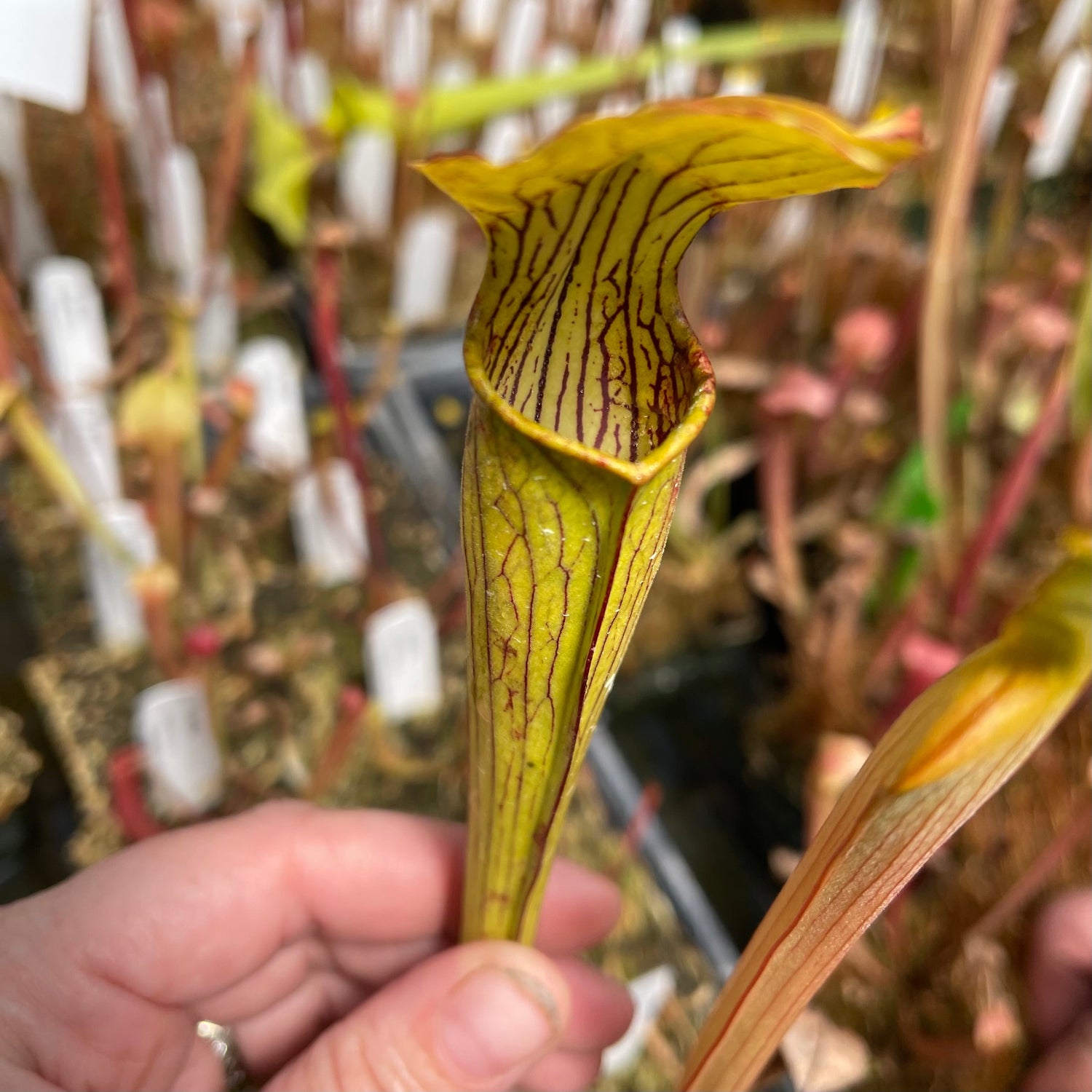
Sarracenia oreophila is nearly extinct in the wild. It looks similar to Sarracenia flava, producing most of its pitchers in spring and going dormant in late summer. Pitchers are tall and stately, usually green, but many clones have strong red venation. Sarracenia oreophila is a species with a greater tolerance for cold. One of the funny, quirky qualities of oreophila is that its pitchers can wrinkly in summer, giving it a very unusual appearance!
California Carnivores can ship this plant outside of California as per Permit Number ESPER0002076, the plant and any resulting seeds or progeny may not be planted on Federal property, these are artificially propagated.
DORMANT SEASONALLY, STARTING AS EARLY AS OCTOBER AND LASTING AS LATE AS MARCH, DEPENDING ON THE CONDITIONS AND SPECIES/HYBRID.
The pitchers turn brown and die back to the rhizome, or non-carnivorous leaves (phyllodia) grow during this time. Please see the final photo to see how Sarracenia look when dormant. They will begin to grow vigorously again in Spring when photoperiods lengthen and temperatures increase.
Care Instructions:
Growth Habit: Sarracenia primarily grow along the Southeastern coastal plain of the United States. They grow pitchers, which are modified leaves, seasonally that can vary in height, color, and size depending on the species or hybrid. The pitchers can die back during the growing season, but new pitchers will grow throughout the spring and summer. The pitchers start to grow in spring, and many grow as the year progresses; in summer, they will be at their best. In summer, you may see brown or black on your pitchers, which can be normal nectar burn or crisping from heat. As Fall comes on, the pitchers may start to die back, turning brown, and by winter, many or all of the pitchers are brown, but the rhizome remains healthy and intact throughout winter dormancy even if you cannot see anything growing. Sarracenia have brown, black, or white roots and do not generally have many of them. The rhizome can be brown and still be healthy.
Sun: Full sun. Sarracenia require lots of direct sun to grow and form pitchers properly. In many areas, they can be grown outdoors in full sun. If you live in a very hot AND very dry place like Arizona or Sacramento, for example, you will want to grow your plants in full morning sun with protection from the afternoon sun or under 30% shade cloth. It is common for several pitchers to "burn" and die back when you first place your plant into the sun; your plant is acclimating to your conditions, and in most cases, new leaves will soon grow and be fully acclimated. Sarracenia can be grown indoors on extremely sunny windowsills that receive all-day sun, but they will require a grow light in most circumstances due to the amount of light the plant needs. Grow lights should be 6-12” from the plant, depending on the light, and on a 10-12 hour day length. Sarracenia generally are not a good candidate for a terrarium as they need intense light and get quite tall. Shorter species like Sarracenia purpurea will do better in a terrarium. Grow outdoors if possible for best results.
Water: Always keep them in a saucer with a few inches of distilled, rainwater, or reverse osmosis water. Never let them dry out, especially in the hot summer months. Sarracenia are bog plants that prefer water-logged conditions unless you live somewhere both very hot AND extremely humid, like Alabama. In that case, let the water tray dry out for a day or two between refills. Always use distilled, reverse osmosis, or rainwater only. These plants are sensitive to their water quality, and giving them mineral and salt-free water is very important. In winter, when the plants are dormant, you can let them dry out a bit between rain storms, but do not let the soil get so dry that it pulls away from the edges of the pots. Be sure to supplement water as needed in between rains in winter.
Temperature and Dormancy: These are warm-temperate plants, meaning they need warm summers and chilly winters. They should be grown outdoors year-round in areas with mild winters. They thrive in temperatures ranging from 10 degrees - 100F degrees and can take a brief freeze or high-temperature spike up to 105F degrees for a short period. If nighttime temps drop below 10 but rise again during the day above 40, your plant will be fine outside.
If you live in an area with very cold winters, where nighttime temperatures drop below 10 degrees for sustained periods, you have three options for providing them with winter dormancy: the garage method, mulching in, or the fridge method. Dormancy is triggered by a combination of exposure to shorter photo-periods and cooler temperatures in the 40-60's F. While you can skip a dormancy period once or twice, in the long term, your plant will begin to do poorly and will eventually die if you skip this crucial period.
The garage method: Bring your plant indoors to a sunny windowsill in an unheated room or garage, where the nighttime temperatures will dip down to 50-60F. Keep it well watered during this period, do not let it dry out, and put it outside again when the outside nighttime temperatures increase consistently above 10F.
The mulch method: Mulch them in very, very well outdoors. Pack at least four inches of mulch on top of the plants and all around the sides to prevent winds from chilling them and freezing the roots. You can also dig the pots into the ground and then mulch heavily on top.
The fridge method: remove the plants from pots, gently clean the roots of soil, wrap the roots in a bit of damp long-fibered New Zealand sphagnum moss, place the plants in a resealable bag, and put the bag into the refrigerator. Leave them in the fridge from October to February, periodically checking on them to ensure they are still moist and not growing mold or fungus. Pot them back up in February. You can vary the timing to align with your outside nighttime temperatures so that your plants can come out of dormancy when it is safe to place them back outside. You can leave them in the fridge for an extended period if you have very long winters.
Soil and Repotting: We prefer a mix of four-part fertilizer-free peat moss to one-part perlite. You can add our pre-made mix to your order here. You do not need to repot your plant when you receive it from us for at least a year, and we recommend against it during the spring-summer months. Repot Sarracenia every 1-3 years in winter when they are dormant. Avoid placing in excessively large pots; size up only a few inches at a time. They do well in tall pots. Soil can also develop a swampy smell, especially right after shipping, when the plant is wrapped in plastic and sealed. This is normal; these plants grow naturally in bogs and swampy conditions, and peat moss can develop a bit of an anaerobic smell, but this does not indicate a problem with the soil.
Feeding and Fertilizer: Sarracenia will catch plenty of food when grown outdoors. When grown indoors, they will significantly benefit from fertilizing, both a foliar fertilizer and feeding the pitchers. Plants grown outdoors will appreciate a foliar feed as well. Apply MaxSea fertilizer once per month to the foliage only. Dilute 1/4 teaspoon of MaxSea into one gallon of water and then apply to the pitchers, and inside the pitchers, with a mister bottle or a watering can. Osmocote slow-release flower and vegetable pellets can be dropped into the pitchers with a bit of distilled water. Pellets can burn the sides of the pitchers where they come to rest; that is normal.
More Information: For further information on dormancy, repotting, dividing, and more, check out our website or our YouTube channel.
Sarracenia purpurea ssp. venosa are always show stopping plants; deeply colorful with large, gently undulating pitchers and forming large rosettes in their pots.
These are seed grown.
Sarracenia purpurea benefits from overhead watering so as to fill its pitchers with water. It also doesn’t lose its pitchers to winter dormancy as much as other Sarracenia species.
DORMANT SEASONALLY, STARTING AS EARLY AS OCTOBER AND LASTING AS LATE AS MARCH, DEPENDING ON THE CONDITIONS AND SPECIES/HYBRID. The pitchers turn brown and die back to the rhizome, or non-carnivorous leaves (phyllodia) grow during this time. Please see the final photo to see how Sarracenia look when dormant. They will begin to grow vigorously again in Spring when photoperiods lengthen and temperatures increase.
Care Instructions:
Growth Habit: Sarracenia primarily grow along the Southeastern coastal plain of the United States. They grow pitchers, which are modified leaves, seasonally that can vary in height, color, and size depending on the species or hybrid. The pitchers can die back during the growing season, but new pitchers will grow throughout the spring and summer. The pitchers start to grow in spring, and many grow as the year progresses; in summer, they will be at their best. In summer, you may see brown or black on your pitchers, which can be normal nectar burn or crisping from heat. As Fall comes on, the pitchers may start to die back, turning brown, and by winter, many or all of the pitchers are brown, but the rhizome remains healthy and intact throughout winter dormancy even if you cannot see anything growing. Sarracenia have brown, black, or white roots and do not generally have many of them. The rhizome can be brown and still be healthy.
Sun: Full sun. Sarracenia require lots of direct sun to grow and form pitchers properly. In many areas, they can be grown outdoors in full sun. If you live in a very hot AND very dry place like Arizona or Sacramento, for example, you will want to grow your plants in full morning sun with protection from the afternoon sun or under 30% shade cloth. It is common for several pitchers to "burn" and die back when you first place your plant into the sun; your plant is acclimating to your conditions, and in most cases, new leaves will soon grow and be fully acclimated. Sarracenia can be grown indoors on extremely sunny windowsills that receive all-day sun, but they will require a grow light in most circumstances due to the amount of light the plant needs. Grow lights should be 6-12” from the plant, depending on the light, and on a 10-12 hour day length. Sarracenia generally are not a good candidate for a terrarium as they need intense light and get quite tall. Shorter species like Sarracenia purpurea will do better in a terrarium. Grow outdoors if possible for best results.
Water: Always keep them in a saucer with a few inches of distilled, rainwater, or reverse osmosis water. Never let them dry out, especially in the hot summer months. Sarracenia are bog plants that prefer water-logged conditions unless you live somewhere both very hot AND extremely humid, like Alabama. In that case, let the water tray dry out for a day or two between refills. Always use distilled, reverse osmosis, or rainwater only. These plants are sensitive to their water quality, and giving them mineral and salt-free water is very important. In winter, when the plants are dormant, you can let them dry out a bit between rain storms, but do not let the soil get so dry that it pulls away from the edges of the pots. Be sure to supplement water as needed in between rains in winter.
Temperature and Dormancy: These are warm-temperate plants, meaning they need warm summers and chilly winters. They should be grown outdoors year-round in areas with mild winters. They thrive in temperatures ranging from 20 degrees - 100F degrees and can take a brief freeze or high-temperature spike up to 105F degrees for a short period. If nighttime temps drop below 20 but rise again during the day above 40, your plant will be fine outside.
If you live in an area with very cold winters, where nighttime temperatures drop below 20 degrees for sustained periods, you have three options for providing them with winter dormancy: the garage method, mulching in, or the fridge method. Dormancy is triggered by a combination of exposure to shorter photo-periods and cooler temperatures in the 40-60's F. While you can skip a dormancy period once or twice, in the long term, your plant will begin to do poorly and will eventually die if you skip this crucial period.
The garage method: Bring your plant indoors to a sunny windowsill in an unheated room or garage, where the nighttime temperatures will dip down to 50-60F. Keep it well watered during this period, do not let it dry out, and put it outside again when the outside nighttime temperatures increase consistently above 20F.
The mulch method: Mulch them in very, very well outdoors. Pack at least four inches of mulch on top of the plants and all around the sides to prevent winds from chilling them and freezing the roots. You can also dig the pots into the ground and then mulch heavily on top.
The fridge method: remove the plants from pots, gently clean the roots of soil, wrap the roots in a bit of damp long-fibered New Zealand sphagnum moss, place the plants in a resealable bag, and put the bag into the refrigerator. Leave them in the fridge from October to February, periodically checking on them to ensure they are still moist and not growing mold or fungus. Pot them back up in February. You can vary the timing to align with your outside nighttime temperatures so that your plants can come out of dormancy when it is safe to place them back outside. You can leave them in the fridge for an extended period if you have very long winters.
Soil and Repotting: We prefer a mix of four-part fertilizer-free peat moss to one-part perlite. You can add our pre-made mix to your order here. You do not need to repot your plant when you receive it from us for at least a year, and we recommend against it during the spring-summer months. Repot Sarracenia every 1-3 years in winter when they are dormant. Avoid placing in excessively large pots; size up only a few inches at a time. They do well in tall pots. Soil can also develop a swampy smell, especially right after shipping, when the plant is wrapped in plastic and sealed. This is normal; these plants grow naturally in bogs and swampy conditions, and peat moss can develop a bit of an anaerobic smell, but this does not indicate a problem with the soil.
Feeding and Fertilizer: Sarracenia will catch plenty of food when grown outdoors. When grown indoors, they will significantly benefit from fertilizing, both a foliar fertilizer and feeding the pitchers. Plants grown outdoors will appreciate a foliar feed as well. Apply MaxSea fertilizer once per month to the foliage only. Dilute 1/4 teaspoon of MaxSea into one gallon of water and then apply to the pitchers, and inside the pitchers, with a mister bottle or a watering can. Osmocote slow-release flower and vegetable pellets can be dropped into the pitchers with a bit of distilled water. Pellets can burn the sides of the pitchers where they come to rest; that is normal.
More Information: For further information on dormancy, repotting, dividing, and more, check out our website or our YouTube channel.
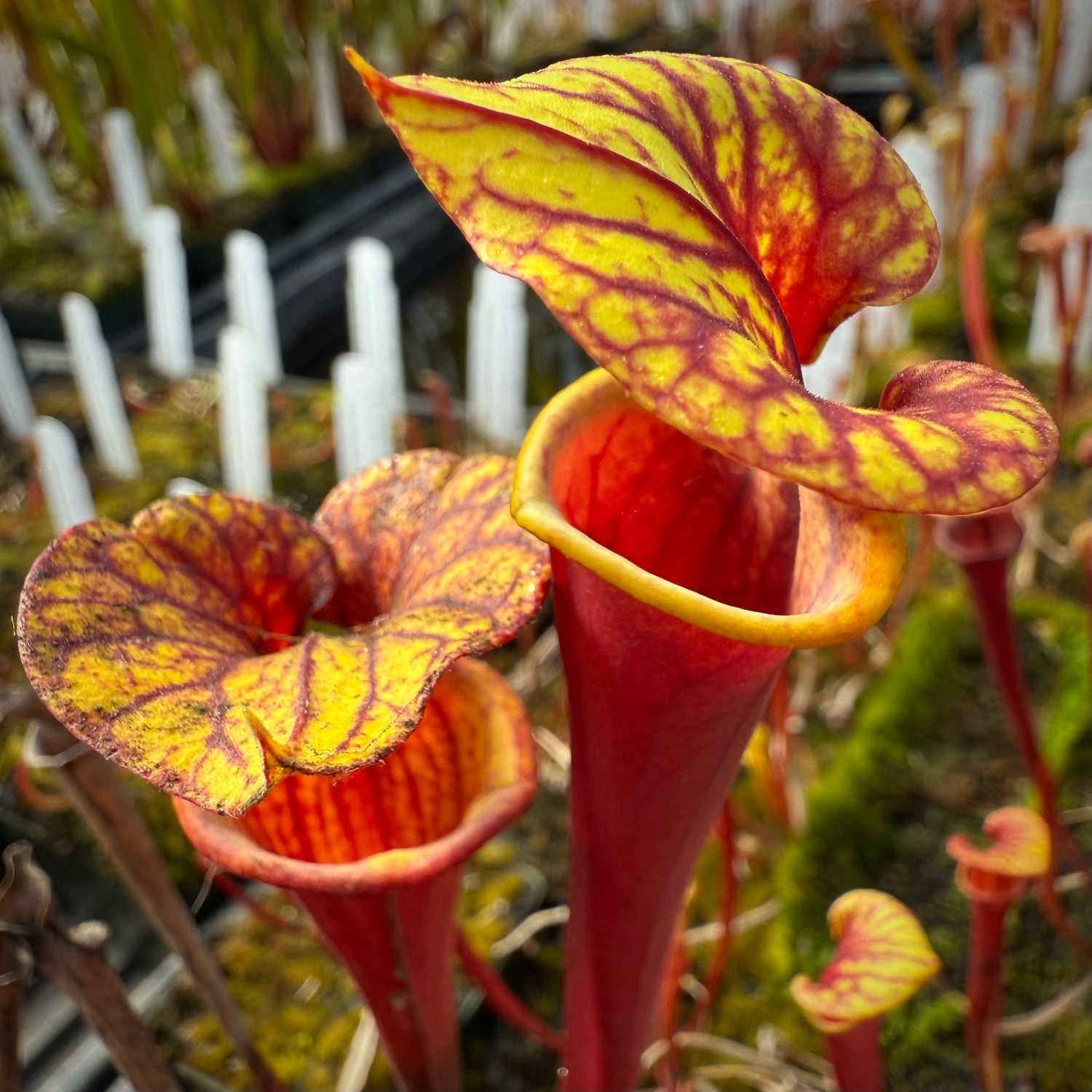
This is a fantastic color variety of Sarracenia flava! The entire pitcher's body is a stunning orangey-red, complemented by a deep red throat. The top of the lid and the lip stay vibrant green-yellow, creating a beautiful and eye-catching contrast. Spring pitchers can be more green, and as spring turns into summer, the pitcher's colors intensify and deepen, making it a truly mesmerizing sight!
These are seed-grown plants, so there is a bit of variation, but they will all have classic rubricorpora color and size!
DORMANT SEASONALLY, STARTING AS EARLY AS OCTOBER AND LASTING AS LATE AS MARCH, DEPENDING ON THE CONDITIONS AND SPECIES/HYBRID. The pitchers turn brown and die back to the rhizome, or non-carnivorous leaves (phyllodia) grow during this time. Please see the final photo to see how Sarracenia look when dormant. They will begin to grow vigorously again in Spring when photoperiods lengthen and temperatures increase.
Care Instructions:
Growth Habit: Sarracenia primarily grow along the Southeastern coastal plain of the United States. They grow pitchers, which are modified leaves, seasonally that can vary in height, color, and size depending on the species or hybrid. The pitchers can die back during the growing season, but new pitchers will grow throughout the spring and summer. The pitchers start to grow in spring, and many grow as the year progresses; in summer, they will be at their best. In summer, you may see brown or black on your pitchers, which can be normal nectar burn or crisping from heat. As Fall comes on, the pitchers may start to die back, turning brown, and by winter, many or all of the pitchers are brown, but the rhizome remains healthy and intact throughout winter dormancy even if you cannot see anything growing. Sarracenia have brown, black, or white roots and do not generally have many of them. The rhizome can be brown and still be healthy.
Sun: Full sun. Sarracenia require lots of direct sun to grow and form pitchers properly. In many areas, they can be grown outdoors in full sun. If you live in a very hot AND very dry place like Arizona or Sacramento, for example, you will want to grow your plants in full morning sun with protection from the afternoon sun or under 30% shade cloth. It is common for several pitchers to "burn" and die back when you first place your plant into the sun; your plant is acclimating to your conditions, and in most cases, new leaves will soon grow and be fully acclimated. Sarracenia can be grown indoors on extremely sunny windowsills that receive all-day sun, but they will require a grow light in most circumstances due to the amount of light the plant needs. Grow lights should be 6-12” from the plant, depending on the light, and on a 10-12 hour day length. Sarracenia generally are not a good candidate for a terrarium as they need intense light and get quite tall. Shorter species like Sarracenia purpurea will do better in a terrarium. Grow outdoors if possible for best results.
Water: Always keep them in a saucer with a few inches of distilled, rainwater, or reverse osmosis water. Never let them dry out, especially in the hot summer months. Sarracenia are bog plants that prefer water-logged conditions unless you live somewhere both very hot AND extremely humid, like Alabama. In that case, let the water tray dry out for a day or two between refills. Always use distilled, reverse osmosis, or rainwater only. These plants are sensitive to their water quality, and giving them mineral and salt-free water is very important. In winter, when the plants are dormant, you can let them dry out a bit between rain storms, but do not let the soil get so dry that it pulls away from the edges of the pots. Be sure to supplement water as needed in between rains in winter.
Temperature and Dormancy: These are warm-temperate plants, meaning they need warm summers and chilly winters. They should be grown outdoors year-round in areas with mild winters. They thrive in temperatures ranging from 20 degrees - 100F degrees and can take a brief freeze or high-temperature spike up to 105F degrees for a short period. If nighttime temps drop below 20 but rise again during the day above 40, your plant will be fine outside.
If you live in an area with very cold winters, where nighttime temperatures drop below 20 degrees for sustained periods, you have three options for providing them with winter dormancy: the garage method, mulching in, or the fridge method. Dormancy is triggered by a combination of exposure to shorter photo-periods and cooler temperatures in the 40-60's F. While you can skip a dormancy period once or twice, in the long term, your plant will begin to do poorly and will eventually die if you skip this crucial period.
The garage method: Bring your plant indoors to a sunny windowsill in an unheated room or garage, where the nighttime temperatures will dip down to 50-60F. Keep it well watered during this period, do not let it dry out, and put it outside again when the outside nighttime temperatures increase consistently above 20F.
The mulch method: Mulch them in very, very well outdoors. Pack at least four inches of mulch on top of the plants and all around the sides to prevent winds from chilling them and freezing the roots. You can also dig the pots into the ground and then mulch heavily on top.
The fridge method: remove the plants from pots, gently clean the roots of soil, wrap the roots in a bit of damp long-fibered New Zealand sphagnum moss, place the plants in a resealable bag, and put the bag into the refrigerator. Leave them in the fridge from October to February, periodically checking on them to ensure they are still moist and not growing mold or fungus. Pot them back up in February. You can vary the timing to align with your outside nighttime temperatures so that your plants can come out of dormancy when it is safe to place them back outside. You can leave them in the fridge for an extended period if you have very long winters.
Soil and Repotting: We prefer a mix of four-part fertilizer-free peat moss to one-part perlite. You can add our pre-made mix to your order here. You do not need to repot your plant when you receive it from us for at least a year, and we recommend against it during the spring-summer months. Repot Sarracenia every 1-3 years in winter when they are dormant. Avoid placing in excessively large pots; size up only a few inches at a time. They do well in tall pots. Soil can also develop a swampy smell, especially right after shipping, when the plant is wrapped in plastic and sealed. This is normal; these plants grow naturally in bogs and swampy conditions, and peat moss can develop a bit of an anaerobic smell, but this does not indicate a problem with the soil.
Feeding and Fertilizer: Sarracenia will catch plenty of food when grown outdoors. When grown indoors, they will significantly benefit from fertilizing, both a foliar fertilizer and feeding the pitchers. Plants grown outdoors will appreciate a foliar feed as well. Apply MaxSea fertilizer once per month to the foliage only. Dilute 1/4 teaspoon of MaxSea into one gallon of water and then apply to the pitchers, and inside the pitchers, with a mister bottle or a watering can. Osmocote slow-release flower and vegetable pellets can be dropped into the pitchers with a bit of distilled water. Pellets can burn the sides of the pitchers where they come to rest; that is normal.
More Information: For further information on dormancy, repotting, dividing, and more, check out our website or our YouTube channel.
Sarracenia purpurea ssp. venosa var. montana is the exceptionally beautiful mountain form of purpurea ssp venosa! Its intricately venated pitchers have a pinched hood at the top, like a little witches hat! We’re so excited to have these because they’re so hard to find and almost never offered in the US!
Sarracenia purpurea benefits from overhead watering so as to fill its pitchers with water. It also doesn’t lose its pitchers to winter dormancy as much as other Sarracenia species.
These are tissue culture and are small sized plants that will quickly grow next spring to a larger size!
DORMANT SEASONALLY, STARTING AS EARLY AS OCTOBER AND LASTING AS LATE AS MARCH, DEPENDING ON THE CONDITIONS AND SPECIES/HYBRID. The pitchers turn brown and die back to the rhizome, or non-carnivorous leaves (phyllodia) grow during this time. Please see the final photo to see how Sarracenia look when dormant. They will begin to grow vigorously again in Spring when photoperiods lengthen and temperatures increase.
Care Instructions:
Growth Habit: Sarracenia primarily grow along the Southeastern coastal plain of the United States. They grow pitchers, which are modified leaves, seasonally that can vary in height, color, and size depending on the species or hybrid. The pitchers can die back during the growing season, but new pitchers will grow throughout the spring and summer. The pitchers start to grow in spring, and many grow as the year progresses; in summer, they will be at their best. In summer, you may see brown or black on your pitchers, which can be normal nectar burn or crisping from heat. As Fall comes on, the pitchers may start to die back, turning brown, and by winter, many or all of the pitchers are brown, but the rhizome remains healthy and intact throughout winter dormancy even if you cannot see anything growing. Sarracenia have brown, black, or white roots and do not generally have many of them. The rhizome can be brown and still be healthy.
Sun: Full sun. Sarracenia require lots of direct sun to grow and form pitchers properly. In many areas, they can be grown outdoors in full sun. If you live in a very hot AND very dry place like Arizona or Sacramento, for example, you will want to grow your plants in full morning sun with protection from the afternoon sun or under 30% shade cloth. It is common for several pitchers to "burn" and die back when you first place your plant into the sun; your plant is acclimating to your conditions, and in most cases, new leaves will soon grow and be fully acclimated. Sarracenia can be grown indoors on extremely sunny windowsills that receive all-day sun, but they will require a grow light in most circumstances due to the amount of light the plant needs. Grow lights should be 6-12” from the plant, depending on the light, and on a 10-12 hour day length. Sarracenia generally are not a good candidate for a terrarium as they need intense light and get quite tall. Shorter species like Sarracenia purpurea will do better in a terrarium. Grow outdoors if possible for best results.
Water: Always keep them in a saucer with a few inches of distilled, rainwater, or reverse osmosis water. Never let them dry out, especially in the hot summer months. Sarracenia are bog plants that prefer water-logged conditions unless you live somewhere both very hot AND extremely humid, like Alabama. In that case, let the water tray dry out for a day or two between refills. Always use distilled, reverse osmosis, or rainwater only. These plants are sensitive to their water quality, and giving them mineral and salt-free water is very important. In winter, when the plants are dormant, you can let them dry out a bit between rain storms, but do not let the soil get so dry that it pulls away from the edges of the pots. Be sure to supplement water as needed in between rains in winter.
Temperature and Dormancy: These are warm-temperate plants, meaning they need warm summers and chilly winters. They should be grown outdoors year-round in areas with mild winters. They thrive in temperatures ranging from 20 degrees - 100F degrees and can take a brief freeze or high-temperature spike up to 105F degrees for a short period. If nighttime temps drop below 20 but rise again during the day above 40, your plant will be fine outside.
If you live in an area with very cold winters, where nighttime temperatures drop below 20 degrees for sustained periods, you have three options for providing them with winter dormancy: the garage method, mulching in, or the fridge method. Dormancy is triggered by a combination of exposure to shorter photo-periods and cooler temperatures in the 40-60's F. While you can skip a dormancy period once or twice, in the long term, your plant will begin to do poorly and will eventually die if you skip this crucial period.
The garage method: Bring your plant indoors to a sunny windowsill in an unheated room or garage, where the nighttime temperatures will dip down to 50-60F. Keep it well watered during this period, do not let it dry out, and put it outside again when the outside nighttime temperatures increase consistently above 20F.
The mulch method: Mulch them in very, very well outdoors. Pack at least four inches of mulch on top of the plants and all around the sides to prevent winds from chilling them and freezing the roots. You can also dig the pots into the ground and then mulch heavily on top.
The fridge method: remove the plants from pots, gently clean the roots of soil, wrap the roots in a bit of damp long-fibered New Zealand sphagnum moss, place the plants in a resealable bag, and put the bag into the refrigerator. Leave them in the fridge from October to February, periodically checking on them to ensure they are still moist and not growing mold or fungus. Pot them back up in February. You can vary the timing to align with your outside nighttime temperatures so that your plants can come out of dormancy when it is safe to place them back outside. You can leave them in the fridge for an extended period if you have very long winters.
Soil and Repotting: We prefer a mix of four-part fertilizer-free peat moss to one-part perlite. You can add our pre-made mix to your order here. You do not need to repot your plant when you receive it from us for at least a year, and we recommend against it during the spring-summer months. Repot Sarracenia every 1-3 years in winter when they are dormant. Avoid placing in excessively large pots; size up only a few inches at a time. They do well in tall pots. Soil can also develop a swampy smell, especially right after shipping, when the plant is wrapped in plastic and sealed. This is normal; these plants grow naturally in bogs and swampy conditions, and peat moss can develop a bit of an anaerobic smell, but this does not indicate a problem with the soil.
Feeding and Fertilizer: Sarracenia will catch plenty of food when grown outdoors. When grown indoors, they will significantly benefit from fertilizing, both a foliar fertilizer and feeding the pitchers. Plants grown outdoors will appreciate a foliar feed as well. Apply MaxSea fertilizer once per month to the foliage only. Dilute 1/4 teaspoon of MaxSea into one gallon of water and then apply to the pitchers, and inside the pitchers, with a mister bottle or a watering can. Osmocote slow-release flower and vegetable pellets can be dropped into the pitchers with a bit of distilled water. Pellets can burn the sides of the pitchers where they come to rest; that is normal.
More Information: For further information on dormancy, repotting, dividing, and more, check out our website or our YouTube channel.
Sarracenia rubra ssp. gulfensis originates from the Florida panhandle. The pitchers are upright and narrow, and the large, pointed lid undulates slightly. The coloration varies from olive green with red veins to entirely red plants. The small red flowers are weakly scented of raspberries. These charming plants have tons of pitchers!
Sarracenia rubra often produces its most beautiful and largest pitchers in late summer or early fall, so it puts on a long display of color and beauty!
These are seed-grown.
DORMANT SEASONALLY, STARTING AS EARLY AS OCTOBER AND LASTING AS LATE AS MARCH, DEPENDING ON THE CONDITIONS AND SPECIES/HYBRID. The pitchers turn brown and die back to the rhizome, or non-carnivorous leaves (phyllodia) grow during this time. Please see the final photo to see how Sarracenia look when dormant. They will begin to grow vigorously again in Spring when photoperiods lengthen and temperatures increase.
Care Instructions:
Growth Habit: Sarracenia primarily grow along the Southeastern coastal plain of the United States. They grow pitchers, which are modified leaves, seasonally that can vary in height, color, and size depending on the species or hybrid. The pitchers can die back during the growing season, but new pitchers will grow throughout the spring and summer. The pitchers start to grow in spring, and many grow as the year progresses; in summer, they will be at their best. In summer, you may see brown or black on your pitchers, which can be normal nectar burn or crisping from heat. As Fall comes on, the pitchers may start to die back, turning brown, and by winter, many or all of the pitchers are brown, but the rhizome remains healthy and intact throughout winter dormancy even if you cannot see anything growing. Sarracenia have brown, black, or white roots and do not generally have many of them. The rhizome can be brown and still be healthy.
Sun: Full sun. Sarracenia require lots of direct sun to grow and form pitchers properly. In many areas, they can be grown outdoors in full sun. If you live in a very hot AND very dry place like Arizona or Sacramento, for example, you will want to grow your plants in full morning sun with protection from the afternoon sun or under 30% shade cloth. It is common for several pitchers to "burn" and die back when you first place your plant into the sun; your plant is acclimating to your conditions, and in most cases, new leaves will soon grow and be fully acclimated. Sarracenia can be grown indoors on extremely sunny windowsills that receive all-day sun, but they will require a grow light in most circumstances due to the amount of light the plant needs. Grow lights should be 6-12” from the plant, depending on the light, and on a 10-12 hour day length. Sarracenia generally are not a good candidate for a terrarium as they need intense light and get quite tall. Shorter species like Sarracenia purpurea will do better in a terrarium. Grow outdoors if possible for best results.
Water: Always keep them in a saucer with a few inches of distilled, rainwater, or reverse osmosis water. Never let them dry out, especially in the hot summer months. Sarracenia are bog plants that prefer water-logged conditions unless you live somewhere both very hot AND extremely humid, like Alabama. In that case, let the water tray dry out for a day or two between refills. Always use distilled, reverse osmosis, or rainwater only. These plants are sensitive to their water quality, and giving them mineral and salt-free water is very important. In winter, when the plants are dormant, you can let them dry out a bit between rain storms, but do not let the soil get so dry that it pulls away from the edges of the pots. Be sure to supplement water as needed in between rains in winter.
Temperature and Dormancy: These are warm-temperate plants, meaning they need warm summers and chilly winters. They should be grown outdoors year-round in areas with mild winters. They thrive in temperatures ranging from 20 degrees - 100F degrees and can take a brief freeze or high-temperature spike up to 105F degrees for a short period. If nighttime temps drop below 20 but rise again during the day above 40, your plant will be fine outside.
If you live in an area with very cold winters, where nighttime temperatures drop below 20 degrees for sustained periods, you have three options for providing them with winter dormancy: the garage method, mulching in, or the fridge method. Dormancy is triggered by a combination of exposure to shorter photo-periods and cooler temperatures in the 40-60's F. While you can skip a dormancy period once or twice, in the long term, your plant will begin to do poorly and will eventually die if you skip this crucial period.
The garage method: Bring your plant indoors to a sunny windowsill in an unheated room or garage, where the nighttime temperatures will dip down to 50-60F. Keep it well watered during this period, do not let it dry out, and put it outside again when the outside nighttime temperatures increase consistently above 20F.
The mulch method: Mulch them in very, very well outdoors. Pack at least four inches of mulch on top of the plants and all around the sides to prevent winds from chilling them and freezing the roots. You can also dig the pots into the ground and then mulch heavily on top.
The fridge method: remove the plants from pots, gently clean the roots of soil, wrap the roots in a bit of damp long-fibered New Zealand sphagnum moss, place the plants in a resealable bag, and put the bag into the refrigerator. Leave them in the fridge from October to February, periodically checking on them to ensure they are still moist and not growing mold or fungus. Pot them back up in February. You can vary the timing to align with your outside nighttime temperatures so that your plants can come out of dormancy when it is safe to place them back outside. You can leave them in the fridge for an extended period if you have very long winters.
Soil and Repotting: We prefer a mix of four-part fertilizer-free peat moss to one-part perlite. You can add our pre-made mix to your order here. You do not need to repot your plant when you receive it from us for at least a year, and we recommend against it during the spring-summer months. Repot Sarracenia every 1-3 years in winter when they are dormant. Avoid placing in excessively large pots; size up only a few inches at a time. They do well in tall pots. Soil can also develop a swampy smell, especially right after shipping, when the plant is wrapped in plastic and sealed. This is normal; these plants grow naturally in bogs and swampy conditions, and peat moss can develop a bit of an anaerobic smell, but this does not indicate a problem with the soil.
Feeding and Fertilizer: Sarracenia will catch plenty of food when grown outdoors. When grown indoors, they will significantly benefit from fertilizing, both a foliar fertilizer and feeding the pitchers. Plants grown outdoors will appreciate a foliar feed as well. Apply MaxSea fertilizer once per month to the foliage only. Dilute 1/4 teaspoon of MaxSea into one gallon of water and then apply to the pitchers, and inside the pitchers, with a mister bottle or a watering can. Osmocote slow-release flower and vegetable pellets can be dropped into the pitchers with a bit of distilled water. Pellets can burn the sides of the pitchers where they come to rest; that is normal.
More Information: For further information on dormancy, repotting, dividing, and more, check out our website or our YouTube channel.
Sarracenia flava var. atropurpurea “Our Darkest” x flava var rugelii ‘Bud’s Gargoyle’ Potted
From $ 24.99
Unit price perSarracenia flava var. atropurpurea “Our Darkest” x flava var rugelii ‘Bud’s Gargoyle’ Potted
From $ 24.99
Unit price perSarracenia flava var. atropurpurea “Our Darkest” x flava var rugelii ‘Bud’s Gargoyle’ is a fantastic seed-grown batch of Sarracenia that we expect to have broad, impressive lids and wide, open mouths! The coloration is scarlet-red with bright yellow lids and mouth, although a few are a striking all-red! We expect these pitchers to be quite tall when mature.
These are seed-grown, and there is variability in size and coloration.
DORMANT SEASONALLY, STARTING AS EARLY AS OCTOBER AND LASTING AS LATE AS MARCH, DEPENDING ON THE CONDITIONS AND SPECIES/HYBRID. The pitchers turn brown and die back to the rhizome, or non-carnivorous leaves (phyllodia) grow during this time. Please see the final photo to see how Sarracenia look when dormant. They will begin to grow vigorously again in Spring when photoperiods lengthen and temperatures increase.
Care Instructions:
Growth Habit: Sarracenia primarily grow along the Southeastern coastal plain of the United States. They grow pitchers, which are modified leaves, seasonally that can vary in height, color, and size depending on the species or hybrid. The pitchers can die back during the growing season, but new pitchers will grow throughout the spring and summer. The pitchers start to grow in spring, and many grow as the year progresses; in summer, they will be at their best. In summer, you may see brown or black on your pitchers, which can be normal nectar burn or crisping from heat. As Fall comes on, the pitchers may start to die back, turning brown, and by winter, many or all of the pitchers are brown, but the rhizome remains healthy and intact throughout winter dormancy even if you cannot see anything growing. Sarracenia have brown, black, or white roots and do not generally have many of them. The rhizome can be brown and still be healthy.
Sun: Full sun. Sarracenia require lots of direct sun to grow and form pitchers properly. In many areas, they can be grown outdoors in full sun. If you live in a very hot AND very dry place like Arizona or Sacramento, for example, you will want to grow your plants in full morning sun with protection from the afternoon sun or under 30% shade cloth. It is common for several pitchers to "burn" and die back when you first place your plant into the sun; your plant is acclimating to your conditions, and in most cases, new leaves will soon grow and be fully acclimated. Sarracenia can be grown indoors on extremely sunny windowsills that receive all-day sun, but they will require a grow light in most circumstances due to the amount of light the plant needs. Grow lights should be 6-12” from the plant, depending on the light, and on a 10-12 hour day length. Sarracenia generally are not a good candidate for a terrarium as they need intense light and get quite tall. Shorter species like Sarracenia purpurea will do better in a terrarium. Grow outdoors if possible for best results.
Water: Always keep them in a saucer with a few inches of distilled, rainwater, or reverse osmosis water. Never let them dry out, especially in the hot summer months. Sarracenia are bog plants that prefer water-logged conditions unless you live somewhere both very hot AND extremely humid, like Alabama. In that case, let the water tray dry out for a day or two between refills. Always use distilled, reverse osmosis, or rainwater only. These plants are sensitive to their water quality, and giving them mineral and salt-free water is very important. In winter, when the plants are dormant, you can let them dry out a bit between rain storms, but do not let the soil get so dry that it pulls away from the edges of the pots. Be sure to supplement water as needed in between rains in winter.
Temperature and Dormancy: These are warm-temperate plants, meaning they need warm summers and chilly winters. They should be grown outdoors year-round in areas with mild winters. They thrive in temperatures ranging from 20 degrees - 100F degrees and can take a brief freeze or high-temperature spike up to 105F degrees for a short period. If nighttime temps drop below 20 but rise again during the day above 40, your plant will be fine outside.
If you live in an area with very cold winters, where nighttime temperatures drop below 20 degrees for sustained periods, you have three options for providing them with winter dormancy: the garage method, mulching in, or the fridge method. Dormancy is triggered by a combination of exposure to shorter photo-periods and cooler temperatures in the 40-60's F. While you can skip a dormancy period once or twice, in the long term, your plant will begin to do poorly and will eventually die if you skip this crucial period.
The garage method: Bring your plant indoors to a sunny windowsill in an unheated room or garage, where the nighttime temperatures will dip down to 50-60F. Keep it well watered during this period, do not let it dry out, and put it outside again when the outside nighttime temperatures increase consistently above 20F.
The mulch method: Mulch them in very, very well outdoors. Pack at least four inches of mulch on top of the plants and all around the sides to prevent winds from chilling them and freezing the roots. You can also dig the pots into the ground and then mulch heavily on top.
The fridge method: remove the plants from pots, gently clean the roots of soil, wrap the roots in a bit of damp long-fibered New Zealand sphagnum moss, place the plants in a resealable bag, and put the bag into the refrigerator. Leave them in the fridge from October to February, periodically checking on them to ensure they are still moist and not growing mold or fungus. Pot them back up in February. You can vary the timing to align with your outside nighttime temperatures so that your plants can come out of dormancy when it is safe to place them back outside. You can leave them in the fridge for an extended period if you have very long winters.
Soil and Repotting: We prefer a mix of four-part fertilizer-free peat moss to one-part perlite. You can add our pre-made mix to your order here. You do not need to repot your plant when you receive it from us for at least a year, and we recommend against it during the spring-summer months. Repot Sarracenia every 1-3 years in winter when they are dormant. Avoid placing in excessively large pots; size up only a few inches at a time. They do well in tall pots. Soil can also develop a swampy smell, especially right after shipping, when the plant is wrapped in plastic and sealed. This is normal; these plants grow naturally in bogs and swampy conditions, and peat moss can develop a bit of an anaerobic smell, but this does not indicate a problem with the soil.
Feeding and Fertilizer: Sarracenia will catch plenty of food when grown outdoors. When grown indoors, they will significantly benefit from fertilizing, both a foliar fertilizer and feeding the pitchers. Plants grown outdoors will appreciate a foliar feed as well. Apply MaxSea fertilizer once per month to the foliage only. Dilute 1/4 teaspoon of MaxSea into one gallon of water and then apply to the pitchers, and inside the pitchers, with a mister bottle or a watering can. Osmocote slow-release flower and vegetable pellets can be dropped into the pitchers with a bit of distilled water. Pellets can burn the sides of the pitchers where they come to rest; that is normal.
More Information: For further information on dormancy, repotting, dividing, and more, check out our website or our YouTube channel.
Sarracenia x “Acquerello”, a hybrid of Sarracenia flava var. rubricorpora “F131D” x moorei “All Red Giant #18”, is characterized by narrow, tall pitchers and red-purple coloration bordering on black. This plant has the darkest coloration with splashes of golden color on the lid. These will be tall and beautiful!
DORMANT SEASONALLY, STARTING AS EARLY AS OCTOBER AND LASTING AS LATE AS MARCH, DEPENDING ON THE CONDITIONS AND SPECIES/HYBRID. The pitchers turn brown and die back to the rhizome, or non-carnivorous leaves (phyllodia) grow during this time. Please see the final photo to see how Sarracenia look when dormant. They will begin to grow vigorously again in Spring when photoperiods lengthen and temperatures increase.
Care Instructions:
Growth Habit: Sarracenia primarily grow along the Southeastern coastal plain of the United States. They grow pitchers, which are modified leaves, seasonally that can vary in height, color, and size depending on the species or hybrid. The pitchers can die back during the growing season, but new pitchers will grow throughout the spring and summer. The pitchers start to grow in spring, and many grow as the year progresses; in summer, they will be at their best. In summer, you may see brown or black on your pitchers, which can be normal nectar burn or crisping from heat. As Fall comes on, the pitchers may start to die back, turning brown, and by winter, many or all of the pitchers are brown, but the rhizome remains healthy and intact throughout winter dormancy even if you cannot see anything growing. Sarracenia have brown, black, or white roots and do not generally have many of them. The rhizome can be brown and still be healthy.
Sun: Full sun. Sarracenia require lots of direct sun to grow and form pitchers properly. In many areas, they can be grown outdoors in full sun. If you live in a very hot AND very dry place like Arizona or Sacramento, for example, you will want to grow your plants in full morning sun with protection from the afternoon sun or under 30% shade cloth. It is common for several pitchers to "burn" and die back when you first place your plant into the sun; your plant is acclimating to your conditions, and in most cases, new leaves will soon grow and be fully acclimated. Sarracenia can be grown indoors on extremely sunny windowsills that receive all-day sun, but they will require a grow light in most circumstances due to the amount of light the plant needs. Grow lights should be 6-12” from the plant, depending on the light, and on a 10-12 hour day length. Sarracenia generally are not a good candidate for a terrarium as they need intense light and get quite tall. Shorter species like Sarracenia purpurea will do better in a terrarium. Grow outdoors if possible for best results.
Water: Always keep them in a saucer with a few inches of distilled, rainwater, or reverse osmosis water. Never let them dry out, especially in the hot summer months. Sarracenia are bog plants that prefer water-logged conditions unless you live somewhere both very hot AND extremely humid, like Alabama. In that case, let the water tray dry out for a day or two between refills. Always use distilled, reverse osmosis, or rainwater only. These plants are sensitive to their water quality, and giving them mineral and salt-free water is very important. In winter, when the plants are dormant, you can let them dry out a bit between rain storms, but do not let the soil get so dry that it pulls away from the edges of the pots. Be sure to supplement water as needed in between rains in winter.
Temperature and Dormancy: These are warm-temperate plants, meaning they need warm summers and chilly winters. They should be grown outdoors year-round in areas with mild winters. They thrive in temperatures ranging from 20 degrees - 100F degrees and can take a brief freeze or high-temperature spike up to 105F degrees for a short period. If nighttime temps drop below 20 but rise again during the day above 40, your plant will be fine outside.
If you live in an area with very cold winters, where nighttime temperatures drop below 20 degrees for sustained periods, you have three options for providing them with winter dormancy: the garage method, mulching in, or the fridge method. Dormancy is triggered by a combination of exposure to shorter photo-periods and cooler temperatures in the 40-60's F. While you can skip a dormancy period once or twice, in the long term, your plant will begin to do poorly and will eventually die if you skip this crucial period.
The garage method: Bring your plant indoors to a sunny windowsill in an unheated room or garage, where the nighttime temperatures will dip down to 50-60F. Keep it well watered during this period, do not let it dry out, and put it outside again when the outside nighttime temperatures increase consistently above 20F.
The mulch method: Mulch them in very, very well outdoors. Pack at least four inches of mulch on top of the plants and all around the sides to prevent winds from chilling them and freezing the roots. You can also dig the pots into the ground and then mulch heavily on top.
The fridge method: remove the plants from pots, gently clean the roots of soil, wrap the roots in a bit of damp long-fibered New Zealand sphagnum moss, place the plants in a resealable bag, and put the bag into the refrigerator. Leave them in the fridge from October to February, periodically checking on them to ensure they are still moist and not growing mold or fungus. Pot them back up in February. You can vary the timing to align with your outside nighttime temperatures so that your plants can come out of dormancy when it is safe to place them back outside. You can leave them in the fridge for an extended period if you have very long winters.
Soil and Repotting: We prefer a mix of four-part fertilizer-free peat moss to one-part perlite. You can add our pre-made mix to your order here. You do not need to repot your plant when you receive it from us for at least a year, and we recommend against it during the spring-summer months. Repot Sarracenia every 1-3 years in winter when they are dormant. Avoid placing in excessively large pots; size up only a few inches at a time. They do well in tall pots. Soil can also develop a swampy smell, especially right after shipping, when the plant is wrapped in plastic and sealed. This is normal; these plants grow naturally in bogs and swampy conditions, and peat moss can develop a bit of an anaerobic smell, but this does not indicate a problem with the soil.
Feeding and Fertilizer: Sarracenia will catch plenty of food when grown outdoors. When grown indoors, they will significantly benefit from fertilizing, both a foliar fertilizer and feeding the pitchers. Plants grown outdoors will appreciate a foliar feed as well. Apply MaxSea fertilizer once per month to the foliage only. Dilute 1/4 teaspoon of MaxSea into one gallon of water and then apply to the pitchers, and inside the pitchers, with a mister bottle or a watering can. Osmocote slow-release flower and vegetable pellets can be dropped into the pitchers with a bit of distilled water. Pellets can burn the sides of the pitchers where they come to rest; that is normal.
More Information: For further information on dormancy, repotting, dividing, and more, check out our website or our YouTube channel.
These are a beautiful bright red-black complex hybrid from Europe. Each pitcher has lighter colors at the bottom of base and darkens at the pitcher lids! These will be compact plants with a profusion of pitchers and ruffly lids.
DORMANT SEASONALLY, STARTING AS EARLY AS OCTOBER AND LASTING AS LATE AS MARCH, DEPENDING ON THE CONDITIONS AND SPECIES/HYBRID. The pitchers turn brown and die back to the rhizome, or non-carnivorous leaves (phyllodia) grow during this time. Please see the final photo to see how Sarracenia look when dormant. They will begin to grow vigorously again in Spring when photoperiods lengthen and temperatures increase.
Care Instructions:
Growth Habit: Sarracenia primarily grow along the Southeastern coastal plain of the United States. They grow pitchers, which are modified leaves, seasonally that can vary in height, color, and size depending on the species or hybrid. The pitchers can die back during the growing season, but new pitchers will grow throughout the spring and summer. The pitchers start to grow in spring, and many grow as the year progresses; in summer, they will be at their best. In summer, you may see brown or black on your pitchers, which can be normal nectar burn or crisping from heat. As Fall comes on, the pitchers may start to die back, turning brown, and by winter, many or all of the pitchers are brown, but the rhizome remains healthy and intact throughout winter dormancy even if you cannot see anything growing. Sarracenia have brown, black, or white roots and do not generally have many of them. The rhizome can be brown and still be healthy.
Sun: Full sun. Sarracenia require lots of direct sun to grow and form pitchers properly. In many areas, they can be grown outdoors in full sun. If you live in a very hot AND very dry place like Arizona or Sacramento, for example, you will want to grow your plants in full morning sun with protection from the afternoon sun or under 30% shade cloth. It is common for several pitchers to "burn" and die back when you first place your plant into the sun; your plant is acclimating to your conditions, and in most cases, new leaves will soon grow and be fully acclimated. Sarracenia can be grown indoors on extremely sunny windowsills that receive all-day sun, but they will require a grow light in most circumstances due to the amount of light the plant needs. Grow lights should be 6-12” from the plant, depending on the light, and on a 10-12 hour day length. Sarracenia generally are not a good candidate for a terrarium as they need intense light and get quite tall. Shorter species like Sarracenia purpurea will do better in a terrarium. Grow outdoors if possible for best results.
Water: Always keep them in a saucer with a few inches of distilled, rainwater, or reverse osmosis water. Never let them dry out, especially in the hot summer months. Sarracenia are bog plants that prefer water-logged conditions unless you live somewhere both very hot AND extremely humid, like Alabama. In that case, let the water tray dry out for a day or two between refills. Always use distilled, reverse osmosis, or rainwater only. These plants are sensitive to their water quality, and giving them mineral and salt-free water is very important. In winter, when the plants are dormant, you can let them dry out a bit between rain storms, but do not let the soil get so dry that it pulls away from the edges of the pots. Be sure to supplement water as needed in between rains in winter.
Temperature and Dormancy: These are warm-temperate plants, meaning they need warm summers and chilly winters. They should be grown outdoors year-round in areas with mild winters. They thrive in temperatures ranging from 20 degrees - 100F degrees and can take a brief freeze or high-temperature spike up to 105F degrees for a short period. If nighttime temps drop below 20 but rise again during the day above 40, your plant will be fine outside.
If you live in an area with very cold winters, where nighttime temperatures drop below 20 degrees for sustained periods, you have three options for providing them with winter dormancy: the garage method, mulching in, or the fridge method. Dormancy is triggered by a combination of exposure to shorter photo-periods and cooler temperatures in the 40-60's F. While you can skip a dormancy period once or twice, in the long term, your plant will begin to do poorly and will eventually die if you skip this crucial period.
The garage method: Bring your plant indoors to a sunny windowsill in an unheated room or garage, where the nighttime temperatures will dip down to 50-60F. Keep it well watered during this period, do not let it dry out, and put it outside again when the outside nighttime temperatures increase consistently above 20F.
The mulch method: Mulch them in very, very well outdoors. Pack at least four inches of mulch on top of the plants and all around the sides to prevent winds from chilling them and freezing the roots. You can also dig the pots into the ground and then mulch heavily on top.
The fridge method: remove the plants from pots, gently clean the roots of soil, wrap the roots in a bit of damp long-fibered New Zealand sphagnum moss, place the plants in a resealable bag, and put the bag into the refrigerator. Leave them in the fridge from October to February, periodically checking on them to ensure they are still moist and not growing mold or fungus. Pot them back up in February. You can vary the timing to align with your outside nighttime temperatures so that your plants can come out of dormancy when it is safe to place them back outside. You can leave them in the fridge for an extended period if you have very long winters.
Soil and Repotting: We prefer a mix of four-part fertilizer-free peat moss to one-part perlite. You can add our pre-made mix to your order here. You do not need to repot your plant when you receive it from us for at least a year, and we recommend against it during the spring-summer months. Repot Sarracenia every 1-3 years in winter when they are dormant. Avoid placing in excessively large pots; size up only a few inches at a time. They do well in tall pots. Soil can also develop a swampy smell, especially right after shipping, when the plant is wrapped in plastic and sealed. This is normal; these plants grow naturally in bogs and swampy conditions, and peat moss can develop a bit of an anaerobic smell, but this does not indicate a problem with the soil.
Feeding and Fertilizer: Sarracenia will catch plenty of food when grown outdoors. When grown indoors, they will significantly benefit from fertilizing, both a foliar fertilizer and feeding the pitchers. Plants grown outdoors will appreciate a foliar feed as well. Apply MaxSea fertilizer once per month to the foliage only. Dilute 1/4 teaspoon of MaxSea into one gallon of water and then apply to the pitchers, and inside the pitchers, with a mister bottle or a watering can. Osmocote slow-release flower and vegetable pellets can be dropped into the pitchers with a bit of distilled water. Pellets can burn the sides of the pitchers where they come to rest; that is normal.
More Information: For further information on dormancy, repotting, dividing, and more, check out our website or our YouTube channel.
Sarracenia leucophylla ‘Calen’s Super’ x flava var atropurpurea Potted
From $ 49.99
Unit price perSarracenia leucophylla ‘Calen’s Super’ x flava var atropurpurea Potted
From $ 49.99
Unit price perSarracenia leucophylla ‘Calen’s Super’ x flava var atropurpurea is spectacularly vibrant red! These are seed-grown but almost universally luminescent, bright red! Damon crossed the tall, beautiful leucophylla ‘Calen’s Super’ with his best, darkest flava var atropurpurea to create a towering giant with fiery red color! These plants are a mix of neon pink and wine red with some variation in the lid accent colors.
These are all seed-grown, so there is variation in size, shape, and form.
DORMANT SEASONALLY, STARTING AS EARLY AS OCTOBER AND LASTING AS LATE AS MARCH, DEPENDING ON THE CONDITIONS AND SPECIES/HYBRID. The pitchers turn brown and die back to the rhizome, or non-carnivorous leaves (phyllodia) grow during this time. Please see the final photo to see how Sarracenia look when dormant. They will begin to grow vigorously again in Spring when photoperiods lengthen and temperatures increase.
Care Instructions:
Growth Habit: Sarracenia primarily grow along the Southeastern coastal plain of the United States. They grow pitchers, which are modified leaves, seasonally that can vary in height, color, and size depending on the species or hybrid. The pitchers can die back during the growing season, but new pitchers will grow throughout the spring and summer. The pitchers start to grow in spring, and many grow as the year progresses; in summer, they will be at their best. In summer, you may see brown or black on your pitchers, which can be normal nectar burn or crisping from heat. As Fall comes on, the pitchers may start to die back, turning brown, and by winter, many or all of the pitchers are brown, but the rhizome remains healthy and intact throughout winter dormancy even if you cannot see anything growing. Sarracenia have brown, black, or white roots and do not generally have many of them. The rhizome can be brown and still be healthy.
Sun: Full sun. Sarracenia require lots of direct sun to grow and form pitchers properly. In many areas, they can be grown outdoors in full sun. If you live in a very hot AND very dry place like Arizona or Sacramento, for example, you will want to grow your plants in full morning sun with protection from the afternoon sun or under 30% shade cloth. It is common for several pitchers to "burn" and die back when you first place your plant into the sun; your plant is acclimating to your conditions, and in most cases, new leaves will soon grow and be fully acclimated. Sarracenia can be grown indoors on extremely sunny windowsills that receive all-day sun, but they will require a grow light in most circumstances due to the amount of light the plant needs. Grow lights should be 6-12” from the plant, depending on the light, and on a 10-12 hour day length. Sarracenia generally are not a good candidate for a terrarium as they need intense light and get quite tall. Shorter species like Sarracenia purpurea will do better in a terrarium. Grow outdoors if possible for best results.
Water: Always keep them in a saucer with a few inches of distilled, rainwater, or reverse osmosis water. Never let them dry out, especially in the hot summer months. Sarracenia are bog plants that prefer water-logged conditions unless you live somewhere both very hot AND extremely humid, like Alabama. In that case, let the water tray dry out for a day or two between refills. Always use distilled, reverse osmosis, or rainwater only. These plants are sensitive to their water quality, and giving them mineral and salt-free water is very important. In winter, when the plants are dormant, you can let them dry out a bit between rain storms, but do not let the soil get so dry that it pulls away from the edges of the pots. Be sure to supplement water as needed in between rains in winter.
Temperature and Dormancy: These are warm-temperate plants, meaning they need warm summers and chilly winters. They should be grown outdoors year-round in areas with mild winters. They thrive in temperatures ranging from 20 degrees - 100F degrees and can take a brief freeze or high-temperature spike up to 105F degrees for a short period. If nighttime temps drop below 20 but rise again during the day above 40, your plant will be fine outside.
If you live in an area with very cold winters, where nighttime temperatures drop below 20 degrees for sustained periods, you have three options for providing them with winter dormancy: the garage method, mulching in, or the fridge method. Dormancy is triggered by a combination of exposure to shorter photo-periods and cooler temperatures in the 40-60's F. While you can skip a dormancy period once or twice, in the long term, your plant will begin to do poorly and will eventually die if you skip this crucial period.
The garage method: Bring your plant indoors to a sunny windowsill in an unheated room or garage, where the nighttime temperatures will dip down to 50-60F. Keep it well watered during this period, do not let it dry out, and put it outside again when the outside nighttime temperatures increase consistently above 20F.
The mulch method: Mulch them in very, very well outdoors. Pack at least four inches of mulch on top of the plants and all around the sides to prevent winds from chilling them and freezing the roots. You can also dig the pots into the ground and then mulch heavily on top.
The fridge method: remove the plants from pots, gently clean the roots of soil, wrap the roots in a bit of damp long-fibered New Zealand sphagnum moss, place the plants in a resealable bag, and put the bag into the refrigerator. Leave them in the fridge from October to February, periodically checking on them to ensure they are still moist and not growing mold or fungus. Pot them back up in February. You can vary the timing to align with your outside nighttime temperatures so that your plants can come out of dormancy when it is safe to place them back outside. You can leave them in the fridge for an extended period if you have very long winters.
Soil and Repotting: We prefer a mix of four-part fertilizer-free peat moss to one-part perlite. You can add our pre-made mix to your order here. You do not need to repot your plant when you receive it from us for at least a year, and we recommend against it during the spring-summer months. Repot Sarracenia every 1-3 years in winter when they are dormant. Avoid placing in excessively large pots; size up only a few inches at a time. They do well in tall pots. Soil can also develop a swampy smell, especially right after shipping, when the plant is wrapped in plastic and sealed. This is normal; these plants grow naturally in bogs and swampy conditions, and peat moss can develop a bit of an anaerobic smell, but this does not indicate a problem with the soil.
Feeding and Fertilizer: Sarracenia will catch plenty of food when grown outdoors. When grown indoors, they will significantly benefit from fertilizing, both a foliar fertilizer and feeding the pitchers. Plants grown outdoors will appreciate a foliar feed as well. Apply MaxSea fertilizer once per month to the foliage only. Dilute 1/4 teaspoon of MaxSea into one gallon of water and then apply to the pitchers, and inside the pitchers, with a mister bottle or a watering can. Osmocote slow-release flower and vegetable pellets can be dropped into the pitchers with a bit of distilled water. Pellets can burn the sides of the pitchers where they come to rest; that is normal.
More Information: For further information on dormancy, repotting, dividing, and more, check out our website or our YouTube channel.
Sarracenia flava v. rugelii is the classic color form of Sarracenia flava. A dark blotch punctuates the vibrant, chartreuse pitchers at the throat. The dark red blotch starts as a thin, red line on seedlings and develops at maturity—wide, rounded, lightly undulating lids tower over the huge pitchers. We love this variety; large, lightly ruffly lids and electric green pitchers are always a cheerful harbinger of spring!
These plants are seed-grown from Bay Co, FL, so there is some variation.
DORMANT SEASONALLY, STARTING AS EARLY AS OCTOBER AND LASTING AS LATE AS MARCH, DEPENDING ON THE CONDITIONS AND SPECIES/HYBRID. The pitchers turn brown and die back to the rhizome, or non-carnivorous leaves (phyllodia) grow during this time. Please see the final photo to see how Sarracenia look when dormant. They will begin to grow vigorously again in Spring when photoperiods lengthen and temperatures increase.
Care Instructions:
Growth Habit: Sarracenia primarily grow along the Southeastern coastal plain of the United States. They grow pitchers, which are modified leaves, seasonally that can vary in height, color, and size depending on the species or hybrid. The pitchers can die back during the growing season, but new pitchers will grow throughout the spring and summer. The pitchers start to grow in spring, and many grow as the year progresses; in summer, they will be at their best. In summer, you may see brown or black on your pitchers, which can be normal nectar burn or crisping from heat. As Fall comes on, the pitchers may start to die back, turning brown, and by winter, many or all of the pitchers are brown, but the rhizome remains healthy and intact throughout winter dormancy even if you cannot see anything growing. Sarracenia have brown, black, or white roots and do not generally have many of them. The rhizome can be brown and still be healthy.
Sun: Full sun. Sarracenia require lots of direct sun to grow and form pitchers properly. In many areas, they can be grown outdoors in full sun. If you live in a very hot AND very dry place like Arizona or Sacramento, for example, you will want to grow your plants in full morning sun with protection from the afternoon sun or under 30% shade cloth. It is common for several pitchers to "burn" and die back when you first place your plant into the sun; your plant is acclimating to your conditions, and in most cases, new leaves will soon grow and be fully acclimated. Sarracenia can be grown indoors on extremely sunny windowsills that receive all-day sun, but they will require a grow light in most circumstances due to the amount of light the plant needs. Grow lights should be 6-12” from the plant, depending on the light, and on a 10-12 hour day length. Sarracenia generally are not a good candidate for a terrarium as they need intense light and get quite tall. Shorter species like Sarracenia purpurea will do better in a terrarium. Grow outdoors if possible for best results.
Water: Always keep them in a saucer with a few inches of distilled, rainwater, or reverse osmosis water. Never let them dry out, especially in the hot summer months. Sarracenia are bog plants that prefer water-logged conditions unless you live somewhere both very hot AND extremely humid, like Alabama. In that case, let the water tray dry out for a day or two between refills. Always use distilled, reverse osmosis, or rainwater only. These plants are sensitive to their water quality, and giving them mineral and salt-free water is very important. In winter, when the plants are dormant, you can let them dry out a bit between rain storms, but do not let the soil get so dry that it pulls away from the edges of the pots. Be sure to supplement water as needed in between rains in winter.
Temperature and Dormancy: These are warm-temperate plants, meaning they need warm summers and chilly winters. They should be grown outdoors year-round in areas with mild winters. They thrive in temperatures ranging from 20 degrees - 100F degrees and can take a brief freeze or high-temperature spike up to 105F degrees for a short period. If nighttime temps drop below 20 but rise again during the day above 40, your plant will be fine outside.
If you live in an area with very cold winters, where nighttime temperatures drop below 20 degrees for sustained periods, you have three options for providing them with winter dormancy: the garage method, mulching in, or the fridge method. Dormancy is triggered by a combination of exposure to shorter photo-periods and cooler temperatures in the 40-60's F. While you can skip a dormancy period once or twice, in the long term, your plant will begin to do poorly and will eventually die if you skip this crucial period.
The garage method: Bring your plant indoors to a sunny windowsill in an unheated room or garage, where the nighttime temperatures will dip down to 50-60F. Keep it well watered during this period, do not let it dry out, and put it outside again when the outside nighttime temperatures increase consistently above 20F.
The mulch method: Mulch them in very, very well outdoors. Pack at least four inches of mulch on top of the plants and all around the sides to prevent winds from chilling them and freezing the roots. You can also dig the pots into the ground and then mulch heavily on top.
The fridge method: remove the plants from pots, gently clean the roots of soil, wrap the roots in a bit of damp long-fibered New Zealand sphagnum moss, place the plants in a resealable bag, and put the bag into the refrigerator. Leave them in the fridge from October to February, periodically checking on them to ensure they are still moist and not growing mold or fungus. Pot them back up in February. You can vary the timing to align with your outside nighttime temperatures so that your plants can come out of dormancy when it is safe to place them back outside. You can leave them in the fridge for an extended period if you have very long winters.
Soil and Repotting: We prefer a mix of four-part fertilizer-free peat moss to one-part perlite. You can add our pre-made mix to your order here. You do not need to repot your plant when you receive it from us for at least a year, and we recommend against it during the spring-summer months. Repot Sarracenia every 1-3 years in winter when they are dormant. Avoid placing in excessively large pots; size up only a few inches at a time. They do well in tall pots. Soil can also develop a swampy smell, especially right after shipping, when the plant is wrapped in plastic and sealed. This is normal; these plants grow naturally in bogs and swampy conditions, and peat moss can develop a bit of an anaerobic smell, but this does not indicate a problem with the soil.
Feeding and Fertilizer: Sarracenia will catch plenty of food when grown outdoors. When grown indoors, they will significantly benefit from fertilizing, both a foliar fertilizer and feeding the pitchers. Plants grown outdoors will appreciate a foliar feed as well. Apply MaxSea fertilizer once per month to the foliage only. Dilute 1/4 teaspoon of MaxSea into one gallon of water and then apply to the pitchers, and inside the pitchers, with a mister bottle or a watering can. Osmocote slow-release flower and vegetable pellets can be dropped into the pitchers with a bit of distilled water. Pellets can burn the sides of the pitchers where they come to rest; that is normal.
More Information: For further information on dormancy, repotting, dividing, and more, check out our website or our YouTube channel.
Sarracenia alata, the Pale Trumpet, has unique, superbly pale yellow, almost pure white flowers. It has very upright pitchers that are quite variable in both size and coloration. Sarracenia alata has neatly pointed lids, usually held closely to the mouth with a slightly bulging throat.
These are tissue culture plants.
DORMANT SEASONALLY, STARTING AS EARLY AS OCTOBER AND LASTING AS LATE AS MARCH, DEPENDING ON THE CONDITIONS AND SPECIES/HYBRID. The pitchers turn brown and die back to the rhizome, or non-carnivorous leaves (phyllodia) grow during this time. Please see the final photo to see how Sarracenia look when dormant. They will begin to grow vigorously again in Spring when photoperiods lengthen and temperatures increase.
Care Instructions:
Growth Habit: Sarracenia primarily grow along the Southeastern coastal plain of the United States. They grow pitchers, which are modified leaves, seasonally that can vary in height, color, and size depending on the species or hybrid. The pitchers can die back during the growing season, but new pitchers will grow throughout the spring and summer. The pitchers start to grow in spring, and many grow as the year progresses; in summer, they will be at their best. In summer, you may see brown or black on your pitchers, which can be normal nectar burn or crisping from heat. As Fall comes on, the pitchers may start to die back, turning brown, and by winter, many or all of the pitchers are brown, but the rhizome remains healthy and intact throughout winter dormancy even if you cannot see anything growing. Sarracenia have brown, black, or white roots and do not generally have many of them. The rhizome can be brown and still be healthy.
Sun: Full sun. Sarracenia require lots of direct sun to grow and form pitchers properly. In many areas, they can be grown outdoors in full sun. If you live in a very hot AND very dry place like Arizona or Sacramento, for example, you will want to grow your plants in full morning sun with protection from the afternoon sun or under 30% shade cloth. It is common for several pitchers to "burn" and die back when you first place your plant into the sun; your plant is acclimating to your conditions, and in most cases, new leaves will soon grow and be fully acclimated. Sarracenia can be grown indoors on extremely sunny windowsills that receive all-day sun, but they will require a grow light in most circumstances due to the amount of light the plant needs. Grow lights should be 6-12” from the plant, depending on the light, and on a 10-12 hour day length. Sarracenia generally are not a good candidate for a terrarium as they need intense light and get quite tall. Shorter species like Sarracenia purpurea will do better in a terrarium. Grow outdoors if possible for best results.
Water: Always keep them in a saucer with a few inches of distilled, rainwater, or reverse osmosis water. Never let them dry out, especially in the hot summer months. Sarracenia are bog plants that prefer water-logged conditions unless you live somewhere both very hot AND extremely humid, like Alabama. In that case, let the water tray dry out for a day or two between refills. Always use distilled, reverse osmosis, or rainwater only. These plants are sensitive to their water quality, and giving them mineral and salt-free water is very important. In winter, when the plants are dormant, you can let them dry out a bit between rain storms, but do not let the soil get so dry that it pulls away from the edges of the pots. Be sure to supplement water as needed in between rains in winter.
Temperature and Dormancy: These are warm-temperate plants, meaning they need warm summers and chilly winters. They should be grown outdoors year-round in areas with mild winters. They thrive in temperatures ranging from 20 degrees - 100F degrees and can take a brief freeze or high-temperature spike up to 105F degrees for a short period. If nighttime temps drop below 20 but rise again during the day above 40, your plant will be fine outside.
If you live in an area with very cold winters, where nighttime temperatures drop below 20 degrees for sustained periods, you have three options for providing them with winter dormancy: the garage method, mulching in, or the fridge method. Dormancy is triggered by a combination of exposure to shorter photo-periods and cooler temperatures in the 40-60's F. While you can skip a dormancy period once or twice, in the long term, your plant will begin to do poorly and will eventually die if you skip this crucial period.
The garage method: Bring your plant indoors to a sunny windowsill in an unheated room or garage, where the nighttime temperatures will dip down to 50-60F. Keep it well watered during this period, do not let it dry out, and put it outside again when the outside nighttime temperatures increase consistently above 20F.
The mulch method: Mulch them in very, very well outdoors. Pack at least four inches of mulch on top of the plants and all around the sides to prevent winds from chilling them and freezing the roots. You can also dig the pots into the ground and then mulch heavily on top.
The fridge method: remove the plants from pots, gently clean the roots of soil, wrap the roots in a bit of damp long-fibered New Zealand sphagnum moss, place the plants in a resealable bag, and put the bag into the refrigerator. Leave them in the fridge from October to February, periodically checking on them to ensure they are still moist and not growing mold or fungus. Pot them back up in February. You can vary the timing to align with your outside nighttime temperatures so that your plants can come out of dormancy when it is safe to place them back outside. You can leave them in the fridge for an extended period if you have very long winters.
Soil and Repotting: We prefer a mix of four-part fertilizer-free peat moss to one-part perlite. You can add our pre-made mix to your order here. You do not need to repot your plant when you receive it from us for at least a year, and we recommend against it during the spring-summer months. Repot Sarracenia every 1-3 years in winter when they are dormant. Avoid placing in excessively large pots; size up only a few inches at a time. They do well in tall pots. Soil can also develop a swampy smell, especially right after shipping, when the plant is wrapped in plastic and sealed. This is normal; these plants grow naturally in bogs and swampy conditions, and peat moss can develop a bit of an anaerobic smell, but this does not indicate a problem with the soil.
Feeding and Fertilizer: Sarracenia will catch plenty of food when grown outdoors. When grown indoors, they will significantly benefit from fertilizing, both a foliar fertilizer and feeding the pitchers. Plants grown outdoors will appreciate a foliar feed as well. Apply MaxSea fertilizer once per month to the foliage only. Dilute 1/4 teaspoon of MaxSea into one gallon of water and then apply to the pitchers, and inside the pitchers, with a mister bottle or a watering can. Osmocote slow-release flower and vegetable pellets can be dropped into the pitchers with a bit of distilled water. Pellets can burn the sides of the pitchers where they come to rest; that is normal.
More Information: For further information on dormancy, repotting, dividing, and more, check out our website or our YouTube channel.
Sarracenia flava “Waccamaw Mix” is a seed-grown batch of deep-red, gorgeous flava genetics from Steve Galic. He made these by crossing the famous super red flava var attopurpurea “Waccamaw” with his best flavas! These are all very red, most with a vivid yellow lip, and others a full garnet-red! We expect these to be nice and tall as well!
These are seed-grown plants, and there is a lot of variability in size and color.
DORMANT SEASONALLY, STARTING AS EARLY AS OCTOBER AND LASTING AS LATE AS MARCH, DEPENDING ON THE CONDITIONS AND SPECIES/HYBRID. The pitchers turn brown and die back to the rhizome, or non-carnivorous leaves (phyllodia) grow during this time. Please see the final photo to see how Sarracenia look when dormant. They will begin to grow vigorously again in Spring when photoperiods lengthen and temperatures increase.
Care Instructions:
Growth Habit: Sarracenia primarily grow along the Southeastern coastal plain of the United States. They grow pitchers, which are modified leaves, seasonally that can vary in height, color, and size depending on the species or hybrid. The pitchers can die back during the growing season, but new pitchers will grow throughout the spring and summer. The pitchers start to grow in spring, and many grow as the year progresses; in summer, they will be at their best. In summer, you may see brown or black on your pitchers, which can be normal nectar burn or crisping from heat. As Fall comes on, the pitchers may start to die back, turning brown, and by winter, many or all of the pitchers are brown, but the rhizome remains healthy and intact throughout winter dormancy even if you cannot see anything growing. Sarracenia have brown, black, or white roots and do not generally have many of them. The rhizome can be brown and still be healthy.
Sun: Full sun. Sarracenia require lots of direct sun to grow and form pitchers properly. In many areas, they can be grown outdoors in full sun. If you live in a very hot AND very dry place like Arizona or Sacramento, for example, you will want to grow your plants in full morning sun with protection from the afternoon sun or under 30% shade cloth. It is common for several pitchers to "burn" and die back when you first place your plant into the sun; your plant is acclimating to your conditions, and in most cases, new leaves will soon grow and be fully acclimated. Sarracenia can be grown indoors on extremely sunny windowsills that receive all-day sun, but they will require a grow light in most circumstances due to the amount of light the plant needs. Grow lights should be 6-12” from the plant, depending on the light, and on a 10-12 hour day length. Sarracenia generally are not a good candidate for a terrarium as they need intense light and get quite tall. Shorter species like Sarracenia purpurea will do better in a terrarium. Grow outdoors if possible for best results.
Water: Always keep them in a saucer with a few inches of distilled, rainwater, or reverse osmosis water. Never let them dry out, especially in the hot summer months. Sarracenia are bog plants that prefer water-logged conditions unless you live somewhere both very hot AND extremely humid, like Alabama. In that case, let the water tray dry out for a day or two between refills. Always use distilled, reverse osmosis, or rainwater only. These plants are sensitive to their water quality, and giving them mineral and salt-free water is very important. In winter, when the plants are dormant, you can let them dry out a bit between rain storms, but do not let the soil get so dry that it pulls away from the edges of the pots. Be sure to supplement water as needed in between rains in winter.
Temperature and Dormancy: These are warm-temperate plants, meaning they need warm summers and chilly winters. They should be grown outdoors year-round in areas with mild winters. They thrive in temperatures ranging from 20 degrees - 100F degrees and can take a brief freeze or high-temperature spike up to 105F degrees for a short period. If nighttime temps drop below 20 but rise again during the day above 40, your plant will be fine outside.
If you live in an area with very cold winters, where nighttime temperatures drop below 20 degrees for sustained periods, you have three options for providing them with winter dormancy: the garage method, mulching in, or the fridge method. Dormancy is triggered by a combination of exposure to shorter photo-periods and cooler temperatures in the 40-60's F. While you can skip a dormancy period once or twice, in the long term, your plant will begin to do poorly and will eventually die if you skip this crucial period.
The garage method: Bring your plant indoors to a sunny windowsill in an unheated room or garage, where the nighttime temperatures will dip down to 50-60F. Keep it well watered during this period, do not let it dry out, and put it outside again when the outside nighttime temperatures increase consistently above 20F.
The mulch method: Mulch them in very, very well outdoors. Pack at least four inches of mulch on top of the plants and all around the sides to prevent winds from chilling them and freezing the roots. You can also dig the pots into the ground and then mulch heavily on top.
The fridge method: remove the plants from pots, gently clean the roots of soil, wrap the roots in a bit of damp long-fibered New Zealand sphagnum moss, place the plants in a resealable bag, and put the bag into the refrigerator. Leave them in the fridge from October to February, periodically checking on them to ensure they are still moist and not growing mold or fungus. Pot them back up in February. You can vary the timing to align with your outside nighttime temperatures so that your plants can come out of dormancy when it is safe to place them back outside. You can leave them in the fridge for an extended period if you have very long winters.
Soil and Repotting: We prefer a mix of four-part fertilizer-free peat moss to one-part perlite. You can add our pre-made mix to your order here. You do not need to repot your plant when you receive it from us for at least a year, and we recommend against it during the spring-summer months. Repot Sarracenia every 1-3 years in winter when they are dormant. Avoid placing in excessively large pots; size up only a few inches at a time. They do well in tall pots. Soil can also develop a swampy smell, especially right after shipping, when the plant is wrapped in plastic and sealed. This is normal; these plants grow naturally in bogs and swampy conditions, and peat moss can develop a bit of an anaerobic smell, but this does not indicate a problem with the soil.
Feeding and Fertilizer: Sarracenia will catch plenty of food when grown outdoors. When grown indoors, they will significantly benefit from fertilizing, both a foliar fertilizer and feeding the pitchers. Plants grown outdoors will appreciate a foliar feed as well. Apply MaxSea fertilizer once per month to the foliage only. Dilute 1/4 teaspoon of MaxSea into one gallon of water and then apply to the pitchers, and inside the pitchers, with a mister bottle or a watering can. Osmocote slow-release flower and vegetable pellets can be dropped into the pitchers with a bit of distilled water. Pellets can burn the sides of the pitchers where they come to rest; that is normal.
More Information: For further information on dormancy, repotting, dividing, and more, check out our website or our YouTube channel.
This handsome Sarracenia oreophila v. ornata has the characteristic wide open mouth of all Mountain Trumpets. Its deeply red veined throats are topped with a gently doming lids.
Sarracenia oreophila is nearly extinct in the wild. It produces most of its pitchers in spring and goes dormant in late summer. Sarracenia oreophila is a species with a greater tolerance for cold. One of the funny, quirky qualities of oreophila is that its pitchers can wrinkle in summer, giving it a very unusual appearance!
This species is usually the first up in spring, alongside flava and is usually fully dormant early in the Fall, if you order after September it will arrive cut back.
California Carnivores can ship this plant outside of California as per Permit Number ESPER0002076, the plant and any resulting seeds or progeny may not be planted on Federal property, these are artificially propagated.
DORMANT SEASONALLY, STARTING AS EARLY AS OCTOBER AND LASTING AS LATE AS MARCH, DEPENDING ON THE CONDITIONS AND SPECIES/HYBRID. The pitchers turn brown and die back to the rhizome, or non-carnivorous leaves (phyllodia) grow during this time. Please see the final photo to see how Sarracenia look when dormant. They will begin to grow vigorously again in Spring when photoperiods lengthen and temperatures increase.
Care Instructions:
Growth Habit: Sarracenia primarily grow along the Southeastern coastal plain of the United States. They grow pitchers, which are modified leaves, seasonally that can vary in height, color, and size depending on the species or hybrid. The pitchers can die back during the growing season, but new pitchers will grow throughout the spring and summer. The pitchers start to grow in spring, and many grow as the year progresses; in summer, they will be at their best. In summer, you may see brown or black on your pitchers, which can be normal nectar burn or crisping from heat. As Fall comes on, the pitchers may start to die back, turning brown, and by winter, many or all of the pitchers are brown, but the rhizome remains healthy and intact throughout winter dormancy even if you cannot see anything growing. Sarracenia have brown, black, or white roots and do not generally have many of them. The rhizome can be brown and still be healthy.
Sun: Full sun. Sarracenia require lots of direct sun to grow and form pitchers properly. In many areas, they can be grown outdoors in full sun. If you live in a very hot AND very dry place like Arizona or Sacramento, for example, you will want to grow your plants in full morning sun with protection from the afternoon sun or under 30% shade cloth. It is common for several pitchers to "burn" and die back when you first place your plant into the sun; your plant is acclimating to your conditions, and in most cases, new leaves will soon grow and be fully acclimated. Sarracenia can be grown indoors on extremely sunny windowsills that receive all-day sun, but they will require a grow light in most circumstances due to the amount of light the plant needs. Grow lights should be 6-12” from the plant, depending on the light, and on a 10-12 hour day length. Sarracenia generally are not a good candidate for a terrarium as they need intense light and get quite tall. Shorter species like Sarracenia purpurea will do better in a terrarium. Grow outdoors if possible for best results.
Water: Always keep them in a saucer with a few inches of distilled, rainwater, or reverse osmosis water. Never let them dry out, especially in the hot summer months. Sarracenia are bog plants that prefer water-logged conditions unless you live somewhere both very hot AND extremely humid, like Alabama. In that case, let the water tray dry out for a day or two between refills. Always use distilled, reverse osmosis, or rainwater only. These plants are sensitive to their water quality, and giving them mineral and salt-free water is very important. In winter, when the plants are dormant, you can let them dry out a bit between rain storms, but do not let the soil get so dry that it pulls away from the edges of the pots. Be sure to supplement water as needed in between rains in winter.
Temperature and Dormancy: These are warm-temperate plants, meaning they need warm summers and chilly winters. They should be grown outdoors year-round in areas with mild winters. They thrive in temperatures ranging from 10 degrees - 100F degrees and can take a brief freeze or high-temperature spike up to 105F degrees for a short period. If nighttime temps drop below 10 but rise again during the day above 40, your plant will be fine outside.
If you live in an area with very cold winters, where nighttime temperatures drop below 10 degrees for sustained periods, you have three options for providing them with winter dormancy: the garage method, mulching in, or the fridge method. Dormancy is triggered by a combination of exposure to shorter photo-periods and cooler temperatures in the 40-60's F. While you can skip a dormancy period once or twice, in the long term, your plant will begin to do poorly and will eventually die if you skip this crucial period.
The garage method: Bring your plant indoors to a sunny windowsill in an unheated room or garage, where the nighttime temperatures will dip down to 50-60F. Keep it well watered during this period, do not let it dry out, and put it outside again when the outside nighttime temperatures increase consistently above 10F.
The mulch method: Mulch them in very, very well outdoors. Pack at least four inches of mulch on top of the plants and all around the sides to prevent winds from chilling them and freezing the roots. You can also dig the pots into the ground and then mulch heavily on top.
The fridge method: remove the plants from pots, gently clean the roots of soil, wrap the roots in a bit of damp long-fibered New Zealand sphagnum moss, place the plants in a resealable bag, and put the bag into the refrigerator. Leave them in the fridge from October to February, periodically checking on them to ensure they are still moist and not growing mold or fungus. Pot them back up in February. You can vary the timing to align with your outside nighttime temperatures so that your plants can come out of dormancy when it is safe to place them back outside. You can leave them in the fridge for an extended period if you have very long winters.
Soil and Repotting: We prefer a mix of four-part fertilizer-free peat moss to one-part perlite. You can add our pre-made mix to your order here. You do not need to repot your plant when you receive it from us for at least a year, and we recommend against it during the spring-summer months. Repot Sarracenia every 1-3 years in winter when they are dormant. Avoid placing in excessively large pots; size up only a few inches at a time. They do well in tall pots. Soil can also develop a swampy smell, especially right after shipping, when the plant is wrapped in plastic and sealed. This is normal; these plants grow naturally in bogs and swampy conditions, and peat moss can develop a bit of an anaerobic smell, but this does not indicate a problem with the soil.
Feeding and Fertilizer: Sarracenia will catch plenty of food when grown outdoors. When grown indoors, they will significantly benefit from fertilizing, both a foliar fertilizer and feeding the pitchers. Plants grown outdoors will appreciate a foliar feed as well. Apply MaxSea fertilizer once per month to the foliage only. Dilute 1/4 teaspoon of MaxSea into one gallon of water and then apply to the pitchers, and inside the pitchers, with a mister bottle or a watering can. Osmocote slow-release flower and vegetable pellets can be dropped into the pitchers with a bit of distilled water. Pellets can burn the sides of the pitchers where they come to rest; that is normal.
More Information: For further information on dormancy, repotting, dividing, and more, check out our website or our YouTube channel.
Sarracenia ( x ‘Ember’ ) x ( x ‘Saurus’ ) is a show-stopping new hybrid for 2025! ‘Ember’ is well known for its hooded, purple-red, plentiful pitchers. ‘Saurus’ is a Phil Faulisi creation that needs no introduction. It is widely considered the best and biggest dark red moorei out there! These plants have combined the best of both parents with profusions of pitchers with exaggerated lids and vivid fire-like coloration!
These seed-grown plants have insane variability in size, form, and color, no two look the same!
DORMANT SEASONALLY, STARTING AS EARLY AS OCTOBER AND LASTING AS LATE AS MARCH, DEPENDING ON THE CONDITIONS AND SPECIES/HYBRID. The pitchers turn brown and die back to the rhizome, or non-carnivorous leaves (phyllodia) grow during this time. Please see the final photo to see how Sarracenia look when dormant. They will begin to grow vigorously again in Spring when photoperiods lengthen and temperatures increase.
Care Instructions:
Growth Habit: Sarracenia primarily grow along the Southeastern coastal plain of the United States. They grow pitchers, which are modified leaves, seasonally that can vary in height, color, and size depending on the species or hybrid. The pitchers can die back during the growing season, but new pitchers will grow throughout the spring and summer. The pitchers start to grow in spring, and many grow as the year progresses; in summer, they will be at their best. In summer, you may see brown or black on your pitchers, which can be normal nectar burn or crisping from heat. As Fall comes on, the pitchers may start to die back, turning brown, and by winter, many or all of the pitchers are brown, but the rhizome remains healthy and intact throughout winter dormancy even if you cannot see anything growing. Sarracenia have brown, black, or white roots and do not generally have many of them. The rhizome can be brown and still be healthy.
Sun: Full sun. Sarracenia require lots of direct sun to grow and form pitchers properly. In many areas, they can be grown outdoors in full sun. If you live in a very hot AND very dry place like Arizona or Sacramento, for example, you will want to grow your plants in full morning sun with protection from the afternoon sun or under 30% shade cloth. It is common for several pitchers to "burn" and die back when you first place your plant into the sun; your plant is acclimating to your conditions, and in most cases, new leaves will soon grow and be fully acclimated. Sarracenia can be grown indoors on extremely sunny windowsills that receive all-day sun, but they will require a grow light in most circumstances due to the amount of light the plant needs. Grow lights should be 6-12” from the plant, depending on the light, and on a 10-12 hour day length. Sarracenia generally are not a good candidate for a terrarium as they need intense light and get quite tall. Shorter species like Sarracenia purpurea will do better in a terrarium. Grow outdoors if possible for best results.
Water: Always keep them in a saucer with a few inches of distilled, rainwater, or reverse osmosis water. Never let them dry out, especially in the hot summer months. Sarracenia are bog plants that prefer water-logged conditions unless you live somewhere both very hot AND extremely humid, like Alabama. In that case, let the water tray dry out for a day or two between refills. Always use distilled, reverse osmosis, or rainwater only. These plants are sensitive to their water quality, and giving them mineral and salt-free water is very important. In winter, when the plants are dormant, you can let them dry out a bit between rain storms, but do not let the soil get so dry that it pulls away from the edges of the pots. Be sure to supplement water as needed in between rains in winter.
Temperature and Dormancy: These are warm-temperate plants, meaning they need warm summers and chilly winters. They should be grown outdoors year-round in areas with mild winters. They thrive in temperatures ranging from 20 degrees - 100F degrees and can take a brief freeze or high-temperature spike up to 105F degrees for a short period. If nighttime temps drop below 20 but rise again during the day above 40, your plant will be fine outside.
If you live in an area with very cold winters, where nighttime temperatures drop below 20 degrees for sustained periods, you have three options for providing them with winter dormancy: the garage method, mulching in, or the fridge method. Dormancy is triggered by a combination of exposure to shorter photo-periods and cooler temperatures in the 40-60's F. While you can skip a dormancy period once or twice, in the long term, your plant will begin to do poorly and will eventually die if you skip this crucial period.
The garage method: Bring your plant indoors to a sunny windowsill in an unheated room or garage, where the nighttime temperatures will dip down to 50-60F. Keep it well watered during this period, do not let it dry out, and put it outside again when the outside nighttime temperatures increase consistently above 20F.
The mulch method: Mulch them in very, very well outdoors. Pack at least four inches of mulch on top of the plants and all around the sides to prevent winds from chilling them and freezing the roots. You can also dig the pots into the ground and then mulch heavily on top.
The fridge method: remove the plants from pots, gently clean the roots of soil, wrap the roots in a bit of damp long-fibered New Zealand sphagnum moss, place the plants in a resealable bag, and put the bag into the refrigerator. Leave them in the fridge from October to February, periodically checking on them to ensure they are still moist and not growing mold or fungus. Pot them back up in February. You can vary the timing to align with your outside nighttime temperatures so that your plants can come out of dormancy when it is safe to place them back outside. You can leave them in the fridge for an extended period if you have very long winters.
Soil and Repotting: We prefer a mix of four-part fertilizer-free peat moss to one-part perlite. You can add our pre-made mix to your order here. You do not need to repot your plant when you receive it from us for at least a year, and we recommend against it during the spring-summer months. Repot Sarracenia every 1-3 years in winter when they are dormant. Avoid placing in excessively large pots; size up only a few inches at a time. They do well in tall pots. Soil can also develop a swampy smell, especially right after shipping, when the plant is wrapped in plastic and sealed. This is normal; these plants grow naturally in bogs and swampy conditions, and peat moss can develop a bit of an anaerobic smell, but this does not indicate a problem with the soil.
Feeding and Fertilizer: Sarracenia will catch plenty of food when grown outdoors. When grown indoors, they will significantly benefit from fertilizing, both a foliar fertilizer and feeding the pitchers. Plants grown outdoors will appreciate a foliar feed as well. Apply MaxSea fertilizer once per month to the foliage only. Dilute 1/4 teaspoon of MaxSea into one gallon of water and then apply to the pitchers, and inside the pitchers, with a mister bottle or a watering can. Osmocote slow-release flower and vegetable pellets can be dropped into the pitchers with a bit of distilled water. Pellets can burn the sides of the pitchers where they come to rest; that is normal.
More Information: For further information on dormancy, repotting, dividing, and more, check out our website or our YouTube channel.
Sarracenia flava v rubricorpora “Fire Top” is a very special, select rubricorpora. Many years ago, Damon gifted a particularly nice plant to Alison, our office manager (if you’ve emailed us, she’s been the one to help you!). Recently, she brought the plant back to divide, and we were able to take some of the divisions for you! This unbelievable plant is so fiery and so colorful that we had to name it!
These are divisions. X-Large divisions have more than one growth point but may not be taller than Large divisions, they will have more pitchers and fill out more quickly.
DORMANT SEASONALLY, STARTING AS EARLY AS OCTOBER AND LASTING AS LATE AS MARCH, DEPENDING ON THE CONDITIONS AND SPECIES/HYBRID. The pitchers turn brown and die back to the rhizome, or non-carnivorous leaves (phyllodia) grow during this time. Please see the final photo to see how Sarracenia look when dormant. They will begin to grow vigorously again in Spring when photoperiods lengthen and temperatures increase.
Care Instructions:
Growth Habit: Sarracenia primarily grow along the Southeastern coastal plain of the United States. They grow pitchers, which are modified leaves, seasonally that can vary in height, color, and size depending on the species or hybrid. The pitchers can die back during the growing season, but new pitchers will grow throughout the spring and summer. The pitchers start to grow in spring, and many grow as the year progresses; in summer, they will be at their best. In summer, you may see brown or black on your pitchers, which can be normal nectar burn or crisping from heat. As Fall comes on, the pitchers may start to die back, turning brown, and by winter, many or all of the pitchers are brown, but the rhizome remains healthy and intact throughout winter dormancy even if you cannot see anything growing. Sarracenia have brown, black, or white roots and do not generally have many of them. The rhizome can be brown and still be healthy.
Sun: Full sun. Sarracenia require lots of direct sun to grow and form pitchers properly. In many areas, they can be grown outdoors in full sun. If you live in a very hot AND very dry place like Arizona or Sacramento, for example, you will want to grow your plants in full morning sun with protection from the afternoon sun or under 30% shade cloth. It is common for several pitchers to "burn" and die back when you first place your plant into the sun; your plant is acclimating to your conditions, and in most cases, new leaves will soon grow and be fully acclimated. Sarracenia can be grown indoors on extremely sunny windowsills that receive all-day sun, but they will require a grow light in most circumstances due to the amount of light the plant needs. Grow lights should be 6-12” from the plant, depending on the light, and on a 10-12 hour day length. Sarracenia generally are not a good candidate for a terrarium as they need intense light and get quite tall. Shorter species like Sarracenia purpurea will do better in a terrarium. Grow outdoors if possible for best results.
Water: Always keep them in a saucer with a few inches of distilled, rainwater, or reverse osmosis water. Never let them dry out, especially in the hot summer months. Sarracenia are bog plants that prefer water-logged conditions unless you live somewhere both very hot AND extremely humid, like Alabama. In that case, let the water tray dry out for a day or two between refills. Always use distilled, reverse osmosis, or rainwater only. These plants are sensitive to their water quality, and giving them mineral and salt-free water is very important. In winter, when the plants are dormant, you can let them dry out a bit between rain storms, but do not let the soil get so dry that it pulls away from the edges of the pots. Be sure to supplement water as needed in between rains in winter.
Temperature and Dormancy: These are warm-temperate plants, meaning they need warm summers and chilly winters. They should be grown outdoors year-round in areas with mild winters. They thrive in temperatures ranging from 20 degrees - 100F degrees and can take a brief freeze or high-temperature spike up to 105F degrees for a short period. If nighttime temps drop below 20 but rise again during the day above 40, your plant will be fine outside.
If you live in an area with very cold winters, where nighttime temperatures drop below 20 degrees for sustained periods, you have three options for providing them with winter dormancy: the garage method, mulching in, or the fridge method. Dormancy is triggered by a combination of exposure to shorter photo-periods and cooler temperatures in the 40-60's F. While you can skip a dormancy period once or twice, in the long term, your plant will begin to do poorly and will eventually die if you skip this crucial period.
The garage method: Bring your plant indoors to a sunny windowsill in an unheated room or garage, where the nighttime temperatures will dip down to 50-60F. Keep it well watered during this period, do not let it dry out, and put it outside again when the outside nighttime temperatures increase consistently above 20F.
The mulch method: Mulch them in very, very well outdoors. Pack at least four inches of mulch on top of the plants and all around the sides to prevent winds from chilling them and freezing the roots. You can also dig the pots into the ground and then mulch heavily on top.
The fridge method: remove the plants from pots, gently clean the roots of soil, wrap the roots in a bit of damp long-fibered New Zealand sphagnum moss, place the plants in a resealable bag, and put the bag into the refrigerator. Leave them in the fridge from October to February, periodically checking on them to ensure they are still moist and not growing mold or fungus. Pot them back up in February. You can vary the timing to align with your outside nighttime temperatures so that your plants can come out of dormancy when it is safe to place them back outside. You can leave them in the fridge for an extended period if you have very long winters.
Soil and Repotting: We prefer a mix of four-part fertilizer-free peat moss to one-part perlite. You can add our pre-made mix to your order here. You do not need to repot your plant when you receive it from us for at least a year, and we recommend against it during the spring-summer months. Repot Sarracenia every 1-3 years in winter when they are dormant. Avoid placing in excessively large pots; size up only a few inches at a time. They do well in tall pots. Soil can also develop a swampy smell, especially right after shipping, when the plant is wrapped in plastic and sealed. This is normal; these plants grow naturally in bogs and swampy conditions, and peat moss can develop a bit of an anaerobic smell, but this does not indicate a problem with the soil.
Feeding and Fertilizer: Sarracenia will catch plenty of food when grown outdoors. When grown indoors, they will significantly benefit from fertilizing, both a foliar fertilizer and feeding the pitchers. Plants grown outdoors will appreciate a foliar feed as well. Apply MaxSea fertilizer once per month to the foliage only. Dilute 1/4 teaspoon of MaxSea into one gallon of water and then apply to the pitchers, and inside the pitchers, with a mister bottle or a watering can. Osmocote slow-release flower and vegetable pellets can be dropped into the pitchers with a bit of distilled water. Pellets can burn the sides of the pitchers where they come to rest; that is normal.
More Information: For further information on dormancy, repotting, dividing, and more, check out our website or our YouTube channel.
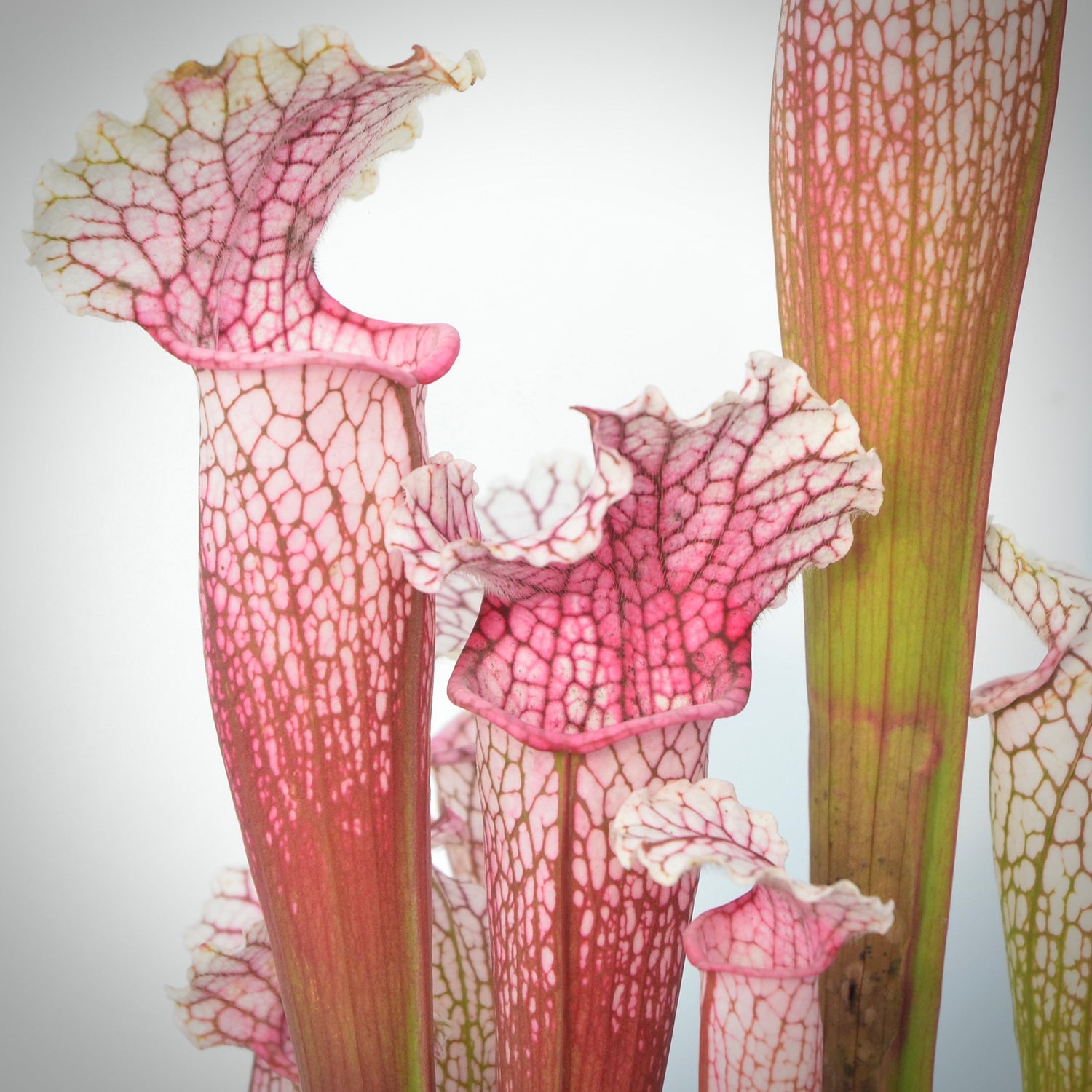
Sarracenia rubra ssp. alabamensis is one of the most endangered species of the American pitcher plants and grows in only a handful of remaining sites. The late summer pitchers are some of the best in the genus! They have an elegant shape, long lid and are glowing yellow, unlike any Sarracenia!
These are seedgrown. Please note, this is a smaller species.
California Carnivores can ship this plant outside of California as per Permit Number ESPER0002076, the plant and any resulting seeds or progeny may not be planted on Federal property, these are artificially propagated.
DORMANT SEASONALLY, STARTING AS EARLY AS OCTOBER AND LASTING AS LATE AS MARCH, DEPENDING ON THE CONDITIONS AND SPECIES/HYBRID. The pitchers turn brown and die back to the rhizome, or non-carnivorous leaves (phyllodia) grow during this time. Please see the final photo to see how Sarracenia look when dormant. They will begin to grow vigorously again in Spring when photoperiods lengthen and temperatures increase.
Care Instructions:
Growth Habit: Sarracenia primarily grow along the Southeastern coastal plain of the United States. They grow pitchers, which are modified leaves, seasonally that can vary in height, color, and size depending on the species or hybrid. The pitchers can die back during the growing season, but new pitchers will grow throughout the spring and summer. The pitchers start to grow in spring, and many grow as the year progresses; in summer, they will be at their best. In summer, you may see brown or black on your pitchers, which can be normal nectar burn or crisping from heat. As Fall comes on, the pitchers may start to die back, turning brown, and by winter, many or all of the pitchers are brown, but the rhizome remains healthy and intact throughout winter dormancy even if you cannot see anything growing. Sarracenia have brown, black, or white roots and do not generally have many of them. The rhizome can be brown and still be healthy.
Sun: Full sun. Sarracenia require lots of direct sun to grow and form pitchers properly. In many areas, they can be grown outdoors in full sun. If you live in a very hot AND very dry place like Arizona or Sacramento, for example, you will want to grow your plants in full morning sun with protection from the afternoon sun or under 30% shade cloth. It is common for several pitchers to "burn" and die back when you first place your plant into the sun; your plant is acclimating to your conditions, and in most cases, new leaves will soon grow and be fully acclimated. Sarracenia can be grown indoors on extremely sunny windowsills that receive all-day sun, but they will require a grow light in most circumstances due to the amount of light the plant needs. Grow lights should be 6-12” from the plant, depending on the light, and on a 10-12 hour day length. Sarracenia generally are not a good candidate for a terrarium as they need intense light and get quite tall. Shorter species like Sarracenia purpurea will do better in a terrarium. Grow outdoors if possible for best results.
Water: Always keep them in a saucer with a few inches of distilled, rainwater, or reverse osmosis water. Never let them dry out, especially in the hot summer months. Sarracenia are bog plants that prefer water-logged conditions unless you live somewhere both very hot AND extremely humid, like Alabama. In that case, let the water tray dry out for a day or two between refills. Always use distilled, reverse osmosis, or rainwater only. These plants are sensitive to their water quality, and giving them mineral and salt-free water is very important. In winter, when the plants are dormant, you can let them dry out a bit between rain storms, but do not let the soil get so dry that it pulls away from the edges of the pots. Be sure to supplement water as needed in between rains in winter.
Temperature and Dormancy: These are warm-temperate plants, meaning they need warm summers and chilly winters. They should be grown outdoors year-round in areas with mild winters. They thrive in temperatures ranging from 20 degrees - 100F degrees and can take a brief freeze or high-temperature spike up to 105F degrees for a short period. If nighttime temps drop below 20 but rise again during the day above 40, your plant will be fine outside.
If you live in an area with very cold winters, where nighttime temperatures drop below 20 degrees for sustained periods, you have three options for providing them with winter dormancy: the garage method, mulching in, or the fridge method. Dormancy is triggered by a combination of exposure to shorter photo-periods and cooler temperatures in the 40-60's F. While you can skip a dormancy period once or twice, in the long term, your plant will begin to do poorly and will eventually die if you skip this crucial period.
The garage method: Bring your plant indoors to a sunny windowsill in an unheated room or garage, where the nighttime temperatures will dip down to 50-60F. Keep it well watered during this period, do not let it dry out, and put it outside again when the outside nighttime temperatures increase consistently above 20F.
The mulch method: Mulch them in very, very well outdoors. Pack at least four inches of mulch on top of the plants and all around the sides to prevent winds from chilling them and freezing the roots. You can also dig the pots into the ground and then mulch heavily on top.
The fridge method: remove the plants from pots, gently clean the roots of soil, wrap the roots in a bit of damp long-fibered New Zealand sphagnum moss, place the plants in a resealable bag, and put the bag into the refrigerator. Leave them in the fridge from October to February, periodically checking on them to ensure they are still moist and not growing mold or fungus. Pot them back up in February. You can vary the timing to align with your outside nighttime temperatures so that your plants can come out of dormancy when it is safe to place them back outside. You can leave them in the fridge for an extended period if you have very long winters.
Soil and Repotting: We prefer a mix of four-part fertilizer-free peat moss to one-part perlite. You can add our pre-made mix to your order here. You do not need to repot your plant when you receive it from us for at least a year, and we recommend against it during the spring-summer months. Repot Sarracenia every 1-3 years in winter when they are dormant. Avoid placing in excessively large pots; size up only a few inches at a time. They do well in tall pots. Soil can also develop a swampy smell, especially right after shipping, when the plant is wrapped in plastic and sealed. This is normal; these plants grow naturally in bogs and swampy conditions, and peat moss can develop a bit of an anaerobic smell, but this does not indicate a problem with the soil.
Feeding and Fertilizer: Sarracenia will catch plenty of food when grown outdoors. When grown indoors, they will significantly benefit from fertilizing, both a foliar fertilizer and feeding the pitchers. Plants grown outdoors will appreciate a foliar feed as well. Apply MaxSea fertilizer once per month to the foliage only. Dilute 1/4 teaspoon of MaxSea into one gallon of water and then apply to the pitchers, and inside the pitchers, with a mister bottle or a watering can. Osmocote slow-release flower and vegetable pellets can be dropped into the pitchers with a bit of distilled water. Pellets can burn the sides of the pitchers where they come to rest; that is normal.
More Information: For further information on dormancy, repotting, dividing, and more, check out our website or our YouTube channel.
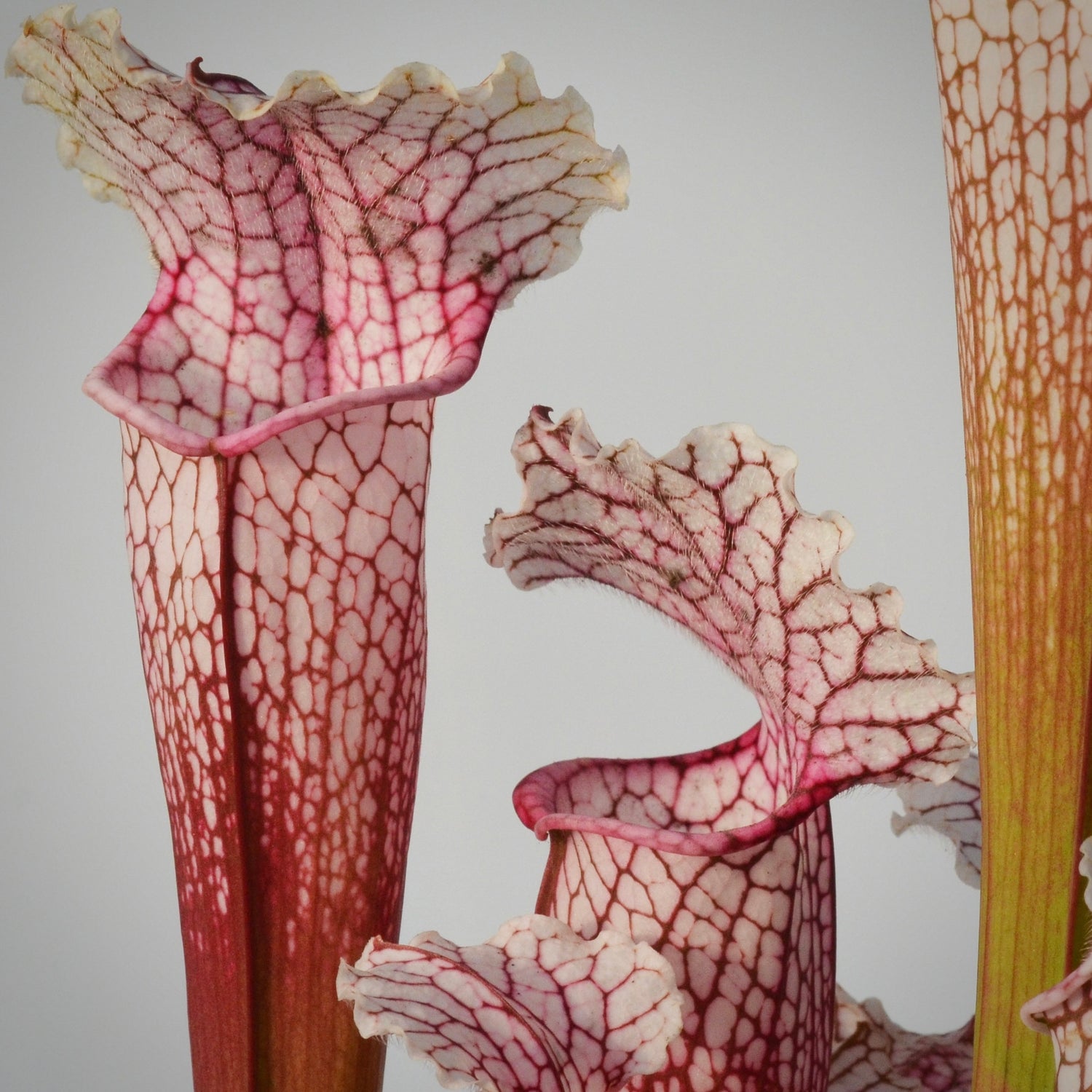
Showing 25/52