

My first one of these. It arrived in perfect shape! Thank you!
Awesome, healthy plant! Very pleased. Thank you!
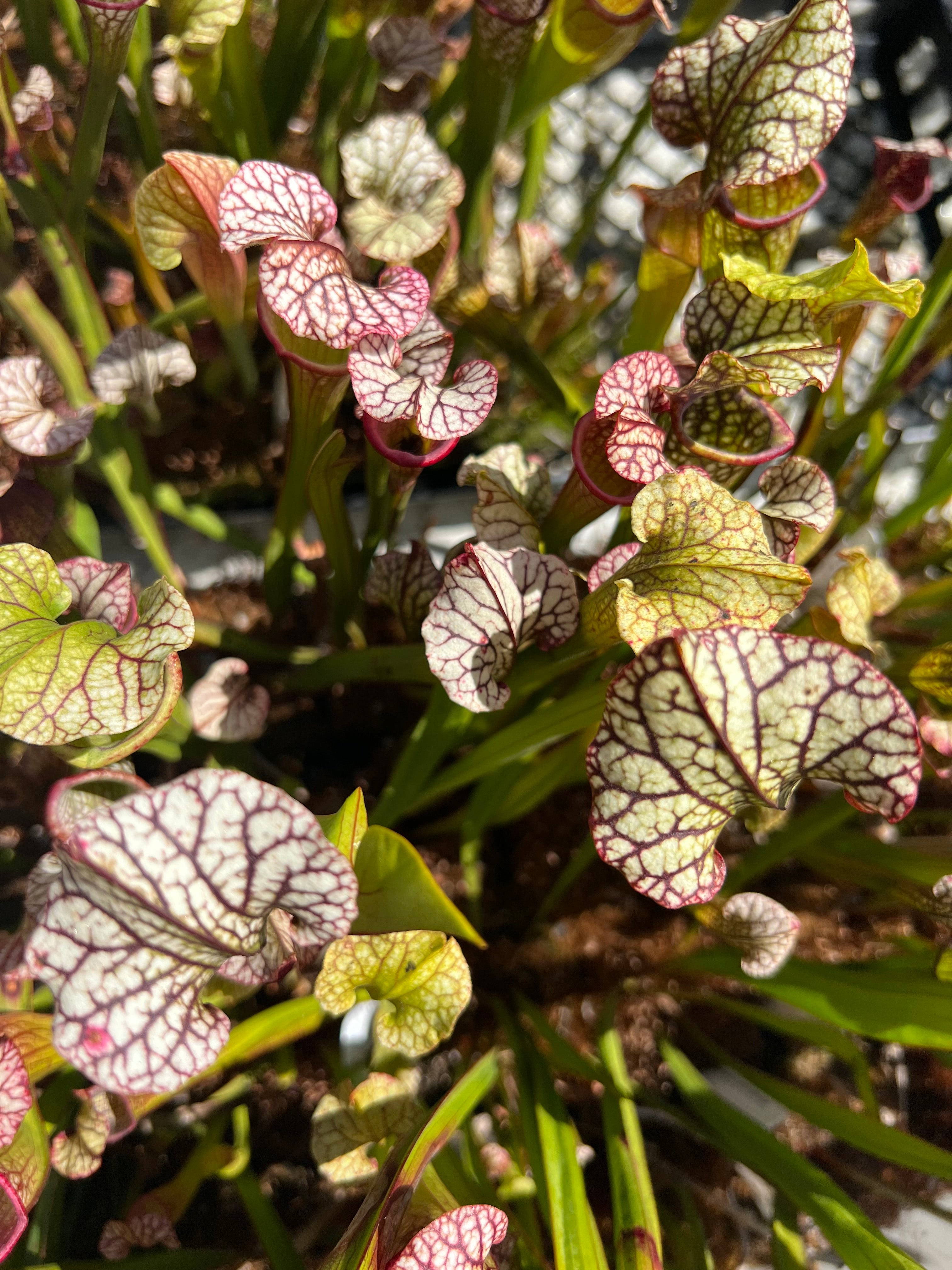
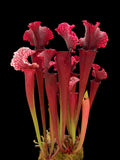
American pitcher plant species can hybridize to create amazing, beautiful and fantastic Sarracenia like the famous 'Judith Hindle' pictured at left. These plants are easy to grow; outdoors in full sun for most of the year, always sitting in a saucer of distilled water. They will reward you with plentiful pitchers that catch an absurd amount of insects each summer! They do go dormant in winter and the pitchers will turn brown and die back to the base of the plant only to double in size again in spring.
Sort by:
36 products
36 products


Sarracenia x ‘Godzuki’ has been a CalCarn classic for decades. It is a simple cross between minor and oreophila originally done by Leo Song. Because we have long considered ‘Godzuki’ a perfect plant, Damon hasn’t done much crossing of these two species. But he realized he could make a super version of the original when he crossed his amazing, old oreophila “Sand Mtn” with our spectacular and renowned minor “Giant”!
Damon’s goal was to make super-Godzuki, and by the look of things, he succeeded! These will have all the great lizard look to them but will probably be almost three feet tall at maturity!
DORMANT SEASONALLY, STARTING AS EARLY AS OCTOBER AND LASTING AS LATE AS MARCH, DEPENDING ON THE CONDITIONS AND SPECIES/HYBRID. The pitchers turn brown and die back to the rhizome, or non-carnivorous leaves (phyllodia) grow during this time. Please see the final photo to see how Sarracenia look when dormant. They will begin to grow vigorously again in Spring when photoperiods lengthen and temperatures increase.
Care Instructions:
Growth Habit: Sarracenia primarily grow along the Southeastern coastal plain of the United States. They grow pitchers, which are modified leaves, seasonally that can vary in height, color, and size depending on the species or hybrid. The pitchers can die back during the growing season, but new pitchers will grow throughout the spring and summer. The pitchers start to grow in spring, and many grow as the year progresses; in summer, they will be at their best. In summer, you may see brown or black on your pitchers, which can be normal nectar burn or crisping from heat. As Fall comes on, the pitchers may start to die back, turning brown, and by winter, many or all of the pitchers are brown, but the rhizome remains healthy and intact throughout winter dormancy even if you cannot see anything growing. Sarracenia have brown, black, or white roots and do not generally have many of them. The rhizome can be brown and still be healthy.
Sun: Full sun. Sarracenia require lots of direct sun to grow and form pitchers properly. In many areas, they can be grown outdoors in full sun. If you live in a very hot AND very dry place like Arizona or Sacramento, for example, you will want to grow your plants in full morning sun with protection from the afternoon sun or under 30% shade cloth. It is common for several pitchers to "burn" and die back when you first place your plant into the sun; your plant is acclimating to your conditions, and in most cases, new leaves will soon grow and be fully acclimated. Sarracenia can be grown indoors on extremely sunny windowsills that receive all-day sun, but they will require a grow light in most circumstances due to the amount of light the plant needs. Grow lights should be 6-12” from the plant, depending on the light, and on a 10-12 hour day length. Sarracenia generally are not a good candidate for a terrarium as they need intense light and get quite tall. Shorter species like Sarracenia purpurea will do better in a terrarium. Grow outdoors if possible for best results.
Water: Always keep them in a saucer with a few inches of distilled, rainwater, or reverse osmosis water. Never let them dry out, especially in the hot summer months. Sarracenia are bog plants that prefer water-logged conditions unless you live somewhere both very hot AND extremely humid, like Alabama. In that case, let the water tray dry out for a day or two between refills. Always use distilled, reverse osmosis, or rainwater only. These plants are sensitive to their water quality, and giving them mineral and salt-free water is very important. In winter, when the plants are dormant, you can let them dry out a bit between rain storms, but do not let the soil get so dry that it pulls away from the edges of the pots. Be sure to supplement water as needed in between rains in winter.
Temperature and Dormancy: These are warm-temperate plants, meaning they need warm summers and chilly winters. They should be grown outdoors year-round in areas with mild winters. They thrive in temperatures ranging from 20 degrees - 100F degrees and can take a brief freeze or high-temperature spike up to 105F degrees for a short period. If nighttime temps drop below 20 but rise again during the day above 40, your plant will be fine outside.
If you live in an area with very cold winters, where nighttime temperatures drop below 20 degrees for sustained periods, you have three options for providing them with winter dormancy: the garage method, mulching in, or the fridge method. Dormancy is triggered by a combination of exposure to shorter photo-periods and cooler temperatures in the 40-60's F. While you can skip a dormancy period once or twice, in the long term, your plant will begin to do poorly and will eventually die if you skip this crucial period.
The garage method: Bring your plant indoors to a sunny windowsill in an unheated room or garage, where the nighttime temperatures will dip down to 50-60F. Keep it well watered during this period, do not let it dry out, and put it outside again when the outside nighttime temperatures increase consistently above 20F.
The mulch method: Mulch them in very, very well outdoors. Pack at least four inches of mulch on top of the plants and all around the sides to prevent winds from chilling them and freezing the roots. You can also dig the pots into the ground and then mulch heavily on top.
The fridge method: remove the plants from pots, gently clean the roots of soil, wrap the roots in a bit of damp long-fibered New Zealand sphagnum moss, place the plants in a resealable bag, and put the bag into the refrigerator. Leave them in the fridge from October to February, periodically checking on them to ensure they are still moist and not growing mold or fungus. Pot them back up in February. You can vary the timing to align with your outside nighttime temperatures so that your plants can come out of dormancy when it is safe to place them back outside. You can leave them in the fridge for an extended period if you have very long winters.
Soil and Repotting: We prefer a mix of four-part fertilizer-free peat moss to one-part perlite. You can add our pre-made mix to your order here. You do not need to repot your plant when you receive it from us for at least a year, and we recommend against it during the spring-summer months. Repot Sarracenia every 1-3 years in winter when they are dormant. Avoid placing in excessively large pots; size up only a few inches at a time. They do well in tall pots. Soil can also develop a swampy smell, especially right after shipping, when the plant is wrapped in plastic and sealed. This is normal; these plants grow naturally in bogs and swampy conditions, and peat moss can develop a bit of an anaerobic smell, but this does not indicate a problem with the soil.
Feeding and Fertilizer: Sarracenia will catch plenty of food when grown outdoors. When grown indoors, they will significantly benefit from fertilizing, both a foliar fertilizer and feeding the pitchers. Plants grown outdoors will appreciate a foliar feed as well. Apply MaxSea fertilizer once per month to the foliage only. Dilute 1/4 teaspoon of MaxSea into one gallon of water and then apply to the pitchers, and inside the pitchers, with a mister bottle or a watering can. Osmocote slow-release flower and vegetable pellets can be dropped into the pitchers with a bit of distilled water. Pellets can burn the sides of the pitchers where they come to rest; that is normal.
More Information: For further information on dormancy, repotting, dividing, and more, check out our website or our YouTube channel.


This renowned cultivar; Sarracenia x ‘Reptilian Rose’ is a beautiful and striking Sarracenia. This complex oreophila hybrid has tall, stunningly colorful pitchers. The pitchers grow in yellow and green and then a deep rosy red. The intricate venation on the throats is reminiscent of a lizard and the plants have copious amounts of sweet smelling nectar, almost a rosy scent. Large, undulating lids give the plant a picturesque feel.
These are divisions and a must have the Sarracenia collector.
DORMANT SEASONALLY, STARTING AS EARLY AS OCTOBER AND LASTING AS LATE AS MARCH, DEPENDING ON THE CONDITIONS AND SPECIES/HYBRID. The pitchers turn brown and die back to the rhizome, or non-carnivorous leaves (phyllodia) grow during this time. Please see the final photo to see how Sarracenia look when dormant. They will begin to grow vigorously again in Spring when photoperiods lengthen and temperatures increase.
Care Instructions:
Growth Habit: Sarracenia primarily grow along the Southeastern coastal plain of the United States. They grow pitchers, which are modified leaves, seasonally that can vary in height, color, and size depending on the species or hybrid. The pitchers can die back during the growing season, but new pitchers will grow throughout the spring and summer. The pitchers start to grow in spring, and many grow as the year progresses; in summer, they will be at their best. In summer, you may see brown or black on your pitchers, which can be normal nectar burn or crisping from heat. As Fall comes on, the pitchers may start to die back, turning brown, and by winter, many or all of the pitchers are brown, but the rhizome remains healthy and intact throughout winter dormancy even if you cannot see anything growing. Sarracenia have brown, black, or white roots and do not generally have many of them. The rhizome can be brown and still be healthy.
Sun: Full sun. Sarracenia require lots of direct sun to grow and form pitchers properly. In many areas, they can be grown outdoors in full sun. If you live in a very hot AND very dry place like Arizona or Sacramento, for example, you will want to grow your plants in full morning sun with protection from the afternoon sun or under 30% shade cloth. It is common for several pitchers to "burn" and die back when you first place your plant into the sun; your plant is acclimating to your conditions, and in most cases, new leaves will soon grow and be fully acclimated. Sarracenia can be grown indoors on extremely sunny windowsills that receive all-day sun, but they will require a grow light in most circumstances due to the amount of light the plant needs. Grow lights should be 6-12” from the plant, depending on the light, and on a 10-12 hour day length. Sarracenia generally are not a good candidate for a terrarium as they need intense light and get quite tall. Shorter species like Sarracenia purpurea will do better in a terrarium. Grow outdoors if possible for best results.
Water: Always keep them in a saucer with a few inches of distilled, rainwater, or reverse osmosis water. Never let them dry out, especially in the hot summer months. Sarracenia are bog plants that prefer water-logged conditions unless you live somewhere both very hot AND extremely humid, like Alabama. In that case, let the water tray dry out for a day or two between refills. Always use distilled, reverse osmosis, or rainwater only. These plants are sensitive to their water quality, and giving them mineral and salt-free water is very important. In winter, when the plants are dormant, you can let them dry out a bit between rain storms, but do not let the soil get so dry that it pulls away from the edges of the pots. Be sure to supplement water as needed in between rains in winter.
Temperature and Dormancy: These are warm-temperate plants, meaning they need warm summers and chilly winters. They should be grown outdoors year-round in areas with mild winters. They thrive in temperatures ranging from 20 degrees - 100F degrees and can take a brief freeze or high-temperature spike up to 105F degrees for a short period. If nighttime temps drop below 20 but rise again during the day above 40, your plant will be fine outside.
If you live in an area with very cold winters, where nighttime temperatures drop below 20 degrees for sustained periods, you have three options for providing them with winter dormancy: the garage method, mulching in, or the fridge method. Dormancy is triggered by a combination of exposure to shorter photo-periods and cooler temperatures in the 40-60's F. While you can skip a dormancy period once or twice, in the long term, your plant will begin to do poorly and will eventually die if you skip this crucial period.
The garage method: Bring your plant indoors to a sunny windowsill in an unheated room or garage, where the nighttime temperatures will dip down to 50-60F. Keep it well watered during this period, do not let it dry out, and put it outside again when the outside nighttime temperatures increase consistently above 20F.
The mulch method: Mulch them in very, very well outdoors. Pack at least four inches of mulch on top of the plants and all around the sides to prevent winds from chilling them and freezing the roots. You can also dig the pots into the ground and then mulch heavily on top.
The fridge method: remove the plants from pots, gently clean the roots of soil, wrap the roots in a bit of damp long-fibered New Zealand sphagnum moss, place the plants in a resealable bag, and put the bag into the refrigerator. Leave them in the fridge from October to February, periodically checking on them to ensure they are still moist and not growing mold or fungus. Pot them back up in February. You can vary the timing to align with your outside nighttime temperatures so that your plants can come out of dormancy when it is safe to place them back outside. You can leave them in the fridge for an extended period if you have very long winters.
Soil and Repotting: We prefer a mix of four-part fertilizer-free peat moss to one-part perlite. You can add our pre-made mix to your order here. You do not need to repot your plant when you receive it from us for at least a year, and we recommend against it during the spring-summer months. Repot Sarracenia every 1-3 years in winter when they are dormant. Avoid placing in excessively large pots; size up only a few inches at a time. They do well in tall pots. Soil can also develop a swampy smell, especially right after shipping, when the plant is wrapped in plastic and sealed. This is normal; these plants grow naturally in bogs and swampy conditions, and peat moss can develop a bit of an anaerobic smell, but this does not indicate a problem with the soil.
Feeding and Fertilizer: Sarracenia will catch plenty of food when grown outdoors. When grown indoors, they will significantly benefit from fertilizing, both a foliar fertilizer and feeding the pitchers. Plants grown outdoors will appreciate a foliar feed as well. Apply MaxSea fertilizer once per month to the foliage only. Dilute 1/4 teaspoon of MaxSea into one gallon of water and then apply to the pitchers, and inside the pitchers, with a mister bottle or a watering can. Osmocote slow-release flower and vegetable pellets can be dropped into the pitchers with a bit of distilled water. Pellets can burn the sides of the pitchers where they come to rest; that is normal.
More Information: For further information on dormancy, repotting, dividing, and more, check out our website or our YouTube channel.


Sarracenia x ‘Lynda Butt’ is the famous plant created and named by Adrian Slack in the 1980s, and it’s as beautiful now as it was then! Tall, elegant pitchers are a buttery rich yellow with thick, wine-red venation and fluttery lids! It was named for Lynda Butt, who worked with Adrian Slack in his nursery.
These are divisions and are limited in quantity.
DORMANT SEASONALLY, STARTING AS EARLY AS OCTOBER AND LASTING AS LATE AS MARCH, DEPENDING ON THE CONDITIONS AND SPECIES/HYBRID. The pitchers turn brown and die back to the rhizome, or non-carnivorous leaves (phyllodia) grow during this time. Please see the final photo to see how Sarracenia look when dormant. They will begin to grow vigorously again in Spring when photoperiods lengthen and temperatures increase.
Care Instructions:
Growth Habit: Sarracenia primarily grow along the Southeastern coastal plain of the United States. They grow pitchers, which are modified leaves, seasonally that can vary in height, color, and size depending on the species or hybrid. The pitchers can die back during the growing season, but new pitchers will grow throughout the spring and summer. The pitchers start to grow in spring, and many grow as the year progresses; in summer, they will be at their best. In summer, you may see brown or black on your pitchers, which can be normal nectar burn or crisping from heat. As Fall comes on, the pitchers may start to die back, turning brown, and by winter, many or all of the pitchers are brown, but the rhizome remains healthy and intact throughout winter dormancy even if you cannot see anything growing. Sarracenia have brown, black, or white roots and do not generally have many of them. The rhizome can be brown and still be healthy.
Sun: Full sun. Sarracenia require lots of direct sun to grow and form pitchers properly. In many areas, they can be grown outdoors in full sun. If you live in a very hot AND very dry place like Arizona or Sacramento, for example, you will want to grow your plants in full morning sun with protection from the afternoon sun or under 30% shade cloth. It is common for several pitchers to "burn" and die back when you first place your plant into the sun; your plant is acclimating to your conditions, and in most cases, new leaves will soon grow and be fully acclimated. Sarracenia can be grown indoors on extremely sunny windowsills that receive all-day sun, but they will require a grow light in most circumstances due to the amount of light the plant needs. Grow lights should be 6-12” from the plant, depending on the light, and on a 10-12 hour day length. Sarracenia generally are not a good candidate for a terrarium as they need intense light and get quite tall. Shorter species like Sarracenia purpurea will do better in a terrarium. Grow outdoors if possible for best results.
Water: Always keep them in a saucer with a few inches of distilled, rainwater, or reverse osmosis water. Never let them dry out, especially in the hot summer months. Sarracenia are bog plants that prefer water-logged conditions unless you live somewhere both very hot AND extremely humid, like Alabama. In that case, let the water tray dry out for a day or two between refills. Always use distilled, reverse osmosis, or rainwater only. These plants are sensitive to their water quality, and giving them mineral and salt-free water is very important. In winter, when the plants are dormant, you can let them dry out a bit between rain storms, but do not let the soil get so dry that it pulls away from the edges of the pots. Be sure to supplement water as needed in between rains in winter.
Temperature and Dormancy: These are warm-temperate plants, meaning they need warm summers and chilly winters. They should be grown outdoors year-round in areas with mild winters. They thrive in temperatures ranging from 20 degrees - 100F degrees and can take a brief freeze or high-temperature spike up to 105F degrees for a short period. If nighttime temps drop below 20 but rise again during the day above 40, your plant will be fine outside.
If you live in an area with very cold winters, where nighttime temperatures drop below 20 degrees for sustained periods, you have three options for providing them with winter dormancy: the garage method, mulching in, or the fridge method. Dormancy is triggered by a combination of exposure to shorter photo-periods and cooler temperatures in the 40-60's F. While you can skip a dormancy period once or twice, in the long term, your plant will begin to do poorly and will eventually die if you skip this crucial period.
The garage method: Bring your plant indoors to a sunny windowsill in an unheated room or garage, where the nighttime temperatures will dip down to 50-60F. Keep it well watered during this period, do not let it dry out, and put it outside again when the outside nighttime temperatures increase consistently above 20F.
The mulch method: Mulch them in very, very well outdoors. Pack at least four inches of mulch on top of the plants and all around the sides to prevent winds from chilling them and freezing the roots. You can also dig the pots into the ground and then mulch heavily on top.
The fridge method: remove the plants from pots, gently clean the roots of soil, wrap the roots in a bit of damp long-fibered New Zealand sphagnum moss, place the plants in a resealable bag, and put the bag into the refrigerator. Leave them in the fridge from October to February, periodically checking on them to ensure they are still moist and not growing mold or fungus. Pot them back up in February. You can vary the timing to align with your outside nighttime temperatures so that your plants can come out of dormancy when it is safe to place them back outside. You can leave them in the fridge for an extended period if you have very long winters.
Soil and Repotting: We prefer a mix of four-part fertilizer-free peat moss to one-part perlite. You can add our pre-made mix to your order here. You do not need to repot your plant when you receive it from us for at least a year, and we recommend against it during the spring-summer months. Repot Sarracenia every 1-3 years in winter when they are dormant. Avoid placing in excessively large pots; size up only a few inches at a time. They do well in tall pots. Soil can also develop a swampy smell, especially right after shipping, when the plant is wrapped in plastic and sealed. This is normal; these plants grow naturally in bogs and swampy conditions, and peat moss can develop a bit of an anaerobic smell, but this does not indicate a problem with the soil.
Feeding and Fertilizer: Sarracenia will catch plenty of food when grown outdoors. When grown indoors, they will significantly benefit from fertilizing, both a foliar fertilizer and feeding the pitchers. Plants grown outdoors will appreciate a foliar feed as well. Apply MaxSea fertilizer once per month to the foliage only. Dilute 1/4 teaspoon of MaxSea into one gallon of water and then apply to the pitchers, and inside the pitchers, with a mister bottle or a watering can. Osmocote slow-release flower and vegetable pellets can be dropped into the pitchers with a bit of distilled water. Pellets can burn the sides of the pitchers where they come to rest; that is normal.
More Information: For further information on dormancy, repotting, dividing, and more, check out our website or our YouTube channel.


Sarracenia x ‘Maroon’ is a super cute hybrid of rubra and purpurea. It has a profusion of plump, red, tubby pitchers. Known for its prolific pitcher production and compact size, this variety is an excellent choice for beginners looking to cultivate carnivorous plants.
These are tissue culture plants.
DORMANT SEASONALLY, STARTING AS EARLY AS OCTOBER AND LASTING AS LATE AS MARCH, DEPENDING ON THE CONDITIONS AND SPECIES/HYBRID. The pitchers turn brown and die back to the rhizome, or non-carnivorous leaves (phyllodia) grow during this time. Please see the final photo to see how Sarracenia look when dormant. They will begin to grow vigorously again in Spring when photoperiods lengthen and temperatures increase.
Care Instructions:
Growth Habit: Sarracenia primarily grow along the Southeastern coastal plain of the United States. They grow pitchers, which are modified leaves, seasonally that can vary in height, color, and size depending on the species or hybrid. The pitchers can die back during the growing season, but new pitchers will grow throughout the spring and summer. The pitchers start to grow in spring, and many grow as the year progresses; in summer, they will be at their best. In summer, you may see brown or black on your pitchers, which can be normal nectar burn or crisping from heat. As Fall comes on, the pitchers may start to die back, turning brown, and by winter, many or all of the pitchers are brown, but the rhizome remains healthy and intact throughout winter dormancy even if you cannot see anything growing. Sarracenia have brown, black, or white roots and do not generally have many of them. The rhizome can be brown and still be healthy.
Sun: Full sun. Sarracenia require lots of direct sun to grow and form pitchers properly. In many areas, they can be grown outdoors in full sun. If you live in a very hot AND very dry place like Arizona or Sacramento, for example, you will want to grow your plants in full morning sun with protection from the afternoon sun or under 30% shade cloth. It is common for several pitchers to "burn" and die back when you first place your plant into the sun; your plant is acclimating to your conditions, and in most cases, new leaves will soon grow and be fully acclimated. Sarracenia can be grown indoors on extremely sunny windowsills that receive all-day sun, but they will require a grow light in most circumstances due to the amount of light the plant needs. Grow lights should be 6-12” from the plant, depending on the light, and on a 10-12 hour day length. Sarracenia generally are not a good candidate for a terrarium as they need intense light and get quite tall. Shorter species like Sarracenia purpurea will do better in a terrarium. Grow outdoors if possible for best results.
Water: Always keep them in a saucer with a few inches of distilled, rainwater, or reverse osmosis water. Never let them dry out, especially in the hot summer months. Sarracenia are bog plants that prefer water-logged conditions unless you live somewhere both very hot AND extremely humid, like Alabama. In that case, let the water tray dry out for a day or two between refills. Always use distilled, reverse osmosis, or rainwater only. These plants are sensitive to their water quality, and giving them mineral and salt-free water is very important. In winter, when the plants are dormant, you can let them dry out a bit between rain storms, but do not let the soil get so dry that it pulls away from the edges of the pots. Be sure to supplement water as needed in between rains in winter.
Temperature and Dormancy: These are warm-temperate plants, meaning they need warm summers and chilly winters. They should be grown outdoors year-round in areas with mild winters. They thrive in temperatures ranging from 20 degrees - 100F degrees and can take a brief freeze or high-temperature spike up to 105F degrees for a short period. If nighttime temps drop below 20 but rise again during the day above 40, your plant will be fine outside.
If you live in an area with very cold winters, where nighttime temperatures drop below 20 degrees for sustained periods, you have three options for providing them with winter dormancy: the garage method, mulching in, or the fridge method. Dormancy is triggered by a combination of exposure to shorter photo-periods and cooler temperatures in the 40-60's F. While you can skip a dormancy period once or twice, in the long term, your plant will begin to do poorly and will eventually die if you skip this crucial period.
The garage method: Bring your plant indoors to a sunny windowsill in an unheated room or garage, where the nighttime temperatures will dip down to 50-60F. Keep it well watered during this period, do not let it dry out, and put it outside again when the outside nighttime temperatures increase consistently above 20F.
The mulch method: Mulch them in very, very well outdoors. Pack at least four inches of mulch on top of the plants and all around the sides to prevent winds from chilling them and freezing the roots. You can also dig the pots into the ground and then mulch heavily on top.
The fridge method: remove the plants from pots, gently clean the roots of soil, wrap the roots in a bit of damp long-fibered New Zealand sphagnum moss, place the plants in a resealable bag, and put the bag into the refrigerator. Leave them in the fridge from October to February, periodically checking on them to ensure they are still moist and not growing mold or fungus. Pot them back up in February. You can vary the timing to align with your outside nighttime temperatures so that your plants can come out of dormancy when it is safe to place them back outside. You can leave them in the fridge for an extended period if you have very long winters.
Soil and Repotting: We prefer a mix of four-part fertilizer-free peat moss to one-part perlite. You can add our pre-made mix to your order here. You do not need to repot your plant when you receive it from us for at least a year, and we recommend against it during the spring-summer months. Repot Sarracenia every 1-3 years in winter when they are dormant. Avoid placing in excessively large pots; size up only a few inches at a time. They do well in tall pots. Soil can also develop a swampy smell, especially right after shipping, when the plant is wrapped in plastic and sealed. This is normal; these plants grow naturally in bogs and swampy conditions, and peat moss can develop a bit of an anaerobic smell, but this does not indicate a problem with the soil.
Feeding and Fertilizer: Sarracenia will catch plenty of food when grown outdoors. When grown indoors, they will significantly benefit from fertilizing, both a foliar fertilizer and feeding the pitchers. Plants grown outdoors will appreciate a foliar feed as well. Apply MaxSea fertilizer once per month to the foliage only. Dilute 1/4 teaspoon of MaxSea into one gallon of water and then apply to the pitchers, and inside the pitchers, with a mister bottle or a watering can. Osmocote slow-release flower and vegetable pellets can be dropped into the pitchers with a bit of distilled water. Pellets can burn the sides of the pitchers where they come to rest; that is normal.
More Information: For further information on dormancy, repotting, dividing, and more, check out our website or our YouTube channel.


Sarracenia x ‘Purple People Eater’ is a really rare and beautiful hybrid! Created by Peter years and years ago and carefully collected by long time friend to the nursery, John Rizzi, we recently reacquired this rare beauty! This plant will form a bouquet for red, ruffly-lidded pitchers that slowly darken to a deep purple-red! These divisions are very rare and in limited supply. This will stay a more compact hybrid so the sizing will appear smaller.
These are divisions.
DORMANT SEASONALLY, STARTING AS EARLY AS OCTOBER AND LASTING AS LATE AS MARCH, DEPENDING ON THE CONDITIONS AND SPECIES/HYBRID. The pitchers turn brown and die back to the rhizome, or non-carnivorous leaves (phyllodia) grow during this time. Please see the final photo to see how Sarracenia look when dormant. They will begin to grow vigorously again in Spring when photoperiods lengthen and temperatures increase.
Care Instructions:
Growth Habit: Sarracenia primarily grow along the Southeastern coastal plain of the United States. They grow pitchers, which are modified leaves, seasonally that can vary in height, color, and size depending on the species or hybrid. The pitchers can die back during the growing season, but new pitchers will grow throughout the spring and summer. The pitchers start to grow in spring, and many grow as the year progresses; in summer, they will be at their best. In summer, you may see brown or black on your pitchers, which can be normal nectar burn or crisping from heat. As Fall comes on, the pitchers may start to die back, turning brown, and by winter, many or all of the pitchers are brown, but the rhizome remains healthy and intact throughout winter dormancy even if you cannot see anything growing. Sarracenia have brown, black, or white roots and do not generally have many of them. The rhizome can be brown and still be healthy.
Sun: Full sun. Sarracenia require lots of direct sun to grow and form pitchers properly. In many areas, they can be grown outdoors in full sun. If you live in a very hot AND very dry place like Arizona or Sacramento, for example, you will want to grow your plants in full morning sun with protection from the afternoon sun or under 30% shade cloth. It is common for several pitchers to "burn" and die back when you first place your plant into the sun; your plant is acclimating to your conditions, and in most cases, new leaves will soon grow and be fully acclimated. Sarracenia can be grown indoors on extremely sunny windowsills that receive all-day sun, but they will require a grow light in most circumstances due to the amount of light the plant needs. Grow lights should be 6-12” from the plant, depending on the light, and on a 10-12 hour day length. Sarracenia generally are not a good candidate for a terrarium as they need intense light and get quite tall. Shorter species like Sarracenia purpurea will do better in a terrarium. Grow outdoors if possible for best results.
Water: Always keep them in a saucer with a few inches of distilled, rainwater, or reverse osmosis water. Never let them dry out, especially in the hot summer months. Sarracenia are bog plants that prefer water-logged conditions unless you live somewhere both very hot AND extremely humid, like Alabama. In that case, let the water tray dry out for a day or two between refills. Always use distilled, reverse osmosis, or rainwater only. These plants are sensitive to their water quality, and giving them mineral and salt-free water is very important. In winter, when the plants are dormant, you can let them dry out a bit between rain storms, but do not let the soil get so dry that it pulls away from the edges of the pots. Be sure to supplement water as needed in between rains in winter.
Temperature and Dormancy: These are warm-temperate plants, meaning they need warm summers and chilly winters. They should be grown outdoors year-round in areas with mild winters. They thrive in temperatures ranging from 20 degrees - 100F degrees and can take a brief freeze or high-temperature spike up to 105F degrees for a short period. If nighttime temps drop below 20 but rise again during the day above 40, your plant will be fine outside.
If you live in an area with very cold winters, where nighttime temperatures drop below 20 degrees for sustained periods, you have three options for providing them with winter dormancy: the garage method, mulching in, or the fridge method. Dormancy is triggered by a combination of exposure to shorter photo-periods and cooler temperatures in the 40-60's F. While you can skip a dormancy period once or twice, in the long term, your plant will begin to do poorly and will eventually die if you skip this crucial period.
The garage method: Bring your plant indoors to a sunny windowsill in an unheated room or garage, where the nighttime temperatures will dip down to 50-60F. Keep it well watered during this period, do not let it dry out, and put it outside again when the outside nighttime temperatures increase consistently above 20F.
The mulch method: Mulch them in very, very well outdoors. Pack at least four inches of mulch on top of the plants and all around the sides to prevent winds from chilling them and freezing the roots. You can also dig the pots into the ground and then mulch heavily on top.
The fridge method: remove the plants from pots, gently clean the roots of soil, wrap the roots in a bit of damp long-fibered New Zealand sphagnum moss, place the plants in a resealable bag, and put the bag into the refrigerator. Leave them in the fridge from October to February, periodically checking on them to ensure they are still moist and not growing mold or fungus. Pot them back up in February. You can vary the timing to align with your outside nighttime temperatures so that your plants can come out of dormancy when it is safe to place them back outside. You can leave them in the fridge for an extended period if you have very long winters.
Soil and Repotting: We prefer a mix of four-part fertilizer-free peat moss to one-part perlite. You can add our pre-made mix to your order here. You do not need to repot your plant when you receive it from us for at least a year, and we recommend against it during the spring-summer months. Repot Sarracenia every 1-3 years in winter when they are dormant. Avoid placing in excessively large pots; size up only a few inches at a time. They do well in tall pots. Soil can also develop a swampy smell, especially right after shipping, when the plant is wrapped in plastic and sealed. This is normal; these plants grow naturally in bogs and swampy conditions, and peat moss can develop a bit of an anaerobic smell, but this does not indicate a problem with the soil.
Feeding and Fertilizer: Sarracenia will catch plenty of food when grown outdoors. When grown indoors, they will significantly benefit from fertilizing, both a foliar fertilizer and feeding the pitchers. Plants grown outdoors will appreciate a foliar feed as well. Apply MaxSea fertilizer once per month to the foliage only. Dilute 1/4 teaspoon of MaxSea into one gallon of water and then apply to the pitchers, and inside the pitchers, with a mister bottle or a watering can. Osmocote slow-release flower and vegetable pellets can be dropped into the pitchers with a bit of distilled water. Pellets can burn the sides of the pitchers where they come to rest; that is normal.
More Information: For further information on dormancy, repotting, dividing, and more, check out our website or our YouTube channel.


Sarracenia x ‘Royal Ruby’ is a spectacular plant! First found in the wild and thought to be a cross of leucophylla x flava, it’s been a proven winner for decades! It has absurdly tall, crimson pitchers with large undulating lids and deeply pointed mouths. Everything about this plant is elegant and beautiful. Its pitchers last a long time through the growing season, and its rich, red color makes it stand out in the garden. ‘Royal Ruby’ is also an excellent breeder! It has been used as a parent in many famous cultivars.
These are divisions and are limited in quantity.
DORMANT SEASONALLY, STARTING AS EARLY AS OCTOBER AND LASTING AS LATE AS MARCH, DEPENDING ON THE CONDITIONS AND SPECIES/HYBRID. The pitchers turn brown and die back to the rhizome, or non-carnivorous leaves (phyllodia) grow during this time. Please see the final photo to see how Sarracenia look when dormant. They will begin to grow vigorously again in Spring when photoperiods lengthen and temperatures increase.
Care Instructions:
Growth Habit: Sarracenia primarily grow along the Southeastern coastal plain of the United States. They grow pitchers, which are modified leaves, seasonally that can vary in height, color, and size depending on the species or hybrid. The pitchers can die back during the growing season, but new pitchers will grow throughout the spring and summer. The pitchers start to grow in spring, and many grow as the year progresses; in summer, they will be at their best. In summer, you may see brown or black on your pitchers, which can be normal nectar burn or crisping from heat. As Fall comes on, the pitchers may start to die back, turning brown, and by winter, many or all of the pitchers are brown, but the rhizome remains healthy and intact throughout winter dormancy even if you cannot see anything growing. Sarracenia have brown, black, or white roots and do not generally have many of them. The rhizome can be brown and still be healthy.
Sun: Full sun. Sarracenia require lots of direct sun to grow and form pitchers properly. In many areas, they can be grown outdoors in full sun. If you live in a very hot AND very dry place like Arizona or Sacramento, for example, you will want to grow your plants in full morning sun with protection from the afternoon sun or under 30% shade cloth. It is common for several pitchers to "burn" and die back when you first place your plant into the sun; your plant is acclimating to your conditions, and in most cases, new leaves will soon grow and be fully acclimated. Sarracenia can be grown indoors on extremely sunny windowsills that receive all-day sun, but they will require a grow light in most circumstances due to the amount of light the plant needs. Grow lights should be 6-12” from the plant, depending on the light, and on a 10-12 hour day length. Sarracenia generally are not a good candidate for a terrarium as they need intense light and get quite tall. Shorter species like Sarracenia purpurea will do better in a terrarium. Grow outdoors if possible for best results.
Water: Always keep them in a saucer with a few inches of distilled, rainwater, or reverse osmosis water. Never let them dry out, especially in the hot summer months. Sarracenia are bog plants that prefer water-logged conditions unless you live somewhere both very hot AND extremely humid, like Alabama. In that case, let the water tray dry out for a day or two between refills. Always use distilled, reverse osmosis, or rainwater only. These plants are sensitive to their water quality, and giving them mineral and salt-free water is very important. In winter, when the plants are dormant, you can let them dry out a bit between rain storms, but do not let the soil get so dry that it pulls away from the edges of the pots. Be sure to supplement water as needed in between rains in winter.
Temperature and Dormancy: These are warm-temperate plants, meaning they need warm summers and chilly winters. They should be grown outdoors year-round in areas with mild winters. They thrive in temperatures ranging from 20 degrees - 100F degrees and can take a brief freeze or high-temperature spike up to 105F degrees for a short period. If nighttime temps drop below 20 but rise again during the day above 40, your plant will be fine outside.
If you live in an area with very cold winters, where nighttime temperatures drop below 20 degrees for sustained periods, you have three options for providing them with winter dormancy: the garage method, mulching in, or the fridge method. Dormancy is triggered by a combination of exposure to shorter photo-periods and cooler temperatures in the 40-60's F. While you can skip a dormancy period once or twice, in the long term, your plant will begin to do poorly and will eventually die if you skip this crucial period.
The garage method: Bring your plant indoors to a sunny windowsill in an unheated room or garage, where the nighttime temperatures will dip down to 50-60F. Keep it well watered during this period, do not let it dry out, and put it outside again when the outside nighttime temperatures increase consistently above 20F.
The mulch method: Mulch them in very, very well outdoors. Pack at least four inches of mulch on top of the plants and all around the sides to prevent winds from chilling them and freezing the roots. You can also dig the pots into the ground and then mulch heavily on top.
The fridge method: remove the plants from pots, gently clean the roots of soil, wrap the roots in a bit of damp long-fibered New Zealand sphagnum moss, place the plants in a resealable bag, and put the bag into the refrigerator. Leave them in the fridge from October to February, periodically checking on them to ensure they are still moist and not growing mold or fungus. Pot them back up in February. You can vary the timing to align with your outside nighttime temperatures so that your plants can come out of dormancy when it is safe to place them back outside. You can leave them in the fridge for an extended period if you have very long winters.
Soil and Repotting: We prefer a mix of four-part fertilizer-free peat moss to one-part perlite. You can add our pre-made mix to your order here. You do not need to repot your plant when you receive it from us for at least a year, and we recommend against it during the spring-summer months. Repot Sarracenia every 1-3 years in winter when they are dormant. Avoid placing in excessively large pots; size up only a few inches at a time. They do well in tall pots. Soil can also develop a swampy smell, especially right after shipping, when the plant is wrapped in plastic and sealed. This is normal; these plants grow naturally in bogs and swampy conditions, and peat moss can develop a bit of an anaerobic smell, but this does not indicate a problem with the soil.
Feeding and Fertilizer: Sarracenia will catch plenty of food when grown outdoors. When grown indoors, they will significantly benefit from fertilizing, both a foliar fertilizer and feeding the pitchers. Plants grown outdoors will appreciate a foliar feed as well. Apply MaxSea fertilizer once per month to the foliage only. Dilute 1/4 teaspoon of MaxSea into one gallon of water and then apply to the pitchers, and inside the pitchers, with a mister bottle or a watering can. Osmocote slow-release flower and vegetable pellets can be dropped into the pitchers with a bit of distilled water. Pellets can burn the sides of the pitchers where they come to rest; that is normal.
More Information: For further information on dormancy, repotting, dividing, and more, check out our website or our YouTube channel.


Sarracenia x ‘Velvet’ is a lovely plant with beautiful white-topped pitchers covered with delicate red and green veins. The pitchers gradually turn pink as the season progresses. Their soft, velvety texture adds to the plant's allure. Known for its prolific pitcher production and compact size, this variety is an excellent choice for beginners looking to cultivate carnivorous plants.
These are tissue culture plants.
DORMANT SEASONALLY, STARTING AS EARLY AS OCTOBER AND LASTING AS LATE AS MARCH, DEPENDING ON THE CONDITIONS AND SPECIES/HYBRID. The pitchers turn brown and die back to the rhizome, or non-carnivorous leaves (phyllodia) grow during this time. Please see the final photo to see how Sarracenia look when dormant. They will begin to grow vigorously again in Spring when photoperiods lengthen and temperatures increase.
Care Instructions:
Growth Habit: Sarracenia primarily grow along the Southeastern coastal plain of the United States. They grow pitchers, which are modified leaves, seasonally that can vary in height, color, and size depending on the species or hybrid. The pitchers can die back during the growing season, but new pitchers will grow throughout the spring and summer. The pitchers start to grow in spring, and many grow as the year progresses; in summer, they will be at their best. In summer, you may see brown or black on your pitchers, which can be normal nectar burn or crisping from heat. As Fall comes on, the pitchers may start to die back, turning brown, and by winter, many or all of the pitchers are brown, but the rhizome remains healthy and intact throughout winter dormancy even if you cannot see anything growing. Sarracenia have brown, black, or white roots and do not generally have many of them. The rhizome can be brown and still be healthy.
Sun: Full sun. Sarracenia require lots of direct sun to grow and form pitchers properly. In many areas, they can be grown outdoors in full sun. If you live in a very hot AND very dry place like Arizona or Sacramento, for example, you will want to grow your plants in full morning sun with protection from the afternoon sun or under 30% shade cloth. It is common for several pitchers to "burn" and die back when you first place your plant into the sun; your plant is acclimating to your conditions, and in most cases, new leaves will soon grow and be fully acclimated. Sarracenia can be grown indoors on extremely sunny windowsills that receive all-day sun, but they will require a grow light in most circumstances due to the amount of light the plant needs. Grow lights should be 6-12” from the plant, depending on the light, and on a 10-12 hour day length. Sarracenia generally are not a good candidate for a terrarium as they need intense light and get quite tall. Shorter species like Sarracenia purpurea will do better in a terrarium. Grow outdoors if possible for best results.
Water: Always keep them in a saucer with a few inches of distilled, rainwater, or reverse osmosis water. Never let them dry out, especially in the hot summer months. Sarracenia are bog plants that prefer water-logged conditions unless you live somewhere both very hot AND extremely humid, like Alabama. In that case, let the water tray dry out for a day or two between refills. Always use distilled, reverse osmosis, or rainwater only. These plants are sensitive to their water quality, and giving them mineral and salt-free water is very important. In winter, when the plants are dormant, you can let them dry out a bit between rain storms, but do not let the soil get so dry that it pulls away from the edges of the pots. Be sure to supplement water as needed in between rains in winter.
Temperature and Dormancy: These are warm-temperate plants, meaning they need warm summers and chilly winters. They should be grown outdoors year-round in areas with mild winters. They thrive in temperatures ranging from 20 degrees - 100F degrees and can take a brief freeze or high-temperature spike up to 105F degrees for a short period. If nighttime temps drop below 20 but rise again during the day above 40, your plant will be fine outside.
If you live in an area with very cold winters, where nighttime temperatures drop below 20 degrees for sustained periods, you have three options for providing them with winter dormancy: the garage method, mulching in, or the fridge method. Dormancy is triggered by a combination of exposure to shorter photo-periods and cooler temperatures in the 40-60's F. While you can skip a dormancy period once or twice, in the long term, your plant will begin to do poorly and will eventually die if you skip this crucial period.
The garage method: Bring your plant indoors to a sunny windowsill in an unheated room or garage, where the nighttime temperatures will dip down to 50-60F. Keep it well watered during this period, do not let it dry out, and put it outside again when the outside nighttime temperatures increase consistently above 20F.
The mulch method: Mulch them in very, very well outdoors. Pack at least four inches of mulch on top of the plants and all around the sides to prevent winds from chilling them and freezing the roots. You can also dig the pots into the ground and then mulch heavily on top.
The fridge method: remove the plants from pots, gently clean the roots of soil, wrap the roots in a bit of damp long-fibered New Zealand sphagnum moss, place the plants in a resealable bag, and put the bag into the refrigerator. Leave them in the fridge from October to February, periodically checking on them to ensure they are still moist and not growing mold or fungus. Pot them back up in February. You can vary the timing to align with your outside nighttime temperatures so that your plants can come out of dormancy when it is safe to place them back outside. You can leave them in the fridge for an extended period if you have very long winters.
Soil and Repotting: We prefer a mix of four-part fertilizer-free peat moss to one-part perlite. You can add our pre-made mix to your order here. You do not need to repot your plant when you receive it from us for at least a year, and we recommend against it during the spring-summer months. Repot Sarracenia every 1-3 years in winter when they are dormant. Avoid placing in excessively large pots; size up only a few inches at a time. They do well in tall pots. Soil can also develop a swampy smell, especially right after shipping, when the plant is wrapped in plastic and sealed. This is normal; these plants grow naturally in bogs and swampy conditions, and peat moss can develop a bit of an anaerobic smell, but this does not indicate a problem with the soil.
Feeding and Fertilizer: Sarracenia will catch plenty of food when grown outdoors. When grown indoors, they will significantly benefit from fertilizing, both a foliar fertilizer and feeding the pitchers. Plants grown outdoors will appreciate a foliar feed as well. Apply MaxSea fertilizer once per month to the foliage only. Dilute 1/4 teaspoon of MaxSea into one gallon of water and then apply to the pitchers, and inside the pitchers, with a mister bottle or a watering can. Osmocote slow-release flower and vegetable pellets can be dropped into the pitchers with a bit of distilled water. Pellets can burn the sides of the pitchers where they come to rest; that is normal.
More Information: For further information on dormancy, repotting, dividing, and more, check out our website or our YouTube channel.


Sarracenia x “Acquerello”, a hybrid of Sarracenia flava var. rubricorpora “F131D” x moorei “All Red Giant #18”, is characterized by narrow, tall pitchers and red-purple coloration bordering on black. This plant has the darkest coloration with splashes of golden color on the lid. These will be tall and beautiful!
DORMANT SEASONALLY, STARTING AS EARLY AS OCTOBER AND LASTING AS LATE AS MARCH, DEPENDING ON THE CONDITIONS AND SPECIES/HYBRID. The pitchers turn brown and die back to the rhizome, or non-carnivorous leaves (phyllodia) grow during this time. Please see the final photo to see how Sarracenia look when dormant. They will begin to grow vigorously again in Spring when photoperiods lengthen and temperatures increase.
Care Instructions:
Growth Habit: Sarracenia primarily grow along the Southeastern coastal plain of the United States. They grow pitchers, which are modified leaves, seasonally that can vary in height, color, and size depending on the species or hybrid. The pitchers can die back during the growing season, but new pitchers will grow throughout the spring and summer. The pitchers start to grow in spring, and many grow as the year progresses; in summer, they will be at their best. In summer, you may see brown or black on your pitchers, which can be normal nectar burn or crisping from heat. As Fall comes on, the pitchers may start to die back, turning brown, and by winter, many or all of the pitchers are brown, but the rhizome remains healthy and intact throughout winter dormancy even if you cannot see anything growing. Sarracenia have brown, black, or white roots and do not generally have many of them. The rhizome can be brown and still be healthy.
Sun: Full sun. Sarracenia require lots of direct sun to grow and form pitchers properly. In many areas, they can be grown outdoors in full sun. If you live in a very hot AND very dry place like Arizona or Sacramento, for example, you will want to grow your plants in full morning sun with protection from the afternoon sun or under 30% shade cloth. It is common for several pitchers to "burn" and die back when you first place your plant into the sun; your plant is acclimating to your conditions, and in most cases, new leaves will soon grow and be fully acclimated. Sarracenia can be grown indoors on extremely sunny windowsills that receive all-day sun, but they will require a grow light in most circumstances due to the amount of light the plant needs. Grow lights should be 6-12” from the plant, depending on the light, and on a 10-12 hour day length. Sarracenia generally are not a good candidate for a terrarium as they need intense light and get quite tall. Shorter species like Sarracenia purpurea will do better in a terrarium. Grow outdoors if possible for best results.
Water: Always keep them in a saucer with a few inches of distilled, rainwater, or reverse osmosis water. Never let them dry out, especially in the hot summer months. Sarracenia are bog plants that prefer water-logged conditions unless you live somewhere both very hot AND extremely humid, like Alabama. In that case, let the water tray dry out for a day or two between refills. Always use distilled, reverse osmosis, or rainwater only. These plants are sensitive to their water quality, and giving them mineral and salt-free water is very important. In winter, when the plants are dormant, you can let them dry out a bit between rain storms, but do not let the soil get so dry that it pulls away from the edges of the pots. Be sure to supplement water as needed in between rains in winter.
Temperature and Dormancy: These are warm-temperate plants, meaning they need warm summers and chilly winters. They should be grown outdoors year-round in areas with mild winters. They thrive in temperatures ranging from 20 degrees - 100F degrees and can take a brief freeze or high-temperature spike up to 105F degrees for a short period. If nighttime temps drop below 20 but rise again during the day above 40, your plant will be fine outside.
If you live in an area with very cold winters, where nighttime temperatures drop below 20 degrees for sustained periods, you have three options for providing them with winter dormancy: the garage method, mulching in, or the fridge method. Dormancy is triggered by a combination of exposure to shorter photo-periods and cooler temperatures in the 40-60's F. While you can skip a dormancy period once or twice, in the long term, your plant will begin to do poorly and will eventually die if you skip this crucial period.
The garage method: Bring your plant indoors to a sunny windowsill in an unheated room or garage, where the nighttime temperatures will dip down to 50-60F. Keep it well watered during this period, do not let it dry out, and put it outside again when the outside nighttime temperatures increase consistently above 20F.
The mulch method: Mulch them in very, very well outdoors. Pack at least four inches of mulch on top of the plants and all around the sides to prevent winds from chilling them and freezing the roots. You can also dig the pots into the ground and then mulch heavily on top.
The fridge method: remove the plants from pots, gently clean the roots of soil, wrap the roots in a bit of damp long-fibered New Zealand sphagnum moss, place the plants in a resealable bag, and put the bag into the refrigerator. Leave them in the fridge from October to February, periodically checking on them to ensure they are still moist and not growing mold or fungus. Pot them back up in February. You can vary the timing to align with your outside nighttime temperatures so that your plants can come out of dormancy when it is safe to place them back outside. You can leave them in the fridge for an extended period if you have very long winters.
Soil and Repotting: We prefer a mix of four-part fertilizer-free peat moss to one-part perlite. You can add our pre-made mix to your order here. You do not need to repot your plant when you receive it from us for at least a year, and we recommend against it during the spring-summer months. Repot Sarracenia every 1-3 years in winter when they are dormant. Avoid placing in excessively large pots; size up only a few inches at a time. They do well in tall pots. Soil can also develop a swampy smell, especially right after shipping, when the plant is wrapped in plastic and sealed. This is normal; these plants grow naturally in bogs and swampy conditions, and peat moss can develop a bit of an anaerobic smell, but this does not indicate a problem with the soil.
Feeding and Fertilizer: Sarracenia will catch plenty of food when grown outdoors. When grown indoors, they will significantly benefit from fertilizing, both a foliar fertilizer and feeding the pitchers. Plants grown outdoors will appreciate a foliar feed as well. Apply MaxSea fertilizer once per month to the foliage only. Dilute 1/4 teaspoon of MaxSea into one gallon of water and then apply to the pitchers, and inside the pitchers, with a mister bottle or a watering can. Osmocote slow-release flower and vegetable pellets can be dropped into the pitchers with a bit of distilled water. Pellets can burn the sides of the pitchers where they come to rest; that is normal.
More Information: For further information on dormancy, repotting, dividing, and more, check out our website or our YouTube channel.


“This extraordinary cross between Sarracenia rubra subsp. alabamensis Schnell and Sarracenia minor var. okefenokeensis Schnell resulted from the same 1991 cross that John Hummer used to produce Sarracenia x 'Hummer's Okee Classic'. Sarracenia 'Frogman' B.Rice produces erect green pitchers more than 33 cm (13 inches) tall, liberally patterned with white fenestrations. The oversized lid is golden and heavily veined with bronze. The underside of the lid is solid red, while inside the pitcher is white with strong red venation. The nectar roll is bright red.” - from the International Carnivorous Plant Society cultivar registration.
This classic cross from the 90s still stands out today. Its large, oversized lids deepen in color to a dramatic bright red over time, and they will form many pitchers in a bouquet!
This is a compact hybrid, and the large-sized plants will only be about 12-16” at maturity.
These are divisions and are very rare.
DORMANT SEASONALLY, STARTING AS EARLY AS OCTOBER AND LASTING AS LATE AS MARCH, DEPENDING ON THE CONDITIONS AND SPECIES/HYBRID. The pitchers turn brown and die back to the rhizome, or non-carnivorous leaves (phyllodia) grow during this time. Please see the final photo to see how Sarracenia look when dormant. They will begin to grow vigorously again in Spring when photoperiods lengthen and temperatures increase.
Care Instructions:
Growth Habit: Sarracenia primarily grow along the Southeastern coastal plain of the United States. They grow pitchers, which are modified leaves, seasonally that can vary in height, color, and size depending on the species or hybrid. The pitchers can die back during the growing season, but new pitchers will grow throughout the spring and summer. The pitchers start to grow in spring, and many grow as the year progresses; in summer, they will be at their best. In summer, you may see brown or black on your pitchers, which can be normal nectar burn or crisping from heat. As Fall comes on, the pitchers may start to die back, turning brown, and by winter, many or all of the pitchers are brown, but the rhizome remains healthy and intact throughout winter dormancy even if you cannot see anything growing. Sarracenia have brown, black, or white roots and do not generally have many of them. The rhizome can be brown and still be healthy.
Sun: Full sun. Sarracenia require lots of direct sun to grow and form pitchers properly. In many areas, they can be grown outdoors in full sun. If you live in a very hot AND very dry place like Arizona or Sacramento, for example, you will want to grow your plants in full morning sun with protection from the afternoon sun or under 30% shade cloth. It is common for several pitchers to "burn" and die back when you first place your plant into the sun; your plant is acclimating to your conditions, and in most cases, new leaves will soon grow and be fully acclimated. Sarracenia can be grown indoors on extremely sunny windowsills that receive all-day sun, but they will require a grow light in most circumstances due to the amount of light the plant needs. Grow lights should be 6-12” from the plant, depending on the light, and on a 10-12 hour day length. Sarracenia generally are not a good candidate for a terrarium as they need intense light and get quite tall. Shorter species like Sarracenia purpurea will do better in a terrarium. Grow outdoors if possible for best results.
Water: Always keep them in a saucer with a few inches of distilled, rainwater, or reverse osmosis water. Never let them dry out, especially in the hot summer months. Sarracenia are bog plants that prefer water-logged conditions unless you live somewhere both very hot AND extremely humid, like Alabama. In that case, let the water tray dry out for a day or two between refills. Always use distilled, reverse osmosis, or rainwater only. These plants are sensitive to their water quality, and giving them mineral and salt-free water is very important. In winter, when the plants are dormant, you can let them dry out a bit between rain storms, but do not let the soil get so dry that it pulls away from the edges of the pots. Be sure to supplement water as needed in between rains in winter.
Temperature and Dormancy: These are warm-temperate plants, meaning they need warm summers and chilly winters. They should be grown outdoors year-round in areas with mild winters. They thrive in temperatures ranging from 20 degrees - 100F degrees and can take a brief freeze or high-temperature spike up to 105F degrees for a short period. If nighttime temps drop below 20 but rise again during the day above 40, your plant will be fine outside.
If you live in an area with very cold winters, where nighttime temperatures drop below 20 degrees for sustained periods, you have three options for providing them with winter dormancy: the garage method, mulching in, or the fridge method. Dormancy is triggered by a combination of exposure to shorter photo-periods and cooler temperatures in the 40-60's F. While you can skip a dormancy period once or twice, in the long term, your plant will begin to do poorly and will eventually die if you skip this crucial period.
The garage method: Bring your plant indoors to a sunny windowsill in an unheated room or garage, where the nighttime temperatures will dip down to 50-60F. Keep it well watered during this period, do not let it dry out, and put it outside again when the outside nighttime temperatures increase consistently above 20F.
The mulch method: Mulch them in very, very well outdoors. Pack at least four inches of mulch on top of the plants and all around the sides to prevent winds from chilling them and freezing the roots. You can also dig the pots into the ground and then mulch heavily on top.
The fridge method: remove the plants from pots, gently clean the roots of soil, wrap the roots in a bit of damp long-fibered New Zealand sphagnum moss, place the plants in a resealable bag, and put the bag into the refrigerator. Leave them in the fridge from October to February, periodically checking on them to ensure they are still moist and not growing mold or fungus. Pot them back up in February. You can vary the timing to align with your outside nighttime temperatures so that your plants can come out of dormancy when it is safe to place them back outside. You can leave them in the fridge for an extended period if you have very long winters.
Soil and Repotting: We prefer a mix of four-part fertilizer-free peat moss to one-part perlite. You can add our pre-made mix to your order here. You do not need to repot your plant when you receive it from us for at least a year, and we recommend against it during the spring-summer months. Repot Sarracenia every 1-3 years in winter when they are dormant. Avoid placing in excessively large pots; size up only a few inches at a time. They do well in tall pots. Soil can also develop a swampy smell, especially right after shipping, when the plant is wrapped in plastic and sealed. This is normal; these plants grow naturally in bogs and swampy conditions, and peat moss can develop a bit of an anaerobic smell, but this does not indicate a problem with the soil.
Feeding and Fertilizer: Sarracenia will catch plenty of food when grown outdoors. When grown indoors, they will significantly benefit from fertilizing, both a foliar fertilizer and feeding the pitchers. Plants grown outdoors will appreciate a foliar feed as well. Apply MaxSea fertilizer once per month to the foliage only. Dilute 1/4 teaspoon of MaxSea into one gallon of water and then apply to the pitchers, and inside the pitchers, with a mister bottle or a watering can. Osmocote slow-release flower and vegetable pellets can be dropped into the pitchers with a bit of distilled water. Pellets can burn the sides of the pitchers where they come to rest; that is normal.
More Information: For further information on dormancy, repotting, dividing, and more, check out our website or our YouTube channel.


Sarracenia x “Lovebird” is a plant that’s been in the CalCarn collection for decades, most likely made by Peter in the early days of the nursery. We just divided it for the first time, and while we don’t know the exact parentage, it’s so lovely that we decided to give it a name! The name is a nod to its charming bird-like shape and one of Peter’s favorite movies, The Birds!
This hybrid gets a nice size when mature but is still more compact plant, you can expect large-sized plants to be about 8” tall.
These are very limited in quantity and a new release. They are divisions from an extremely rare botanical collection plant that will not be divided again for years. Once these are gone, we won’t have more for years.
DORMANT SEASONALLY, STARTING AS EARLY AS OCTOBER AND LASTING AS LATE AS MARCH, DEPENDING ON THE CONDITIONS AND SPECIES/HYBRID. The pitchers turn brown and die back to the rhizome, or non-carnivorous leaves (phyllodia) grow during this time. Please see the final photo to see how Sarracenia look when dormant. They will begin to grow vigorously again in Spring when photoperiods lengthen and temperatures increase.
Care Instructions:
Growth Habit: Sarracenia primarily grow along the Southeastern coastal plain of the United States. They grow pitchers, which are modified leaves, seasonally that can vary in height, color, and size depending on the species or hybrid. The pitchers can die back during the growing season, but new pitchers will grow throughout the spring and summer. The pitchers start to grow in spring, and many grow as the year progresses; in summer, they will be at their best. In summer, you may see brown or black on your pitchers, which can be normal nectar burn or crisping from heat. As Fall comes on, the pitchers may start to die back, turning brown, and by winter, many or all of the pitchers are brown, but the rhizome remains healthy and intact throughout winter dormancy even if you cannot see anything growing. Sarracenia have brown, black, or white roots and do not generally have many of them. The rhizome can be brown and still be healthy.
Sun: Full sun. Sarracenia require lots of direct sun to grow and form pitchers properly. In many areas, they can be grown outdoors in full sun. If you live in a very hot AND very dry place like Arizona or Sacramento, for example, you will want to grow your plants in full morning sun with protection from the afternoon sun or under 30% shade cloth. It is common for several pitchers to "burn" and die back when you first place your plant into the sun; your plant is acclimating to your conditions, and in most cases, new leaves will soon grow and be fully acclimated. Sarracenia can be grown indoors on extremely sunny windowsills that receive all-day sun, but they will require a grow light in most circumstances due to the amount of light the plant needs. Grow lights should be 6-12” from the plant, depending on the light, and on a 10-12 hour day length. Sarracenia generally are not a good candidate for a terrarium as they need intense light and get quite tall. Shorter species like Sarracenia purpurea will do better in a terrarium. Grow outdoors if possible for best results.
Water: Always keep them in a saucer with a few inches of distilled, rainwater, or reverse osmosis water. Never let them dry out, especially in the hot summer months. Sarracenia are bog plants that prefer water-logged conditions unless you live somewhere both very hot AND extremely humid, like Alabama. In that case, let the water tray dry out for a day or two between refills. Always use distilled, reverse osmosis, or rainwater only. These plants are sensitive to their water quality, and giving them mineral and salt-free water is very important. In winter, when the plants are dormant, you can let them dry out a bit between rain storms, but do not let the soil get so dry that it pulls away from the edges of the pots. Be sure to supplement water as needed in between rains in winter.
Temperature and Dormancy: These are warm-temperate plants, meaning they need warm summers and chilly winters. They should be grown outdoors year-round in areas with mild winters. They thrive in temperatures ranging from 20 degrees - 100F degrees and can take a brief freeze or high-temperature spike up to 105F degrees for a short period. If nighttime temps drop below 20 but rise again during the day above 40, your plant will be fine outside.
If you live in an area with very cold winters, where nighttime temperatures drop below 20 degrees for sustained periods, you have three options for providing them with winter dormancy: the garage method, mulching in, or the fridge method. Dormancy is triggered by a combination of exposure to shorter photo-periods and cooler temperatures in the 40-60's F. While you can skip a dormancy period once or twice, in the long term, your plant will begin to do poorly and will eventually die if you skip this crucial period.
The garage method: Bring your plant indoors to a sunny windowsill in an unheated room or garage, where the nighttime temperatures will dip down to 50-60F. Keep it well watered during this period, do not let it dry out, and put it outside again when the outside nighttime temperatures increase consistently above 20F.
The mulch method: Mulch them in very, very well outdoors. Pack at least four inches of mulch on top of the plants and all around the sides to prevent winds from chilling them and freezing the roots. You can also dig the pots into the ground and then mulch heavily on top.
The fridge method: remove the plants from pots, gently clean the roots of soil, wrap the roots in a bit of damp long-fibered New Zealand sphagnum moss, place the plants in a resealable bag, and put the bag into the refrigerator. Leave them in the fridge from October to February, periodically checking on them to ensure they are still moist and not growing mold or fungus. Pot them back up in February. You can vary the timing to align with your outside nighttime temperatures so that your plants can come out of dormancy when it is safe to place them back outside. You can leave them in the fridge for an extended period if you have very long winters.
Soil and Repotting: We prefer a mix of four-part fertilizer-free peat moss to one-part perlite. You can add our pre-made mix to your order here. You do not need to repot your plant when you receive it from us for at least a year, and we recommend against it during the spring-summer months. Repot Sarracenia every 1-3 years in winter when they are dormant. Avoid placing in excessively large pots; size up only a few inches at a time. They do well in tall pots. Soil can also develop a swampy smell, especially right after shipping, when the plant is wrapped in plastic and sealed. This is normal; these plants grow naturally in bogs and swampy conditions, and peat moss can develop a bit of an anaerobic smell, but this does not indicate a problem with the soil.
Feeding and Fertilizer: Sarracenia will catch plenty of food when grown outdoors. When grown indoors, they will significantly benefit from fertilizing, both a foliar fertilizer and feeding the pitchers. Plants grown outdoors will appreciate a foliar feed as well. Apply MaxSea fertilizer once per month to the foliage only. Dilute 1/4 teaspoon of MaxSea into one gallon of water and then apply to the pitchers, and inside the pitchers, with a mister bottle or a watering can. Osmocote slow-release flower and vegetable pellets can be dropped into the pitchers with a bit of distilled water. Pellets can burn the sides of the pitchers where they come to rest; that is normal.
More Information: For further information on dormancy, repotting, dividing, and more, check out our website or our YouTube channel.


Sarracenia ( x ‘Leah Wilkerson’ ) x alata anthocyanin-free is a very cool, seed-grown cross of two tall, ruffly, beautifully white and green colored plants! They will all be quite tall, with a green color, some highlighted with red blotched throats, green or white venation, and some entirely neon-green.
These are seed-grown, so there is some variation in color, markings, and size.
DORMANT SEASONALLY, STARTING AS EARLY AS OCTOBER AND LASTING AS LATE AS MARCH, DEPENDING ON THE CONDITIONS AND SPECIES/HYBRID. The pitchers turn brown and die back to the rhizome, or non-carnivorous leaves (phyllodia) grow during this time. Please see the final photo to see how Sarracenia look when dormant. They will begin to grow vigorously again in Spring when photoperiods lengthen and temperatures increase.
Care Instructions:
Growth Habit: Sarracenia primarily grow along the Southeastern coastal plain of the United States. They grow pitchers, which are modified leaves, seasonally that can vary in height, color, and size depending on the species or hybrid. The pitchers can die back during the growing season, but new pitchers will grow throughout the spring and summer. The pitchers start to grow in spring, and many grow as the year progresses; in summer, they will be at their best. In summer, you may see brown or black on your pitchers, which can be normal nectar burn or crisping from heat. As Fall comes on, the pitchers may start to die back, turning brown, and by winter, many or all of the pitchers are brown, but the rhizome remains healthy and intact throughout winter dormancy even if you cannot see anything growing. Sarracenia have brown, black, or white roots and do not generally have many of them. The rhizome can be brown and still be healthy.
Sun: Full sun. Sarracenia require lots of direct sun to grow and form pitchers properly. In many areas, they can be grown outdoors in full sun. If you live in a very hot AND very dry place like Arizona or Sacramento, for example, you will want to grow your plants in full morning sun with protection from the afternoon sun or under 30% shade cloth. It is common for several pitchers to "burn" and die back when you first place your plant into the sun; your plant is acclimating to your conditions, and in most cases, new leaves will soon grow and be fully acclimated. Sarracenia can be grown indoors on extremely sunny windowsills that receive all-day sun, but they will require a grow light in most circumstances due to the amount of light the plant needs. Grow lights should be 6-12” from the plant, depending on the light, and on a 10-12 hour day length. Sarracenia generally are not a good candidate for a terrarium as they need intense light and get quite tall. Shorter species like Sarracenia purpurea will do better in a terrarium. Grow outdoors if possible for best results.
Water: Always keep them in a saucer with a few inches of distilled, rainwater, or reverse osmosis water. Never let them dry out, especially in the hot summer months. Sarracenia are bog plants that prefer water-logged conditions unless you live somewhere both very hot AND extremely humid, like Alabama. In that case, let the water tray dry out for a day or two between refills. Always use distilled, reverse osmosis, or rainwater only. These plants are sensitive to their water quality, and giving them mineral and salt-free water is very important. In winter, when the plants are dormant, you can let them dry out a bit between rain storms, but do not let the soil get so dry that it pulls away from the edges of the pots. Be sure to supplement water as needed in between rains in winter.
Temperature and Dormancy: These are warm-temperate plants, meaning they need warm summers and chilly winters. They should be grown outdoors year-round in areas with mild winters. They thrive in temperatures ranging from 20 degrees - 100F degrees and can take a brief freeze or high-temperature spike up to 105F degrees for a short period. If nighttime temps drop below 20 but rise again during the day above 40, your plant will be fine outside.
If you live in an area with very cold winters, where nighttime temperatures drop below 20 degrees for sustained periods, you have three options for providing them with winter dormancy: the garage method, mulching in, or the fridge method. Dormancy is triggered by a combination of exposure to shorter photo-periods and cooler temperatures in the 40-60's F. While you can skip a dormancy period once or twice, in the long term, your plant will begin to do poorly and will eventually die if you skip this crucial period.
The garage method: Bring your plant indoors to a sunny windowsill in an unheated room or garage, where the nighttime temperatures will dip down to 50-60F. Keep it well watered during this period, do not let it dry out, and put it outside again when the outside nighttime temperatures increase consistently above 20F.
The mulch method: Mulch them in very, very well outdoors. Pack at least four inches of mulch on top of the plants and all around the sides to prevent winds from chilling them and freezing the roots. You can also dig the pots into the ground and then mulch heavily on top.
The fridge method: remove the plants from pots, gently clean the roots of soil, wrap the roots in a bit of damp long-fibered New Zealand sphagnum moss, place the plants in a resealable bag, and put the bag into the refrigerator. Leave them in the fridge from October to February, periodically checking on them to ensure they are still moist and not growing mold or fungus. Pot them back up in February. You can vary the timing to align with your outside nighttime temperatures so that your plants can come out of dormancy when it is safe to place them back outside. You can leave them in the fridge for an extended period if you have very long winters.
Soil and Repotting: We prefer a mix of four-part fertilizer-free peat moss to one-part perlite. You can add our pre-made mix to your order here. You do not need to repot your plant when you receive it from us for at least a year, and we recommend against it during the spring-summer months. Repot Sarracenia every 1-3 years in winter when they are dormant. Avoid placing in excessively large pots; size up only a few inches at a time. They do well in tall pots. Soil can also develop a swampy smell, especially right after shipping, when the plant is wrapped in plastic and sealed. This is normal; these plants grow naturally in bogs and swampy conditions, and peat moss can develop a bit of an anaerobic smell, but this does not indicate a problem with the soil.
Feeding and Fertilizer: Sarracenia will catch plenty of food when grown outdoors. When grown indoors, they will significantly benefit from fertilizing, both a foliar fertilizer and feeding the pitchers. Plants grown outdoors will appreciate a foliar feed as well. Apply MaxSea fertilizer once per month to the foliage only. Dilute 1/4 teaspoon of MaxSea into one gallon of water and then apply to the pitchers, and inside the pitchers, with a mister bottle or a watering can. Osmocote slow-release flower and vegetable pellets can be dropped into the pitchers with a bit of distilled water. Pellets can burn the sides of the pitchers where they come to rest; that is normal.
More Information: For further information on dormancy, repotting, dividing, and more, check out our website or our YouTube channel.
Showing 36/36