

It’s extremely small and still has no leaves in late May.
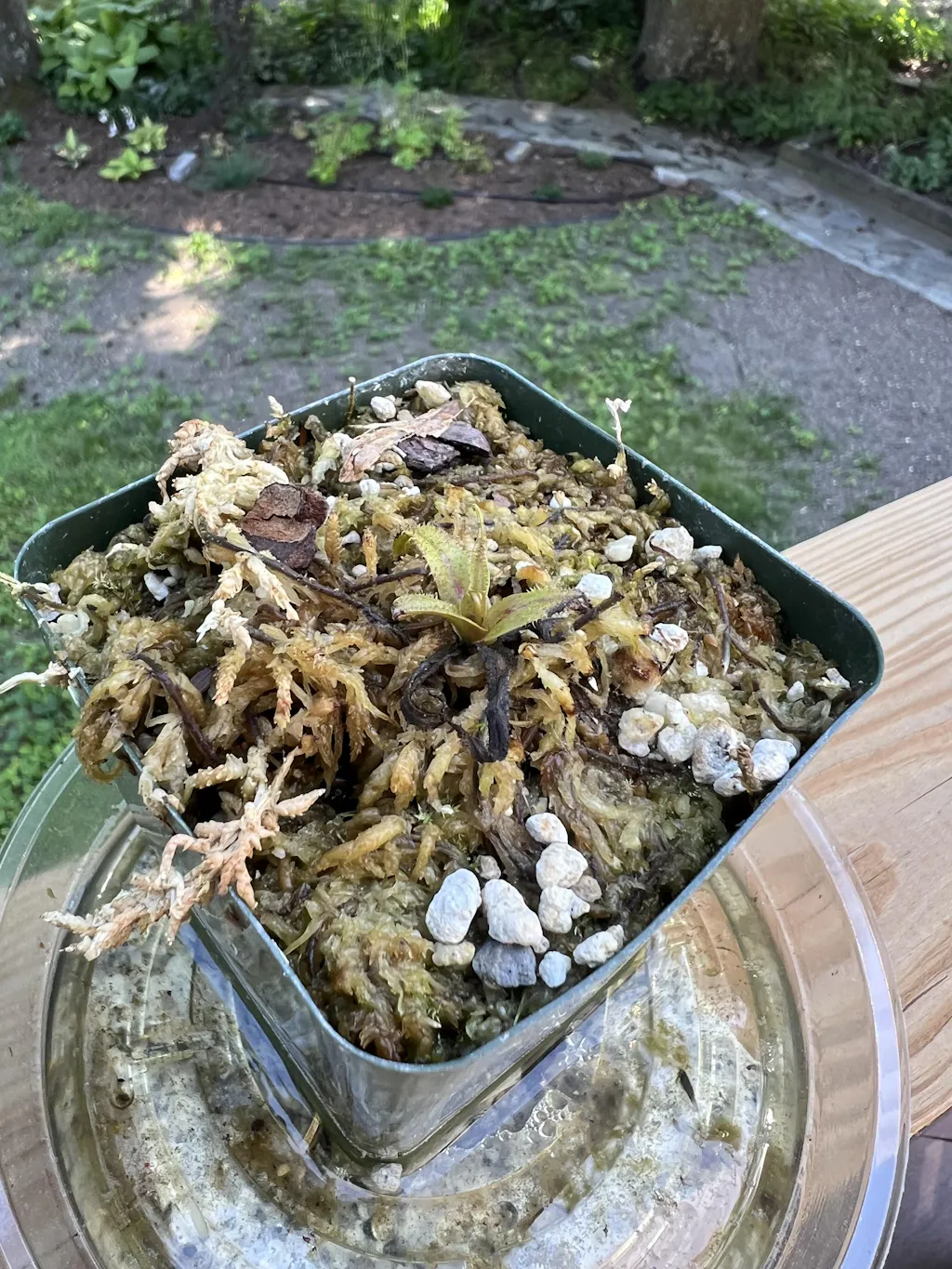
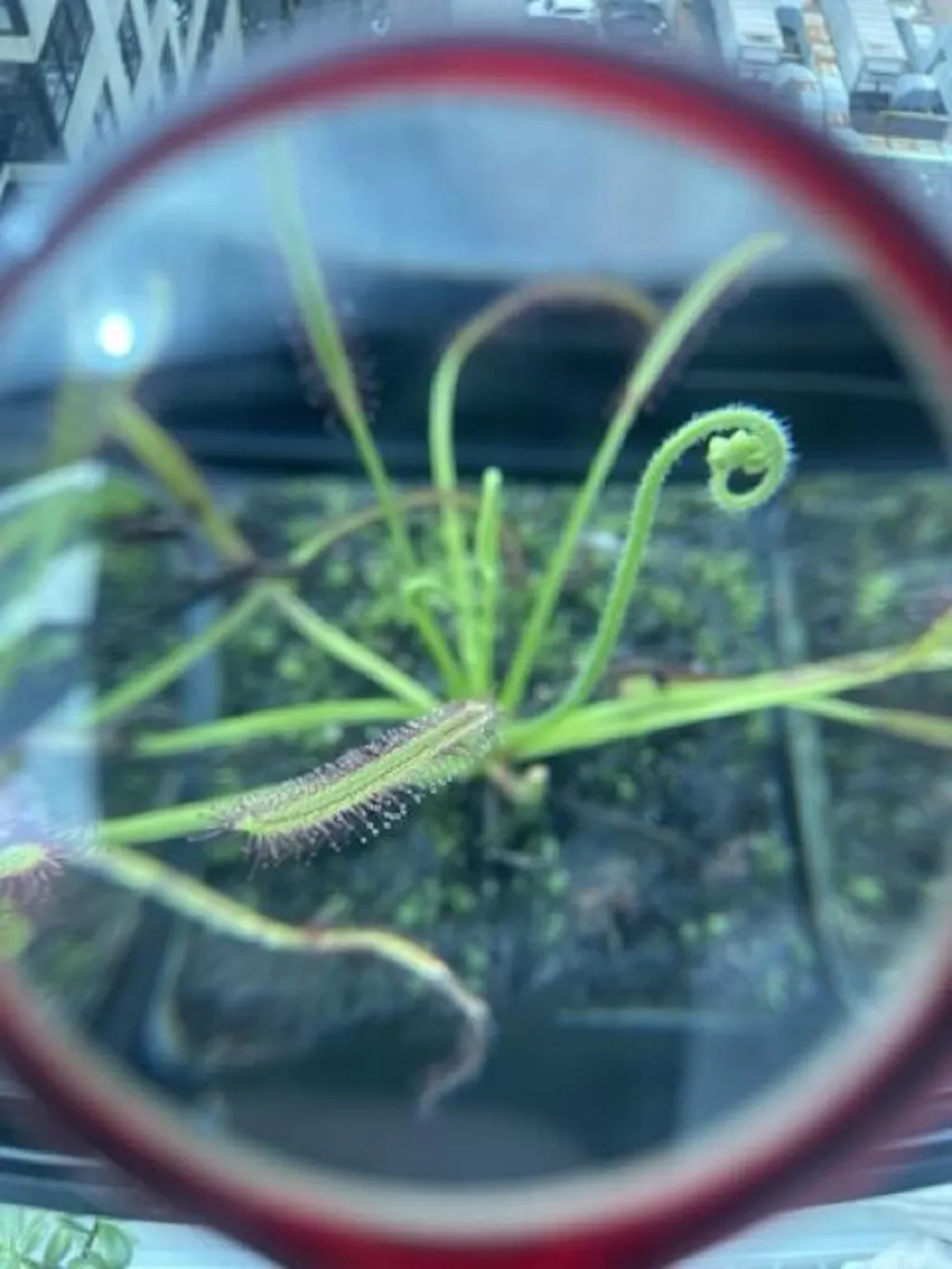
I ordered 3 Drosera capensis... and actually got 4! 2 in one pot! (thank you!). All healthy. One is flowering already.
Sign up for our newsletter!
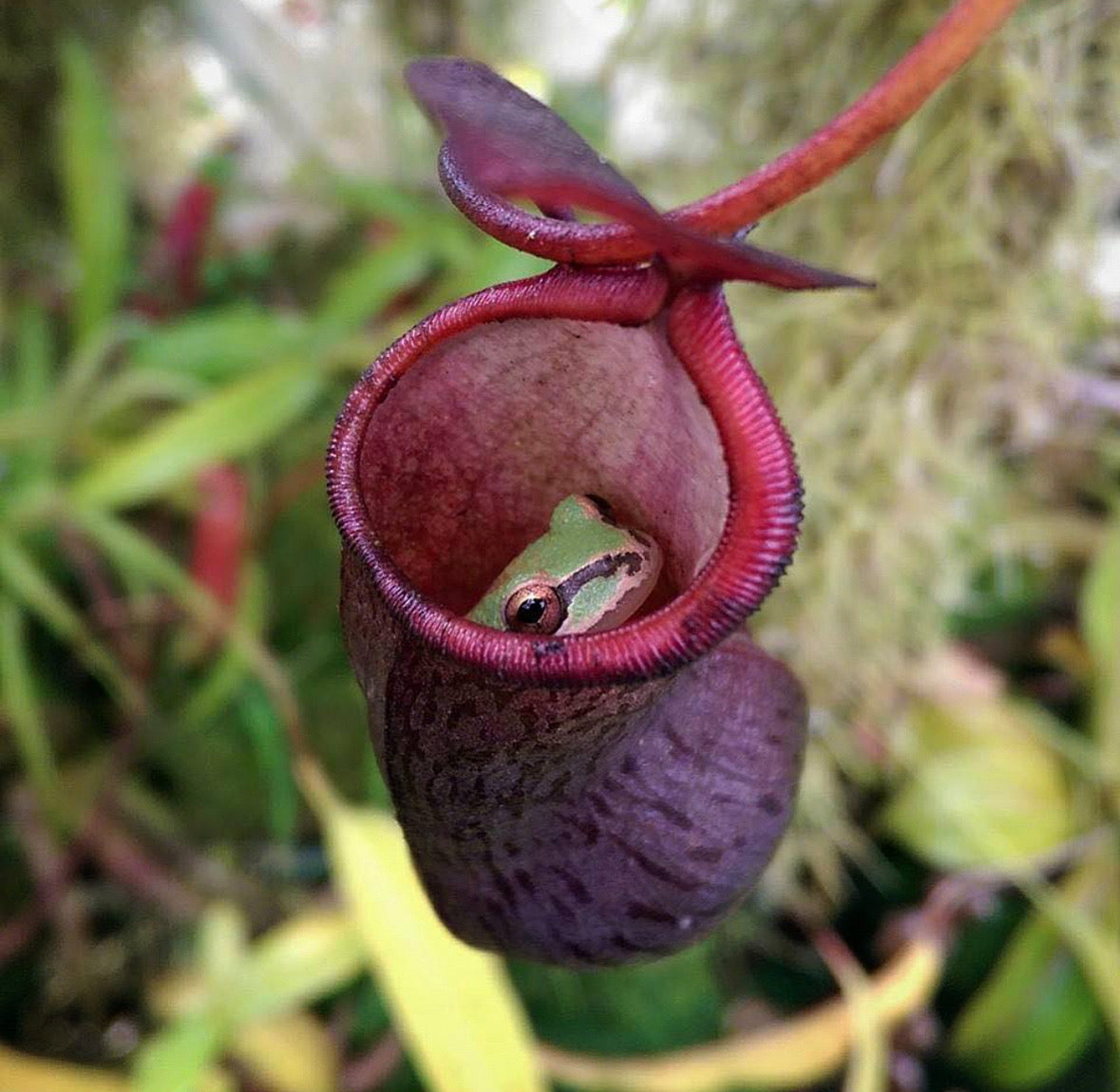

Highland Nepenthes species comprise more than 70% of the genus. They grow at elevations of 3,000 to 10,000 feet above sea level. This is above the lowland heat of the rainforest, and the mountain climate can be considerably cooler and wetter, especially at night. They are hauntingly beautiful, and their pitcher traps are often as elaborate and gaudy as any artistic creation of humankind.
They can grow happily on a sunny windowsill, under grow lights, in a greenhouse, or in a terrarium. They prefer daytime temperatures in the 70s- 80s and a nighttime drop to the 50s- 60s.
Sort by:
33 products
33 products
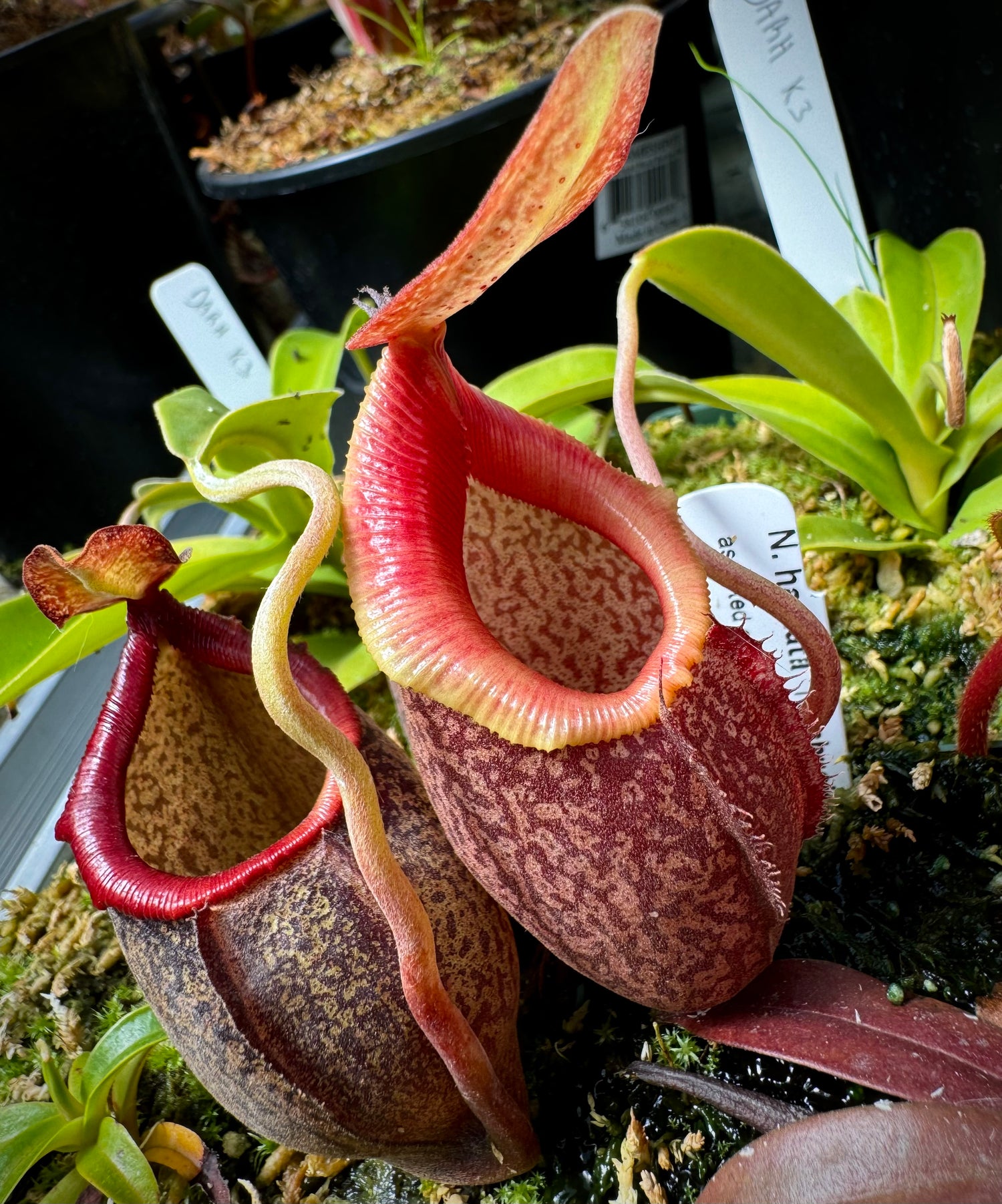
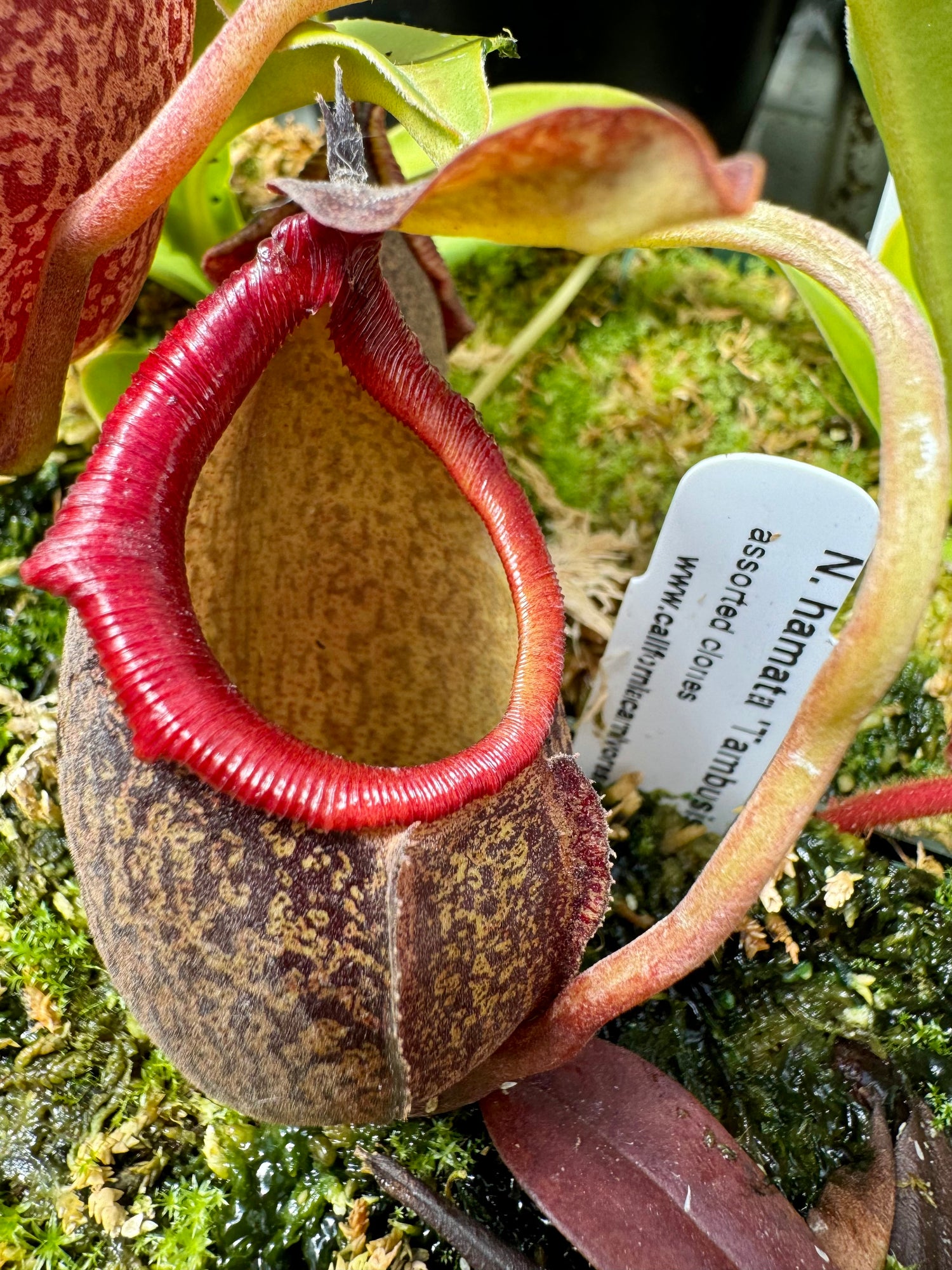
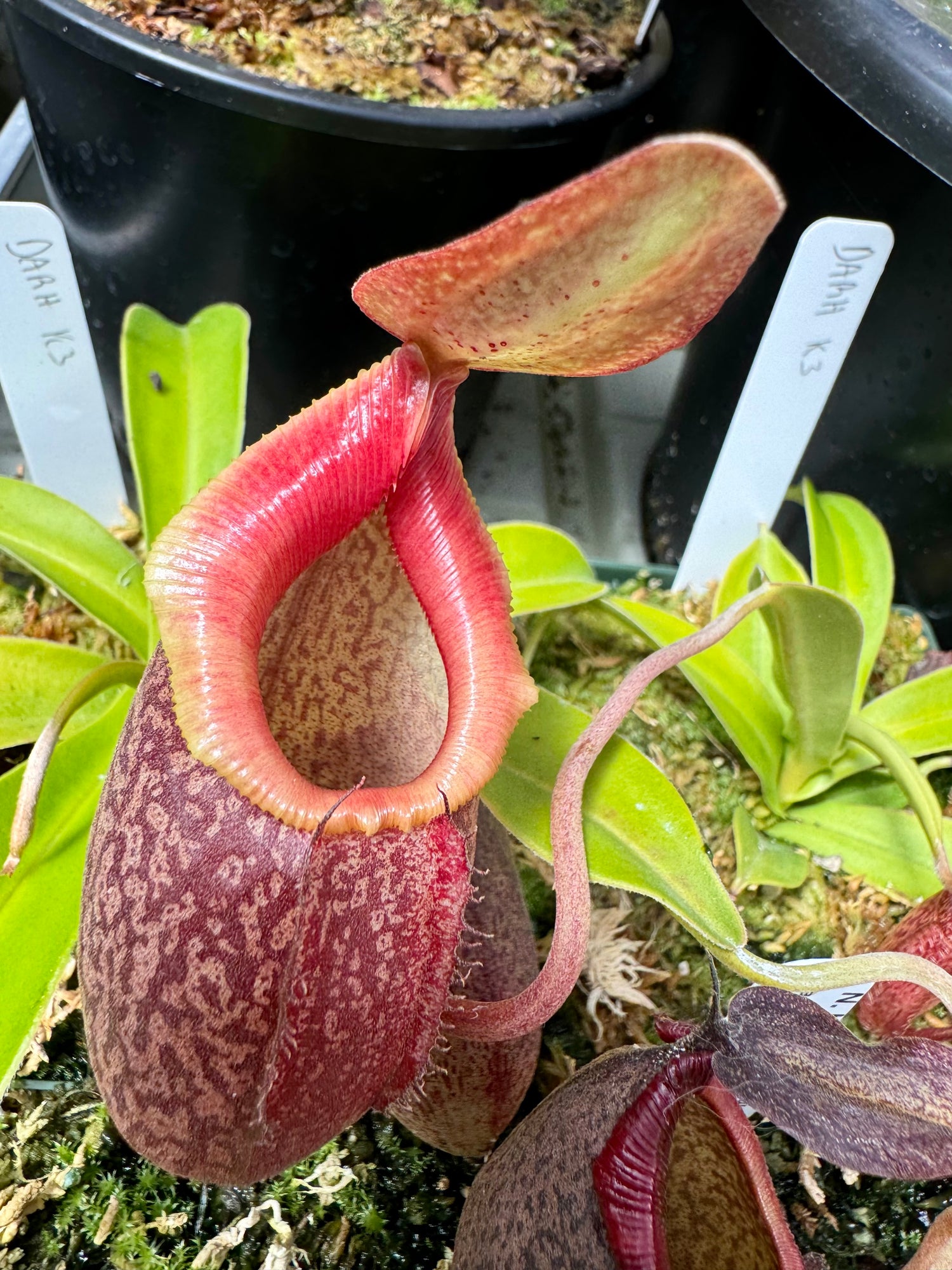
Nepenthes ( densiflora x aristolochioides ) x ( robcantleyi x hamata ) CalCarn Clone Potted
Nepenthes ( densiflora x aristolochioides ) x ( robcantleyi x hamata ) CalCarn Clone Potted
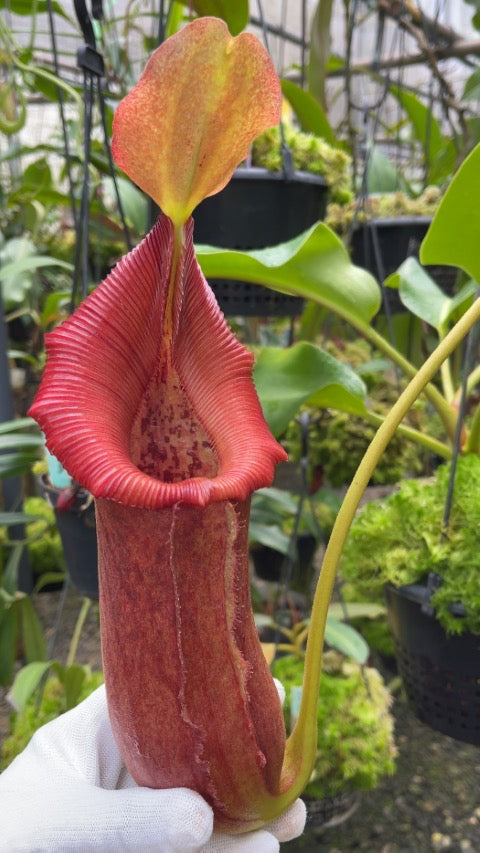
Nepenthes ( densiflora x aristolochioides ) x ( robcantleyi x hamata ) is a new hybrid from the CalCarn lab! We are entirely in love with these cute little tubby pitchers! They have a charming, tapered sausage shape with upside-down, heart-shaped peristomes! The pitchers are speckled red with vivid peristomes, and we’re very excited to see them grow out!
They are from the CalCarn tissue culture lab, and there are multiple clones.
Care Instructions
Growth Habit: Nepenthes are vines and start small; as the plant grows, each leaf will be larger than the last, as will the pitchers that develop from these leaves. It is normal for the pitchers and leaves to die back over time. As leaves and pitchers die back, the plant will continue to vine, turning brown and woody along the stem. Over time, these form large, sprawling vines that can be hung in baskets or trellised upright in large pots. Nepenthes have thin, black roots, and not many of them.
Sun: Nepenthes should be grown on a sunny windowsill where the plant receives direct light for at least four hours daily. Grow in a cooled greenhouse in full sun, but we recommend 30% shade cloth overhead in summer. Grow in a terrarium or shelf under grow lights for the best color and pitcher formation. When grown under lights, lights should be on a 10-12 hour day length, and the plants can be grown six to ten inches from the light, depending on the strength of the light. Poor pitcher formation is usually a sign of not enough light.
Water & Humidity: Water frequently with distilled, reverse osmosis, or rainwater. Do not let the pots sit in water for long periods. You can water from the bottom, fill trays with water, and let the plant dry out for a few days before watering again. Be careful not to dry the plants out completely. Watering overhead occasionally is also beneficial for the plants. Nepenthes appreciate humidity of at least 60% but can do very well in household conditions without increased humidity if watered regularly. Any added humidity will be enjoyed by your plant! Too little humidity is the second most likely cause of poor pitcher formation.
Temperature: Daytime temperatures should be in the 70s-80s, with a 10-20 degree drop in night temperatures. Never expose your plants to temperatures below 40 degrees or above 90 degrees, as this can damage or kill them. Nepenthes do best indoors and should not be grown outdoors in most areas unless you have very mild temperatures.
Dormancy: Nepenthes do not have a dormancy as they are tropical plants, but they can slow down growth in winter when photo periods shorten.
Fertilizer: Apply diluted Maxsea fertilizer once or twice a month to the leaves and inside the pitchers. Slow-release osmocote pellets can be added to the pitchers along with a bit of distilled water. Small pitchers may burn back upon feeding, but this will still greatly benefit the plant with nutrients. Small insects can also be fed to pitchers.
Soil & Repotting: Nepenthes should be grown in a mix of long-fibered New Zealand sphagnum moss, orchid bark, pumice, and perlite. We have all of our custom Nepenthes soil blends available to add to your order, but you do not need to repot your plant for at least a year after receiving it from us. Nepenthes appreciate frequent repotting every three years and only move to a slightly bigger pot.
More Information: For more information on repotting, pests, growing habits, and more, check out our FAQ page or our YouTube channel!
Sun: Nepenthes should be grown on a sunny windowsill where the plant receives direct light for at least four hours daily. Grow in a cooled greenhouse in full sun, but we recommend 30% shade cloth overhead in summer. Grow in a terrarium or shelf under grow lights for the best color and pitcher formation. When grown under lights, lights should be on a 10-12 hour day length, and the plants can be grown six to ten inches from the light, depending on the strength of the light. Poor pitcher formation is usually a sign of not enough light.
Water & Humidity: Water frequently with distilled, reverse osmosis, or rainwater. Do not let the pots sit in water for long periods. You can water from the bottom, fill trays with water, and let the plant dry out for a few days before watering again. Be careful not to dry the plants out completely. Watering overhead occasionally is also beneficial for the plants. Nepenthes appreciate humidity of at least 60% but can do very well in household conditions without increased humidity if watered regularly. Any added humidity will be enjoyed by your plant! Too little humidity is the second most likely cause of poor pitcher formation.
Temperature: Daytime temperatures should be in the 70s-80s, with a 10-20 degree drop in night temperatures. Never expose your plants to temperatures below 40 degrees or above 90 degrees, as this can damage or kill them. Nepenthes do best indoors and should not be grown outdoors in most areas unless you have very mild temperatures.
Dormancy: Nepenthes do not have a dormancy as they are tropical plants, but they can slow down growth in winter when photo periods shorten.
Fertilizer: Apply diluted Maxsea fertilizer once or twice a month to the leaves and inside the pitchers. Slow-release osmocote pellets can be added to the pitchers along with a bit of distilled water. Small pitchers may burn back upon feeding, but this will still greatly benefit the plant with nutrients. Small insects can also be fed to pitchers.
Soil & Repotting: Nepenthes should be grown in a mix of long-fibered New Zealand sphagnum moss, orchid bark, pumice, and perlite. We have all of our custom Nepenthes soil blends available to add to your order, but you do not need to repot your plant for at least a year after receiving it from us. Nepenthes appreciate frequent repotting every three years and only move to a slightly bigger pot.
More Information: For more information on repotting, pests, growing habits, and more, check out our FAQ page or our YouTube channel!
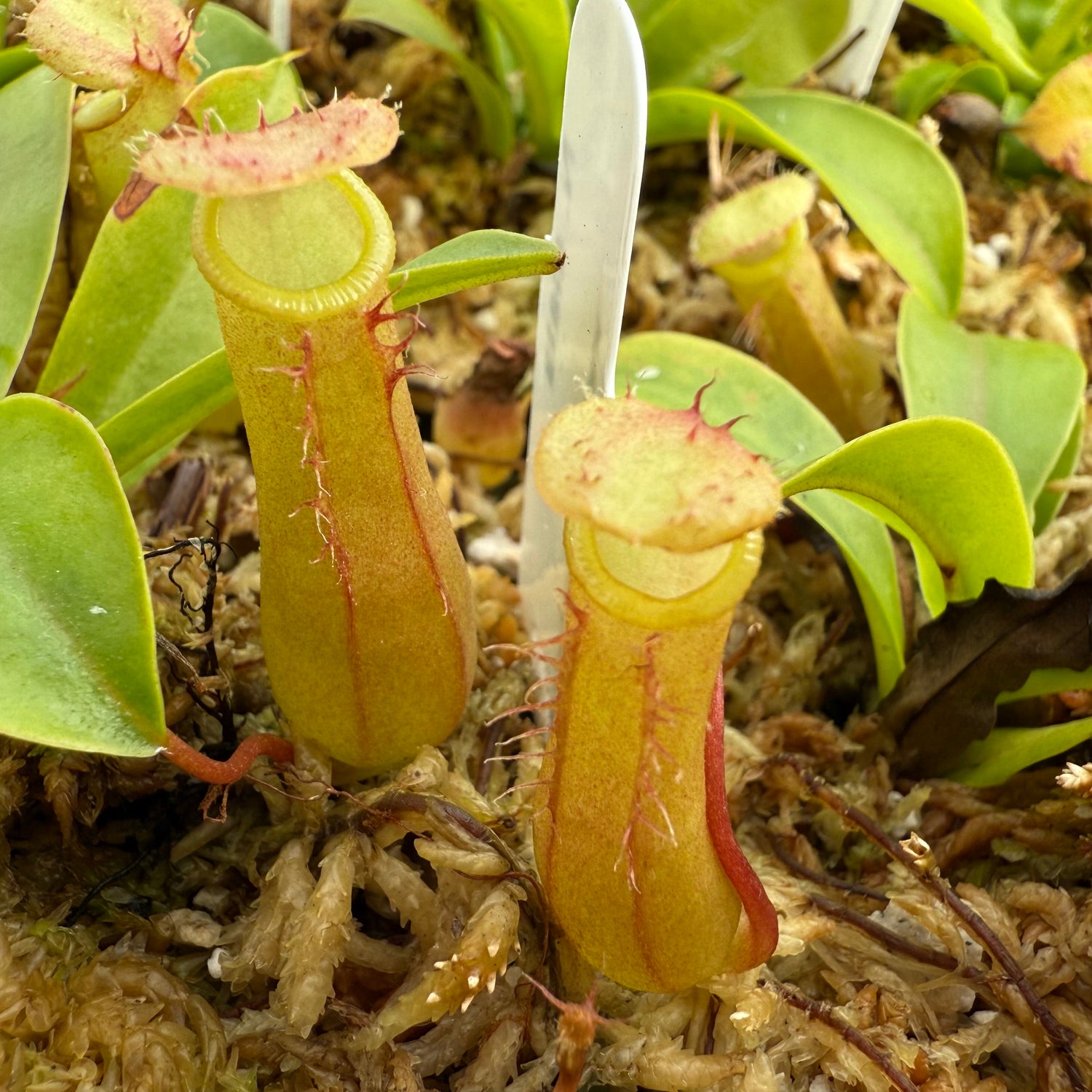
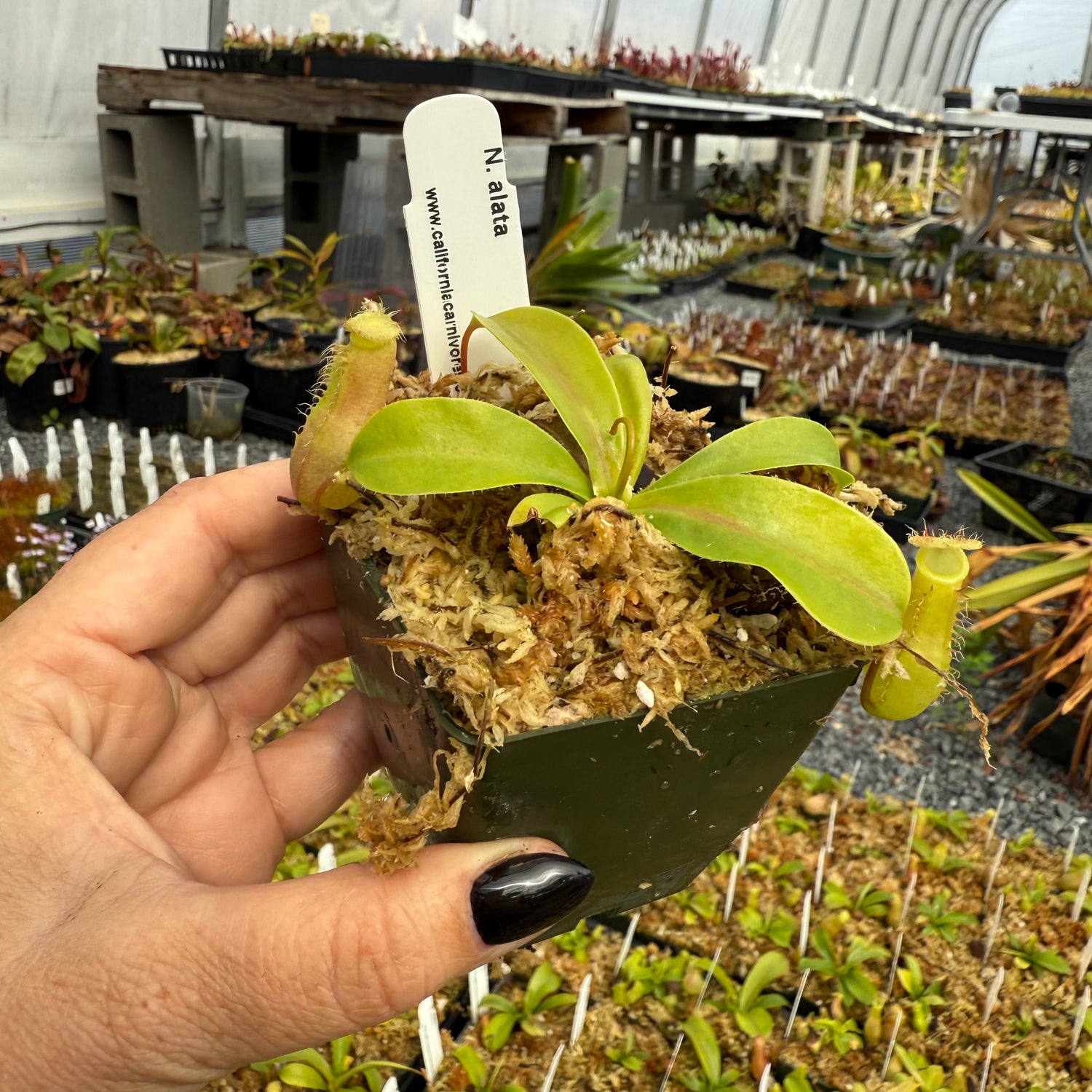

Nepenthes alata is a great Nepenthes for the beginner. It is an ideal candidate for hanging in a sunny window. With proper care, it will grow quickly and each pitcher will be bigger than the last as the vine grows longer and longer!
These are tissue culture plants from over seas and were not sure if they’re pure alata or cantata x alata but either way, they’re a beautiful and easy to grow plant!
Care Instructions
Growth Habit: Nepenthes are vines and start small; as the plant grows, each leaf will be larger than the last, as will the pitchers that develop from these leaves. It is normal for the pitchers and leaves to die back over time. As leaves and pitchers die back, the plant will continue to vine, turning brown and woody along the stem. Over time, these form large, sprawling vines that can be hung in baskets or trellised upright in large pots. Nepenthes have thin, black roots, and not many of them.
Sun: Nepenthes should be grown on a sunny windowsill where the plant receives direct light for at least four hours daily. Grow in a cooled greenhouse in full sun, but we recommend 30% shade cloth overhead in summer. Grow in a terrarium or shelf under grow lights for the best color and pitcher formation. When grown under lights, lights should be on a 10-12 hour day length, and the plants can be grown six to ten inches from the light, depending on the strength of the light. Poor pitcher formation is usually a sign of not enough light.
Water & Humidity: Water frequently with distilled, reverse osmosis, or rainwater. Do not let the pots sit in water for long periods. You can water from the bottom, fill trays with water, and let the plant dry out for a few days before watering again. Be careful not to dry the plants out completely. Watering overhead occasionally is also beneficial for the plants. Nepenthes appreciate humidity of at least 60% but can do very well in household conditions without increased humidity if watered regularly. Any added humidity will be enjoyed by your plant! Too little humidity is the second most likely cause of poor pitcher formation.
Temperature: Daytime temperatures should be in the 70s-80s, with a 10-20 degree drop in night temperatures. Never expose your plants to temperatures below 40 degrees or above 90 degrees, as this can damage or kill them. Nepenthes do best indoors and should not be grown outdoors in most areas unless you have very mild temperatures.
Dormancy: Nepenthes do not have a dormancy as they are tropical plants, but they can slow down growth in winter when photo periods shorten.
Fertilizer: Apply diluted Maxsea fertilizer once or twice a month to the leaves and inside the pitchers. Slow-release osmocote pellets can be added to the pitchers along with a bit of distilled water. Small pitchers may burn back upon feeding, but this will still greatly benefit the plant with nutrients. Small insects can also be fed to pitchers.
Soil & Repotting: Nepenthes should be grown in a mix of long-fibered New Zealand sphagnum moss, orchid bark, pumice, and perlite. We have all of our custom Nepenthes soil blends available to add to your order, but you do not need to repot your plant for at least a year after receiving it from us. Nepenthes appreciate frequent repotting every three years and only move to a slightly bigger pot.
More Information: For more information on repotting, pests, growing habits, and more, check out our FAQ page or our YouTube channel!
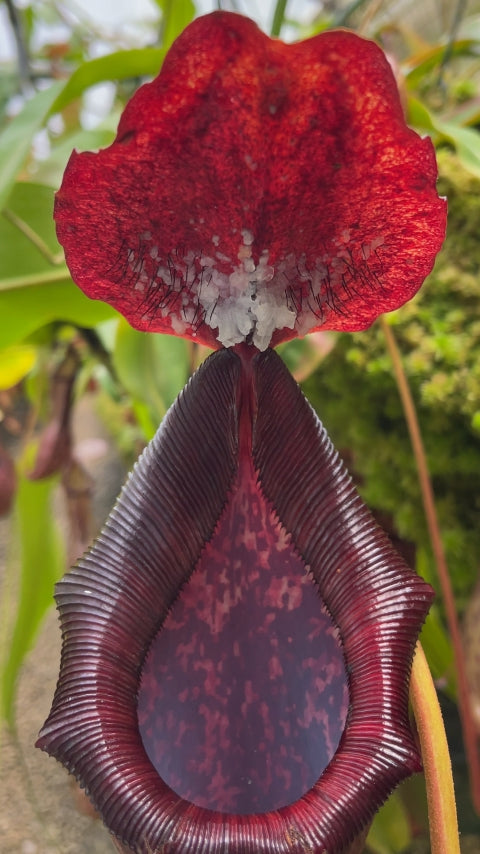
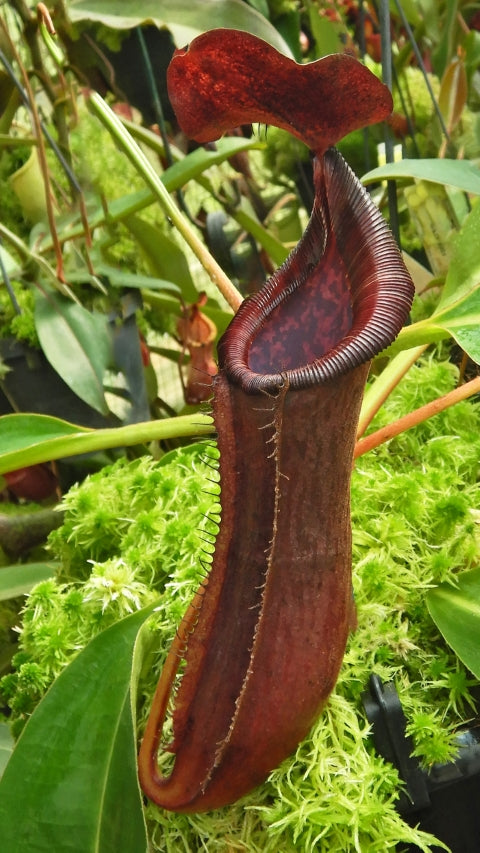
Growth Habit: Nepenthes are vines and start small; as the plant grows, each leaf will be larger than the last, as will the pitchers that develop from these leaves. It is normal for the pitchers and leaves to die back over time. As leaves and pitchers die back, the plant will continue to vine, turning brown and woody along the stem. Over time, these form large, sprawling vines that can be hung in baskets or trellised upright in large pots. Nepenthes have thin, black roots, and not many of them.
Sun: Nepenthes should be grown on a sunny windowsill where the plant receives direct light for at least four hours daily. Grow in a cooled greenhouse in full sun, but we recommend 30% shade cloth overhead in summer. Grow in a terrarium or shelf under grow lights for the best color and pitcher formation. When grown under lights, lights should be on a 10-12 hour day length, and the plants can be grown six to ten inches from the light, depending on the strength of the light. Poor pitcher formation is usually a sign of not enough light.
Water & Humidity: Water frequently with distilled, reverse osmosis, or rainwater. Do not let the pots sit in water for long periods. You can water from the bottom, fill trays with water, and let the plant dry out for a few days before watering again. Be careful not to dry the plants out completely. Watering overhead occasionally is also beneficial for the plants. Nepenthes appreciate humidity of at least 60% but can do very well in household conditions without increased humidity if watered regularly. Any added humidity will be enjoyed by your plant! Too little humidity is the second most likely cause of poor pitcher formation.
Temperature: Daytime temperatures should be in the 70s-80s, with a 10-20 degree drop in night temperatures. Never expose your plants to temperatures below 40 degrees or above 90 degrees, as this can damage or kill them. Nepenthes do best indoors and should not be grown outdoors in most areas unless you have very mild temperatures.
Dormancy: Nepenthes do not have a dormancy as they are tropical plants, but they can slow down growth in winter when photo periods shorten.
Fertilizer: Apply diluted Maxsea fertilizer once or twice a month to the leaves and inside the pitchers. Slow-release osmocote pellets can be added to the pitchers along with a bit of distilled water. Small pitchers may burn back upon feeding, but this will still greatly benefit the plant with nutrients. Small insects can also be fed to pitchers.
Soil & Repotting: Nepenthes should be grown in a mix of long-fibered New Zealand sphagnum moss, orchid bark, pumice, and perlite. We have all of our custom Nepenthes soil blends available to add to your order, but you do not need to repot your plant for at least a year after receiving it from us. Nepenthes appreciate frequent repotting every three years and only move to a slightly bigger pot.
More Information: For more information on repotting, pests, growing habits, and more, check out our FAQ page or our YouTube channel!


Nepenthes burkei x( Burbidgeae x edwardsiana ) is a stunning plant! This cross between two attractive parent plants produces long-lasting and tough pitchers. They pitchers with the waxy texture of Nepenthes burkei. An easy item, suitable for growers of all abilities.
These are from assorted clones in tissue culture from Borneo Exotics, BE-4531.
Care Instructions
Growth Habit: Nepenthes are vines and start small; as the plant grows, each leaf will be larger than the last, as will the pitchers that develop from these leaves. It is normal for the pitchers and leaves to die back over time. As leaves and pitchers die back, the plant will continue to vine, turning brown and woody along the stem. Over time, these form large, sprawling vines that can be hung in baskets or trellised upright in large pots. Nepenthes have thin, black roots, and not many of them.
Sun: Nepenthes should be grown on a sunny windowsill where the plant receives direct light for at least four hours daily. Grow in a cooled greenhouse in full sun, but we recommend 30% shade cloth overhead in summer. Grow in a terrarium or shelf under grow lights for the best color and pitcher formation. When grown under lights, lights should be on a 10-12 hour day length, and the plants can be grown six to ten inches from the light, depending on the strength of the light. Poor pitcher formation is usually a sign of not enough light.
Water & Humidity: Water frequently with distilled, reverse osmosis, or rainwater. Do not let the pots sit in water for long periods. You can water from the bottom, fill trays with water, and let the plant dry out for a few days before watering again. Be careful not to dry the plants out completely. Watering overhead occasionally is also beneficial for the plants. Nepenthes appreciate humidity of at least 60% but can do very well in household conditions without increased humidity if watered regularly. Any added humidity will be enjoyed by your plant! Too little humidity is the second most likely cause of poor pitcher formation.
Temperature: Daytime temperatures should be in the 70s-80s, with a 10-20 degree drop in night temperatures. Never expose your plants to temperatures below 40 degrees or above 90 degrees, as this can damage or kill them. Nepenthes do best indoors and should not be grown outdoors in most areas unless you have very mild temperatures.
Dormancy: Nepenthes do not have a dormancy as they are tropical plants, but they can slow down growth in winter when photo periods shorten.
Fertilizer: Apply diluted Maxsea fertilizer once or twice a month to the leaves and inside the pitchers. Slow-release osmocote pellets can be added to the pitchers along with a bit of distilled water. Small pitchers may burn back upon feeding, but this will still greatly benefit the plant with nutrients. Small insects can also be fed to pitchers.
Soil & Repotting: Nepenthes should be grown in a mix of long-fibered New Zealand sphagnum moss, orchid bark, pumice, and perlite. We have all of our custom Nepenthes soil blends available to add to your order, but you do not need to repot your plant for at least a year after receiving it from us. Nepenthes appreciate frequent repotting every three years and only move to a slightly bigger pot.
More Information: For more information on repotting, pests, growing habits, and more, check out our FAQ page or our YouTube channel!


Sun: Nepenthes should be grown on a sunny windowsill where the plant receives direct light for at least four hours daily. Grow in a cooled greenhouse in full sun, but we recommend 30% shade cloth overhead in summer. Grow in a terrarium or shelf under grow lights for the best color and pitcher formation. When grown under lights, lights should be on a 10-12 hour day length, and the plants can be grown six to ten inches from the light, depending on the strength of the light. Poor pitcher formation is usually a sign of not enough light.
Water & Humidity: Water frequently with distilled, reverse osmosis, or rainwater. Do not let the pots sit in water for long periods. You can water from the bottom, fill trays with water, and let the plant dry out for a few days before watering again. Be careful not to dry the plants out completely. Watering overhead occasionally is also beneficial for the plants. Nepenthes appreciate humidity of at least 60% but can do very well in household conditions without increased humidity if watered regularly. Any added humidity will be enjoyed by your plant! Too little humidity is the second most likely cause of poor pitcher formation.
Temperature: Daytime temperatures should be in the 70s-80s, with a 10-20 degree drop in night temperatures. Never expose your plants to temperatures below 40 degrees or above 90 degrees, as this can damage or kill them. Nepenthes do best indoors and should not be grown outdoors in most areas unless you have very mild temperatures.
Dormancy: Nepenthes do not have a dormancy as they are tropical plants, but they can slow down growth in winter when photo periods shorten.
Fertilizer: Apply diluted Maxsea fertilizer once or twice a month to the leaves and inside the pitchers. Slow-release osmocote pellets can be added to the pitchers along with a bit of distilled water. Small pitchers may burn back upon feeding, but this will still greatly benefit the plant with nutrients. Small insects can also be fed to pitchers.
Soil & Repotting: Nepenthes should be grown in a mix of long-fibered New Zealand sphagnum moss, orchid bark, pumice, and perlite. We have all of our custom Nepenthes soil blends available to add to your order, but you do not need to repot your plant for at least a year after receiving it from us. Nepenthes appreciate frequent repotting every three years and only move to a slightly bigger pot.
More Information: For more information on repotting, pests, growing habits, and more, check out our FAQ page or our YouTube channel!


Sun: Nepenthes should be grown on a sunny windowsill where the plant receives direct light for at least four hours daily. Grow in a cooled greenhouse in full sun, but we recommend 30% shade cloth overhead in summer. Grow in a terrarium or shelf under grow lights for the best color and pitcher formation. When grown under lights, lights should be on a 10-12 hour day length, and the plants can be grown six to ten inches from the light, depending on the strength of the light. Poor pitcher formation is usually a sign of not enough light.
Water & Humidity: Water frequently with distilled, reverse osmosis, or rainwater. Do not let the pots sit in water for long periods. You can water from the bottom, fill trays with water, and let the plant dry out for a few days before watering again. Be careful not to dry the plants out completely. Watering overhead occasionally is also beneficial for the plants. Nepenthes appreciate humidity of at least 60% but can do very well in household conditions without increased humidity if watered regularly. Any added humidity will be enjoyed by your plant! Too little humidity is the second most likely cause of poor pitcher formation.
Temperature: Daytime temperatures should be in the 70s-80s, with a 10-20 degree drop in night temperatures. Never expose your plants to temperatures below 40 degrees or above 90 degrees, as this can damage or kill them. Nepenthes do best indoors and should not be grown outdoors in most areas unless you have very mild temperatures.
Dormancy: Nepenthes do not have a dormancy as they are tropical plants, but they can slow down growth in winter when photo periods shorten.
Fertilizer: Apply diluted Maxsea fertilizer once or twice a month to the leaves and inside the pitchers. Slow-release osmocote pellets can be added to the pitchers along with a bit of distilled water. Small pitchers may burn back upon feeding, but this will still greatly benefit the plant with nutrients. Small insects can also be fed to pitchers.
Soil & Repotting: Nepenthes should be grown in a mix of long-fibered New Zealand sphagnum moss, orchid bark, pumice, and perlite. We have all of our custom Nepenthes soil blends available to add to your order, but you do not need to repot your plant for at least a year after receiving it from us. Nepenthes appreciate frequent repotting every three years and only move to a slightly bigger pot.
More Information: For more information on repotting, pests, growing habits, and more, check out our FAQ page or our YouTube channel!


Growth Habit: Nepenthes are vines and start small; as the plant grows, each leaf will be larger than the last, as will the pitchers that develop from these leaves. It is normal for the pitchers and leaves to die back over time. As leaves and pitchers die back, the plant will continue to vine, turning brown and woody along the stem. Over time, these form large, sprawling vines that can be hung in baskets or trellised upright in large pots. Nepenthes have thin, black roots, and not many of them.
Sun: Nepenthes should be grown on a sunny windowsill where the plant receives direct light for at least four hours daily. Grow in a cooled greenhouse in full sun, but we recommend 30% shade cloth overhead in summer. Grow in a terrarium or shelf under grow lights for the best color and pitcher formation. When grown under lights, lights should be on a 10-12 hour day length, and the plants can be grown six to ten inches from the light, depending on the strength of the light. Poor pitcher formation is usually a sign of not enough light.
Water & Humidity: Water frequently with distilled, reverse osmosis, or rainwater. Do not let the pots sit in water for long periods. You can water from the bottom, fill trays with water, and let the plant dry out for a few days before watering again. Be careful not to dry the plants out completely. Watering overhead occasionally is also beneficial for the plants. This species will appreciate added humidity, humidity over 70% is ideal.
Temperature: Daytime temperatures should be in the 60-80, with a 10 degree drop in night temperatures. Never expose your plants to temperatures below 40 degrees or above 85 degrees, as this can damage or kill them. This species prefers cooler temps and higher humidity at all times. Nepenthes do best indoors and should not be grown outdoors in most areas unless you have very mild temperatures.
Dormancy: Nepenthes do not have a dormancy as they are tropical plants, but they can slow down growth in winter when photo periods shorten.
Fertilizer: Apply diluted Maxsea fertilizer once or twice a month to the leaves and inside the pitchers. Slow-release osmocote pellets can be added to the pitchers along with a bit of distilled water. Small pitchers may burn back upon feeding, but this will still greatly benefit the plant with nutrients. Small insects can also be fed to pitchers.
Soil & Repotting: Nepenthes should be grown in a mix of long-fibered New Zealand sphagnum moss, orchid bark, pumice, and perlite. We have all of our custom Nepenthes soil blends available to add to your order, but you do not need to repot your plant for at least a year after receiving it from us. Nepenthes appreciate frequent repotting every three years and only move to a slightly bigger pot.
More Information: For more information on repotting, pests, growing habits, and more, check out our FAQ page or our YouTube channel!

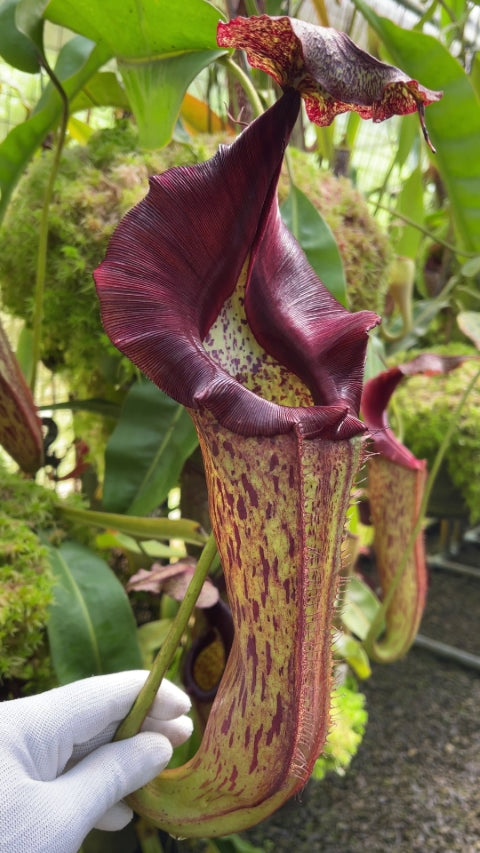
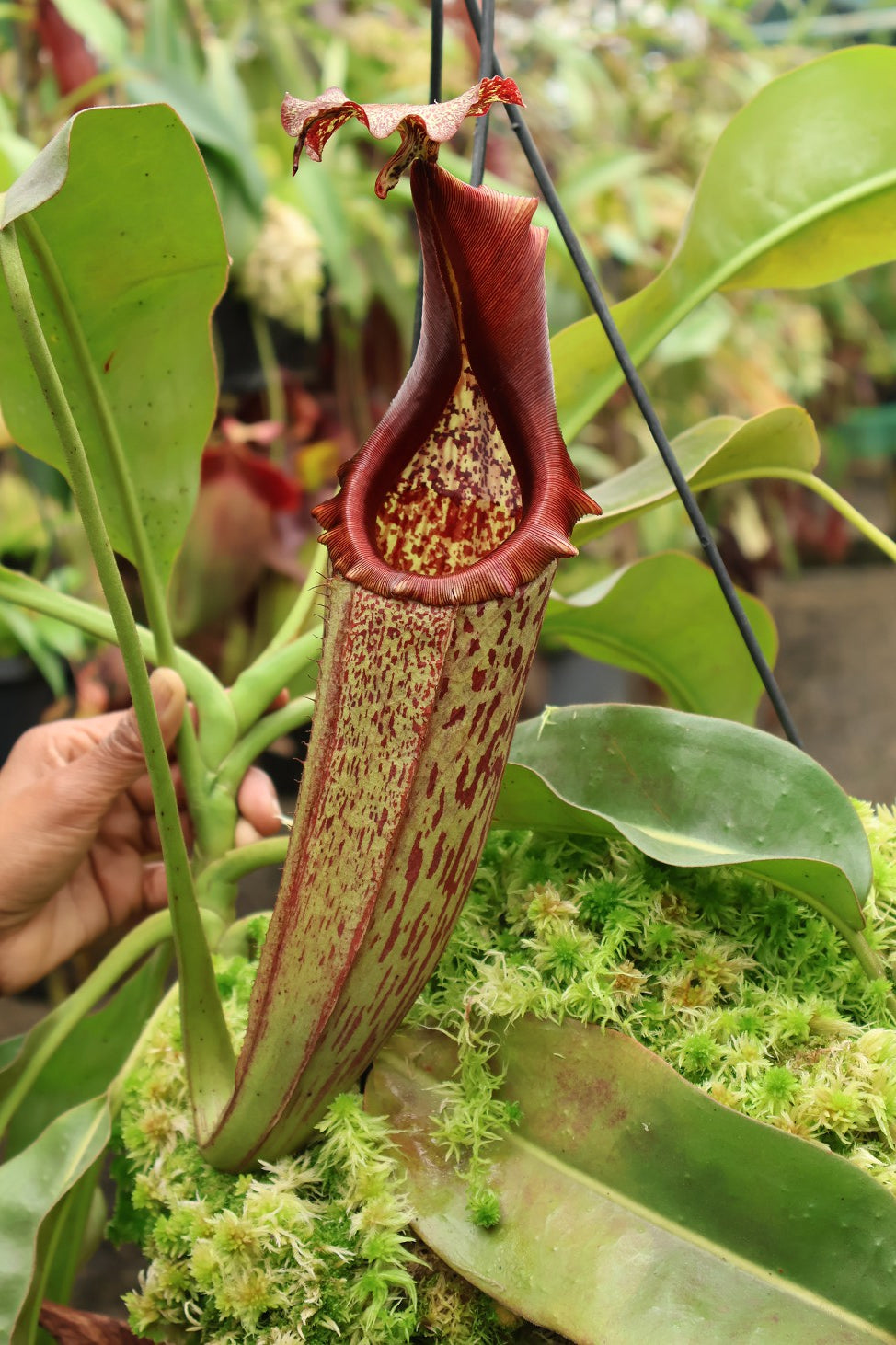
Growth Habit: Nepenthes are vines and start small; as the plant grows, each leaf will be larger than the last, as will the pitchers that develop from these leaves. It is normal for the pitchers and leaves to die back over time. As leaves and pitchers die back, the plant will continue to vine, turning brown and woody along the stem. Over time, these form large, sprawling vines that can be hung in baskets or trellised upright in large pots. Nepenthes have thin, black roots, and not many of them.
Sun: Nepenthes should be grown on a sunny windowsill where the plant receives direct light for at least four hours daily. Grow in a cooled greenhouse in full sun, but we recommend 30% shade cloth overhead in summer. Grow in a terrarium or shelf under grow lights for the best color and pitcher formation. When grown under lights, lights should be on a 10-12 hour day length, and the plants can be grown six to ten inches from the light, depending on the strength of the light. Poor pitcher formation is usually a sign of not enough light.
Water & Humidity: Water frequently with distilled, reverse osmosis, or rainwater. Do not let the pots sit in water for long periods. You can water from the bottom, fill trays with water, and let the plant dry out for a few days before watering again. Be careful not to dry the plants out completely. Watering overhead occasionally is also beneficial for the plants. Nepenthes appreciate humidity of at least 60% but can do very well in household conditions without increased humidity if watered regularly. Any added humidity will be enjoyed by your plant! Too little humidity is the second most likely cause of poor pitcher formation.
Temperature: Daytime temperatures should be in the 70s-80s, with a 10-20 degree drop in night temperatures. Never expose your plants to temperatures below 40 degrees or above 90 degrees, as this can damage or kill them. Nepenthes do best indoors and should not be grown outdoors in most areas unless you have very mild temperatures.
Dormancy: Nepenthes do not have a dormancy as they are tropical plants, but they can slow down growth in winter when photo periods shorten.
Fertilizer: Apply diluted Maxsea fertilizer once or twice a month to the leaves and inside the pitchers. Slow-release osmocote pellets can be added to the pitchers along with a bit of distilled water. Small pitchers may burn back upon feeding, but this will still greatly benefit the plant with nutrients. Small insects can also be fed to pitchers.
Soil & Repotting: Nepenthes should be grown in a mix of long-fibered New Zealand sphagnum moss, orchid bark, pumice, and perlite. We have all of our custom Nepenthes soil blends available to add to your order, but you do not need to repot your plant for at least a year after receiving it from us. Nepenthes appreciate frequent repotting every three years and only move to a slightly bigger pot.
More Information: For more information on repotting, pests, growing habits, and more, check out our FAQ page or our YouTube channel!
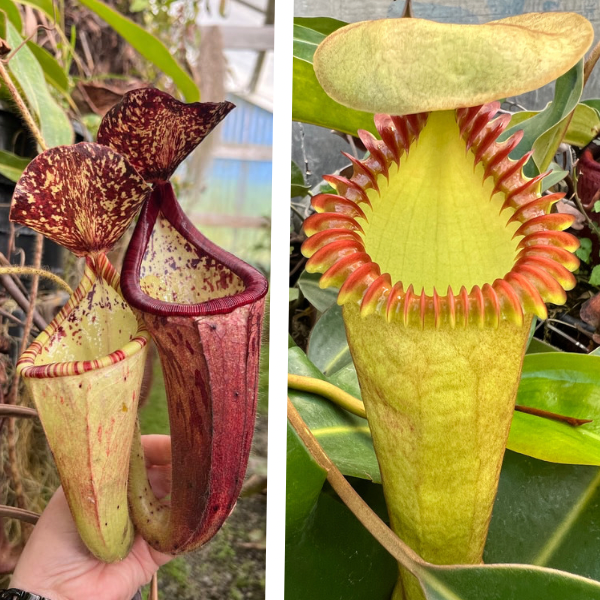
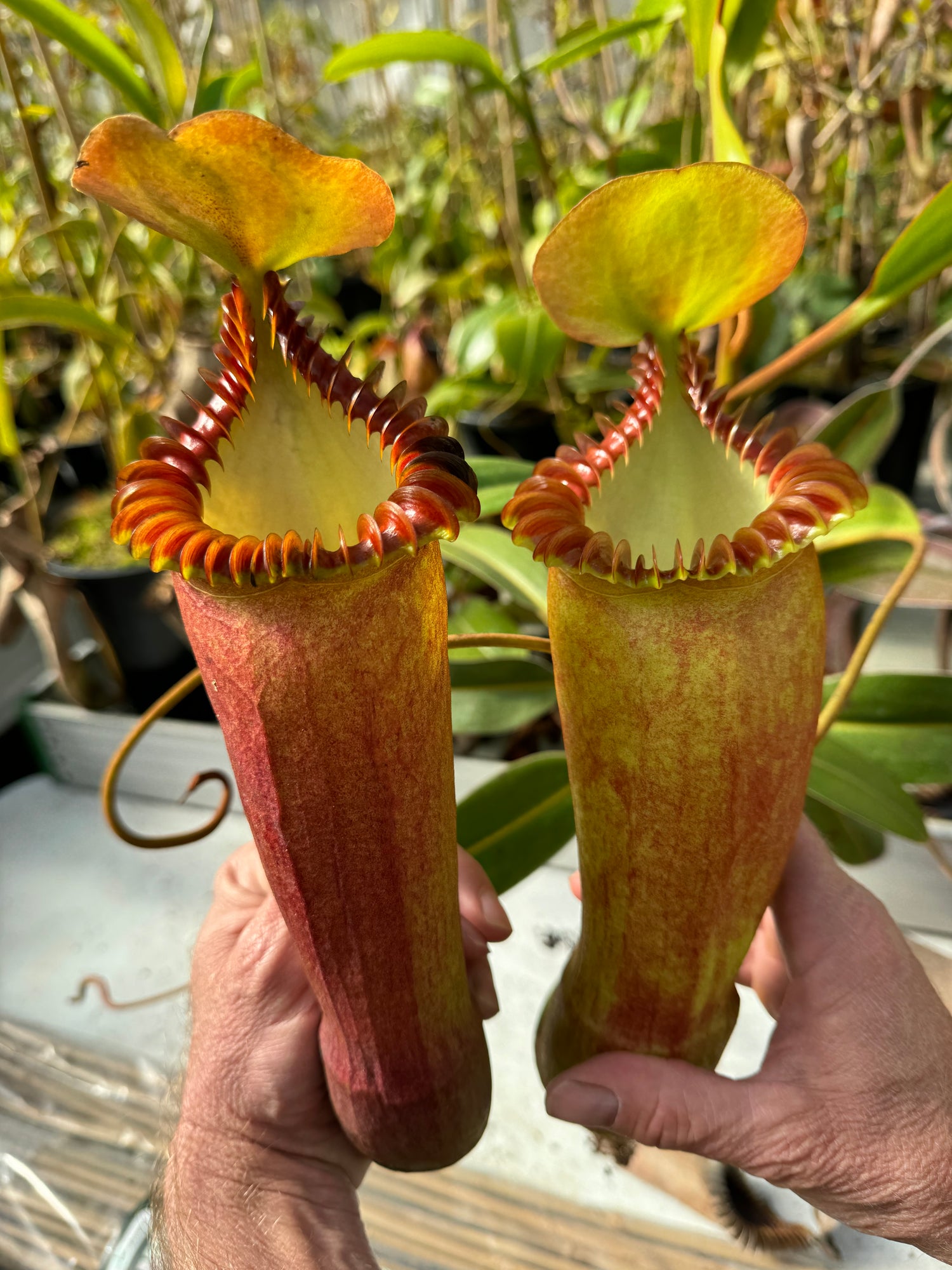
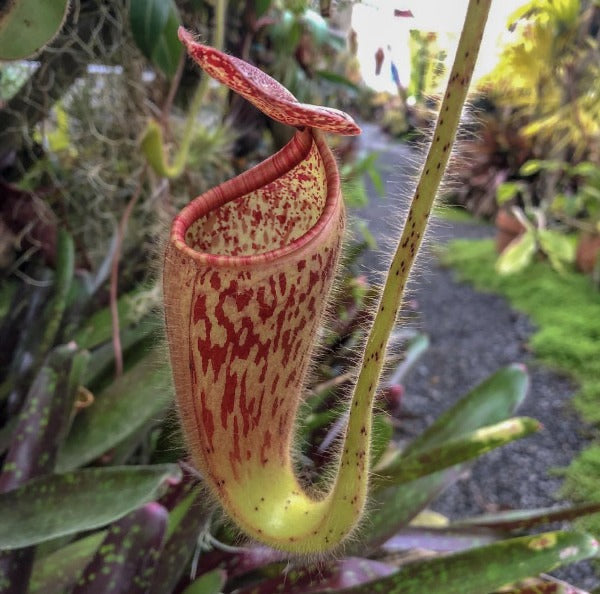
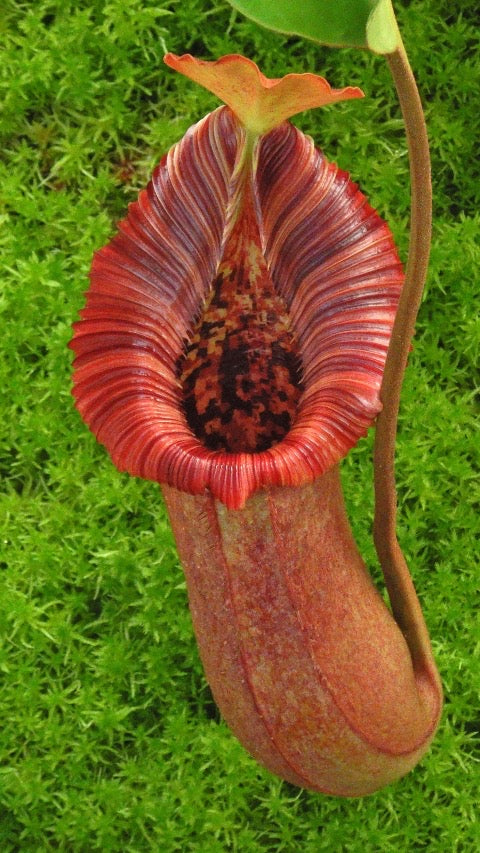
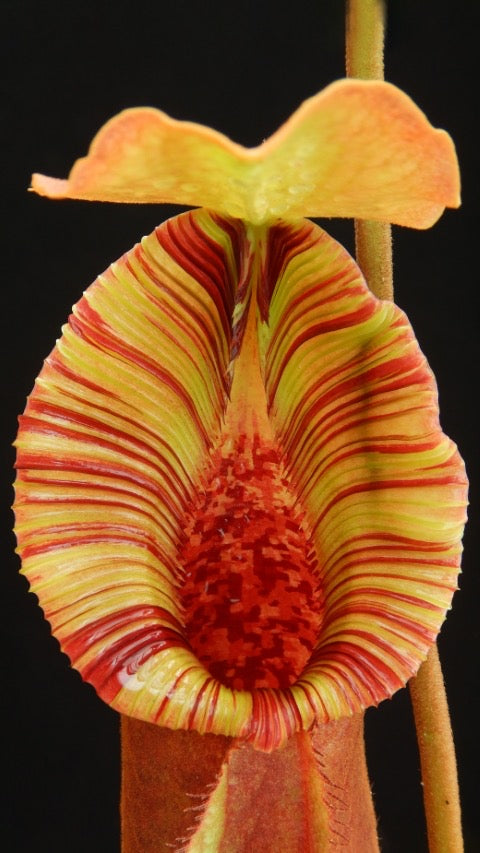
Nepenthes glandulifera x edwardsiana “Giant” CalCarn Seed-Grown Potted
Nepenthes glandulifera x edwardsiana “Giant” CalCarn Seed-Grown Potted
Nepenthes glandulifera x edwardsiana is a brand new CalCarn cross! Our Nepenthes edwardsiana “Giant” is one of the nicest examples of the species in cultivation! Each distinguished pitcher is lined with shaped hooks, an iconic peristome! We’ve combined this with one of our favorite Nepenthes species, glandulifera. Glandulifera has beautiful wide-open peristomes and mottled pitchers, but the best part of glandulifera is the fine hairs covering the plant! We’re so excited to see all the variations coming out of a cross like this; each seed-grown plant will be a unique treasure!
The seedlings already have beautiful little red pitchers, and we expect them to become nice, compact plants with those spectacular Eddie-like pitchers that everyone wants these days!
These are all seed-grown individuals and are not in TC, so don’t miss out on this exciting but limited offering.
The first three photos are of the parents in the cross.
Care Instructions
Growth Habit: Nepenthes are vines and start small; as the plant grows, each leaf will be larger than the last, as will the pitchers that develop from these leaves. It is normal for the pitchers and leaves to die back over time. As leaves and pitchers die back, the plant will continue to vine, turning brown and woody along the stem. Over time, these form large, sprawling vines that can be hung in baskets or trellised upright in large pots. Nepenthes have thin, black roots, and not many of them.
Sun: Nepenthes should be grown on a sunny windowsill where the plant receives direct light for at least four hours daily. Grow in a cooled greenhouse in full sun, but we recommend 30% shade cloth overhead in summer. Grow in a terrarium or shelf under grow lights for the best color and pitcher formation. When grown under lights, lights should be on a 10-12 hour day length, and the plants can be grown six to ten inches from the light, depending on the strength of the light. Poor pitcher formation is usually a sign of not enough light.
Water & Humidity: Water frequently with distilled, reverse osmosis, or rainwater. Do not let the pots sit in water for long periods. You can water from the bottom, fill trays with water, and let the plant dry out for a few days before watering again. Be careful not to dry the plants out completely. Watering overhead occasionally is also beneficial for the plants. Nepenthes appreciate humidity of at least 60% but can do very well in household conditions without increased humidity if watered regularly. Any added humidity will be enjoyed by your plant! Too little humidity is the second most likely cause of poor pitcher formation.
Temperature: Daytime temperatures should be in the 70s-80s, with a 10-20 degree drop in night temperatures. Never expose your plants to temperatures below 40 degrees or above 90 degrees, as this can damage or kill them. Nepenthes do best indoors and should not be grown outdoors in most areas unless you have very mild temperatures.
Dormancy: Nepenthes do not have a dormancy as they are tropical plants, but they can slow down growth in winter when photo periods shorten.
Fertilizer: Apply diluted Maxsea fertilizer once or twice a month to the leaves and inside the pitchers. Slow-release osmocote pellets can be added to the pitchers along with a bit of distilled water. Small pitchers may burn back upon feeding, but this will still greatly benefit the plant with nutrients. Small insects can also be fed to pitchers.
Soil & Repotting: Nepenthes should be grown in a mix of long-fibered New Zealand sphagnum moss, orchid bark, pumice, and perlite. We have all of our custom Nepenthes soil blends available to add to your order, but you do not need to repot your plant for at least a year after receiving it from us. Nepenthes appreciate frequent repotting every three years and only move to a slightly bigger pot.
More Information: For more information on repotting, pests, growing habits, and more, check out our FAQ page or our YouTube channel!


Care Instructions
Growth Habit: Nepenthes are vines and start small; as the plant grows, each leaf will be larger than the last, as will the pitchers that develop from these leaves. It is normal for the pitchers and leaves to die back over time. As leaves and pitchers die back, the plant will continue to vine, turning brown and woody along the stem. Over time, these form large, sprawling vines that can be hung in baskets or trellised upright in large pots. Nepenthes have thin, black roots, and not many of them.
Sun: Nepenthes should be grown on a sunny windowsill where the plant receives direct light for at least four hours daily. Grow in a cooled greenhouse in full sun, but we recommend 30% shade cloth overhead in summer. Grow in a terrarium or shelf under grow lights for the best color and pitcher formation. When grown under lights, lights should be on a 10-12 hour day length, and the plants can be grown six to ten inches from the light, depending on the strength of the light. Poor pitcher formation is usually a sign of not enough light.
Water & Humidity: Water frequently with distilled, reverse osmosis, or rainwater. Do not let the pots sit in water for long periods. You can water from the bottom, fill trays with water, and let the plant dry out for a few days before watering again. Be careful not to dry the plants out completely. Watering overhead occasionally is also beneficial for the plants. Nepenthes appreciate humidity of at least 60% and this species will do best with high humidity.
Temperature: Daytime temperatures should be in the 70s-80s, with a 10-20 degree drop in night temperatures. Never expose your plants to temperatures below 40 degrees or above 90 degrees, as this can damage or kill them. Nepenthes do best indoors and should not be grown outdoors in most areas unless you have very mild temperatures.
Dormancy: Nepenthes do not have a dormancy as they are tropical plants, but they can slow down growth in winter when photo periods shorten.
Fertilizer: Apply diluted Maxsea fertilizer once or twice a month to the leaves and inside the pitchers. Slow-release osmocote pellets can be added to the pitchers along with a bit of distilled water. Small pitchers may burn back upon feeding, but this will still greatly benefit the plant with nutrients. Small insects can also be fed to pitchers.
Soil & Repotting: Nepenthes should be grown in a mix of long-fibered New Zealand sphagnum moss, orchid bark, pumice, and perlite. We have all of our custom Nepenthes soil blends available to add to your order, but you do not need to repot your plant for at least a year after receiving it from us. Nepenthes appreciate frequent repotting every three years and only move to a slightly bigger pot.
More Information: For more information on repotting, pests, growing habits, and more, check out our FAQ page or our YouTube channel!


Nepenthes murudensis x edwardsiana “Giant” is a brand new CalCarn cross! The color on the young pitchers is already very promising; deep red with striped peristomes and we expect these plants to have exceptional red color and the iconic hooked peristome of edwardsiana!
These are all seed grown individuals and this is not in TC so don’t miss out on this exciting but limited offering.
Care Instructions
Growth Habit: Nepenthes are vines and start small; as the plant grows, each leaf will be larger than the last, as will the pitchers that develop from these leaves. It is normal for the pitchers and leaves to die back over time. As leaves and pitchers die back, the plant will continue to vine, turning brown and woody along the stem. Over time, these form large, sprawling vines that can be hung in baskets or trellised upright in large pots. Nepenthes have thin, black roots, and not many of them.
Sun: Nepenthes should be grown on a sunny windowsill where the plant receives direct light for at least four hours daily. Grow in a cooled greenhouse in full sun, but we recommend 30% shade cloth overhead in summer. Grow in a terrarium or shelf under grow lights for the best color and pitcher formation. When grown under lights, lights should be on a 10-12 hour day length, and the plants can be grown six to ten inches from the light, depending on the strength of the light. Poor pitcher formation is usually a sign of not enough light.
Water & Humidity: Water frequently with distilled, reverse osmosis, or rainwater. Do not let the pots sit in water for long periods. You can water from the bottom, fill trays with water, and let the plant dry out for a few days before watering again. Be careful not to dry the plants out completely. Watering overhead occasionally is also beneficial for the plants. Nepenthes appreciate humidity of at least 60% but can do very well in household conditions without increased humidity if watered regularly. Any added humidity will be enjoyed by your plant! Too little humidity is the second most likely cause of poor pitcher formation.
Temperature: Daytime temperatures should be in the 70s-80s, with a 10-20 degree drop in night temperatures. Never expose your plants to temperatures below 40 degrees or above 90 degrees, as this can damage or kill them. Nepenthes do best indoors and should not be grown outdoors in most areas unless you have very mild temperatures.
Dormancy: Nepenthes do not have a dormancy as they are tropical plants, but they can slow down growth in winter when photo periods shorten.
Fertilizer: Apply diluted Maxsea fertilizer once or twice a month to the leaves and inside the pitchers. Slow-release osmocote pellets can be added to the pitchers along with a bit of distilled water. Small pitchers may burn back upon feeding, but this will still greatly benefit the plant with nutrients. Small insects can also be fed to pitchers.
Soil & Repotting: Nepenthes should be grown in a mix of long-fibered New Zealand sphagnum moss, orchid bark, pumice, and perlite. We have all of our custom Nepenthes soil blends available to add to your order, but you do not need to repot your plant for at least a year after receiving it from us. Nepenthes appreciate frequent repotting every three years and only move to a slightly bigger pot.
More Information: For more information on repotting, pests, growing habits, and more, check out our FAQ page or our YouTube channel!


Nepenthes peltata is endemic to Mindanao in the Philippines, where it grows at altitudes between about 800 and 1,600 m, making it a temperature-tolerant intermediate grower. As the name implies, the tendril insertion into the leaf is peltate, emerging before the tip of the leaf. It’s quite variable in form but is always colourful and often has leaves with a bright red underside. Pitchers can become quite large, as the photos here show.
This is a single clone selected from amongst those sold as assorted sold under BE-4025, which vary considerably in shape between individuals. This clone might well be the largest of them.
Sun: Nepenthes should be grown on a sunny windowsill where the plant receives direct light for at least four hours daily. Grow in a cooled greenhouse in full sun, but we recommend 30% shade cloth overhead in summer. Grow in a terrarium or shelf under grow lights for the best color and pitcher formation. When grown under lights, lights should be on a 10-12 hour day length, and the plants can be grown six to ten inches from the light, depending on the strength of the light. Poor pitcher formation is usually a sign of not enough light.
Water & Humidity: Water frequently with distilled, reverse osmosis, or rainwater. Do not let the pots sit in water for long periods. You can water from the bottom, fill trays with water, and let the plant dry out for a few days before watering again. Be careful not to dry the plants out completely. Watering overhead occasionally is also beneficial for the plants. Nepenthes appreciate humidity of at least 60% but can do very well in household conditions without increased humidity if watered regularly. Any added humidity will be enjoyed by your plant! Too little humidity is the second most likely cause of poor pitcher formation.
Temperature: Daytime temperatures should be in the 70s-80s, with a 10-20 degree drop in night temperatures. Never expose your plants to temperatures below 40 degrees or above 90 degrees, as this can damage or kill them. Nepenthes do best indoors and should not be grown outdoors in most areas unless you have very mild temperatures.
Dormancy: Nepenthes do not have a dormancy as they are tropical plants, but they can slow down growth in winter when photo periods shorten.
Fertilizer: Apply diluted Maxsea fertilizer once or twice a month to the leaves and inside the pitchers. Slow-release osmocote pellets can be added to the pitchers along with a bit of distilled water. Small pitchers may burn back upon feeding, but this will still greatly benefit the plant with nutrients. Small insects can also be fed to pitchers.
Soil & Repotting: Nepenthes should be grown in a mix of long-fibered New Zealand sphagnum moss, orchid bark, pumice, and perlite. We have all of our custom Nepenthes soil blends available to add to your order, but you do not need to repot your plant for at least a year after receiving it from us. Nepenthes appreciate frequent repotting every three years and only move to a slightly bigger pot.
More Information: For more information on repotting, pests, growing habits, and more, check out our FAQ page or our YouTube channel!


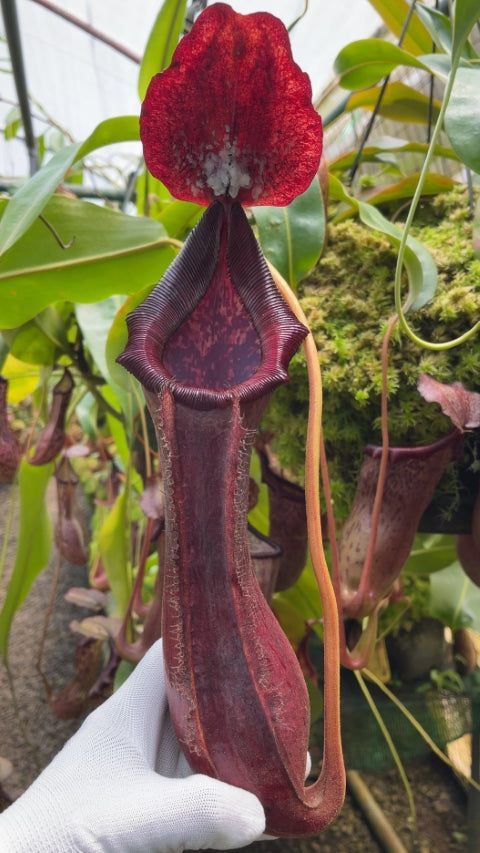
Nepenthes singalana pitchers are sometimes green or red but are often very, very dark, and Nepenthes ramispina has some of the darkest pitchers in the genus. This clone was selected for its uniformly dark pitchers, wine-red pitchers, and gorgeous large flaring peristome. The pitchers have a particularly elegant shape!
These are from a single clone in tissue culture from Borneo Exotics, BE-3829.
Care Instructions
Growth Habit: Nepenthes are vines and start small; as the plant grows, each leaf will be larger than the last, as will the pitchers that develop from these leaves. It is normal for the pitchers and leaves to die back over time. As leaves and pitchers die back, the plant will continue to vine, turning brown and woody along the stem. Over time, these form large, sprawling vines that can be hung in baskets or trellised upright in large pots. Nepenthes have thin, black roots, and not many of them.
Sun: Nepenthes should be grown on a sunny windowsill where the plant receives direct light for at least four hours daily. Grow in a cooled greenhouse in full sun, but we recommend 30% shade cloth overhead in summer. Grow in a terrarium or shelf under grow lights for the best color and pitcher formation. When grown under lights, lights should be on a 10-12 hour day length, and the plants can be grown six to ten inches from the light, depending on the strength of the light. Poor pitcher formation is usually a sign of not enough light.
Water & Humidity: Water frequently with distilled, reverse osmosis, or rainwater. Do not let the pots sit in water for long periods. You can water from the bottom, fill trays with water, and let the plant dry out for a few days before watering again. Be careful not to dry the plants out completely. Watering overhead occasionally is also beneficial for the plants. Nepenthes appreciate humidity of at least 60% but can do very well in household conditions without increased humidity if watered regularly. Any added humidity will be enjoyed by your plant! Too little humidity is the second most likely cause of poor pitcher formation.
Temperature: Daytime temperatures should be in the 70s-80s, with a 10-20 degree drop in night temperatures. Never expose your plants to temperatures below 40 degrees or above 90 degrees, as this can damage or kill them. Nepenthes do best indoors and should not be grown outdoors in most areas unless you have very mild temperatures.
Dormancy: Nepenthes do not have a dormancy as they are tropical plants, but they can slow down growth in winter when photo periods shorten.
Fertilizer: Apply diluted Maxsea fertilizer once or twice a month to the leaves and inside the pitchers. Slow-release osmocote pellets can be added to the pitchers along with a bit of distilled water. Small pitchers may burn back upon feeding, but this will still greatly benefit the plant with nutrients. Small insects can also be fed to pitchers.
Soil & Repotting: Nepenthes should be grown in a mix of long-fibered New Zealand sphagnum moss, orchid bark, pumice, and perlite. We have all of our custom Nepenthes soil blends available to add to your order, but you do not need to repot your plant for at least a year after receiving it from us. Nepenthes appreciate frequent repotting every three years and only move to a slightly bigger pot.
More Information: For more information on repotting, pests, growing habits, and more, check out our FAQ page or our YouTube channel!


Nepenthes robcantleyi is arguably the most spectacular species of Nepenthes yet discovered. They have huge pitchers with giant, flared peristomes that are show stoppingly showy! It’s well known for making large pitchers fast, especially with a boost of humidity.
These little guys are small sized now, but one things for sure, they'll be giant and amazing when they're grown.
These plants are from our own CalCarn tissue culture lab and are from multiple clones.
Care Instructions
Growth Habit: Nepenthes are vines and start small; as the plant grows, each leaf will be larger than the last, as will the pitchers that develop from these leaves. It is normal for the pitchers and leaves to die back over time. As leaves and pitchers die back, the plant will continue to vine, turning brown and woody along the stem. Over time, these form large, sprawling vines that can be hung in baskets or trellised upright in large pots. Nepenthes have thin, black roots, and not many of them.
Sun: Nepenthes should be grown on a sunny windowsill where the plant receives direct light for at least four hours daily. Grow in a cooled greenhouse in full sun, but we recommend 30% shade cloth overhead in summer. Grow in a terrarium or shelf under grow lights for the best color and pitcher formation. When grown under lights, lights should be on a 10-12 hour day length, and the plants can be grown six to ten inches from the light, depending on the strength of the light. Poor pitcher formation is usually a sign of not enough light.
Water & Humidity: Water frequently with distilled, reverse osmosis, or rainwater. Do not let the pots sit in water for long periods. You can water from the bottom, fill trays with water, and let the plant dry out for a few days before watering again. Be careful not to dry the plants out completely. Watering overhead occasionally is also beneficial for the plants. Nepenthes appreciate humidity of at least 60% but can do very well in household conditions without increased humidity if watered regularly. Any added humidity will be enjoyed by your plant! Too little humidity is the second most likely cause of poor pitcher formation.
Temperature: Daytime temperatures should be in the 70s-80s, with a 10-20 degree drop in night temperatures. Never expose your plants to temperatures below 40 degrees or above 90 degrees, as this can damage or kill them. Nepenthes do best indoors and should not be grown outdoors in most areas unless you have very mild temperatures.
Dormancy: Nepenthes do not have a dormancy as they are tropical plants, but they can slow down growth in winter when photo periods shorten.
Fertilizer: Apply diluted Maxsea fertilizer once or twice a month to the leaves and inside the pitchers. Slow-release osmocote pellets can be added to the pitchers along with a bit of distilled water. Small pitchers may burn back upon feeding, but this will still greatly benefit the plant with nutrients. Small insects can also be fed to pitchers.
Soil & Repotting: Nepenthes should be grown in a mix of long-fibered New Zealand sphagnum moss, orchid bark, pumice, and perlite. We have all of our custom Nepenthes soil blends available to add to your order, but you do not need to repot your plant for at least a year after receiving it from us. Nepenthes appreciate frequent repotting every three years and only move to a slightly bigger pot.
More Information: For more information on repotting, pests, growing habits, and more, check out our FAQ page or our YouTube channel!


Nepenthes robcantleyi x ( sibuyanensis x ventricosa ) is really variable and all the variations are beautiful, chonky and show stopping!
These are from assorted clones in tissue culture from Borneo Exotics, BE-3748.
Care Instructions
Growth Habit: Nepenthes are vines and start small; as the plant grows, each leaf will be larger than the last, as will the pitchers that develop from these leaves. It is normal for the pitchers and leaves to die back over time. As leaves and pitchers die back, the plant will continue to vine, turning brown and woody along the stem. Over time, these form large, sprawling vines that can be hung in baskets or trellised upright in large pots. Nepenthes have thin, black roots, and not many of them.
Sun: Nepenthes should be grown on a sunny windowsill where the plant receives direct light for at least four hours daily. Grow in a cooled greenhouse in full sun, but we recommend 30% shade cloth overhead in summer. Grow in a terrarium or shelf under grow lights for the best color and pitcher formation. When grown under lights, lights should be on a 10-12 hour day length, and the plants can be grown six to ten inches from the light, depending on the strength of the light. Poor pitcher formation is usually a sign of not enough light.
Water & Humidity: Water frequently with distilled, reverse osmosis, or rainwater. Do not let the pots sit in water for long periods. You can water from the bottom, fill trays with water, and let the plant dry out for a few days before watering again. Be careful not to dry the plants out completely. Watering overhead occasionally is also beneficial for the plants. Nepenthes appreciate humidity of at least 60% but can do very well in household conditions without increased humidity if watered regularly. Any added humidity will be enjoyed by your plant! Too little humidity is the second most likely cause of poor pitcher formation.
Temperature: Daytime temperatures should be in the 70s-80s, with a 10-20 degree drop in night temperatures. Never expose your plants to temperatures below 40 degrees or above 90 degrees, as this can damage or kill them. Nepenthes do best indoors and should not be grown outdoors in most areas unless you have very mild temperatures.
Dormancy: Nepenthes do not have a dormancy as they are tropical plants, but they can slow down growth in winter when photo periods shorten.
Fertilizer: Apply diluted Maxsea fertilizer once or twice a month to the leaves and inside the pitchers. Slow-release osmocote pellets can be added to the pitchers along with a bit of distilled water. Small pitchers may burn back upon feeding, but this will still greatly benefit the plant with nutrients. Small insects can also be fed to pitchers.
Soil & Repotting: Nepenthes should be grown in a mix of long-fibered New Zealand sphagnum moss, orchid bark, pumice, and perlite. We have all of our custom Nepenthes soil blends available to add to your order, but you do not need to repot your plant for at least a year after receiving it from us. Nepenthes appreciate frequent repotting every three years and only move to a slightly bigger pot.
More Information: For more information on repotting, pests, growing habits, and more, check out our FAQ page or our YouTube channel!


Growth Habit: Nepenthes are vines and start small; as the plant grows, each leaf will be larger than the last, as will the pitchers that develop from these leaves. It is normal for the pitchers and leaves to die back over time. As leaves and pitchers die back, the plant will continue to vine, turning brown and woody along the stem. Over time, these form large, sprawling vines that can be hung in baskets or trellised upright in large pots. Nepenthes have thin, black roots, and not many of them.
Sun: Nepenthes should be grown on a sunny windowsill where the plant receives direct light for at least four hours daily. Grow in a cooled greenhouse in full sun, but we recommend 30% shade cloth overhead in summer. Grow in a terrarium or shelf under grow lights for the best color and pitcher formation. When grown under lights, lights should be on a 10-12 hour day length, and the plants can be grown six to ten inches from the light, depending on the strength of the light. Poor pitcher formation is usually a sign of not enough light.
Water & Humidity: Water frequently with distilled, reverse osmosis, or rainwater. Do not let the pots sit in water for long periods. You can water from the bottom, fill trays with water, and let the plant dry out for a few days before watering again. Be careful not to dry the plants out completely. Watering overhead occasionally is also beneficial for the plants. Nepenthes appreciate humidity of at least 60% but can do very well in household conditions without increased humidity if watered regularly. Any added humidity will be enjoyed by your plant! Too little humidity is the second most likely cause of poor pitcher formation.
Temperature: Daytime temperatures should be in the 70s-80s, with a 10-20 degree drop in night temperatures. Never expose your plants to temperatures below 40 degrees or above 90 degrees, as this can damage or kill them. Nepenthes do best indoors and should not be grown outdoors in most areas unless you have very mild temperatures.
Dormancy: Nepenthes do not have a dormancy as they are tropical plants, but they can slow down growth in winter when photo periods shorten.
Fertilizer: Apply diluted Maxsea fertilizer once or twice a month to the leaves and inside the pitchers. Slow-release osmocote pellets can be added to the pitchers along with a bit of distilled water. Small pitchers may burn back upon feeding, but this will still greatly benefit the plant with nutrients. Small insects can also be fed to pitchers.
Soil & Repotting: Nepenthes should be grown in a mix of long-fibered New Zealand sphagnum moss, orchid bark, pumice, and perlite. We have all of our custom Nepenthes soil blends available to add to your order, but you do not need to repot your plant for at least a year after receiving it from us. Nepenthes appreciate frequent repotting every three years and only move to a slightly bigger pot.
More Information: For more information on repotting, pests, growing habits, and more, check out our FAQ page or our YouTube channel!


One of the best of the spectabilis, the plants from Sibuyatan are a little more beautiful than some of the others. It is also extremely prolific and makes lots of pitchers! Each pitcher is speckled, limey green, and deep red! It can be a compact grower, so it makes an excellent houseplant!
These are from a random selection of clones in tissue culture from Borneo Exotics, BE-3177. These plants can have splotches of red on the leaves.
Care Instructions
Growth Habit: Nepenthes are vines and start small; as the plant grows, each leaf will be larger than the last, as will the pitchers that develop from these leaves. It is normal for the pitchers and leaves to die back over time. As leaves and pitchers die back, the plant will continue to vine, turning brown and woody along the stem. Over time, these form large, sprawling vines that can be hung in baskets or trellised upright in large pots. Nepenthes have thin, black roots, and not many of them.
Sun: Nepenthes should be grown on a sunny windowsill where the plant receives direct light for at least four hours daily. Grow in a cooled greenhouse in full sun, but we recommend 30% shade cloth overhead in summer. Grow in a terrarium or shelf under grow lights for the best color and pitcher formation. When grown under lights, lights should be on a 10-12 hour day length, and the plants can be grown six to ten inches from the light, depending on the strength of the light. Poor pitcher formation is usually a sign of not enough light.
Water & Humidity: Water frequently with distilled, reverse osmosis, or rainwater. Do not let the pots sit in water for long periods. You can water from the bottom, fill trays with water, and let the plant dry out for a few days before watering again. Be careful not to dry the plants out completely. Watering overhead occasionally is also beneficial for the plants. Nepenthes appreciate humidity of at least 60% but can do very well in household conditions without increased humidity if watered regularly. Any added humidity will be enjoyed by your plant! Too little humidity is the second most likely cause of poor pitcher formation.
Temperature: Daytime temperatures should be in the 70s-80s, with a 10-20 degree drop in night temperatures. Never expose your plants to temperatures below 40 degrees or above 90 degrees, as this can damage or kill them. Nepenthes do best indoors and should not be grown outdoors in most areas unless you have very mild temperatures.
Dormancy: Nepenthes do not have a dormancy as they are tropical plants, but they can slow down growth in winter when photo periods shorten.
Fertilizer: Apply diluted Maxsea fertilizer once or twice a month to the leaves and inside the pitchers. Slow-release osmocote pellets can be added to the pitchers along with a bit of distilled water. Small pitchers may burn back upon feeding, but this will still greatly benefit the plant with nutrients. Small insects can also be fed to pitchers.
Soil & Repotting: Nepenthes should be grown in a mix of long-fibered New Zealand sphagnum moss, orchid bark, pumice, and perlite. We have all of our custom Nepenthes soil blends available to add to your order, but you do not need to repot your plant for at least a year after receiving it from us. Nepenthes appreciate frequent repotting every three years and only move to a slightly bigger pot.
More Information: For more information on repotting, pests, growing habits, and more, check out our FAQ page or our YouTube channel!


Growth Habit: Nepenthes are vines and start small; as the plant grows, each leaf will be larger than the last, as will the pitchers that develop from these leaves. It is normal for the pitchers and leaves to die back over time. As leaves and pitchers die back, the plant will continue to vine, turning brown and woody along the stem. Over time, these form large, sprawling vines that can be hung in baskets or trellised upright in large pots. Nepenthes have thin, black roots, and not many of them.
Sun: Nepenthes should be grown on a sunny windowsill where the plant receives direct light for at least four hours daily. Grow in a cooled greenhouse in full sun, but we recommend 30% shade cloth overhead in summer. Grow in a terrarium or shelf under grow lights for the best color and pitcher formation. When grown under lights, lights should be on a 10-12 hour day length, and the plants can be grown six to ten inches from the light, depending on the strength of the light. Poor pitcher formation is usually a sign of not enough light.
Water & Humidity: Water frequently with distilled, reverse osmosis, or rainwater. Do not let the pots sit in water for long periods. You can water from the bottom, fill trays with water, and let the plant dry out for a few days before watering again. Be careful not to dry the plants out completely. Watering overhead occasionally is also beneficial for the plants. Nepenthes appreciate humidity of at least 60% but can do very well in household conditions without increased humidity if watered regularly. Any added humidity will be enjoyed by your plant! Too little humidity is the second most likely cause of poor pitcher formation.
Temperature: Daytime temperatures should be in the 70s-80s, with a 10-20 degree drop in night temperatures. Never expose your plants to temperatures below 40 degrees or above 90 degrees, as this can damage or kill them. Nepenthes do best indoors and should not be grown outdoors in most areas unless you have very mild temperatures.
Dormancy: Nepenthes do not have a dormancy as they are tropical plants, but they can slow down growth in winter when photo periods shorten.
Fertilizer: Apply diluted Maxsea fertilizer once or twice a month to the leaves and inside the pitchers. Slow-release osmocote pellets can be added to the pitchers along with a bit of distilled water. Small pitchers may burn back upon feeding, but this will still greatly benefit the plant with nutrients. Small insects can also be fed to pitchers.
Soil & Repotting: Nepenthes should be grown in a mix of long-fibered New Zealand sphagnum moss, orchid bark, pumice, and perlite. We have all of our custom Nepenthes soil blends available to add to your order, but you do not need to repot your plant for at least a year after receiving it from us. Nepenthes appreciate frequent repotting every three years and only move to a slightly bigger pot.
More Information: For more information on repotting, pests, growing habits, and more, check out our FAQ page or our YouTube channel!


Nepenthes stenophylla is a completely distinctive Bornean species has tubular and hirsute, red-striped pitchers. The clone offered here was selected from among many for its vigour, as well as representing the typical form of the species.
These are from a single, select clone in tissue culture from Borneo Exotics, BE-3905.
Care Instructions
Growth Habit: Nepenthes are vines and start small; as the plant grows, each leaf will be larger than the last, as will the pitchers that develop from these leaves. It is normal for the pitchers and leaves to die back over time. As leaves and pitchers die back, the plant will continue to vine, turning brown and woody along the stem. Over time, these form large, sprawling vines that can be hung in baskets or trellised upright in large pots. Nepenthes have thin, black roots, and not many of them.
Sun: Nepenthes should be grown on a sunny windowsill where the plant receives direct light for at least four hours daily. Grow in a cooled greenhouse in full sun, but we recommend 30% shade cloth overhead in summer. Grow in a terrarium or shelf under grow lights for the best color and pitcher formation. When grown under lights, lights should be on a 10-12 hour day length, and the plants can be grown six to ten inches from the light, depending on the strength of the light. Poor pitcher formation is usually a sign of not enough light.
Water & Humidity: Water frequently with distilled, reverse osmosis, or rainwater. Do not let the pots sit in water for long periods. You can water from the bottom, fill trays with water, and let the plant dry out for a few days before watering again. Be careful not to dry the plants out completely. Watering overhead occasionally is also beneficial for the plants. Nepenthes appreciate humidity of at least 60% but can do very well in household conditions without increased humidity if watered regularly. Any added humidity will be enjoyed by your plant! Too little humidity is the second most likely cause of poor pitcher formation.
Temperature: Daytime temperatures should be in the 70s-80s, with a 10-20 degree drop in night temperatures. Never expose your plants to temperatures below 40 degrees or above 90 degrees, as this can damage or kill them. Nepenthes do best indoors and should not be grown outdoors in most areas unless you have very mild temperatures.
Dormancy: Nepenthes do not have a dormancy as they are tropical plants, but they can slow down growth in winter when photo periods shorten.
Fertilizer: Apply diluted Maxsea fertilizer once or twice a month to the leaves and inside the pitchers. Slow-release osmocote pellets can be added to the pitchers along with a bit of distilled water. Small pitchers may burn back upon feeding, but this will still greatly benefit the plant with nutrients. Small insects can also be fed to pitchers.
Soil & Repotting: Nepenthes should be grown in a mix of long-fibered New Zealand sphagnum moss, orchid bark, pumice, and perlite. We have all of our custom Nepenthes soil blends available to add to your order, but you do not need to repot your plant for at least a year after receiving it from us. Nepenthes appreciate frequent repotting every three years and only move to a slightly bigger pot.
More Information: For more information on repotting, pests, growing habits, and more, check out our FAQ page or our YouTube channel!


These two species, Nepenthes talangensis and Nepenthes glandulifera, were made to be crossed with each other! Both of them have tubby, charismatic pitchers that taper down to a little point at the base of the pitcher. The pitchers of this hybrid are incredibly talented elegant, tapering like wine glasses and with lovely, striped peristomes. These are nice compact plants as they mature; ideal for the terrarium or windowsill.
These are from a select clone in tissue culture from Borneo Exotics, BE-3665.
Growth Habit: Nepenthes are vines and start small; as the plant grows, each leaf will be larger than the last, as will the pitchers that develop from these leaves. It is normal for the pitchers and leaves to die back over time. As leaves and pitchers die back, the plant will continue to vine, turning brown and woody along the stem. Over time, these form large, sprawling vines that can be hung in baskets or trellised upright in large pots. Nepenthes have thin, black roots, and not many of them.
Sun: Nepenthes should be grown on a sunny windowsill where the plant receives direct light for at least four hours daily. Grow in a cooled greenhouse in full sun, but we recommend 30% shade cloth overhead in summer. Grow in a terrarium or shelf under grow lights for the best color and pitcher formation. When grown under lights, lights should be on a 10-12 hour day length, and the plants can be grown six to ten inches from the light, depending on the strength of the light. Poor pitcher formation is usually a sign of not enough light.
Water & Humidity: Water frequently with distilled, reverse osmosis, or rainwater. Do not let the pots sit in water for long periods. You can water from the bottom, fill trays with water, and let the plant dry out for a few days before watering again. Be careful not to dry the plants out completely. Watering overhead occasionally is also beneficial for the plants. Nepenthes appreciate humidity of at least 60% but can do very well in household conditions without increased humidity if watered regularly. Any added humidity will be enjoyed by your plant! Too little humidity is the second most likely cause of poor pitcher formation.
Temperature: Daytime temperatures should be in the 70s-80s, with a 10-20 degree drop in night temperatures. Never expose your plants to temperatures below 40 degrees or above 90 degrees, as this can damage or kill them. Nepenthes do best indoors and should not be grown outdoors in most areas unless you have very mild temperatures.
Dormancy: Nepenthes do not have a dormancy as they are tropical plants, but they can slow down growth in winter when photo periods shorten.
Fertilizer: Apply diluted Maxsea fertilizer once or twice a month to the leaves and inside the pitchers. Slow-release osmocote pellets can be added to the pitchers along with a bit of distilled water. Small pitchers may burn back upon feeding, but this will still greatly benefit the plant with nutrients. Small insects can also be fed to pitchers.
Soil & Repotting: Nepenthes should be grown in a mix of long-fibered New Zealand sphagnum moss, orchid bark, pumice, and perlite. We have all of our custom Nepenthes soil blends available to add to your order, but you do not need to repot your plant for at least a year after receiving it from us. Nepenthes appreciate frequent repotting every three years and only move to a slightly bigger pot.
More Information: For more information on repotting, pests, growing habits, and more, check out our FAQ page or our YouTube channel!


Nepenthes talangensis x robcantleyi is a cross that lives up to its promise! These two species were made to be crossed with each other! The large, pleasantly tubby pitchers have huge, wine-red peristomes with arching lids!
These are from a random selection of clones in tissue culture from Borneo Exotics, BE-3497. Sometimes the leaves of this hybrid can be splotchy in color which is totally normal!
Care Instructions
Growth Habit: Nepenthes are vines and start small; as the plant grows, each leaf will be larger than the last, as will the pitchers that develop from these leaves. It is normal for the pitchers and leaves to die back over time. As leaves and pitchers die back, the plant will continue to vine, turning brown and woody along the stem. Over time, these form large, sprawling vines that can be hung in baskets or trellised upright in large pots. Nepenthes have thin, black roots, and not many of them.
Sun: Nepenthes should be grown on a sunny windowsill where the plant receives direct light for at least four hours daily. Grow in a cooled greenhouse in full sun, but we recommend 30% shade cloth overhead in summer. Grow in a terrarium or shelf under grow lights for the best color and pitcher formation. When grown under lights, lights should be on a 10-12 hour day length, and the plants can be grown six to ten inches from the light, depending on the strength of the light. Poor pitcher formation is usually a sign of not enough light.
Water & Humidity: Water frequently with distilled, reverse osmosis, or rainwater. Do not let the pots sit in water for long periods. You can water from the bottom, fill trays with water, and let the plant dry out for a few days before watering again. Be careful not to dry the plants out completely. Watering overhead occasionally is also beneficial for the plants. Nepenthes appreciate humidity of at least 60% but can do very well in household conditions without increased humidity if watered regularly. Any added humidity will be enjoyed by your plant! Too little humidity is the second most likely cause of poor pitcher formation.
Temperature: Daytime temperatures should be in the 70s-80s, with a 10-20 degree drop in night temperatures. Never expose your plants to temperatures below 40 degrees or above 90 degrees, as this can damage or kill them. Nepenthes do best indoors and should not be grown outdoors in most areas unless you have very mild temperatures.
Dormancy: Nepenthes do not have a dormancy as they are tropical plants, but they can slow down growth in winter when photo periods shorten.
Fertilizer: Apply diluted Maxsea fertilizer once or twice a month to the leaves and inside the pitchers. Slow-release osmocote pellets can be added to the pitchers along with a bit of distilled water. Small pitchers may burn back upon feeding, but this will still greatly benefit the plant with nutrients. Small insects can also be fed to pitchers.
Soil & Repotting: Nepenthes should be grown in a mix of long-fibered New Zealand sphagnum moss, orchid bark, pumice, and perlite. We have all of our custom Nepenthes soil blends available to add to your order, but you do not need to repot your plant for at least a year after receiving it from us. Nepenthes appreciate frequent repotting every three years and only move to a slightly bigger pot.
More Information: For more information on repotting, pests, growing habits, and more, check out our FAQ page or our YouTube channel!


Nepenthes tentaculata is a charming species with unusual and entrancing elliptical-shaped mouths! This clone has red-green leaves with tannish-red pitchers with a chocolate colored peristome. This is one of Damon's favorite plants; it often looks like a little choir singing when the pitchers cluster together in pots!
This is a particularly vigorous clone, carefully selected from a seed grown batch of these unusual plants! Single clone from Borneo Exotics BE-3870.
Care Instructions
Growth Habit: Nepenthes are vines and start small; as the plant grows, each leaf will be larger than the last, as will the pitchers that develop from these leaves. It is normal for the pitchers and leaves to die back over time. As leaves and pitchers die back, the plant will continue to vine, turning brown and woody along the stem. Over time, these form large, sprawling vines that can be hung in baskets or trellised upright in large pots. Nepenthes have thin, black roots, and not many of them.
Sun: Nepenthes should be grown on a sunny windowsill where the plant receives direct light for at least four hours daily. Grow in a cooled greenhouse in full sun, but we recommend 30% shade cloth overhead in summer. Grow in a terrarium or shelf under grow lights for the best color and pitcher formation. When grown under lights, lights should be on a 10-12 hour day length, and the plants can be grown six to ten inches from the light, depending on the strength of the light. Poor pitcher formation is usually a sign of not enough light.
Water & Humidity: Water frequently with distilled, reverse osmosis, or rainwater. Do not let the pots sit in water for long periods. You can water from the bottom, fill trays with water, and let the plant dry out for a few days before watering again. Be careful not to dry the plants out completely. Watering overhead occasionally is also beneficial for the plants. Nepenthes appreciate humidity of at least 60% but can do very well in household conditions without increased humidity if watered regularly. Any added humidity will be enjoyed by your plant! Too little humidity is the second most likely cause of poor pitcher formation.
Temperature: Daytime temperatures should be in the 70s-80s, with a 10-20 degree drop in night temperatures. Never expose your plants to temperatures below 40 degrees or above 90 degrees, as this can damage or kill them. Nepenthes do best indoors and should not be grown outdoors in most areas unless you have very mild temperatures.
Dormancy: Nepenthes do not have a dormancy as they are tropical plants, but they can slow down growth in winter when photo periods shorten.
Fertilizer: Apply diluted Maxsea fertilizer once or twice a month to the leaves and inside the pitchers. Slow-release osmocote pellets can be added to the pitchers along with a bit of distilled water. Small pitchers may burn back upon feeding, but this will still greatly benefit the plant with nutrients. Small insects can also be fed to pitchers.
Soil & Repotting: Nepenthes should be grown in a mix of long-fibered New Zealand sphagnum moss, orchid bark, pumice, and perlite. We have all of our custom Nepenthes soil blends available to add to your order, but you do not need to repot your plant for at least a year after receiving it from us. Nepenthes appreciate frequent repotting every three years and only move to a slightly bigger pot.
More Information: For more information on repotting, pests, growing habits, and more, check out our FAQ page or our YouTube channel!


Nepenthes truncata (D) “Red Flush” x edwardsiana “giant” CalCarn TC Potted
Nepenthes truncata (D) “Red Flush” x edwardsiana “giant” CalCarn TC Potted
We are so excited to be offering our very own grex of Nepenthes Truncata x edwardsiana. This cross has already been done so we know that it is a proven winner! We have redone this cross using two of the most exceptional clones available.
The Truncata ‘D’ is a well known beauty with reddish pitchers and our edwardsiana ‘giant’ is probably the best clone in cultivation. It has perfect big peristome ridges and consistently makes giant pitchers well over a foot tall! This is a must have cross for any Nepenthes collection!
The first photo is of the parents used in this cross, the second photo is Nepenthes edwardsiana “Giant” from CalCarn collection and the third photo is Nepenthes truncata “D Red Flush” from Carnivero.
These plants are from our tissue culture lab and there are multiple clones.
Care Instructions
Growth Habit: Nepenthes are vines and start small; as the plant grows, each leaf will be larger than the last, as will the pitchers that develop from these leaves. It is normal for the pitchers and leaves to die back over time. As leaves and pitchers die back, the plant will continue to vine, turning brown and woody along the stem. Over time, these form large, sprawling vines that can be hung in baskets or trellised upright in large pots. Nepenthes have thin, black roots, and not many of them.
Sun: Nepenthes should be grown on a sunny windowsill where the plant receives direct light for at least four hours daily. Grow in a cooled greenhouse in full sun, but we recommend 30% shade cloth overhead in summer. Grow in a terrarium or shelf under grow lights for the best color and pitcher formation. When grown under lights, lights should be on a 10-12 hour day length, and the plants can be grown six to ten inches from the light, depending on the strength of the light. Poor pitcher formation is usually a sign of not enough light.
Water & Humidity: Water frequently with distilled, reverse osmosis, or rainwater. Do not let the pots sit in water for long periods. You can water from the bottom, fill trays with water, and let the plant dry out for a few days before watering again. Be careful not to dry the plants out completely. Watering overhead occasionally is also beneficial for the plants. Nepenthes appreciate humidity of at least 60% but can do very well in household conditions without increased humidity if watered regularly. Any added humidity will be enjoyed by your plant! Too little humidity is the second most likely cause of poor pitcher formation.
Temperature: Daytime temperatures should be in the 70s-80s, with a 10-20 degree drop in night temperatures. Never expose your plants to temperatures below 40 degrees or above 90 degrees, as this can damage or kill them. Nepenthes do best indoors and should not be grown outdoors in most areas unless you have very mild temperatures.
Dormancy: Nepenthes do not have a dormancy as they are tropical plants, but they can slow down growth in winter when photo periods shorten.
Fertilizer: Apply diluted Maxsea fertilizer once or twice a month to the leaves and inside the pitchers. Slow-release osmocote pellets can be added to the pitchers along with a bit of distilled water. Small pitchers may burn back upon feeding, but this will still greatly benefit the plant with nutrients. Small insects can also be fed to pitchers.
Soil & Repotting: Nepenthes should be grown in a mix of long-fibered New Zealand sphagnum moss, orchid bark, pumice, and perlite. We have all of our custom Nepenthes soil blends available to add to your order, but you do not need to repot your plant for at least a year after receiving it from us. Nepenthes appreciate frequent repotting every three years and only move to a slightly bigger pot.
More Information: For more information on repotting, pests, growing habits, and more, check out our FAQ page or our YouTube channel!

We are so excited to be offering our very own grex of Nepenthes Truncata x edwardsiana. This cross has already been done so we know that it is a proven winner! We have redone this cross using two of the most exceptional clones available.
The Truncata ‘D’ is a well known beauty with reddish pitchers and our edwardsiana ‘giant’ is probably the best clone in cultivation. It has perfect big peristome ridges and consistently makes giant pitchers well over a foot tall! This is a must have cross for any Nepenthes collection!
The first photo is of a small K8, second is of the parents used in this cross, the thits photo is Nepenthes edwardsiana “Giant” from CalCarn collection and the fourth photo is Nepenthes truncata “D Red Flush” from Carnivero.
These plants are from our tissue culture lab and this is a select clone, K8, that is extra vigorous.
Care Instructions
Growth Habit: Nepenthes are vines and start small; as the plant grows, each leaf will be larger than the last, as will the pitchers that develop from these leaves. It is normal for the pitchers and leaves to die back over time. As leaves and pitchers die back, the plant will continue to vine, turning brown and woody along the stem. Over time, these form large, sprawling vines that can be hung in baskets or trellised upright in large pots. Nepenthes have thin, black roots, and not many of them.
Sun: Nepenthes should be grown on a sunny windowsill where the plant receives direct light for at least four hours daily. Grow in a cooled greenhouse in full sun, but we recommend 30% shade cloth overhead in summer. Grow in a terrarium or shelf under grow lights for the best color and pitcher formation. When grown under lights, lights should be on a 10-12 hour day length, and the plants can be grown six to ten inches from the light, depending on the strength of the light. Poor pitcher formation is usually a sign of not enough light.
Water & Humidity: Water frequently with distilled, reverse osmosis, or rainwater. Do not let the pots sit in water for long periods. You can water from the bottom, fill trays with water, and let the plant dry out for a few days before watering again. Be careful not to dry the plants out completely. Watering overhead occasionally is also beneficial for the plants. Nepenthes appreciate humidity of at least 60% but can do very well in household conditions without increased humidity if watered regularly. Any added humidity will be enjoyed by your plant! Too little humidity is the second most likely cause of poor pitcher formation.
Temperature: Daytime temperatures should be in the 70s-80s, with a 10-20 degree drop in night temperatures. Never expose your plants to temperatures below 40 degrees or above 90 degrees, as this can damage or kill them. Nepenthes do best indoors and should not be grown outdoors in most areas unless you have very mild temperatures.
Dormancy: Nepenthes do not have a dormancy as they are tropical plants, but they can slow down growth in winter when photo periods shorten.
Fertilizer: Apply diluted Maxsea fertilizer once or twice a month to the leaves and inside the pitchers. Slow-release osmocote pellets can be added to the pitchers along with a bit of distilled water. Small pitchers may burn back upon feeding, but this will still greatly benefit the plant with nutrients. Small insects can also be fed to pitchers.
Soil & Repotting: Nepenthes should be grown in a mix of long-fibered New Zealand sphagnum moss, orchid bark, pumice, and perlite. We have all of our custom Nepenthes soil blends available to add to your order, but you do not need to repot your plant for at least a year after receiving it from us. Nepenthes appreciate frequent repotting every three years and only move to a slightly bigger pot.
More Information: For more information on repotting, pests, growing habits, and more, check out our FAQ page or our YouTube channel!
Showing 25/33